Private equity: Apollo’s charge to the top; A deep understanding of debt has helped the firm become the industry’s most powerful player
March 14, 2014 Leave a comment
March 10, 2014 6:58 pm
Private equity: Apollo’s charge to the top
By Henny Sender
A deep understanding of debt has helped the firm become the industry’s most powerful player
Late last year Apollo Global Management sold its last chunk of LyondellBasell, the chemical company that many had given up for dead years earlier. With that final sale, Apollo’s profits from its buyout of the company reached $10bn, sealing what was probably the greatest private equity deal of all time.
It was also a very risky and unusual deal. It did not start with an auction, as many private equity deals do. Instead, Apollo gained control of Lyondell by buying up parts of the company’s $25bn debt load over many months. It was able to buy the debt at steep discounts because there was so much of it – and because nobody else would touch it. Apollo’s great rival, Blackstone Group, avoided troubled companies such as Lyondell in the immediate aftermath of the financial crisis, Blackstone executives say. But Apollo and Leon Black, its founder, could not get enough of the debt.
As the crisis worsened many competitors bet that Lyondell and other troubled companies in its portfolio would bring Apollo down. But Apollo’s staff knew the chemicals industry intimately. The investment firm kept buying debt, and for 200 days the price kept falling.
“Earnings went to nothing with blinding speed. The ratings dropped with blinding speed. The company ran out of money at blinding speed,” says Josh Harris, who along with Marc Rowan and Mr Black founded Apollo.
“That was the defining moment in the success of Apollo,” says Steve Schwarzman, Blackstone’s founder, who has been competing with Apollo for more than 20 years. “Most people freeze but Leon went into action. You absolutely have to have a cast-iron stomach and Leon apparently does. He is unbelievably smart.”
When Apollo revealed last week that its three founders had earned more than $1bn in 2013 – more than the founders of any of their rivals, who also had strong years – it cemented the investment firm’s ascendancy. Its rise was powered by an intimate understanding of debt, a crucial advantage at a time when all the big buyout firms believe that the opportunity for future growth is in the provision of debt.
“We traverse downturns,” says Mr Black, who pocketed $546.3m. “Since Apollo was founded in 1990, we have been through four downturns and 40 per cent of all of our money has been invested in down cycles, when everyone else shut down.”
Apollo executives say that if you buy debt at 70 cents on the dollar, you have more chances of being lucky than if you buy at 100 cents. But that does not mean the debt won’t go to 40 cents. You cannot buy so much that you go out of business. It can be very difficult to manage the process.
A transformed business
This philosophy – together with a series of big, successful bets – has made Apollo the most powerful player in the industry. It commands the single biggest fund in the private equity world with its new $18.4bn Fund VIII, which it raised in only 10 months.
Private equity is a mature business. But Apollo has transformed itself to take advantage of a dramatic shift in the post-crisis financial landscape. With new regulations curbing traditional banks’ ability to make riskier loans, Apollo and other private equity firms are stepping in to fill the gap.
“The banks get killed for anything except lending to the top companies and they can’t charge much,” says one senior Federal Reserve official. “They can’t stay alive if that is all they do.”
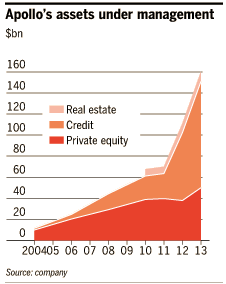
As Apollo and other private equity firms such as Blackstone and KKR transform themselves into lenders, the debate about their role in finance is becoming more intense. Apollo’s founders shun the term “shadow bank” because it implies that the group escapes regulation and seeks to exploit loopholes. But the label sticks to Apollo and other “alternative investment firms” as they become more significant sources of credit in the US and around the globe. For now, they are more lightly regulated because they do not take deposits as traditional banks do.
Apollo bought more than $20bn in senior loans when banks such as Citigroup and Deutsche Bank were forced to shrink their balance sheets in 2008. Since then it has grown into one of the largest bank loan managers in the country. It is expanding further into activities that were once the province of banks – such as financing mining, energy, shipping, infrastructure and aircraft projects – through its numerous credit funds.
Its funds are also buying banks and bank operations in Europe, especially in Spain, where its funds bought Bankia’s auto and consumer loan unit, EVO Banco, an 80-branch retail bank, and Banco Santander’s non-performing real estate loans and assets unit.
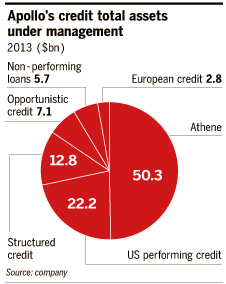
Apollo executives say there are three big opportunities in credit. These include investing in the high-risk debt of troubled companies that may not repay their obligations fully; lending to companies where there is little risk of not getting back 100 cents on the dollar; and complicated debt structures such as the slice and dice pieces of corporate debt in collateralised loan obligations that survived the downdraft in 2008 – unlike their mortgage counterparts.
“The best value today is in debt that is illiquid but safe,” adds Mr Black. “There is a huge premium for complex but safe.” (Mr Black, who is addicted to puzzles and chess, loves anything complex.)
In search of Nirvana
At the same time, Apollo is further along than any of its rivals toward reaching the Nirvana of the big alternative investment firms: “permanent capital”, or money that flows into the firms without the fixed investment periods that characterise the funds they raise from their investors.
Mr Rowan has come up with a way to increase the capital Apollo manages through Athene, a fixed income annuity manager with $60bn that the co-founder built through a series of acquisitions. “Athene is the ideal entity to hold highly rated, safe but less liquid credit investments,” Mr Black says.
Athene is expected to go public later this year. A private offering of its shares now in the works will raise up to $1bn, according to investors.
Athene supplements the money Apollo raises for its limited life funds from its own investors, including some of the world’s most respected pension funds, among them Calpers, Canada Pension Plan Investment Board, and Teacher Retirement System of Texas, which gave it $3bn.
“Everyone wants to be Warren Buffett and they have come the closest,” says Brad Coleman, global head of alternative assets at Citigroup, comparing Athene to the way Mr Buffett uses his Berkshire Hathaway insurers to make investments.
Inauspicious beginnings
Today’s success was far from predictable when Apollo’s three founders got their start at Drexel Burnham Lambert, the junk bond powerhouse that went bankrupt in 1990.
Like DBL, Apollo was once looked down on by its peers. “They were the bootstrap guys,” says one long-time Apollo banker. “The phone wouldn’t ring unless they worked harder than anyone else to make it ring.” Even today, nobody at Apollo wears the white collars and pinstriped suits of their peers elsewhere. Mr Black, a bearlike figure, prowls the halls frequently without a jacket.
Drexel was famous for inventing the junk bonds that finance leveraged buyouts; without them leveraged buyouts were impossible. As head of mergers for Drexel, Mr Black financed about 75 per cent of the buyouts the pioneers of private equity carried out in the 1980s, including KKR’s storied purchase of RJR Nabisco.
Mr Black, sitting in New York, was never associated with the illegal insider trading that brought down Michael Milken, who ran the firm from Los Angeles. After Drexel was shut down by regulators, Mr Black contemplated starting his own buyout boutique. But he received a call from the then French government-controlled Crédit Lyonnais, which asked him to kick-start a mergers business in New York. Mr Black says he convinced the French bank that it made more sense to start an investment business, taking stakes in undervalued companies. The French could take advantage of their triple A rating to borrow cheaply and invest in high-yielding junk bonds.
“I shuttled between New York and Paris for the next few months,” he recalls, sitting in his office among fine art work including ninth and 10th century Khmer Buddhist statues. “It wasn’t so bad to be in Paris.”
Crédit Lyonnais put a total of $7bn into Apollo’s first two funds, an exclusive investment that paid off. Among the early deals was the 1991 purchase of the corporate bond portfolio of the newly rejuvenated Executive Life with a face value of $6bn, for which Apollo paid $3bn with the money from the French bank.
“That put us on the map,” Mr Black adds. (Crédit Lyonnais would end up paying a $770m fine for making false statements to the Federal Reserve in connection with Executive Life.) By the time Crédit Lyonnais stumbled as a result of bad loans and a flawed retail expansion, it did not matter to Mr Black. Apollo had a track record.
To this day Apollo goes its own way as a relentlessly contrarian value investor. Its frugality is legendary. “If you propose a deal that is expensive, you do not belong at Apollo,” says co-founder Mr Harris. The firm’s reluctance to pay top dollar means that often it snaps up the messiest, most troubled companies. Its confidence in its analytical skills, its financial engineering and willingness to rise to operational challenges has repeatedly resulted in outsize profits.
“It is easy to know when to give Apollo the first call,” says Jimmy Lee, JPMorgan Chase’s vice-chairman, who often gets the summons from corporate clients putting themselves up for sale. “You call Apollo for companies that are either completely complicated, totally broken or nobody else wants at any price.”
Ferocious skills
Recent deals that nobody else wanted at the price Apollo was willing to pay include EP Energy, Hostess Brands, McGraw Hill Education, Momentive, Pitney Bowes Management Services and Taminco.
When Apollo has strayed from its legendary discipline the founders have regretted it, most notably with Realogy and Caesars Entertainment, the former Harrah’s. Apollo made those deals at the top of the market, paying at least 50 per cent more each time than its usual limit, which is never to pay more than six times a multiple of earnings.
But it is exactly when its companies look like they are heading for the bankruptcy court that the firm’s ferocious debt skills come to the fore.
With Realogy, a real estate brokerage, Apollo paid $1.3bn, which included an outlay of $423m to purchase debt with a face value of $1.3bn alongside the original equity check, in order to save the company. It went on to list Realogy in 2012 – and double its money, but not before the market crashed, prompting widespread fears that it would collapse. “If they hadn’t bought the debt the company would definitely have gone bust,” says a banker. “If there is a way to get to par, they will find it.”
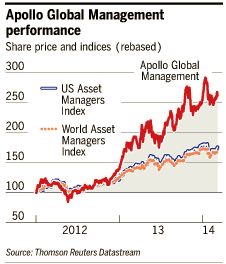
The fate of Caesars – the $30bn buyout Apollo completed with TPG in 2008 is a rare example of it teaming up with another buyout firm – still has not been decided. In the quarter that ended September 30, Apollo valued its investment at 50 cents on the dollar as the stock market rose. Earlier last year, it valued it at a mere 20 cents on the dollar, according to confidential letters sent to its investors.
The tenacity with which Apollo defends its deals is legendary among competitors. At one point both it and Blackstone were nursing troubled deals: Caesars for Apollo and Hilton for Blackstone. Both told their bankers not to sell any of the debt of these deals to their own competitors. But Blackstone managed to buy a chunk of the ailing gaming company, threatening to make it difficult for Apollo to get creditors to agree to terms that would buy the company additional time and flexibility. “We told them they were welcome in our rooms but not in our capital structure,” recalls one Blackstone executive.
So Apollo turned the tables, buying Hilton debt. In some ways, it was the usual credit negotiation between issuer and investor. At the same time, it was a kind of Mexican stand-off with each threatening to torpedo the other’s deal since both are tough negotiators when counterparties are asking for concessions – far tougher than the more passive bankers. “It was highly charged at the time,” recalls Blackstone’s Mr Schwarzman.
Today, Apollo looks stronger than ever. It has a clear succession plan in place. Although Mr Black devotes considerable time to his art and his philanthropy, he continues to work ferociously. But it is clear that Mr Harris and Mr Rowan are the eventual heirs. The three divided the firm’s equity 44-28-28 before Apollo went public.
Mr Black is confident that the firm will find ways to spend its huge war chest – a challenge for other big investment firms. It will have to grow more outside the US. Some initiatives, such as real estate, are still in their early days.
“You sit and watch them catch the falling knife,” adds Erik Hirsch, chief investment officer of Hamilton Lane, a big Apollo investor and consultant to others. “But I have learnt not to look over their shoulder. I trust them.”
 About bambooinnovator
 Bamboo Innovator