Supermarket pricing made merger of Chiquita and Fyffes necessary
March 14, 2014 Leave a comment
Last updated: March 10, 2014 8:54 pm
Supermarket pricing made merger of Chiquita and Fyffes necessary
By FT reporters
The deal to create the world’s largest banana company was first discussed amid multicoloured fruit and flower displays at last October’s Fresh Summit in New Orleans – the annual meeting of the world’s produce distributors. But it was arguably made necessary by the fresh fruit deals to be found in the aisles of any supermarket.
By planning a $1bn merger, Chiquita of the US and Dublin-based Fyffes are attempting to address a retail price squeeze that is peeling away their already thin profit margins.
Bananas have become the biggest fruit on the planet in terms of production volume, as consumers chomp through ever more of them. Global banana production has doubled since 1990 to reach roughly 100m tonnes a year.
But not only are supermarket chains, particularly in Europe, using bananas as loss leaders to attract customers, they are also using their purchasing power to force producers and distributors to absorb wholesale cost increases, which have been exacerbated by poor weather and crop diseases.
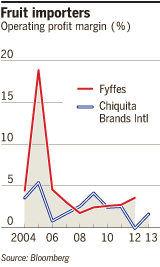
Some of the larger retail groups are also buying their bananas direct from producers, further damaging the revenues of distributors such as Chiquita and Fyffes. Their operating margins have been shrinking: Chiquita’s from 3.5 per cent in 2004 to minus 0.1 per cent for 2012, and Fyffes’ from 4.4 per cent to 3.5 per cent over the same period, say their annual reports.
Announcing the deal on Monday, Ed Lonergan, Chiquita’s chief executive, said: “We have always identified Fyffes as a fantastic partner. The tie up makes particular sense now as the banana market is the most competitive I have ever seen – there are so many players bringing bananas into every port in the world.”
Kaison Chang, at the UN Food and Agriculture Organisation in Rome, agrees that the pricing policy of supermarkets has blurred the industry picture. “With the intense competition in the retail sector, it has been difficult to pass the costs on to consumers.”
A merger is likely to give the combined company more negotiating leverage with suppliers, although the Fairtrade Foundation warns that the merger would only squeeze banana producers further.
Together, ChiquitaFyffes – as the new company will be known – will have combined sales of $4.6bn. It will distribute about 160m cases a year in total, compared with 117m at Del Monte and 110m at Dole.
Even so, analysts argue that it is unlikely to meet antitrust obstacles in the US or Europe.
Although the companies themselves claim not to have calculated the market share of their merged entity, David Holohan, head of research at Merrion Capital in Dublin, estimates that it will only account for 14 per cent of the global market.
As the vast majority of bananas are eaten in the countries where they are grown, that may understate the new company’s importance in the export market.
But while the high profile of their brands makes it likely that global regulators will scrutinise the deal, Mr Holohan expects few competition concerns – as Chiquita and Fyffes are dominant in different parts of the market.
We have always identified Fyffes as a fantastic partner. The tie up makes particular sense now as the banana market is the most competitive I have ever seen – there are so many players bringing bananas into every port in the world
– Ed Lonergan, Chiquita chief executive
In Europe, Fyffes says it is the biggest banana distributor, handing 44m cases a year of a total 280m cases – giving it a market share of 16 per cent. Chiquita says it distributes 33m cases. On these figures, the new company will therefore have almost 30 per cent of the European market.
However, the companies tend to cater to different types of retailer: Chiquita focuses more on margin and quality over volume, while Fyffes is more of a mass market brand. They plan to maintain those separate positions, giving retailers a menu of options, a person familiar with the deal said on Monday.
In the US, Fyffes is much smaller – distributing about 11m cases of a total 250m. It also sells melons and pineapples, an area in which Chiquita is not an active player. Chiquita’s accounts refer to “North America”, where it says it distributes about 72.7m cases of bananas. Given this mix, the transaction isn’t expected to face challenges in the US, the person added.
Nor is the new company’s tax status likely to cause indigestion. It will be domiciled in Ireland, but both Chiquita and Fyffes say there would be no material changes to their taxation as a result of the merger.
 About bambooinnovator
 Bamboo Innovator