DreamWorks Studio Needs a New Script; Struggling Studio, Born of SKG ‘Dream Team,’ Strives Not Just for a Hit, but a Franchise
March 18, 2014 Leave a comment
DreamWorks Studio Needs a New Script
Struggling Studio, Born of SKG ‘Dream Team,’ Strives Not Just for a Hit, but a Franchise
BEN FRITZ
March 13, 2014 4:02 p.m. ET
DreamWorks is hoping a car-chase movie based on the videogame ‘Need for Speed’ can revive the company. Ben Fritz reports on the News Hub. Photo: Dreamworks II.
It started with the goal of reinventing the media business. Now DreamWorks SKG is hoping a car chase movie based on a videogame can revive not just the dream, but the company.
Over the past two decades, the studio founded by Steven Spielberg, former Disney President Jeffrey Katzenberg and music mogul David Geffen as a creator-friendly haven in corporate Hollywood has shut down or sold its television, interactive and music businesses; scrapped plans to build its own 100-acre lot complete with a man-made lake; and repeatedly scaled back the number of movies it produces. Its 2005 sale to Viacom Inc.VIAB -1.25% ‘s Paramount Pictures blew up within three years, leading to a reboot of the company with new financial backers and even more modest goals.
Mr. Geffen has largely retired, and Mr. Katzenberg heads the independent DreamWorks Animation SKG Inc., DWA -4.21% leaving Mr. Spielberg as the only member of the original triumvirate—or “Dream Team”—at the live-action film studio, which was formed in 1994.
Mr. Spielberg now runs DreamWorks with former Universal Pictures Chairman Stacey Snider. The current incarnation launched in 2009 with backing from India’s Reliance Entertainment and has lost at least $100 million due to a dearth of hits, according to people with knowledge of its finances. Another person familiar with the company’s books acknowledged the studio has endured losses but said the amount was lower.
On Friday, DreamWorks and its distribution partner, Walt Disney Co. DIS -1.78% , will release “Need for Speed,” a $66 million adaptation of Electronic Arts Inc. EA -0.90% ‘s videogame series about a high octane, cross-country race. Aaron Paul of “Breaking Bad” plays the lead character, but the real stars are spectacular auto stunts created without the computer effects common in competitors like “Fast & Furious.”
The film represents DreamWorks’ biggest investment in three years, though its relatively modest production budget highlights how limited the studio’s ambitions have become, in an industry where competitors regularly release movies that cost $200 million or more to make.
For three years running DreamWorks has released fewer movies than its own stated plans in part due to cash flow issues.
If “Need for Speed” succeeds at the box office, it would offer a much-needed jolt to the company’s bottom-line and could provide a lasting payoff over the next few years, as DreamWorks is hoping the auto-racing film will become its first production since its split with Paramount to spawn sequels.
Pre-release surveys indicate that is possible, with interest particularly high among young men.
The six “Fast & Furious” movies, also packed with car stunts but made with more stars and bigger budgets, have grossed a total of $2.4 billion world-wide for Universal Pictures, which is owned by Comcast Corp.CMCSA -1.02%
At the same time, Ms. Snider’s future as DreamWorks’ chief executive is in question. She has held preliminary talks with 21st Century Fox Inc. FOXA -1.77% ‘s studio Twentieth Century Fox about taking a senior role there when her contract expires at the end of 2014, according to people familiar with the matter.
(21st Century Fox and News Corp, NWSA -2.75% owner of The Wall Street Journal, were part of the same company until last June.)
Her departure would be a significant blow. It would likely be challenging for Mr. Spielberg to attract another executive of her caliber given the company’s weak track record. Through a spokesman, Mr. Spielberg declined to comment.
An executive at Reliance said his company will remain committed to DreamWorks with or without Ms. Snider. “Reliance is very pleased with the partnership with Steven Spielberg and committed to continue this partnership in the future,” said Amitabh Jhunjhunwala, a group managing director at the conglomerate.
Reliance has invested a little more than $400 million in DreamWorks thus far and owns half the company, with Mr. Spielberg and Ms. Snider controlling the rest.
DreamWorks is too young to have built up the kind of film library that bigger, older studios rely on for regular cash flow from television distribution and DVD and digital sales. And with no older movies to remake or comic books owned by a corporate parent to adapt, DreamWorks faces one of the toughest challenges possible in the entertainment industry: Creating hit movies and a profitable company out of thin air.
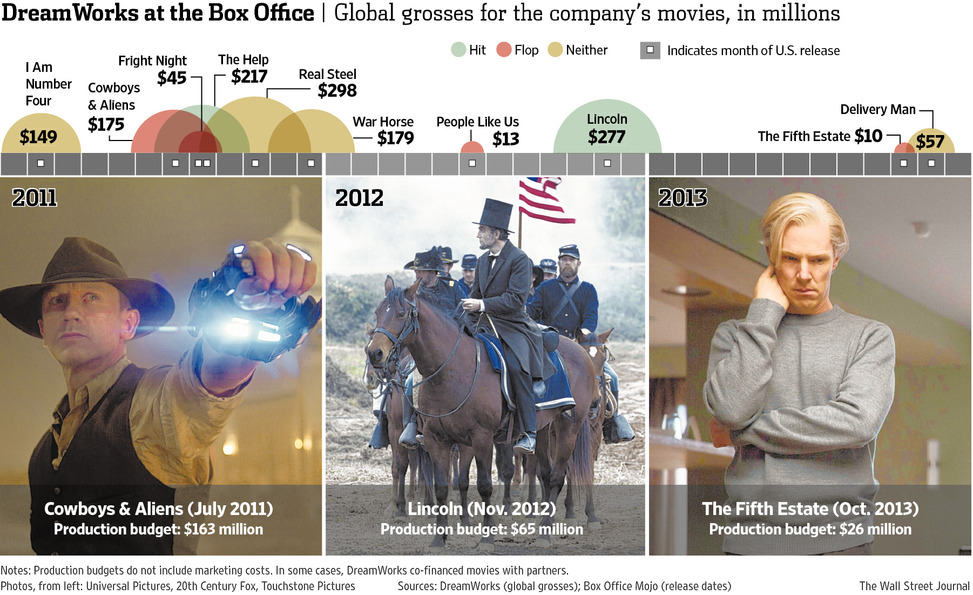
Its successes, “The Help” and “Lincoln,” have been outweighed by flops like “Cowboys & Aliens,” “People Like Us” and “The Fifth Estate.” The last film, about Wikileaks founder Julian Assange, was the lowest grossing movie released by any major studio last year, collecting just $3.3 million at the domestic box office. (It brought in $10 million world-wide.)
When DreamWorks launched, the company said it intended to make as many as six movies per year, a goal it reached in 2011. Following a refinancing by Reliance in 2012, it scaled that number back to three to five.
But it released only two movies in 2012 and 2013 and will do the same this year, because of its financial challenges and difficulty competing with major studios for talent.
Executives at Disney, which has provided DreamWorks with $156 million of credit according to regulatory filings, have said publicly that they expected more movies from its partner than Mr. Spielberg and Ms. Snider have delivered.
With a development budget a fraction the size of Universal’s or Time Warner Inc.’s Warner Bros.’, DreamWorks struggles to land the most sought-after scripts or books. “I’ve had competitive projects where they were interested, but once the price starts getting auctioned up, they say it’s too rich,” said one agent.
But the small studio has a unique selling point: Steven Spielberg, who is intimately involved in everything from reviewing script drafts to giving notes on daily footage.
“Telling Steven Spielberg how I was going to direct his movie was a once-in-a-lifetime opportunity,” said “Need for Speed” director Scott Waugh, who was red hot in Hollywood after his hit 2012 feature directorial debut “Act of Valor.”
In August, DreamWorks will release “The Hundred-Foot Journey,” a $25 million drama starring Helen Mirren and produced by Oprah Winfrey. It has no other movies scheduled or in production.
Mr. Waugh is attached to direct a heist movie, one of several projects DreamWorks hopes to start shooting soon. Others include adaptations of the Roald Dahl children’s book “BFG” and the best-selling novels “The Good Luck of Right Now” and “The Light Between Oceans.”
A key question remains whether the usually prolific Mr. Spielberg, whose last movie was “Lincoln” in 2012, will pick a new project soon. Among those in which he is said to be interested are a long-gestating adaptation of the science-fiction book “Robopocalypse” and a biopic of the Spanish explorer Hernán Cortés.
Unlike major studios, DreamWorks doesn’t have a large pool of potential movies from which to pick. If a few are delayed, as happens often in Hollywood, 2015 could be yet another light year for the company.
 About bambooinnovator
 Bamboo Innovator