SBY Shares His Thoughts on Upcoming Elections
March 18, 2014 Leave a comment
SBY Shares His Thoughts on Upcoming Elections
By Shoeb K. Zainuddin on 08:45 am Mar 12, 2014
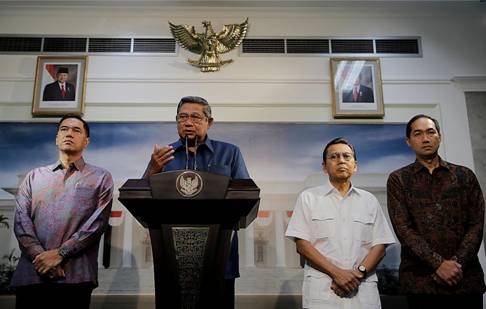
President Susilo Bambang Yudhoyono, second from left, accompanied by Vice President Boediono, second from right, and a press conference regarding the replacement of Trade Minister Gita Wirjawan, left, with Muhammad Luthfi, right, in Jakarta on February 12, 2014. (Rugapres Photo/Abror Rizki)
Jakarta. President Susilo Bambang Yudhoyono was relaxed as he joked with senior editors on Monday evening at the Bank Mega office. The event was arranged by Bank Mega founder and owner Chairul Tanjung as part of a series of meetings between the press and leading politicians and potential presidential candidates.
As expected, the room was packed, with editors representing all the major media outlets present. Yudhoyono made some opening comments and took questions for the 90-minute session, which covered a broad spectrum of issues.
Promising to personally cook nasi goreng for journalists after the April 9 legislative elections, the president also offered some piercing insights into the upcoming legislative and presidential elections. A veteran of two previous elections, the president is one of the most senior politicians in the country.
His comments were not so much a parting shot before he steps down in October to make way for the new president but more of an evaluation of his two terms in office and what may lie ahead for the nation. The upcoming presidential elections, he noted, will be different from the two previous direct elections.
“I have led this country for two periods, which have provided continuity for the economy and the nation,” Yudhoyono said. “But this year and next year will be less certain because no candidate can claim to be the front-runner. None of them can say with certainty that they will win the presidency.”
This is primarily because no one political party is dominant this year and while recent polls have put the Indonesian Democratic Party of Struggle, led by former president Megawati Sukarnoputri and Golkar party, led by businessman Aburizal Bakrie, as the two front-runners, it is an open field.
Drawing from past experience, Yudhoyono noted that anything can happen in politics and it is not certain that the party that wins the legislative elections will also win the presidency.
This was the case in 2004 when his Democratic Party came in third in the legislative elections but Yudhoyono won the presidency after a runoff with Megawati.
“In 2009 it was more certain. I was more confident of winning because my electability was higher than Megawati and Jusuf Kalla. It was far more certain,” he said.
But the last two months have seen significant political changes. No one party is dominant and the votes are evenly spread.
“In the next one-and-a-half month, anything can happen. I have to say no political party will be dominant in the legislative elections and will be able to form the government on its own.”
Even within his own party, which has 11 candidates vying to be nominated, Yudhoyono said he sees no clear winner but added that all 11 have the capacity and moral character to lead the nation.
Whatever the outcome, however, he said he hoped the country would continue to progress and that the next government would provide continuity in terms of policy and direction. He added that policies and programs that were not completed by his administration should be continued by the next government, which will take office in October this year.
Reflecting on his own plans, the president noted that while he will step down as head of the state come October, he will continue to be involved with the Democratic Party.
“We are still a young party and I want to help it grow and become more professional,” he said. “In the next elections, my party does not have to be number one but it cannot be too small.
“We must be able to contribute. We cannot force the people to vote one way or another but as a moral imperative, we must give them the best options.”
Yudhoyono admitted that he was a believer in political surveys and that his party’s showing over the last few years has not been encouraging. But he claimed the gap between the Democratic Party and the front-runners has narrowed over the past few months and he said he was hopeful that the party would put on a strong showing in the upcoming legislative elections.
“Our history has been that we have always found a way but we cannot miscalculate. We cannot be too ambitious. There will be a solution,” he said.
When asked whether coalition politics hold back development and progress, especially when it comes to building infrastructure, Yudhoyono answered that it is the cost of a multi-party democracy. It takes a long time to get anything done.
“Why did I form a coalition? It’s a headache and it is costly. I had a massive mandate. Despite the fact that I had 61 percent of the vote, the people who voted for me are the silent majority,” he said. “If I had gone on my own, perhaps I would not have lasted this long. Despite the fact that my coalition was weak it was better than not having a coalition. The next president must also be very patient. My advice to him or her is to be careful in looking for coalition partners. It’s not ideal but it’s better.”
 About bambooinnovator
 Bamboo Innovator