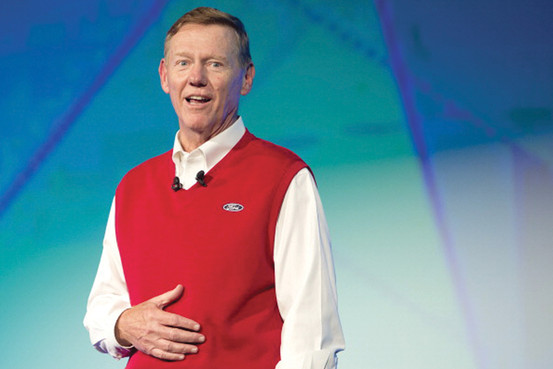
Alan Mulally, imported from the aircraft industry to modernize the Ford Motor Co., used management principles he could have learned in middle school to get the company through the financial crisis
March 19, 2014 Leave a comment
SATURDAY, MARCH 15, 2014
The Long Road Back
By JACK FALVEY | MORE ARTICLES BY AUTHOR
Alan Mulally, imported from the aircraft industry to modernize the Ford Motor Co., used management principles he could have learned in middle school to get the company through the financial crisis.
In 2006, Ford Motor was headed into a long financial tunnel from which there might be no return. Chairman William Ford Jr., his family, and the board of directors knew they needed a new direction. One of the directors, John Thornton, made an overture to Alan Mulally, who had led Boeing back from the abyss. Did he think he could do the same for Ford? His answer was yes.
Bill Ford said, “I have a lot of myself invested in this company, but not my ego; I just want the company to do well. It’s not about me.” So Mulally got the job. His first step: a new business plan. Not the kind that comes out of business school; it was closer to what comes out of middle school.
1) Stop fighting with each other.
2) Tell the truth about the situation.
3) Agree on one set of numbers.
4) Be accountable for your actions.
5) Do less, better.
Mulally directed his immediate subordinates, from the chief financial officer to the general counsel, to attend a weekly business-plan review. They were to bring real numbers for their responsibilities. Few of the top guys knew them. They had subordinates to do those presentations. That was no longer allowed.
In most companies, such accountability — up close and personal — is rare at high levels, and it almost had never been seen at Ford. It now was required every seven days.
Odd Andersen/Getty Images
Turning around a giant ship full of automobiles takes time. Bill Ford and the others had known something was coming, but they didn’t know exactly when, or how big it would be. Necessity created the timing. Ford just beat the global credit crash of 2008.
In 2006, Ford borrowed a boatload of cash. Citigroup, JPMorgan, and Goldman Sachs were the leads in a $23.6 billion revolving credit loan, collateralized with everything Ford owned — including its trademark blue oval, which could be sold to a foreign auto maker if Ford went under.
The stock price was at $8.24 when Mulally arrived in 2006. It would fall as low as $1.85 in January 2009 in the depth of the recession. By then, there was no more money at any price for car companies or almost anyone else to borrow, as GM and Chrysler found out.
“The company had been doing business around the world for almost 100 years, but was not operating globally,” says George Sharp, Ford’s vice president of investor information for Europe. Ford would try to connect the dots in 23 countries at 77 locations, forcing national divisions to work all of their cars onto nine basic designs, or platforms, down from 28. The casualties were immense: Jaguar, Land Rover, Aston Martin, Volvo, Mercury, and thousands of flesh-and-blood employees had to go.
This was not simple. The United Auto Workers union had to be made to understand that the company was near death. In 2006, Ford shared the fact that they were carrying 40,000 more workers than were needed to manufacture their cars. The books were opened to the union, and those numbers proved that the company was in a classic death spiral. Labor costs were holding up spending on new products; without new products, there soon would be no company.
The UAW got the message, and 38,000 Ford workers eventually accepted buyouts. The reduction in force was so effective that Ford could at last make small cars profitably in the U.S. The Ford Focus was built at a plant in Wayne, Mich. Its move to Mexico was canceled.
FORD DID NOT DO EVERYTHING RIGHT. In the middle of the financial crisis, the company was deaf to the power of public image. On Nov. 18, 2008, Mulally and other Ford executives joined a formation of Gulfstream jets, flying with GM and Chrysler to Washington to ask Congress for help. This was reported to the American people the next day as Detroit-style arrogance. They should have gone Southwest.
The car czar Steven Rattner delivered a grim message to the executives of the three companies: All expenditures over $100 million would require his approval. Only Ford, with Mulally’s huge cash hoard, could afford to pull back. The others were too far gone.
Unfairly, the other two companies came back the easy way. All debts of Ford’s rivals were erased in quickie bankruptcies, and the government donated $60 billion of taxpayer money to them and to the UAW.
Never mind all the Washington rhetoric about saving the auto industry. The federal money did not have to be paid back. Ford’s real loans required real debt service. In effect, Ford was up against Chevy TV commercials paid for by the Treasury, the Federal Reserve, and the suckers who had bought GM and Chrysler bonds.
Ford eventually was able to overcome adversity the old-fashioned way — with better products. New Fords built worldwide on the nine platforms in newly efficient factories began to make an impression on buyers. Some had delightful safety features, such as voice-activated phones and control functions.
What caused this success? Ford, a company in which the top executives really knew their numbers, committed to take a high-risk leap forward with their whole product line. They did this knowing full well that their quality ratings would tank until factories and workers climbed the learning curve and customers climbed the confidence curve about its products.
That process continues. Ford receives only average-quality ratings from J.D. Power & Associates on most of its models. But Dave Sargent, vice president of the Global Automotive Group at J.D. Power, praises Ford for bravery: “They went early, they went big, and a lot of learning has come from that.”
The middle-school business plan, executed in the midst of a major global economic downturn, seems to be working. Ford did less, and did it better.
Jack Falvey is a fellow of the New Hampshire Institute of Politics at Saint Anselm College, in Manchester, N.H., where he produces a daily e-mail program called Investor Education Briefs. He is also a member of the adjunct faculties at Boston College and the University of Massachusetts, Boston. He writes from Londonderry, N.H., and he drives a 2013 Ford Explorer.
 About bambooinnovator
 Bamboo Innovator