Dr Copper catches a dose of Chinese flu; Fears China copper inventory will flood market behind price falls
March 19, 2014 Leave a comment
Last updated: March 14, 2014 7:52 pm
Dr Copper catches a dose of Chinese flu
By Neil Hume, Commodities Editor
Fears China copper inventory will flood market behind price falls
“Dr Copper” is poorly. And the prognosis isn’t clear.
The red metal suffered a brutal sell-off last week that pushed the price of the world’s oldest mined commodity to its lowest level in almost four years.
The reason for the slump was China, the world’s biggest consumer of refined copper, which is extensively used in construction and electrical applications and is a key source of profit for many mining companies.
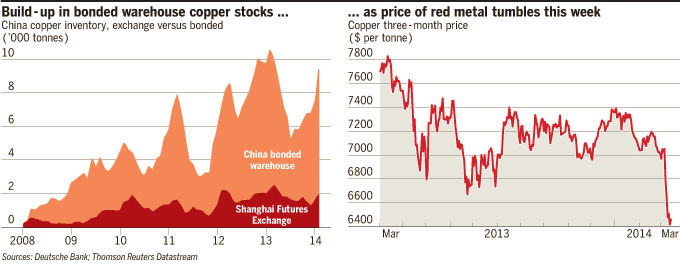
Fears that China’s copper inventory will flood into the market as well as concerns about slowing growth have been at the heart of the steep decline in prices. Copper for delivery in three months on the London Metal Exchange fell 8.5 per cent to $6,453 a tonne last week and is down over 13 per cent in the year to date.
The question now is whether cracks in China’s financial system and an attempt by Beijing to rein in credit triggers widespread liquidation of copper inventories. On this opinion is divided.
“We think that these fears of physical liquidation may be overblown,” says Gayle Berry, director of base metals research at Barclays. “Trading houses sources we spoke with indicate that while falling prices would force the closure of hedges on the LME, exacerbating the drop in prices, there have been few signs of large-scale physical selling.”
Financing deals that use copper as collateral are a hot topic in the market. Many traders believe that up to half China’s copper imports are used as collateral to raise cheap US dollar loans which are then lent on in the shadow banking sector or invested in high yielding assets.
However, seasoned observers say the reality is different and that financing is something that happens before imported copper is released into China, the source of 40 per cent of global copper demand.
“There is a big financing trade and it’s interesting. But it’s something that happens on the journey,” says one large physical trader. “It’s a red herring.”
The recent debt default has raised panic in the market and a significant amount of commentary suggesting that debt defaults will lead to the collapse of the copper financing business
– Matthew Wonnacott, CRU
Analysts agree. “The recent debt default has raised panic in the market and a significant amount of commentary suggesting that debt defaults will lead to the collapse of the copper financing business,” says Matthew Wonnacott, consultant at CRU. “We find these panics wildly overdone, and believe these issues are not related to each other.”
They say the reason importers have been keeping stocks in bonded warehouses is because prices are too low to sell into the domestic market. This, in turn, is a reflection of the current weak underlying demand for copper and other raw materials in China.
“The import arbitrage for copper is deteriorating further, with physical trade making a loss of more than $400 a tonne,” analysts at Macquarie said in a report published last week. “This means that new shipments of copper to China will probably be delivered into the bonded area, rather than domestic warehouses.”
At the end of February, CRU estimates stocks in bonded warehouses had grown to 770,000 tonnes, close to the historical high of 825,000 tonnes recorded in late 2012.
Another factor in this week’s sell off was the activity of speculative Chinese funds, which are becoming increasingly powerful players in commodity markets.
“Who have been the main players in this move? It wasn’t the banks, the commodity trading advisers or hedge funds. It was Chinese speculators. For the first time they have played a significant role in a sell-off,” says a senior executive at one trading house.
These funds, which focus solely on commodities and are scattered around Shanghai and its nearby provinces, have been placing bets against copper for several months. After China experienced its first domestic bond default in modern times earlier this month these speculators went for the jugular, aggressively selling London Metal Exchange and Shanghai copper contracts.
The import arbitrage for copper is deteriorating further, with physical trade making a loss of more than $400 a tonne
– Macquarie analysts
“The speculative positioning in copper was extreme,” says the head of metals at one trading house, pointing to this week’s huge increase in open interest, or new positions.
Moreover, copper was not the only commodity to suffer last week. Iron ore was also under pressure. The key steel making ingredient, which is critical to the profitability of several mining companies including BHP Billiton and Rio Tinto, dropped by 8 per cent on Monday – its biggest one-day fall since August 2009 – to an 18-month low.
Like copper, concerns about financing deals and weakening demand were at the heart of the falls. Chinese steel mills are also struggling with severe overcapacity, heavy debt loads and a government-led clampdown on pollution. Analysts said this had added to a general feeling of nervousness about the outlook for China.
Until those concerns ease, copper and other industrial commodities are likely to remain volatile, especially if the Chinese authorities continue to allow defaults on bonds and other financial products.
However, there are signs of physical support for copper at current prices, says Mr Wonnacott.
“We learnt through calls with fabricators . . . that end users placed orders this week after the LME price tumbled below $6,500,” he says. “We also believe it is possible that [China’s] strategic reserve board is buying at the current price level, given last year’s rumours of buying interest at $6,800.”
 About bambooinnovator
 Bamboo Innovator