Egypt’s tourism firms: It’s murder on the Nile
March 20, 2014 Leave a comment
Egypt’s tourism firms: It’s murder on the Nile
Mar 14th 2014, 11:08 by A. F. | CAIRO
KARIM EL SHARKAWY, the boss of Tarot Tours Garranah, one of Egypt’s biggest tourism operators, clocks in every morning at the firm’s offices in Cairo, and expects his staff to do the same. Strict timekeeping is a new experience for his employees. But the company, like its rivals, is having to do all it can to contain costs as it suffers a fierce downturn with no end in sight.
The revolution of 2011 dealt a heavy blow to Egypt’s tourism industry, which in 2013 directly or indirectly employed 2.9m people or 11.5% of the country’s workforce—down from 3.7m and 15.5% in 2010. The frequent bouts of violence since the uprising, played out on news bulletins around the world, have discouraged many visitors from returning. Last year only 9m came, 5m fewer than in 2010. Egypt’s tourism receipts are down from $12.5 billion then to an estimated $5.8 billion in 2013.
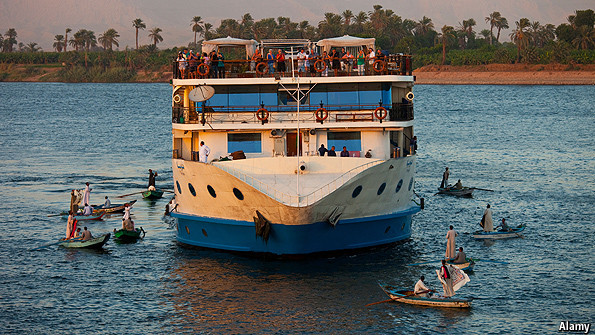
For businesses that serve tourists, the downturn feels even worse than those figures suggest. Tarot Tour’s fleet of tourist buses, its riverboats on the Nile and its dozen hotels on the Red Sea coast have emptied out. Its revenues are now just 30% of what they were before the revolution. At least, unlike most rivals, it has a big parent to keep it going: it is part of Orascom, a conglomerate whose interests stretch from construction to telecoms.
Tarot Tour’s beach resorts are doing less badly than other bits of the business, despite fierce competition from more stable countries. Just to show holidaymakers they are safe, the tourism ministry has installed webcams. Yet the most profitable customers used to be the culture vultures who combine trips to the monuments of Luxor and Aswan with a visit to the pyramids near the capital. Now these higher-spending tourists are anxious about passing through Cairo and tend to call off the whole trip. Instead, beach resorts are attracting more bargain hunters. As a result, the average spending per tourist—and hence profits—have dropped.
Of the nearly 300 vessels once plying the route between Aswan and Luxor barely a handful are now operating. Tamer Erian of Nile Exploration, which owns six boats, all permanently moored since May, says despite cutting prices by 70%, the 60-cabin ships had only a handful of reservations, and so he stopped running the service. Hisham El Gabri, a tour guide, laments that almost the only visitors he sees at the moment are Indians and Malaysians, who are more willing to brave the risks than rich Westerners, but more penny-pinching.
To cope with the slump Mr Sharkawy has cut staff and is making better use of the internet to attract business. Although Egypt’s tourism industry is one of the world’s longest-established, it has been slow to adapt to the internet age. Worldwide, about two-thirds of travel was booked online in 2012, but only 13% of visits to Egypt.
Other Egyptian tourism firms are also looking online for custom. Agaztak, modelled on Airbnb, a website that lets private home-owners rent accommodation to travellers, launched last year and now offers 2,000 properties.Mateegi.com will soon launch to promote camping by the Red Sea.
Several countries have now lifted their travel alerts advising against visiting Egypt. But it will take a period of sustained political stability for Cairo to regain its place on the tourist trail, and that seems a distant prospect. That puts Tarot’s parent company, Orascom, in a difficult spot. It recently opened a water sports complex and a hotel by the Red Sea; a luxury apartment complex is due to open this year. The company initiated the projects in 2009 when business was booming and the government offered them the land cheaply as long as it was developed quickly. As the crisis has dragged on, the company had to keep working on the developments, to avoid the risk of the government taking back the property. It can only hope that Egyptian politics will continue to cool down, and that the foreigners will start returning soon.
 About bambooinnovator
 Bamboo Innovator