A new test for Alzheimer’s may be on the cards. But it is not here yet
March 25, 2014 Leave a comment
A new test for Alzheimer’s may be on the cards. But it is not here yet
Mar 15th 2014 | From the print edition
AS JOHN IOANNIDIS prepares to launch an institute intended, among other things, to combat small, statistically underpowered scientific studies (see article), just such a study has hit the headlines. The media reaction to it neatly illustrates what Dr Ioannidis is talking about, for the impression given by those headlines is that researchers have found a way to predict Alzheimer’s disease. At the moment, that cannot be done reliably, though a brain scan or a spinal tap can confirm suspicions. And the researchers have not—at least, not yet—found a test, for their results were based on data from a handful of people in what may be an unrepresentative sample of humanity.
But the new study also illustrates the need not to throw the baby of understanding out with the bathwater of rigour. Though it is small, if its conclusions are upheld by subsequent work it may help explain what is going on in Alzheimer’s disease. It may even lead to a test that really does work. And that would have implications for the search for a treatment.
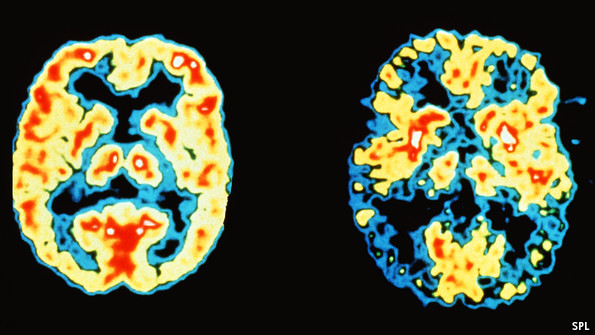
Alzheimer’s disease, an ailment that wrecks people’s brains (see picture above, of a healthy and an afflicted brain), affects 35m people—a number expected to increase to 115m by 2050. It is incurable. It is also hard to detect until a sufferer’s behaviour begins to change and he starts to lose his memory, by which time a lot of damage has already been done to his brain.
In the short term, a simple way of finding out whose brains are starting to head in the direction of Alzheimer’s would help scientific understanding of the pre-symptomatic phase of the disease. In the longer run, and from a patient’s point of view, early intervention with any drug that might one day be found to work will be better than waiting until his brain is so badly harmed that his memory starts going and his behaviour changes.
What Howard Federoff, of Georgetown University Medical Centre in Washington, DC, has done is to provide the basis from which such a test might be developed. His research, just published in Nature Medicine, identified ten molecules whose concentrations in the blood, taken together, predicted with 90% confidence whether someone in the group he studied went on to develop symptoms of Alzheimer’s within the next three years.
He and his colleagues started with 525 volunteers aged 70 or older, from whom they took blood samples. Three years later they looked at 18 of them who had had no symptoms when the study began, but had subsequently developed some, and compared their original blood samples with those of apparently similar volunteers who had remained unaffected.
Compared with those in the control group, they found, the 18 had lower levels of ten particular molecules. This retrospective coincidence could, of course, have been just that—a coincidence. So they repeated the analysis with 10 more of the original volunteers who had been symptom-free and then developed symptoms. They got the same result.
This strengthened the hypothesis that levels of the ten molecules really do predict Alzheimer’s. It still needs to be confirmed by bigger studies, but if the pattern holds, and particularly if it holds in other ethnic groups (most of the 525 were white Americans) and in other countries, a test might be on the cards. This would let researchers conduct drug trials on those who were asymptomatic, and therefore search for a way not merely to treat Alzheimer’s disease, but to prevent its manifestation.
The molecules in question may also help illuminate what is happening in the early stages of Alzheimer’s. They are all phospholipids, which are components of cell membranes. Why Alzheimer’s should reduce phospholipid levels in the blood is unclear, but those levels might easily reflect problems in the membranes of the affected brain cells.
An interesting result, then, which—as is true of a lot of science—might or might not go on to become important. Not wasting effort on small, underpowered studies is a laudable aim. But it is not always clear in advance which work will vanish into the morass and which will act as a spur to further investigation.
 About bambooinnovator
 Bamboo Innovator