Hong Kong’s Alibaba Lament
March 25, 2014 Leave a comment
Hong Kong’s Alibaba Lament
AARON BACK
March 18, 2014 8:42 a.m. ET
Hong Kong regulators are sticking to their “one share, one vote” principles. But that doesn’t make the territory friendly to ordinary investors.
News that Chinese Internet giant Alibaba is heading to New York for its $15 billion initial public offering has left Asia’s most prominent financial center in soul-searching mode. Hong Kong rules don’t allow the type of shareholder structure Alibaba wants to employ to keep its founders in control. Regulators rightly decided that bending the rules for one high-profile listing wouldn’t set a good precedent.
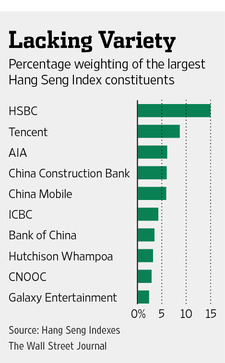
But if it can’t attract China’s best and most innovative companies, Hong Kong is left as a one-dimensional market. Financial and property firms dominate the benchmark Hang Seng Index, with a 54% weighting by free-float market value. Chinese Internet company Tencent 0700.HK -1.04% andLenovo 0992.HK +1.43% are the only two technology companies out of 60 in the index.
More worrying is that Chinese state-owned firms account for 38%. Since only minority stakes are floated, the narrow principle of one-share, one vote is upheld, even as Beijing retains total control.
Meanwhile, many big private-sector companies are effectively controlled by wealthy families through elaborate cross-shareholdings. Take the hotly anticipated IPO for supermarket and pharmacy chain A.S. Watson. The $5 billion to $6 billion deal will offer exposure to a China consumer growth story. But a controlling stake still will be held byHutchison Whampoa, 0013.HK +1.59% which is 50% owned by Cheung Kong,0001.HK -0.41% in turn 43% owned by Li Ka-shing, Asia’s richest person.
The concentration of finance companies and Chinese state behemoths has contributed to a dispiriting underperformance. The Hang Seng Index is up just 2% over the past four years, compared with the S&P 500’s 62% rise.
More exposure to Chinese companies such as Tencent would help. The $5 billion listing later this year of WH Group, the company that bought U.S. pork maker Smithfield, is the type of deal Hong Kong could do with more of.
With Alibaba stepping aside, investors should see Hong Kong’s stock market for what it is: a concentrated and unappetizing bet.
 About bambooinnovator
 Bamboo Innovator