Bill Gates: The Rolling Stone Interview; The richest man in the world explains how to save the planet

Bill Gates: The Rolling Stone Interview
The richest man in the world explains how to save the planet
by JEFF GOODELL
MARCH 13, 2014
At 58, Bill Gates is not only the richest man in the world, with a fortune that now exceeds $76 billion, but he may also be the most optimistic. In his view, the world is a giant operating system that just needs to be debugged. Gates’ driving idea – the idea that animates his life, that guides his philanthropy, that keeps him late in his sleek book-lined office overlooking Lake Washington, outside Seattle – is the hacker’s notion that the code for these problems can be rewritten, that errors can be fixed, that huge systems – whether it’s Windows 8, global poverty or climate change – can be improved if you have the right tools and the right skills. The Bill & Melinda Gates Foundation, the philanthropic organization with a $36 billion endowment that he runs with his wife, is like a giant startup whose target market is human civilization.

Read more of this post

Short Sellers’ New Favorite Platform: Twitter; Hedge fund managers are increasingly tweeting their research and their sharp-edged attacks in a medium that was made for stirring up trouble

Short Sellers’ New Favorite Platform: Twitter
Hedge fund managers are increasingly tweeting their research and their sharp-edged attacks betting that a company’s stock will fall instead of rise, in a medium that was made for stirring up trouble.
posted on March 18, 2014 at 11:25am EDT
Mariah SummersBuzzFeed Staff
MuddyWatersResearch@muddywatersreFollow
$NQ – Net revenue comment is BS. Business Tax makes clear that YDT’s gross rev (before paying customers) is far too low.
9:05 AM – 25 Oct 13

Read more of this post

Marketwired to stop selling to high-frequency traders

Marketwired to stop selling to high-frequency traders
3:46am IST
(Adds comments from legal experts and trading firm executive)
By Karen Freifeld
NEW YORK, March 19 (Reuters) – Marketwired, a company that publishes and distributes corporate earnings and other market-moving news releases, said on Wednesday it would no longer sell directly to high-frequency trading companies.

Read more of this post

Robert Samuelson: China has fallen into the “middle-income trap” – a significant event full of domestic and international implications

China’s next challenge
By Robert J. Samuelson, Thursday, March 20, 12:57 AM
China has fallen into the “middle-income trap” — a significant event full of domestic and international implications. Its economy is visibly slowing; lower-than-expected industrial production and exports are the latest evidence. Global stock markets have responded nervously. But in some ways, the slowdown isn’t China’s fault and was entirely predictable. The explanation is the middle-income trap.

Read more of this post

Books are losing the war for our attention. Here’s how they could fight back

Books are losing the war for our attention. Here’s how they could fight back.
By Matt McFarland, Updated: March 19 at 9:13 am
Technology has reshaped everything from how we communicate to how we find a mate or a job. Yet the experience of reading books remains largely untransformed, and the popularity of books has suffered in the face of flashier media formats that are perfected for our busy world.

Read more of this post

China’s “Minsky Moment” Is Here, Morgan Stanley Finds; It is the point at which Ponzi and speculative borrowers are no longer able to roll over their debts or borrow additional capital to make interest payments

China’s “Minsky Moment” Is Here, Morgan Stanley Finds
Tyler Durden on 03/19/2014 12:06 -0400
From Morgan Stanley’s Cyril Moulle-Berteaux and Sergei Parmenov, who pick up where our simple chart showing China’s “debt nightmare” left off.
We have described in detail over the past two years how we believe China’s twin excesses (excessive investment funded by excessive debt) will inevitably unwind, causing a substantial slowdown in China’s economy, significantly below market expectations. In recent weeks, a trip to the region and further research into China’s shadow banking system have convinced us that China is approaching its “Minsky Moment,” (Display 1) which increases the chances of a disorderly unwind of China’s excesses. The efficiency with which credit generates economic activity is already deteriorating, as more investments are made in non-productive projects and more debt is being used to repay old debts.

Read more of this post

Indonesian elections 2014: Banned, but vote-buying still plagues election process

Indonesian elections 2014: Banned, but vote-buying still plagues election process
Wednesday, March 19, 2014 – 03:44
Zubaidah Nazeer
The Straits Times
JAKARTA – When lawyer Taufik Basari visited constituents in his Jakarta district to distribute leaflets telling them why he deserved their vote, many asked him why the envelope was missing.

Read more of this post

More Japanese parents turning to Internet babysitting services

More Japanese parents turning to Internet babysitting services
Wednesday, March 19, 2014 – 11:50
The Japan News/Asia News Network
Sitter’s Net, a website that helps parents find babysitters, has been frequently used because it is cheap and flexible when it comes to responding to urgent requests. The service was used by the 22-year-old mother of a 2-year-old boy in Isogo Ward, Yokohama. The boy was found dead in Fujimi, Saitama Prefecture.

Read more of this post

China corruption drive goes after ‘guzzling’ officials

China corruption drive goes after ‘guzzling’ officials
Wednesday, March 19, 2014 – 13:08
AFP
SHANGHAI – China’s officials may need to tighten their belts after authorities ordered official canteens to serve “smaller portions” in a crackdown on over-indulgence, the Xinhua state news agency reported.

Read more of this post

Luxury giants flex their muscle to lock down prime window space

Luxury giants flex their muscle to lock down prime window space
Wednesday, March 19, 2014 – 20:43
Reuters
PARIS – French luxury group LVMH is trying to push out smaller rivals from plush Place Vendome in Paris after buying one of its highest-profile buildings, illustrating the intensifying battle for Europe’s prime retail locations. Read more of this post

Fast Retailing’s Uniqlo to turn over half of Japan part-timers into regular staff

Fast Retailing’s Uniqlo to turn over half of Japan part-timers into regular staff
Wednesday, Mar 19, 2014
Reuters
TOKYO – Fast Retailing Co said on Wednesday it plans to turn just over half of its 30,000 part-timers at its Uniqlo casual clothing stores in Japan into regular staff over two to three years in a bid to secure stable employment.
Uniqlo has long suffered high turnover among part-time sales staff – a byproduct of a rigorous and lengthy training process that has helped it earn a reputation for first-rate store service.

Read more of this post

Vuclip’s Nickhil Jakatdar: Bringing ‘Must-have’ Mobile Video to Emerging Markets

Vuclip’s Nickhil Jakatdar: Bringing ‘Must-have’ Mobile Video to Emerging Markets
Mar 13, 2014
Nickhil Jakatdar is a U.S.-based serial entrepreneur. With his most recent venture, Vuclip, which streams video on mobile phones, Jakatdar is focusing on emerging markets like India where he sees huge potential. What makes Vuclip stand apart from similar services is technology that optimizes video in real time, Jakatdar says.

Read more of this post

Spain Adopts the ‘Israel Model’ to Engineer a Biotech Resurgence

Spain Adopts the ‘Israel Model’ to Engineer a Biotech Resurgence
Mar 14, 2014
Spain is one of the world’s leading nations in biotechnology research, but it lags behind in technology transfer and the creation of new companies. Nevertheless, the importance of this sector in Spain’s economy is growing. On an annual basis, the sector as a whole sells more than 76 billion euros of products, according to Asebio, Spain’s biotech industry association. Overall, more than 3,025 companies are involved in biotech research and development in Spain. And although 97% of these firms are small and mid-size companies, they are leaders in job creation, increasing personnel rolls at an annual rate of more than 20%.

Read more of this post

‘Uncertainty Traps’: Why a Lack of Information Can Paralyze an Economy

‘Uncertainty Traps’: Why a Lack of Information Can Paralyze an Economy
Mar 14, 2014
Years later, the aftershocks of the Great Recession still resonate. Unemployment remains high, and economic growth is sluggish. The United States, despite some bright spots — like a recovering housing market and soaring stock prices — just hasn’t been able to snap back to normal

Read more of this post

Why New York AG wants curbs on high-frequency traders

March 19, 2014, 10:32 a.m. EDT
Why New York AG wants curbs on high-frequency traders
By Sital S. Patel
NEW YORK (MarketWatch) — High-frequency trading was thrust back into the spotlight when New York’s Attorney General Eric Schneiderman announced he would be taking a deeper look at the “unfair advantages” they have over regulator investors.
The New York regulator said U.S. exchanges allow traders to obtain pricing information fractions of a second earlier, through technology, giving them an edge.

Read more of this post

Keynes and Hayek: Prophets for today; Keynes’ interpretation of Hayek is stillr relevant for economic policy makers

Keynes and Hayek: Prophets for today
Mar 14th 2014, 16:43 by C.R. | LONDON
ON MARCH 10th 1944, seventy years ago this month, a relatively-obscure Austrian émigrépublished a book that would become one of the great classics of 20th-century economic literature. The new economic ideas of John Maynard Keynes were much in fashion in that period; this new book judged them rather harshly.

Read more of this post

Unease grows among U.S. doctors over Indian drug quality

Unease grows among U.S. doctors over Indian drug quality
Tue, Mar 18 2014
By Toni Clarke and Bill Berkrot
WASHINGTON/NEW YORK (Reuters) – Some U.S. doctors are becoming concerned about the quality of generic drugs supplied by Indian manufacturers following a flurry of recalls and import bans by the Food and Drug Administration.

Read more of this post

BT: Olam ‘market talk’, what market talk?

BT: Olam ‘market talk’, what market talk?
March 19th, 2014 | Author: Editorial
Yesterday (18 Mar), Singapore’s business daily The Business Times (BT) published an article by financial journalist Andrea Soh [Link].
In it, Andrea claims that there were market rumours that could possibly account for the surge in Olam International’s (Olam) share price.

Read more of this post

Why Muslims Still Can’t Adopt in India

Mar 19, 2014
Why Muslims Still Can’t Adopt in India
SHANOOR SEERVAI
When India’s Supreme Court ruled in February that a Muslim woman was free to adopt despite being a Muslim, one reasonable response was “Why wasn’t she allowed to do so already?”

Read more of this post

Copper Plunges To Fresh 5-Year Low

Copper Plunges To Fresh 5-Year Low
Tyler Durden on 03/19/2014 09:20 -0400
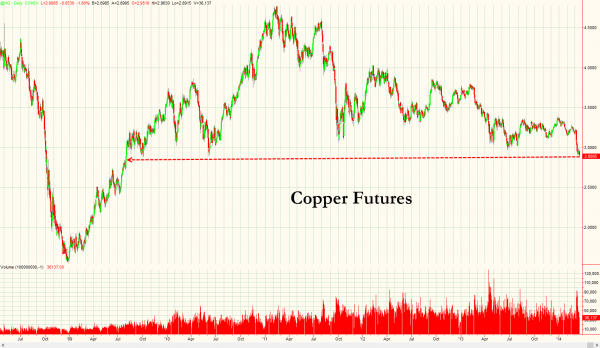
As we explained in great detail yesterday, the selling in commodities is far from over. The extent of China’s commodity-backed-financing is only now beginning to be understood and forced sales (along with the vicious circle of collapsing collateral values and increasingly tightening credit) are hard to stop for a government set of reform. Copper prices were heavy overnight in Asia but this morning has seen futures plunge on heavy volume below $289 – the lowest since July 2009- breaking key support levels. For the same reasoning, zinc and aluminum are under pressure, as is steel rebar and gold.
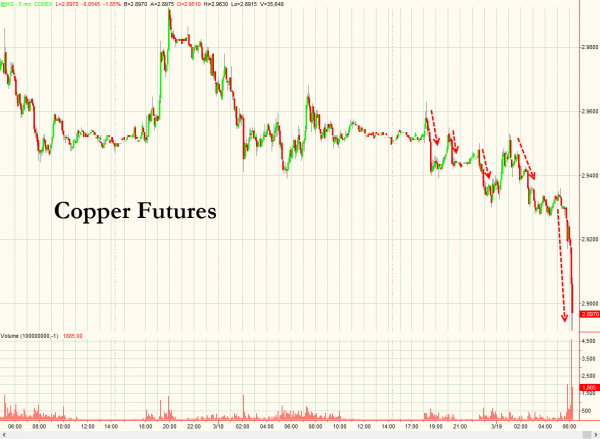
image001-1

Which has dropped copper prices to 5-year lows…(breaking critical support)

image002-1

What Is The Common Theme: Iron Ore, Soybeans, Palm Oil, Rubber, Zinc, Aluminum, Gold, Copper, And Nickel?
Tyler Durden on 03/18/2014 19:53 -0400
If you said a short list of commodities manipulated by the Too Big To Prosecute banks, you are probably right, but the answer we were looking for is that these are all the various, and increasingly more ridiculous, commodities that serve to make up the bulk of China’s hot money flow (those flows into China which are not reflected in the current account flows or FDI) facilitating synthetic structures, also known asChinese Commodity Funding Deals.
Of these the copper “monetary metal” funding pathway is best known, and in fact we covered the inevitable end of the Chinese Copper Financing Deals in gruesome detail last May in “The Bronze Swan Arrives: Is The End Of Copper Financing China’s “Lehman Event.” What happened next was that despite repeated warnings by the PBOC and SAFE that it would end the hot money inflows masked by funding deals, China not only encouraged more CCFDs but aggressively expanded into other commodities, such as iron ore, and as we now learn, weird and wacky commodities such the abovementioned soybeans, palm oil, rubber, zinc, aluminum, gold and nickel. To be sure this was largely precipitated by the near collapse in the overnight lending market in June of 2013 when China’s first and so far only real tapering attempt nearly destroyed the domestic financial system.
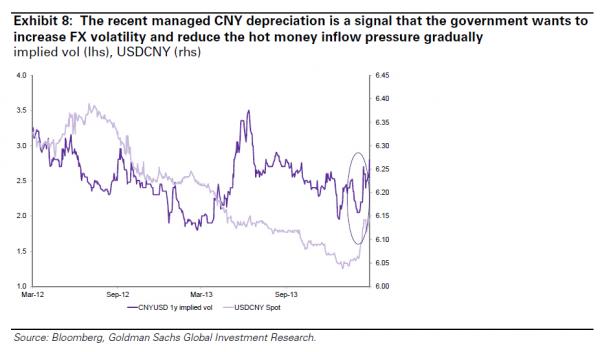
So what has changed since last May, in addition to the realization that virtually every hard asset is now being used by China to mask hot money inflows into the Chinese economy taking advantage of rate differentials between the Renminbi and the Dollar? Well, this time around China may finally be serious about normalizing its epic credit bubble, which as we pointed out before, added a ridiculous $1 trillion in bank assets in just the fourth quarter of 2013 alone. Specifically, as Goldman notes in a just released analysts on the future of CCDS, “the recent managed CNY depreciation is a signal that the government wants to increase FX volatility and reduce the hot money inflow pressure gradually.”
In other words, the day when the Commodity Funding Deals finally end is fast approaching.
Here is Goldman’s take on what will certainly be a watershed event – one which will certainly dwarf the recent Chaori Solar default in its significance and scale.
Financing deal concerns mounting as CNY volatility rises

Concerns on an unwind of commodity financing deals trigger selloff

The recent sell-off in copper and iron ore prices reflects the market’s ongoing concerns regarding the impact of a potential unwind of Chinese commodity financing deals, though the weak underlying market fundamentals should not be discounted. The concerns intensified following the recent CNY depreciation which has raised uncertainty regarding the profitability of the deals and the impact on different asset classes were they to unwind. Up to 1mt of copper and 30mt of iron ore could be released were the deals to unwind, which would be bearish given the relatively limited physical liquidity to absorb the shock.

CCFDs are facilitating China’s total credit growth

We believe CCFDs are ongoing and facilitating ‘hot money’ inflows into China by providing a mechanism to import low-cost foreign financing. In general, the profitability of most hedged commodity financing deals remains substantial (iron ore is the exception), due to a still positive CNY and USD interest rate differential, limited depreciation in the CNY forward curve and available commodity supply. In 2013, ‘hot money’ accounted for c. 42% of the growth in China’s monetary base of which we estimate that CCFDs contributed US$81-160 bn or c.31% of China’s total FX short-term loans. Given this, it is crucial for the government to manage the immediate impact of ‘hot money’ flow changes on the economy and markets.

More commodities are used; a medium-term unwind is bearish

An increasing range of commodities are being used to raise foreign financing, which now includes iron ore, soybeans, palm oil, rubber, zinc, and aluminum, as well as gold, copper, and nickel. CCFDs create excess physical demand and tighten the physical markets artificially; in contrast, an unwind creates excess supply and thus is bearish to prices. We think CCFDs will be unwound over the medium term, mainly triggered by an increase in Chinese FX volatility, as indicated by recent CNY depreciation and PBOC’s latest move to widen the daily trading band. FX volatility could result in a higher cost of currency hedging, effectively closing the interest rate arbitrage. Higher US rates are another likely catalyst for an unwind in the long run.A continuous CNY depreciation in the short term, however, would trigger some deals to be unwound sooner than expected, and hence place downside risks to our short-term commodity price forecasts.
It should now become apparent why the ongoing sharp devaluation of the CNY, far more than merely impacting a few massively levered speculators, and recall that the European Knock In point of maximum vega is about USDCNY 6.20 as discussed previously, will have a far more broad hit to asset levels not just in China but across the world if and when the inevitable moment of CCFD unwind finally begins, and in a reflexive fashion, initial selling begets more selling, more CNY devaluation, greater margin calls, further CCFD unwinds, and so on, until finally the PBOC has no choice but to come in and bail out the financial system one more time.
For those unfamiliar with the concept of CCFD, and too lazy to read our previous article on the topic, here is Goldman’s Roger Yuan with a succinct summary of just why these key component of China’s shadow funding mechanism are so important on the way up… and down.
Days numbered for Chinese commodity financing deals
As part of a broader shift in China’s funding base from domestic to various foreign funding vehicles, Chinese commodity financing deals have become increasingly prevalent, owing to the combination of the relatively high level of Chinese interest rates and the existence of Chinese capital controls. Financing deals use commodities and other goods as a tool to unlock the interest rate differential, with potential implications for Chinese growth, China’s linkage with ex-China interest rates, CNY volatility and commodity market pricing.
In contrast to some media reports, we find that the bulk of Chinese commodity financing deals are ongoing, facilitating ‘hot money’ inflows into China and providing a mechanism to import low cost foreign financing. In general, the profitability of most currency and commodity hedged Chinese commodity financing deals remains substantial, owing to a still positive CNY and USD based interest rate differential (>4%), limited depreciation in the CNY over the past month (<2%) and the CNY forward curve (limited cost of hedging the currency exposure), and a lack of tightness in the underlying commodity (i.e. limited cost of hedging the commodity). Returns in copper are still >10% (Exhibit 1), and up to 1mt of physical copper could still be tied up in deals (Exhibit 2).
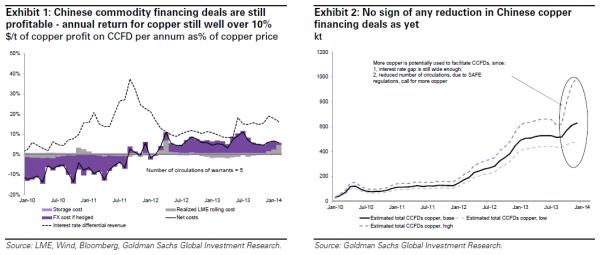
image003-1

While triggered by concerns about Chinese credit following the Chaori default, an unwind in iron ore financing deals, and concerns about an unwind in copper financing deals, the recent copper price weakness has reflected the combination of sluggish Chinese demand growth and strong global copper supply growth, rather than a financing deal unwind. Supporting this assertion is the fact that nickel (to an even greater extent than copper), and zinc both have a sizeable amount of exposure to financing deals, and their prices have substantially outperformed copper. Further, were this a true copper financing deal unwind, Chinese bonded copper prices would have led the price declines (instead they lagged the domestic Shanghai copper price declines), Chinese bonded stocks would have declined (instead they have risen) and the LME futures curve would likely have moved into contango (it remains in backwardation).
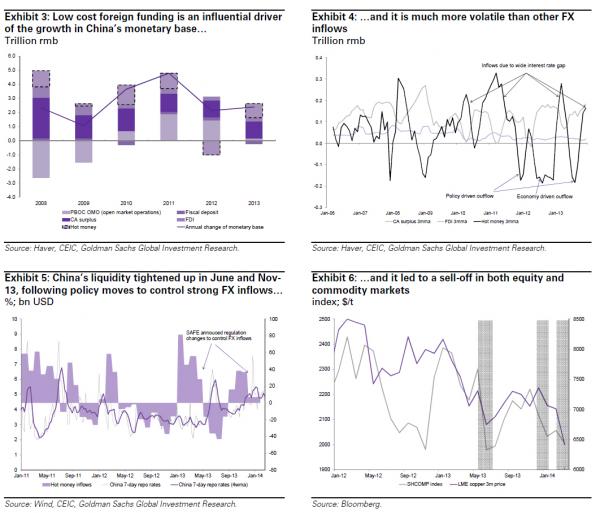
More broadly, the main reason why the government has not shut down ‘hot money’ inflows in an abrupt fashion to date, in our opinion, is that a complete shutdown could have major consequences for China’s short-term liquidity. Indeed, China’s economic growth is increasingly supported by different types of FX inflows, including those from commodity financing deals, as they can bring in low cost foreign funding and increase China’s monetary base, the foundation of both China’s rapid credit growth and solid economy growth. In 2013, we estimate that c.42% of the increase of China’s monetary base can be attributed to the low cost foreign funding or the ‘hot money’ inflows (Exhibit 3).

image004-1
These FX / hot money inflows are of substantial size and high volatility (Exhibit 4) and the government attempts to smoothly manage the short-term liquidity cycle in response to these flows. When these flows are very strong China tends to respond (Exhibit 5), as in June and December 2013, as well as February/March 2014, with bearish implications for equities and commodities (Exhibit 6).

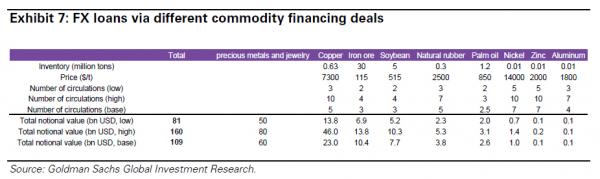
There are three main drivers of ‘hot money’ inflows: commodity financing deals, overinvoicing exports, and the black market. In this article, we focus on the Chinese commodity financing deal channel, which has by our estimates facilitated roughly US$81-160 bn of FX inflows since 2010, which is c.31% of China’s total FX short-term borrowings (duration < 1 year) (Exhibit 7). Of these deals, gold, copper and iron ore are three leading commodities, followed by soybean, palm oil, natural rubber, nickel, zinc and aluminum.

image005-1

One reason why the range of commodities and the amount of each of those commodities being used for financing purposes has increased since mid-2013 is that the Chinese government moved to reduce the amount of money that can be borrowed per commodity unit. This reduction in apparent financing deal ‘leverage’6 (to c.3-10 times the value of the commodity from much higher levels a year ago), has meant that larger amounts of commodities are needed to raise the same amount of low cost foreign funding. In copper’s case for example, the amount of copper used in financing deals could have risen from 500kt to 1mt over the past nine months, as shown in Exhibit 2.
Looking ahead, our view is that Chinese commodity financing deals will gradually unwind over the medium term (the next 12-24 months), driven by an increase in FX hedging costs, which would slowly erode financing deal profitability and eventually close the interest rate arbitrage. Indeed, we expect that the government will continue to increase FX volatility in order to manage the hot money inflow cycle, thus increasing FX hedging among broader market participants, and raising the cost of hedging the currency for commodity financing deals. This FX policy outlook would be in line with the government’s policy targets of gradually increasing the CNY trading band before eventually loosening the nation’s capital controls, and is likely to occur before the CNY/USD interest rate differentials close, based on our Economists’ forecasts. Finally, an abrupt government crackdown on Chinese commodity financing deals, even with an offsetting monetary stimulus package, is unlikely in our view, given the potential negative impact this could have on credit and thus economic growth.

image006-1

With respect to the impact of an unwind in Chinese commodity financing deals on China’s economic growth, we expect that the government will actively manage the impact on domestic credit creation, however we note that this process, if not managed perfectly, will not be without downside risks to Chinese growth.
From a commodity market perspective, financing deals create excess physical demand and tighten the physical markets, using part of the profits from the CNY/USD interest rate differential to pay to hold the physical commodity. While commodity financing deals are usually neutral in terms of their commodity position owing to an offsetting commodity futures hedge, the impact of the purchasing of the physical commodity on the physical market is likely to be larger than the impact of the selling of the commodity futures on the futures market (ZH: unless of course momentum algos take offsetting commodity futures hedge selling in, say, gold and boost, or “ignite” the downward momentum to a far greater degree than the offsetting physical buying, making a recursive pattern whereby buying physical ends up resulting in a lower physical price as has been the case with gold over the past year). This reflects the fact that physical inventory is much smaller than the open interest in the futures market (Exhibit 9). As well as placing upward pressure on the physical price, Chinese commodity financing deals ‘tighten’ the spread between the physical commodity price and the futures price (Exhibit 10).
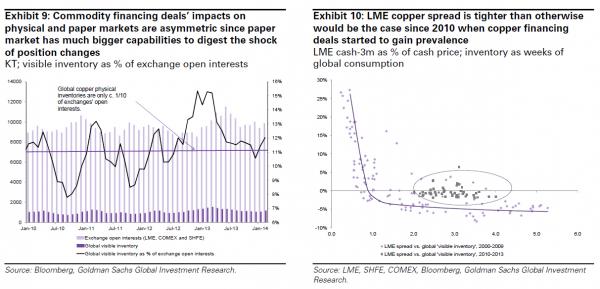
image007-1

In this context, an unwind of Chinese commodity financing deals would likely result in an increase in availability of physical inventory (physical selling), and an increase in futures buying (buying back the hedge) – thereby resulting in a lower physical price than futures price, as well as resulting in a lower overall price curve (or full carry) (Exhibit 11).
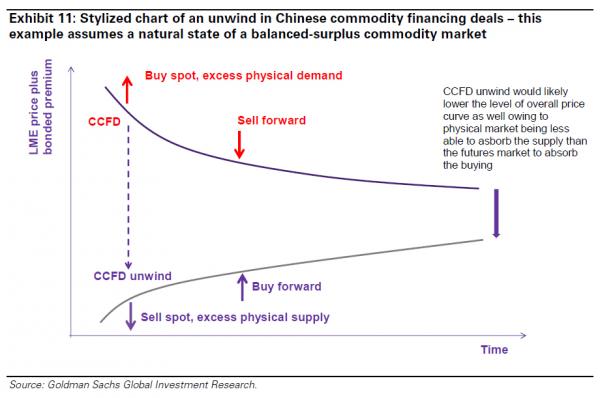
image008-1

China’s Housing Problem In One Chart

China’s Housing Problem In One Chart
Tyler Durden on 03/19/2014 11:02 -0400
The one problem with every Ponzi scheme is that it must constantly grow, in both demand and supply terms, for the mass delusion to continue. The other problem, of course, is that every Ponzi scheme always comes to an end…. which may have just happened in China where as the chart below shows, as of this moment at least, the supply side to the Chinese housing ponzi (and recall that in China the bubble is not in the stock market like in the US, but in housing) has slammed shut.
image001-4

How a Party Leader Fell Off a Urumqi Mountain; Yang Gang lost his clout when investigators started looking at a project that extended from Xinjiang’s capital city into nearby mountains

03.17.2014 13:15
How a Party Leader Fell Off a Urumqi Mountain
Yang Gang lost his clout when investigators started looking at a project that extended from Xinjiang’s capital city into nearby mountains
By staff reporter Li Yan

(Beijing) – Police nabbed property developer Zhao Xingru and detained her for more than 30 days in late 2012 and early 2013 based on fraud allegations filed by executives at one of the country’s largest developers, Hangzhou-based Greentown China Group.
But the detention ended abruptly and in the end Zhao was cleared of several serious charges leveled by Greentown, including contract forgery and faking transaction documents.

image001-3 Read more of this post

Decoding PBOC’s Move against QR Code Mobile Payments; Central Bank Mulls Tough Rules for Third-Party Payment Firms

03.17.2014 18:45
Closer Look: Decoding PBOC’s Move against QR Code Mobile Payments
The technology used by Alipay and Tencent is unsafe, the central bank says, a move that has to have executives at UnionPay smiling
By staff reporter Qin Min
(Beijing) – The central bank has said handling payments by scanning quick response (QR) codes is not safe and should be stopped.
The order regarding QR codes – those blotches of black and white that can be scanned using a phone’s camera – came in a document the bank sent to third-party payment handler Alipay on March 13.

Read more of this post

Corruption Scandals Hit Science Officials in Guangdong; Third provincial official comes under investigation since graft fighters started looking into how funds for research projects are used

03.18.2014 19:02
Corruption Scandals Hit Science Officials in Guangdong
Third provincial official comes under investigation since graft fighters started looking into how funds for research projects are used
By staff reporters Wang Jing and Ren Zhongyuan
(Beijing) – Another Guangdong official linked to the science and technology sector has run afoul of corruption fighters, who are examining how funds for research projects are disbursed.

Read more of this post

State-Owned Enterprises Slowly Letting Go; From Shanghai to Guangdong, private investors will be welcomed under a new phase of SOE reform

03.19.2014 19:17
State-Owned Enterprises Slowly Letting Go
From Shanghai to Guangdong, private investors will be welcomed under a new phase of SOE reform
By staff reporters Yu Hairong, Wang Xiaoqing, Lin Jinbing and Zhang Yuzhe
(Beijing) – A conglomerate with interests ranging from appliance manufacturing to port management has made a first step in the latest round of reforms to state-owned enterprises (SOEs) by opening the door to private investors.

Read more of this post

World’s largest online financial market will be in China: CEO

World’s largest online financial market will be in China: CEO
Staff Reporter
2014-03-19
China could make as much of a contribution to the world as Apple’s iPhone, as the country is likely to become the world’s largest market for online financial funds in the next five years, said Gregory Gibb, CEO of the Shanghai Lujiazui International Financial Asset Exchange, also known as Lufax.

Read more of this post

Cash flow problems could lead to developers defaulting

Cash flow problems could lead to developers defaulting
BEIJING, March 19 (Xinhua) — A headline-making debt woe afflicting a small Chinese property developer has highlighted an ongoing cash-flow headache in the sector. Industry analysts said they expected some smaller companies to default and home prices to decline in third- and fourth-tier cities.

Read more of this post

Long-troubled Korean shippers have that sinking feeling; Hyundai Elevator has a derivatives trading contract with financial institutions to protect Chairwoman Hyun’s management power from hostile shareholders

Long-troubled shippers have that sinking feeling
Lower credit ratings more bad news for Hanjin Shipping, HMM
Mar 20,2014
Hanjin Shipping and Hyundai Merchant Marine (HMM), Korea’s top two maritime shippers, are becoming troublemakers within their groups as liquidity crises create a drag on overall business.

Read more of this post

Chris Anderson, the best-selling author of “The Long Tail”, said Korean companies should form a business environment with a more open attitude toward sharing ideas, sources and platforms

Entrepreneur preaches openness for innovation
Mar 20,2014
Chris Anderson, the best-selling author of “The Long Tail” and “Free” and a former editor in chief of Wired Magazine, said Korean companies should form a business environment with a more open attitude toward sharing ideas, sources and platforms, especially in the software industry.

Read more of this post

Regulation stalls Korea’s Paju’s plan to build ‘Ferrari World’ for 3 years

Regulation stalls Paju’s plan to build ‘Ferrari World’ for 3 years
Chae Soo-hwan
2014.03.19 17:43:56
The Paju city’s government announced in 2011 it would build the Ferrari-themed amusement park “Ferrari World” at Baekseok-ri, a location near the railway Wollong Station on the Gyeongui Line, in the city in Gyeonggi province.

Read more of this post