World’s smallest stock markets battle growing pains

June 2, 2014 4:38 pm

World’s smallest stock markets battle growing pains

By Elaine Moore

image001

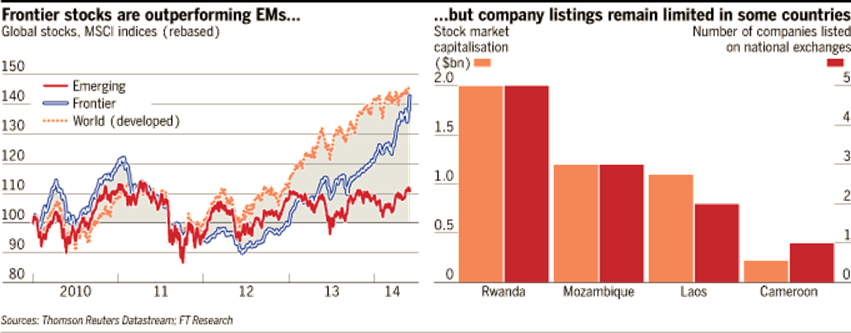
Every day, the flip-flop wearing moped drivers who make up the majority of Cambodia’s street traffic can look up at the tallest tower in Phnom Penh and check the performance of their country’s stock market.

It does not take long. Three years after the exchange opened the electronic billboard outside still shows the price, value and trading volume of a single listed company: the Phnom Penh Water Supply Authority. Read more of this post

“Most funds tend to revolve around one portfolio’s manager’s views of the world. You just can’t run hundreds of billions of dollars, or in our case trillions, that way. You can’t be a fiduciary that way.”

June 2, 2014 10:33 pm

UBS investment chief poised to quit company

By James Shotter in Zürich

Alexander Friedman is to step down as UBS’s global chief investment officer after three and a half years to pursue “a new opportunity outside the firm”.

The Swiss bank said that Mr Friedman, a former chief financial officer of the Bill & Melinda Gates Foundation, would be succeeded by Mark Haefele, head of the bank’s global investment office. Read more of this post

Chinese exporters have a long record of using fake trade receipts to bring US dollars onshore, swap them into local currency and benefit from the higher interest rates and appreciation. That distorts China’s economic data

June 2, 2014 7:50 am

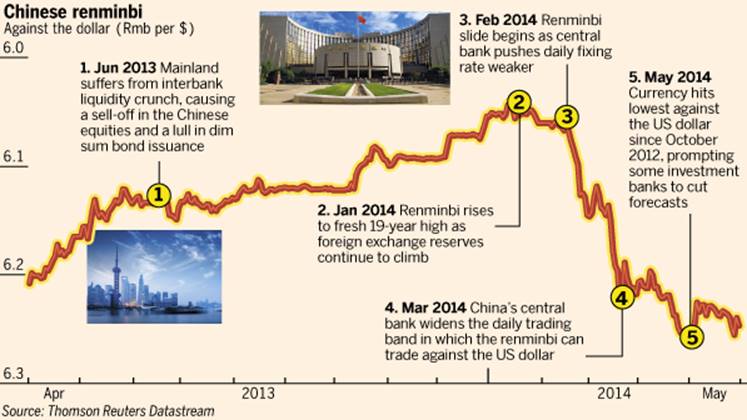
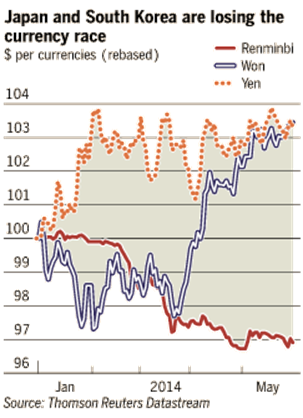
Renminbi bulls seize on hopes for economy

By Josh Noble in Hong Kong

image002-1 image001-8

Remember when currency policy, rather than maritime disputes, used to top the agenda for US-China relations?

Washington long complained that Beijing kept its currency artificially weak, helping it win manufacturing business and amass roughly $4tn in foreign exchange reserves.

For a while, appreciation proved an effective antidote – a stronger renminbi meant a quieter US Treasury. Between the summer of 2010 and January this year, the renminbi had risen almost 12 per cent against the dollar, to reach its highest level in almost two decades. Read more of this post

Bitcoin could be used to hide assets in divorces, warn lawyers

June 2, 2014 2:15 pm

Bitcoin could be used to hide assets in divorces, warn lawyers

By Jane Croft

Bitcoin, the electronic currency, could be used by divorcing spouses to hide assets from estranged partners, lawyers have said, as court battles shift their focus to the disclosure of assets.

Divorce settlements in England are seen as particularly generous to ex-wives, because judges recognise the equal contributions made by the breadwinner and the homemaker in a marriage, and divide the assets equally.

Moreover, courts are increasingly having to deal with legal battles brought by one side claiming the other has not made full disclosure of assets and has concealed wealth. Read more of this post

Constancy in the path to virtue: Moral behaviour ought to be persistently adopted so that it forms a kind of second nature

Updated: Tuesday June 3, 2014 MYT 7:02:36 AM

Constancy in the path to virtue

Moral behaviour ought to be persistently adopted so that it forms a kind of second nature.

ONCE, Aishah, who was a wife of the Prophet Muhammad, was asked about his way in good deeds: did he perform some actions exclusively on some particular days?

She replied that the Prophet did things like a raining cloud, which when it begins to pour knows no stopping; likewise, once the Prophet started doing something, he would do it continuously. (Narrated by Bukhari.)

Aishah reported also that the Prophet said: “The good deeds which are most pleasing to Allah are those which are performed with greatest constancy, even if they amount to little.” (Narrated by Abu Dawud.) Read more of this post

Under fire Australian miners look to repair their image

Last updated: June 1, 2014 8:41 am

Under fire Australian miners look to repair their image

By Jamie Smyth in Bulga, Australia

Tony Brown typically spends his days ferrying tourists to and from the Great Barrier Reef. But last month, the charter boat operator flew to Europe where he helped persuade Deutsche Bank and HSBC not to fund the expansion of a coal port that green groups claim could destroy the Unesco World Heritage-listed site.

“The dredging required to build the port is a risk to the reef and the A$6bn tourist industry that depends on it,” says Mr Brown, who has vowed to continue the fight to block what would become the world’s largest coal port at Abbot Point in Queensland.

The decision by the banks is the latest victory in a global campaign being waged against the funding of fossil fuel projects and companies by green groups, which allege they are causing catastrophic global warming. Read more of this post

Japan charms European investors despite growth fears; “Japan remains an under-analysed and under-appreciated market, with a lot more improvement going on in governance, capital efficiency and shareholder returns than most casual investo r

June 1, 2014 6:18 am

Japan charms European investors despite growth fears

By Madison Marriage

Enthusiasm for Japan-focused funds in Europe has not abated, despite fears that Prime Minister Shinzo Abe’s economic reforms have begun to run out of steam.

European investors placed €3.1bn in Japan-focused funds in the first three months of the year, according to figures from Cerulli Associates, the research firm.

This followed a bumper year for Japan fund managers in 2013, during which European investors allocated €13.6bn to the asset class – a sharp reversal on the €2.1bn of outflows suffered in 2012. Read more of this post

Barrick Gold’s chief admits lessons learnt from recent setbacks

June 2, 2014 3:30 pm

Barrick Gold’s chief admits lessons learnt from recent setbacks

By James Wilson, Mining Correspondent

Barrick Gold built its case for a merger with Newmont Mining on the savings the world’s two largest gold miners by output could extract from their joint holdings in Nevada. Now Barrick’s chief executive says that the miner has “moved on” from the aborted merger attempt but insists Nevada remains central to its plans.

Jamie Sokalsky played up the potential for Barrick to grow on the back of its own gold discoveries in the US state, and says that even without a merger Barrick will still look for ways to co-operate in Nevada with Newmont. “There are some things we could do on the ground,” he says.

Mr Sokalsky also adds the Canadian group has “learned some hard lessons” from recent setbacks such as its shelved attempt to build its huge Pascua-Lama gold mine in South America and will now take a more gradual approach to growth. The change of emphasis shows how miners have been forced to temper their ambitions because of the weak gold price. Read more of this post

Pascal Soriot: Leader of the great escape; The AstraZeneca chief on saying ‘no’ to Pfizer bid

THE MONDAY INTERVIEW

Last updated: June 1, 2014 3:59 pm

Pascal Soriot: Leader of the great escape

By Andrew Ward

A dose of politics: Pascal Soriot was adept in telling British lawmakers that a takeover by Pfizer might put lives at risk, a line eagerly picked up by UK media; but he prefers to spend his time with scientists

For some chief executives, a $100bn takeover battle would be something to relish. Pascal Soriot is not one of them.

The French CEO of UK drugmaker AstraZeneca has spent much of the past month surrounded by bankers and lawyers as he fought off an unwanted approach from Pfizer.

With the US drugmaker repelled, at least for now, Mr Soriot is relieved to be getting back to the business of making medicines: “I find it a lot more exciting to be talking to customers and scientists.” Read more of this post

Li & Fung’s strategy to make the maths work

June 2, 2014 5:43 pm

Li & Fung’s strategy to make the maths work

By Demetri Sevastopulo

Different figures: the Juicy Couture brand is owned by GBG, the unit that Li & Fung plans to list separately

When Li & Fung was set up in Canton, now known as Guangzhou, in 1906, it specialised in exporting traditional Chinese goods – from silk and porcelain to tea and fireworks – to the west.

Over the past century it has transformed itself into the world’s biggest sourcing company, with turnover last year approaching $21bn.

Wherever you live, there is a good chance that some of your clothes, toys or household goods were sourced by Li & Fung from factories in China and around the globe for retailers such as Walmart, fashion companies such as Calvin Klein, or brands owned by the group, such as Juicy Couture. Read more of this post

One day, two revolutions and uncertain destinies; June 4 1989 brought deeply contrasting events to Poland and China, writes Timothy Garton Ash

June 2, 2014 6:39 pm

One day, two revolutions and uncertain destinies

By Timothy Garton Ash

June 4 1989 brought deeply contrasting events to Poland and China, writes Timothy Garton Ash

Twenty-five years ago the world changed course. On June 4 1989 semi-free elections in Poland kick-started the end of communism across the whole Soviet bloc – and the Tiananmen Square massacre launched China on an entirely different trajectory. The consequences are still being played out, from Ukraine to the South China Sea.

I will never forget coming back to a newspaper office in Warsaw that afternoon, with elated Polish friends, and noticing on a television screen the first grainy footage of the bodies of Chinese protesters being carried on makeshift stretchers down the streets of Beijing. Read more of this post

Indian power: Narendra Modi must centralise it

Indian power: Narendra Modi must centralise it

Nick Butler | Jun 01 13:27 | 10 | Share

Imagine being elected prime minister of a country with one and a quarter billion people, about 300m of whom live in absolute poverty. That is the challenge facingNarendra Modi in India. The hardest question must be to know where to start.

When it comes to energy Mr Modi’s first acts have been encouraging. He has set a high but achievable target for the installation of solar, on and off the grid, building on his experience in the state of Gujarat. He has also forced together three key ministries – covering power, coal and renewables – under a new minister, Piyush Goyal. He should probably have gone further and added petroleum and natural gas as well. Structural change in the complex bureaucracy of the Indian government matters a lot. Read more of this post

Crooked UK professionals face five-year jail terms; Lawyers and accountants who work for organised criminals will face five-year jail terms under a crackdown on white-collar professionals who profit from crime while turning a blind eye

June 3, 2014 12:01 am

Crooked UK professionals face five-year jail terms

By Helen Warrell, Jane Croft and Sam Fleming

Lawyers and accountants who work for organised criminals will face five-year jail terms under a crackdown on white-collar professionals who profit from crime while turning a blind eye.

Measures, to be introduced in Wednesday’s Queen’s Speech will include a new offence of “participation in an organised crime group” for those who write contracts, rent warehouse space or deliver packages on behalf of gangster networks. This follows an example set by countries such as Ireland, Canada and New Zealand, which already have a “dual conspiracy” system to prosecute professional associates even if they are not directly involved in crimes. Read more of this post

Shire strategy fails to keep predators at bay; The UK-listed, Dublin-based speciality drugmaker has long been touted as an attractive prize – especially for US rivals drawn to Ireland’s low corporate tax rate

June 2, 2014 10:11 pm
Shire strategy fails to keep predators at bay
By Andrew Ward, Arash Massoudi and Neil Hume
When bankers talk about the deal frenzy gripping the pharmaceuticals sector, it rarely takes long for Shire’s name to come up as a potential target.
The UK-listed, Dublin-based speciality drugmaker has long been touted as an attractive prize – especially for US rivals drawn to Ireland’s low corporate tax rate.
However, Flemming Ornskov, chief executive, is doing his best to cast Shire as predator rather than prey.
Less than six months after completing its $4.2bn takeover of ViroPharma and two weeks after a $260m deal to buy Lumena, Shire is looking to complete a hat trick of acquisitions in the US rare disease sector. Read more of this post

Better to hire big fish from little ponds; Companies are getting better at spotting great character

June 2, 2014 3:34 pm

Better to hire big fish from little ponds

By Philip Delves Broughton

Companies are getting better at spotting great character

In the recent National Football League draft, the New York Giants had an unusual criterion for selecting players from college. Obviously, it wanted big, fast, strong young men, able to endure the brutality of professional American football. But it also wanted them “clean” and upstanding, with no scandals and no behavioural problems. And of its seven draftees, five had served as captains on their college teams.

Tom Coughlin, the Giants’ manager, explained why this mattered: “It’s someone who leads by example. It isn’t about talking; it isn’t about all that stuff. It’s about playing hard, being consistent, having virtues and values that you believe in and are not willing to sacrifice them for popularity.” Read more of this post

Returns of pre-packaged fund – also known as model portfolios – hit by huge fees

June 2, 2014 7:42 pm

Packaged fund returns hit by huge fees

By Emma Dunkley

The investment returns on “pre-packaged” portfolios sold by wealth managers could vary by as much as £46,000 over a decade on a £500,000 pension due to the wide range of fees charged, a report reveals.

Research by investment platform Skandia based on data from The Lang Cat, an independent consultancy, shows the total cost of investing in these pre-packaged funds – also known as model portfolios – can have a substantial impact, knocking thousands of pounds off returns.

Model portfolios invest in a number of funds to target a level of returns and a degree of risk. Wealth managers may offer a number of such portfolios, often assigning them a risk rating to suit different types of investor. Read more of this post

China faces crucial choice over future growth; Growth can be robust or consumption-led but not both

June 2, 2014 6:08 am

China faces crucial choice over future growth

By Manoj Pradhan

Growth can be robust or consumption-led but not both

China has always divided investor opinion. The biggest debate now is about the future path China’s growth will take. Bulls say the transition to sustainable growth will be smooth; bears argue it will be volatile. Yet both agree consumption will rise to offset weaker investment. The result? Economic growth of 6 per cent, give or take, led by consumption.

This may turn out to be wishful thinking. Growth in China can either be robust, or consumption-led, but not both. If China chooses consumption-led growth, it could also be choosing much lower growth than the 6 per cent or so most have in mind.

There are three reasons for this. First, high investment growth in the past few years has added capital and supported labour income and hence consumption. Lower investment growth would weaken that support. Read more of this post

Do not be fooled by fund rankings; Memory of risks fades as crisis drops out of performance tables

Last updated: June 2, 2014 11:18 am

Do not be fooled by fund rankings

By Stephen Foley

Memory of risks fades as crisis drops out of performance tables

To the extent that good can come from calamity, the silver lining of the credit crunch is that it has begat an era of more cautious lending, tougher capital rules and wider regulation, plus more risk-aware investment processes. The crisis was so searing that its lessons will be carried by a whole generation of finance professionals.

It is not the fading of human memories that should worry us most. It is a fading of statistical memory.

As we have checked off the string of “fifth anniversaries” of credit crisis milestones, the period is being erased from some of the most important metrics used by investors to plan their portfolios – with the result that the risks in those portfolios may be unwittingly drifting upwards. Read more of this post

Australia: End of the boom; A cooling Chinese economy has hurt the mining sector, prompting protests over the tough new budget

June 2, 2014 6:19 pm

Australia: End of the boom

By Jamie Smyth

A cooling Chinese economy has hurt the mining sector, prompting protests over the tough new budget

The small coal mining town of Singleton was so over-run by contractors seeking jobs during Australia’s decade-long mining boom that some had to join waiting lists for apartments. Unemployment was virtually non-existent and businesses thrived as an army of workers arrived to work in the dozen mines that ring the town.

“It was so vibrant here it was impossible to keep good staff. Most went to highly paid jobs in the mines,” says Danny Gresham, director of the Singleton Tyre and Battery Centre, a local industry supplier. Read more of this post

New Immunotherapy Drug Data Show Promise in Treating Cancer; Drugs From Bristol-Myers and Merck Shown to Prolong Lives of Some Cancer Patients

New Immunotherapy Drug Data Show Promise in Treating Cancer

Drugs From Bristol-Myers and Merck Shown to Prolong Lives of Some Cancer Patients

PETER LOFTUS and RON WINSLOW

June 2, 2014 7:30 a.m. ET

Drugs designed to unleash the body’s own immune system against cancer are significantly prolonging the lives of some people with hard-to-treat forms of the deadly disease. WSJ’s Jeanne Whalen joins Tanya Rivero on Lunch Break to explain. Photo: Getty

CHICAGO—Drugs designed to unleash the body’s own immune system against cancer are significantly prolonging the lives of some people with hard-to-treat forms of the deadly disease.

The latest evidence: Patients with the skin cancer melanoma who received a combination of two Bristol-Myers Squibb Co. BMY -1.31% immunotherapies in a clinical trial lived an average of more than three years, researchers reported Monday. In another study, about 70% of advanced melanoma patients receiving aMerck MRK +0.12% & Co. immunotherapy were still alive after one year of treatment. Read more of this post

Economic Wind Doesn’t Fill Companies’ Sales; This is a break from the usual pattern, where public-company sales increase at a much faster pace than overall sales during economic expansions and fall much more during recessions.

Economic Wind Doesn’t Fill Companies’ Sales

JUSTIN LAHART

Updated June 2, 2014 3:48 p.m. ET

image001-6

Even with a tepid economy, it is surprising just how difficult it has been for U.S. companies to get sales going.

With nearly all the results in, it looks like revenue at companies in the S&P 500 rose 3.6% in the first quarter from a year earlier, according to S&P Dow Jones Indices. That is only marginally higher than the 3.4% gain in economywide sales, as measured by final sales of goods and services produced in the U.S.

This is a break from the usual pattern, where public-company sales increase at a much faster pace than overall sales during economic expansions and fall much more during recessions. Nor is the weakness of corporate sales a recent phenomenon. They have increased just 3.4% over the past two years, while economywide sales have risen 6.9%. Read more of this post

Apple’s Soft Launch for New Devices

Apple’s Soft Launch for New Devices

DAN GALLAGHER

June 2, 2014 5:27 p.m. ET

Apple‘s AAPL -0.69% faithful were predictably wowed at its developers’ conference kickoff. The bigger test comes this fall once customers get an actual look at Apple’s new products.

That matters because, for all the focus on software in Monday’s opening keynote, Apple remains a hardware firm, using software and content to push sales of high-end devices at high margins. And with new designs like a large-screen iPhone and maybe a smartwatch expected in coming months, the question is how to maintain those margins.

It won’t be easy. Apple may have pioneered touch screen smartphones, but competition from the likes of GoogleGOOGL -1.28% Microsoft MSFT -0.37% andSamsung Electronics 005930.SE +1.65% has forced it to raise the stakes to stay competitive. Read more of this post

Index ETFs May Not Track Benchmarks as Expected; The Basic Idea: Their Returns Trail by the Amount of Fund Expenses. But That Isn’t the Whole Story

Index ETFs May Not Track Benchmarks as Expected

The Basic Idea: Their Returns Trail by the Amount of Fund Expenses. But That Isn’t the Whole Story.

ARI I. WEINBERG

Updated June 2, 2014 5:21 p.m. ET

The party line on index exchange-traded funds is that they offer easy exposure to a benchmark, less the fund’s expense ratio. If a stock index were to gain 10% this year, for instance, and an index ETF charges 0.1% of fund assets a year in expenses, an investor in that ETF might expect to earn 9.9%.

The reality is messier. The fund’s costs to buy and sell securities, and other aspects of portfolio management, influence your return as well.

For most stock ETFs, this slippage beyond the expense ratio is usually marginal: The median added cost is four-hundredths of a percentage point for ETFs with more than $100 million in assets that invest in U.S. stocks, according to data from research firm ETF.com. Some ETFs even overcome some costs to deliver tighter index-hugging than their expense ratios would indicate.

In other cases, the lag in ETF performance is significantly greater than one might expect based on fund expenses alone. Read more of this post

A Big-Name Index Is No. 2 in Returns; The Russell 2000 Trails the S&P SmallCap 600 Over Multiple Periods

A Big-Name Index Is No. 2 in Returns

The Russell 2000 Trails the S&P SmallCap 600 Over Multiple Periods

TOM LAURICELLA

June 2, 2014 5:20 p.m. ET

The lineup of stocks in the Russell 2000 small-stock index—and all the index funds that track it—gets an annual tweaking this month. One thing that may not change: the venerable benchmark’s lagging performance versus a younger rival.

image001-4

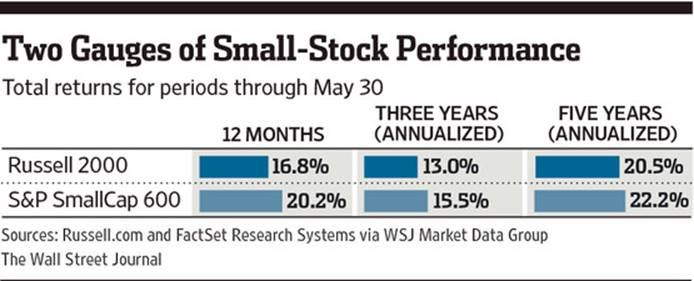
For tracking small-company stocks, the 30-year old Russell 2000 is the go-to metric for most investors. But there’s another game in town, and it has often chalked up better total returns than the Russell: the S&P SmallCap 600. Since its launch, the S&P 600 has beaten the Russell 2000 in 12 of 19 years. The S&P benchmark is ahead for the five-, three- and one-year periods through the end of May, including leading by 20.2% to 16.8% over the latest 12 months. Read more of this post

‘Alternative’ Mutual Funds: Different, Yes. Better? Not Lately. Funds With Nontraditional Strategies Haven’t Beaten Stocks Over the Past Few Years

‘Alternative’ Mutual Funds: Different, Yes. Better? Not Lately.

Funds With Nontraditional Strategies Haven’t Beaten Stocks Over the Past Few Years

DAISY MAXEY

Updated June 2, 2014 5:22 p.m. ET

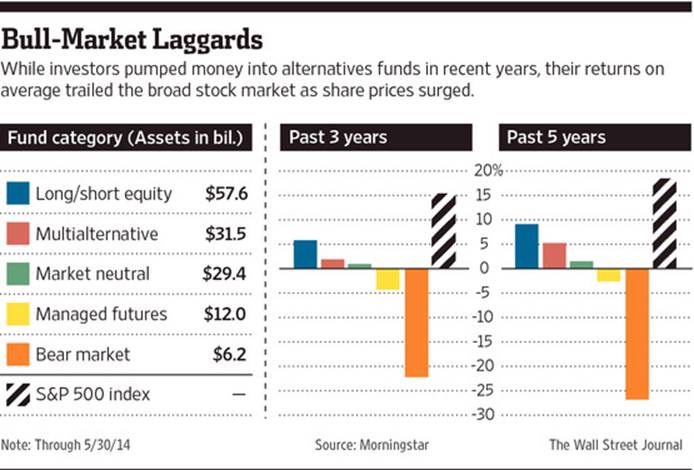
Investors spooked by the stock-market collapse of 2008 have been pouring money into so-called alternative mutual funds ever since. It’s a strategy that they hope will help cushion the blow if stocks take another dive.

image001-3

It may still do that yet. But meanwhile, many of those investors have taken a beating on their alternative funds as stocks staged an impressive recovery. Consider it a lesson in what to expect from funds whose mission is to set a different course from the stock market. If these funds perform as expected, “you’re protected on the downside, but you’re really going to pay a price if the market is raging,” says Adam Zoll, an analyst at research firm Morningstar Inc. Read more of this post

Stock Investors Can Handle the Truth; The ban on ‘locking’ markets has the effect of hiding the best prices

Stock Investors Can Handle the Truth

The ban on ‘locking’ markets has the effect of hiding the best prices.

CAMERON SMITH

June 2, 2014 7:33 p.m. ET

Most investors would be surprised to learn that current stock-market regulations actually prevent them from seeing and receiving the best price. Why? Well, in 2005 federal regulators at the Securities and Exchange Commission decided, in the immortal words of Jack Nicholson in “A Few Good Men,” that investors “can’t handle the truth” and that seeing true market prices would only confuse them.

Given the SEC’s willingness to conduct pilot programs to make U.S. markets more efficient and competitive, one would hope that eliminating a regulation that reduces transparency and thus harms investors would move to the top of the pilot-program list.

This can’t-handle-the-truth rule is a seemingly arcane part of the SEC’s Regulation NMS, implemented in 2007, that prohibits a market from displaying a quote that would “lock” the quote of another market. In other words, if one market is displaying, say an offer at $15.50 in IBMIBM +0.72% then another market should not display a matching bid in IBM at $15.50.

The simple reason is that, in theory, if a bid is the same as an offer, it should result in a trade. Indeed, the stated purpose of the prohibition is that it promotes healthy interaction between buyers and sellers and contributes to a fair and orderly market. Read more of this post
China Keeps Tiananmen Chatter Under Wraps Ahead of Anniversary

China Keeps Tiananmen Chatter Under Wraps Ahead of Anniversary

Dozens Detained, Questioned or Put Under House Arrest, Rights Groups Say

image001-2

BRIAN SPEGELE and JOSH CHIN

Updated June 2, 2014 3:14 p.m. ET

In Hong Kong, protesters recreated scenes from the Tiananmen Square crackdown. In mainland China, however, such displays were forbidden. Associated Press

BEIJING—China’s leadership is leaving little to chance ahead of this week’s 25th anniversary of the bloody quashing of the Tiananmen Square protests, having embarked on a widespread clampdown on dissent that has targeted lawyers, rights activists and journalists, among others.

Rights groups say dozens have been detained, questioned or put under house arrest to try to make sure no commemorations are held. The group Chinese Human Rights Defenders puts the number at 50 “detained, disappeared or summoned.” Read more of this post

The recent collapse of highflying technology and health-care stocks has stung buyers who paid steep prices for shares sold by the companies earlier this year in a surge of follow-on offerings

Secondary Sales Squeeze Investors

Slide in Technology, Health-Care Stocks Has Cooled Demand for Follow-On Sales

MATT JARZEMSKY

June 2, 2014 7:23 p.m. ET

A gold rush in public-company stock offerings has failed to pan out for many investors.

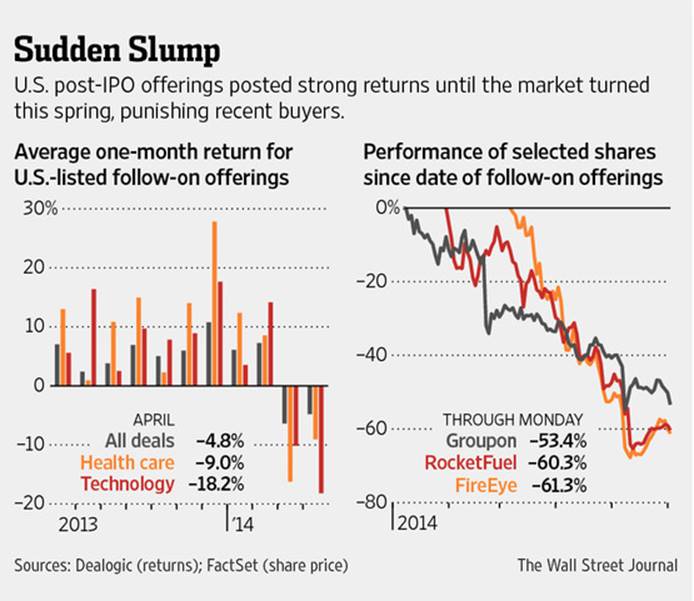
The recent collapse of highflying technology and health-care stocks has stung buyers who paid steep prices for shares sold by the companies earlier this year in a surge of deals known as follow-on offerings.

image001-1

That has cooled demand for the sales, meaning companies won’t see the same strong pricing that prevailed earlier in the year. At the same time, the stock prices of companies that completed offerings before the rout may come under pressure as investors use any rebounds to sell and reduce their losses.

When it comes to deals involving these once top-performing stocks, “Every purchase has been a bad purchase and every sale has been too small,” said Andrew Cupps, chief investment officer of Cupps Capital Management LLC. Read more of this post

Is this the new Lululemon? Twin entrepreneurs are heading to the US with their online activewear enterprise

Is this the new Lululemon?

June 2, 2014

Christine D’Mello

Twin entrepreneurs are heading to the US with their online activewear enterprise.

image001

Julie and Sali Stevanja have their eyes on one of the biggest markets in the world.

The growth of the fitness industry in Australia has spawned many associated businesses.

From 24-hour gyms and outdoor fitness facilities to sporting gear and activewear, various enterprises are tapping into the opportunities.

One sector to benefit is activewear. The local athletic apparel industry increased 8.3 per cent from 2006 to 2012, according to an industry outlook report by Ken Research.

Activewear boasts such glamorous names as adidas by Stella McCartney, Nike and Jodhi Meares’ The Upside, while Australian brands Vie Active, Running Bare and Lorna Jane are doing a roaring trade. In fact the Brisbane-based Lorna Jane will be put up for sale for a reported $500 million. Read more of this post

How to attract great clients

How to attract great clients

May 30, 2014

Big ideas are what successful business is all about. Each week Alexandra Cain takes a look at anything and everything to help your business shoot the lights out.

I’ve had a couple of instances recently where I’ve bumped heads with clients due to mismatched expectations about how the relationship should progress. It reminded me of a piece of advice I was given when I set up my business: train your clients, or they will run rings around you.

Maybe the word “train” is a bit harsh, but it is important to make sure both sides of the relationship have a common understanding about its nature. If they don’t, guaranteed it will end in tears.

I also think it’s important to keep in mind the client is coming to you for your advice. If they knew how to do the job themselves, they would. But they don’t, so they’ve asked you. Read more of this post