A Big-Name Index Is No. 2 in Returns; The Russell 2000 Trails the S&P SmallCap 600 Over Multiple Periods
June 6, 2014 Leave a comment
A Big-Name Index Is No. 2 in Returns
The Russell 2000 Trails the S&P SmallCap 600 Over Multiple Periods
TOM LAURICELLA
June 2, 2014 5:20 p.m. ET
The lineup of stocks in the Russell 2000 small-stock index—and all the index funds that track it—gets an annual tweaking this month. One thing that may not change: the venerable benchmark’s lagging performance versus a younger rival.
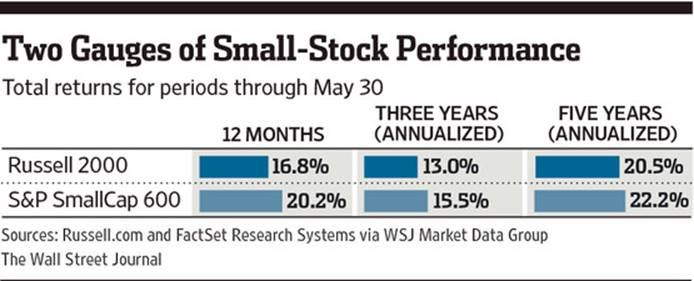
For tracking small-company stocks, the 30-year old Russell 2000 is the go-to metric for most investors. But there’s another game in town, and it has often chalked up better total returns than the Russell: the S&P SmallCap 600. Since its launch, the S&P 600 has beaten the Russell 2000 in 12 of 19 years. The S&P benchmark is ahead for the five-, three- and one-year periods through the end of May, including leading by 20.2% to 16.8% over the latest 12 months.
The differences between the two benchmarks provide a window into the wonky and highly competitive world of index construction. The rivalry has heightened because index composition isn’t just an academic question anymore. Thanks to the proliferation of index-tracking exchange-traded funds, a choice of benchmarks can have a real impact on investors’ portfolios.
“Every index embodies a bet” for investors, says Doug Sandler, chief equity officer at RiverFront Investment Group in Richmond, Va. “You have to find the bias.” At RiverFront, which manages $4.6 billion, the investment choice for small caps is the iShares Core S&P Small-Cap IJR -0.27% ETF, which tracks the S&P 600.
Philosophical Differences
Differences in performance reflect different philosophies for building indexes—in this case, whether the index should strive to capture all small-cap stocks or just reflect the performance of some of them, especially those ofstronger companies that are easier to trade.
At Russell Investments—which parent Northwestern Mutual Life Insurance Co. put up for auction early this year—the methodology is to divvy the U.S. stock market up between large and small stocks as of the last day of May. The Russell 1000 captures the largest 1,000 stocks, and the Russell 2000 is essentially the next 2,000 (aside from some minor adjustments for stocks that have a very low percentage of their shares publicly available to trade). Theindexes combined capture some 98% of the stock market by capitalization, Russell says. The new lineup is effective after the close on June 27.
“For a truly accurate benchmark, you have to have it be fully representative,” says David Koenig, investment strategist at Russell. He says that’s especially important for investment managers who use indexes as a way to measure their performance. “Otherwise, if you’re measuring a manager against a subset of the market, it already has a bias built into it,” he says.
Fighting Words
S&P Dow Jones Indices, a unit of McGraw Hill Financial Inc., sets more specific boundaries for stocks’ eligibility for its index, and a committee decides which stocks should be included. Only stocks with market capitalization of $350 million to $1.6 billion can be included in the S&P 600. The Russell 2000’s smallest stock as of last June was GSE Holding Inc. at $129 million—often considered “microcap” level. The largest was Seaboard Corp. at $3.6 billion—which would be in the middle of the range for the S&P MidCap 400.
“The S&P 600 is really a better expression of the small-cap space,” in large part because it is limited to stocks commonly defined as small caps, says Philip Murphy, vice president of equity indexes at S&P Dow Jones Indices. S&P also culls out stocks that have less than 50% of their shares available to trade.
Perhaps most significant for performance, S&P—unlike Russell—imposes a profitability screen for its index. Companies have to have been profitable for the previous four quarters to be eligible. Recently, 511 companies in the Russell 2000 had reported no earnings or a loss for the first quarter of 2014, or were expected to, according to FactSet.
While excluding unprofitable companies may lead to better returns, “that’s a much more subjective approach,” says Russell’s Mr. Koenig. He adds, in what are fighting words in the indexing world, “it’s an active strategy.”
 About bambooinnovator

