China’s Richer-Than-Romney Lawmakers Show Xi’s Reform Challenge

China’s Richer-Than-Romney Lawmakers Show Xi’s Reform Challenge

The ranks of China’s ultra-wealthy in its legislature swelled 20 percent this year, highlighting the vested interests that may oppose any measures by incoming President Xi Jinping to reduce the nation’s wealth gap.

Ninety members of the National People’s Congress are on a list of China’s 1,000 richest people published by the Shanghai- based Hurun Report, up from 75 last year, according to a review of the data by Bloomberg News. Everyone on the Hurun list had a fortune of at least 1.8 billion yuan ($289.4 million), more than former Republican presidential candidate Mitt Romney.

The growing presence of wealthy people in the legislature coincides with efforts by Xi to stem corruption and the public display of luxury by officials as he seeks to address concern the Communist Party no longer represents interests of ordinary Chinese. Xi’s task may become more difficult as the rich move to cement their gains through legislation, said Yang Fengchun, an associate professor of government and management at Peking University.

“The National People’s Congress has a lot of rich businesspeople who have the knowledge and the means to make laws, and that’s a privilege the rest of society doesn’t have,” Yang said in a telephone interview. “The common people believe that they can’t protect the rights of the weak.” Read more of this post
China: Interest rate hikes ‘cannot be ruled out’

Interest rate hikes ‘cannot be ruled out’

Updated: 2013-03-07 09:51

By Wang Xiaotian ( China Daily)

Diverse measures could be used to help control inflation, says adviser Read more of this post

Prices of traditional Chinese medicine cordyceps (“caterpillar fungus”) surge out of control; US$19/kg in 1982 to US$142,680/kg

Prices of caterpillar fungus surge out of control

Staff Reporter

  • 2013-03-07

Prices of cordyceps — a traditional Chinese medicine better known in English as caterpillar fungus — have flown skywards in recent years as new buyers in the market purchase in unusually high quantities, the Shanghai-based First Financial Daily reported.

Cordyceps are caterpillars infected with a parasitic fungus, which kills its host in the end. They are mainly collected in the mountains of the frigid Tibetan Plateau during a period of over two months beginning April 20.

With researchers discovering more medicinal value in cordyceps after the 1990s, prices of the top-class medical fungus have skyrocketed from 1982’s 120 yuan (US$19) per kilogram to 1993’s 3,000 yuan (US$482) per kilogram.

Its prices shot up further to 16,000 yuan (US$2,571) per kilogram in 2003, when SARS hit China. As of last year, there were no signs of slowing up as they touched 888,000 yuan (US$142,680) per kilogram in 2012, the newspaper said, Read more of this post

With Positions to Fill, Employers Wait for Perfection

March 6, 2013

With Positions to Fill, Employers Wait for Perfection

By CATHERINE RAMPELL

unemp

American employers have a variety of job vacancies, piles of cash and countless well-qualified candidates. But despite a slowly improving economy, many companies remain reluctant to actually hire, stringing job applicants along for weeks or months before they make a decision.

If they ever do.

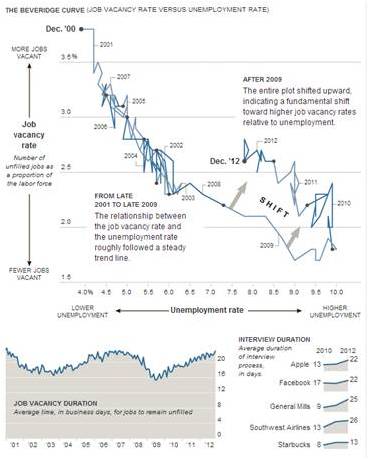
The number of job openings has increased to levels not seen since the height of the financial crisis, but vacancies are staying unfilled much longer than they used to — an average of 23 business days today compared to a low of 15 in mid-2009, according to a new measure of Labor Department data by the economists Steven J. Davis, Jason Faberman and John Haltiwanger. Read more of this post

Internet rumors and xenophobia cost the world’s biggest instant noodle maker Tingyi/Master Kong $2.4 billion

Internet rumors and xenophobia cost the world’s biggest instant noodle maker $2.4 billion

By Gwynn Guilford — 4 hours ago

When most people think “ramen” they think Japan, but that association has landed Master Kong, the world’s biggest instant noodle maker, in a lot of hot water. The company, which is based in Taiwan and listed in Hong Kong, has lost some $2.4 billion in market capitalization after false rumors about its ownership circulated during Japan and China’s showdown over islands in the East China Sea. Japanese products and companies have been hit with damaging boycotts and protests since the crisis began last fall. That’s also when spurious rumors began circulating online that Master Kong’s parent company Tingyi was majority-owned by a Japanese company. Then a mass campaign encouraged a boycott  via internet and SMS, alleging that the Hong Kong-listed noodle-maker had donated ¥300 million to Japan’s purchase of the controversial islands, as reported by Chinese media blog Danwei, which also created this great chart: 

screen-shot-2013-03-06-at-4-52-36-pm

The smear campaign got its facts wrong—the Japanese instant food company Sanyo owns 33.18% of Tingyi, just behind Taiwan’s Ting Hsin, which owns 33.27%. And the company didn’t make any pledges to buy the islands for Japan. But the facts are little consolation to the company or its investors. Tingyi says the originator of what it calls “Japanese investment-gate” (link in Chinese) was its biggest competitor in the ramen market, Uni-President (which, for its part, denies involvement). But this just goes to show how volatile a mix of social media, misinformation, and xenophobia can be—even before you add the extra spicy packet.

For App Makers, China Is Untapped and Untamed

Updated March 6, 2013, 7:29 p.m. ET

For App Makers, China Is Untapped and Untamed

The biggest app makers are increasingly setting their sights on China, as the internationalization of the apps business creates no only greater opportunities for developers but also heightened risks, Scott Austin reports. Photo: Getty Images.

By JESSICA E. LESSIN

China is emerging as the next battleground for global app makers—but cracking the world’s largest smartphone market is proving to be vexing.

App makers must navigate dozens of app stores with looser rules than in the U.S., fend off a proliferation of cloned apps, and steer around a thicket of regulations and intense competition from local developers.

What’s more, companies that charge for their apps are finding they need to get more creative about business models in China since users there are accustomed to getting most digital content free. Read more of this post

From chair maker to chairman of Index Group ($300m sales): Leading with trust; “Trust is a key element of leadership quality. We should trust our team members for their honesty and be able to let them trust us as well,”

From chair maker to chairman: Leading with trust

Published: 7 Mar 2013 at 00.00’Just responding to the competition is not enough. We have to bear in mind all the time that we need to keep our business growing,” says Pisith Patamasatayasonthi, the president and chief executive of Index Living Mall Co Ltd. “Since Index was established in 1973, I have tried to expand the business in different aspects in order to grow and be competitive at all times.”

478954

Pisith: Managing people is key

A modest and soft-spoken executive, Mr Pisith says he learned the value of constantly seeking new ideas through his own work experience, especially when dealing with foreign customers. “I came from a small family retail business upcountry,” he says. “My first product was a folding chair. Although I’m not a carpenter myself, I was able to manage and work through my people, who were experienced chair makers. “At this very early stage of my own business, I saw clearly that the rule of management _ whether one is a small retailer or a chair maker _ is the same, which is effective management of people. However, managing through people is not as easy as it seems to be.” Read more of this post

Former Thai DPM and chief economic architect Somkid: “The country is like a Monet painting – nice to look at from a distance but just a blur at closer inspection”; Thailand may become a country without a future if its leaders continue to overlook visionary and sustainable development

Somkid scathing on ‘lip service’ of populist govt

JEERAPONG PRASERTPOLKRUNG
THE NATION March 7, 2013 1:00 am

Thailand may become a country without a future if its leaders continue to overlook visionary and sustainable development, Somkid Jatusripitak, a former deputy prime minister, said on Tuesday.

“The country is like a Monet painting – nice to look at from a distance but just a blur at closer inspection,” he said, referring to French impressionist Claude Monet, who died in 1926.

Somkid was a guest speaker at an event to mark the 58th anniversary of the Thai Journalists Association. On the surface, the Thai economy is at the forefront of Asean countries, he said. But underneath the apparent success story lurk worrisome trends that could lead to decay. Read more of this post

Bosowa boss Aksa Mahmud tells of humble beginnings; Aksa always insists that his children gain people’s trust. “I will not be very sad if they become poor, but it will break my heart to find out that they cannot be trusted by people,” he said. “It will also shorten my life.”

Bosowa boss tells of humble beginnings, rivalry with Kalla

Tassia Sipahutar, The Jakarta Post, Jakarta | Business | Wed, March 06 2013, 10:59 AM

p13-bbosowa.img_assist_custom-560x385

Family affairs: (From left to right) Bosowa Corporation founder Aksa Mahmud, wife Ramlah and eldest child Erwin celebrate the company’s 40th anniversary in Makassar, South Sulawesi, in this file photo. Established in 1973, Bosowa is now one of the country’s major companies, with strong presence in eastern Indonesia. (Antara/Yusran Uccang)

Aksa Mahmud, founder of conglomerate Bosowa Corporation, is a self-made businessman. Despite his lack of business education, he managed to build a US$1.2 billion business empire from scratch and became one of the nation’s richest people.

Aksa developed his business sense at an early age while growing up in a small village in Lapasu, South Sulawesi.

“I have always wanted to make my own money. At school, I used to sell candy, cakes, whatever snacks I could get my hands on. I also sold ice blocks and dates during the fasting month,” the 67-year-old said while sipping coffee at his Aryaduta hotel in Makassar, South Sulawesi.

At present, Bosowa is one of the most successful companies in the country, with a strong presence in the eastern part of Indonesia. It spans a wide variety of sectors, from infrastructure to finance.

It currently runs a cement business through PT Semen Bosowa Indonesia and PT Semen Bosowa Maros, a car dealership with Mitsubishi and Mercedes-Benz brands, and a transportation business with taxi and air services. Bosowa also holds 14.3 percent and 21.7 percent stakes in the publicly listed PT Nusantara Infrastructure and PT Bank QNB Kesawan, respectively. Read more of this post

The Dirty Laundry of Employee Award Programs: Evidence from the Field

The Dirty Laundry of Employee Award Programs: Evidence from the Field

Timothy Gubler Washington University in Saint Louis – John M. Olin Business School

Ian Larkin Harvard Business School – Negotiation, Organizations and Markets Unit

Lamar Pierce Washington University, Saint Louis – John M. Olin School of Business

February 11, 2013
Harvard Business School NOM Unit Working Paper No. 13-069 

Abstract: 
Many scholars and practitioners have recently argued that corporate awards are a “free” way to motivate employees. We use field data from an attendance award program implemented at one of five industrial laundry plants to show that awards can carry significant spillover costs and may be less effective at motivating employees than the literature suggests. Our quasi-experimental setting shows that two types of unintended consequences limit gains from the reward program. First, employees strategically game the program, improving timeliness only when eligible for the award, and call in sick to retain eligibility. Second, employees with perfect pre-program attendance or high productivity suffered a 6-8% productivity decrease after program introduction, suggesting they were demotivated by awards for good behavior they already exhibited. Overall, our results suggest the award program decreased plant productivity by 1.4%, and that positive effects from awards are accompanied by more complex employee responses that limit program effectiveness.

Cash levels in Brokerage accounts approach lowest levels in history! This is America, Now: The Dow Hits a Record High With Household Income at a Decade Low

Cash levels in Brokerage accounts approach lowest levels in history!

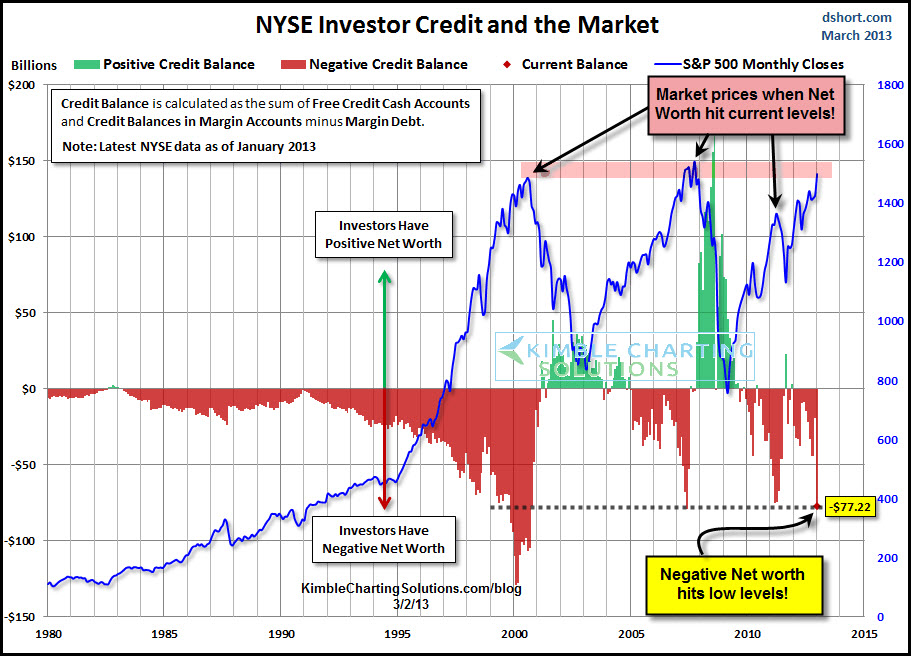
Posted by Chris Kimble on 03/02/2013 at 7:01 am; This entry is filed under Negative Net worthS&P 500.

The awesome chart below was created by  Doug Short, reflecting that a “ton of cash has disappeared in investors pockets this past month!”

negnetworthdshortmar21

Negative Net Worth = “Free Credit Cash accounts (cash available to spend/invest quickly) minus Margin Debt.” The chart Doug put together reflects a rapid decline in available cash/net worth this past month. Read more of this post

Steven Ujifusa on William Francis Gibbs and His Ships; A Man and His Ship: America’s Greatest Naval Architect and His Quest to Build the SS United States; what led Gibbs to build ships and how the builder’s firm became responsible for 70% of all ships built during WWII

Steven Ujifusa on William Francis Gibbs and His Ships

Published : March 06, 2013 in Knowledge@Wharton

Man-and-His-Ship

Named one of TheWall Street Journal‘s top 10 nonfiction books of 2012, Steven Ujifusa’s A Man and His Ship: America’s Greatest Naval Architect and His Quest to Build the SS United States brings William Francis Gibbs’ story to life. Wharton legal studies and business ethics professor G. Richard Shell recently sat down with Ujifusa to learn more about what inspired the author to tell Gibbs’ story, what led Gibbs to build ships and how the builder’s firm became responsible for 70% of all ships built during World War II. Read more of this post

Talking It Out: The New Conversation-centered Leadership; Leadership Conversations is part of a growing recognition that the so-called “command and control” model of organizational leadership is fast becoming outdated in today’s world

Talking It Out: The New Conversation-centered Leadership

Published : March 06, 2013 in Knowledge@Wharton

Every year, hundreds of thousands of new graduates enter the business world, eager to climb the corporate ladder. Their progress on the early rungs of that journey will often be determined by qualities like hard work, determination, knowledge and technical proficiency. But business consultants Alan S. Berson and Richard G. Stieglitz argue that those same qualities prove less helpful at higher rungs on the ladder, and may even be one’s downfall if they are not balanced by a very different set of leadership qualities. They sum up the thesis of their new book, Leadership Conversations: Challenging High-Potential Managers to Become Great Leaders, like this: “As you move into upper leadership levels, your technical skills — what you know — become less important. What counts is whom you know and, perhaps more important, who knows and trusts you.”

The importance of building strong working relationships within an organization may seem self-evident. But Berson and Stieglitz go well beyond a call to establish and maintain open lines of communication. The kind of conversations they are advocating for are not simply talk for talk’s sake. Rather, they are the heart and soul of any thriving organization’s culture: a strategic tool incorporating very specific techniques toward very specific ends.

A Changed Environment

Leadership Conversations is part of a growing recognition that the so-called “command and control” model of organizational leadership is fast becoming outdated in today’s world. The reasons for this shift are many. Today’s business environment is increasingly global, diverse, fluid and unpredictable. Technological change and the rise of social media have fundamentally altered the way companies interact with their customers. Rigidly hierarchical organizations risk losing ground to more nimble, collaborative ones. Read more of this post

Michael Mauboussin on the ‘Success Equation’

Michael Mauboussin on the ‘Success Equation’

Published : March 06, 2013 in Knowledge@Wharton

How do we know which of our successes and failures can be attributed to either skill or luck? That is the question that investment strategist Michael J. Mauboussin explores in his book The Success Equation: Untangling Skill and Luck in Business, Sports, and Investing.Wharton management professor Adam M. Grant recently sat down with Mauboussin to talk about the paradox of skill, the conditions for luck and how to avoid overconfidence.

An edited transcript of the conversation follows.

Adam M. Grant: Michael, we’re delighted to have you here today to talk about your book The Success Equation…. I would love to hear you speak a little bit about this paradox of skill that you have discovered and the relationship between luck and skill.

Mauboussin: Let me first tell you what the definition of the “paradox of skill” is. Specifically, it says that in activities where skill and luck define outcomes, as skill improves, luck becomes more important in determining outcomes. [By that definition,] more skill means more luck, which seems very paradoxical. It’s not my idea. I learned about it from Stephen Jay Gould, the very eminent biologist at Harvard. He talked about it in the context of Ted Williams, the last player to hit over 400 in major league baseball, which he did in 1941. Gould was wondering why no one has been able to achieve over 400 since that time. He looked at [variables such as] maybe because the guys play at night, or they travel too much. Really, none of those things checked out. Then he said, maybe Williams is just this amazing player — an immortal among mortals…. But if you look at every other sport, for example, things measured against the clock — there has been absolute performance everywhere you look, so that doesn’t seem to be the case. Then he thought about it more carefully, and he realized the actual result is because everyone’s gotten better, and as a result, the standard deviation of skill has actually narrowed. If you think about batting average for your season and your player, some level of skill plus some level of luck gives you your outcome. What’s happened generally is that the standard deviation of skill has gone down. Why? Because you’re recruiting players from the world now, versus from just parts of the United States. You’re training better. You’re coaching better — all those kinds of things….

The point is this paradox of skill. We’ve seen the differential skill narrowing. We see it really all over the place. We see it in the world of investing. We see it in the world of business. I think it is very interesting. As skill improves, especially in competitive markets, luck becomes more important determining outcomes. Read more of this post

Daniel Pink on Why ‘To Sell Is Human’

Daniel Pink on Why ‘To Sell Is Human’

Published : March 06, 2013 in Knowledge@Wharton

Bestselling author Daniel Pink’s new book, To Sell Is Human: The Surprising Truth about Moving Others, argues we are all in the sales business. Whether you are an educator, an art director or a project manager, part of your work involves convincing people to make an exchange. Pink recently visited the University of Pennsylvania as a guest lecturer in the Authors@Wharton series, and also teaches in Wharton’s Advanced Management Program. Wharton management professor Adam M. Grant interviewed Pink while he was there to learn more about the ideas in his book, including why consumers mistrust salespeople, what the new ABCs of selling are and why questions may be the greatest selling tool.

An edited transcript of the conversation follows.

Adam M. Grant: We’re excited to have you here to discuss your new book, To Sell Is Human. Could you start off by talking to us a little bit about why we are all in sales?

Daniel Pink: There are a couple of animating ideas in the book, Adam. One of them is that — like it or not — we’re all in sales. If you look at the labor data, one in nine people in the economy today make a living selling stuff. They are car dealers, real estate agents. But I had an instinct about those other eight in nine. I went out and did some survey research and found that those other eight in nine are people who are nominally in sales. They are managers; they are project team leaders; they are teachers and art directors. They are spending an enormous amount of their time in what I call non-sales selling. They’re selling. They’re convincing you to make an exchange. Give me something you have in exchange for something that I have. But it’s not denominated in dollars. It’s denominated in time; it’s denominated in attention; it’s denominated in effort. If you look at how white-collar workers are spending their time — whether they are in traditional sales or in some other kind of function — a lot of their time and efforts are spent convincing, persuading, cajoling and influencing people. The truth is that when you tell people you’re in sales, a lot of people don’t like it very much at all. Read more of this post

Food for Thought: Why Auntie Anne’s Pretzels Failed in China

Food for Thought: Why Auntie Anne’s Pretzels Failed in China

Published : March 06, 2013 in Knowledge@Wharton

China-Twist

Growing up in Indiana and Washington, D.C., Taiwanese-born Wen-Szu Lin often felt torn between two cultures. When, as a young entrepreneur, he was presented with the opportunity to buy the Chinese franchise rights to Auntie Anne’s, his unique background began to feel like an advantage: Who better than a Chinese-American to sell an American product to Chinese consumers? That advantage didn’t carry the English-speaking, American-educated Lin as far as he thought it would. The China Twist: An Entrepreneur’s Cautious Tales of Franchising in China is the story of his journey. At a time when China’s global economic importance continues to grow, the book provides interesting insights into the challenges — the ones you might expect as well as those you don’t necessarily see coming — of launching a business in a dynamic and rapidly evolving consumer landscape. A year after graduating from Wharton with a degree in entrepreneurial management, Lin was working for a global strategy consulting firm. He enjoyed his job but had recently gotten engaged and was hoping for a position that would afford greater financial stability to his future family. As his academic focus might suggest, he wanted the opportunity to build a business of his own from the ground up. A franchise operation seemed like the perfect place to start, offering the best of both worlds: He would own the territory, but also have the advantage of a proven business model and a built-in support system.

Auntie Anne’s offered an enticing opportunity. Explaining the company’s background and the reasons for his enthusiasm about his entrepreneurial venture, Lin writes: “‘Anne’ of Auntie Anne’s Pretzels is Anne Beiler. In 1988, she began mixing, twisting and baking pretzels and a variety of snacks at a farmer’s market in Downingtown, Pa. One day, Anne and her husband Jonas ran out of raw ingredients to make their typical pretzels, so they used the materials they had left in their kitchen. The change in recipe caused their sales to soar. The pretzels sold so well that they decided to stop selling anything else. The recipe they discovered in 1988 is the same recipe sold today at more than a thousand stores in more than twenty countries….

“In the U.S., the stores became extremely popular in most malls and transportation hubs, so it was proven to make money. Another plus: somehow, the brand had taken on a very nostalgic, comforting feeling. Many consumers could often recall a personal experience with Auntie Anne’s. Few brands could claim this kind of emotional bond. More amazing was that Auntie Anne’s had never invested in any above-the-line advertising (that is, TV, radio, print media, etc.). Their marketing plan was simple: enthusiastic employees offering samples of piping hot pretzels to anyone walking within a few feet of the stores.”

Lin and his partner Joseph Sze believed this approach could potentially make pretzels a huge hit in China. So, with a few investors backing their plans, Lin and Sze acquired franchise rights to introduce Auntie Anne’s Pretzels in China and embarked on their venture in 2008. What followed were four harrowing years of red tape, headaches and cultural clashes. Read more of this post

Empathy, the real measure of a doctor

Empathy, the real measure of a doctor

14237214_0

There is a hug I will never forget. Our twin babies had been born severely premature and had just breathed their last. An obstetrician not involved in their care, who was just walking past, looked in and stopped. We just hugged quietly; no words were needed.

5 HOURS 10 MIN AGO

There is a hug I will never forget. Our twin babies had been born severely premature and had just breathed their last. An obstetrician not involved in their care, who was just walking past, looked in and stopped. We just hugged quietly; no words were needed.

Medical school deans have identified empathy as the most important attribute they look for in potential doctors. In this era of powerful diagnostics and instant information, the relevance of empathy has never been greater. Expensive machines and elegant consultation rooms do not and cannot offer empathy. Only humans can. Read more of this post

President Xi: China needs courage for reforms, like “gnawing on a hard bone”; Xi stressed again the importance of innovation and technology in breaking through the bottleneck restriction for development and solve deeply rooted problems.

China needs courage for reforms, like “gnawing on a hard bone”: Xi

  • Xinhua 

2013-03-06

Communist Party of China general-secretary Xi Jinping on Tuesday called for courage like “wading through a dangerous shoal” to help deepen reforms in the country’s development.

While joining national legislators from China’s economic hub of Shanghai to deliberate the government work report, Xi compared the difficulty facing the country’s deepened reform and opening up to that in “storming a fortification.”

The report was delivered Tuesday morning by premier Wen Jiabao at the parliament’s annual session.

“We must have courage like gnawing on a hard bone and wading through a dangerous shoal,” said Xi, who is general secretary of the CPC Central Committee.

The government should give more respect to the law of the market and play a better role in advancing reform and opening up, Xi said.

While deliberating the government work report, Xi stressed again the importance of innovation and technology in breaking through the bottleneck restriction for development and solve deeply rooted problems.

Government and society should facilitate innovation with a global vision to come up with core technologies to drive industrial development, he added.

Shanghai saw a rush of people seeking a divorce over the past two days as couples worked out a way to escape the looming 20 percent tax on the profit from house sales.

Couples in rush to divorce as house sales tax looms

Created: 2013-3-6 1:46:08, Updated: 2013-3-6 1:54:53

Author:Hu Min

Shanghai saw a rush of people seeking a divorce over the past two days as couples worked out a way to escape the looming 20 percent tax on the profit from house sales.

Marriage registrars confirmed that the dramatic surge was triggered by the central government’s property curbs announcement last week, with many couples seeking a quick divorce but a remarriage shortly after.

Houses bought more than five years ago as a seller’s only residence are exempt from tax when resold. But families who own two houses and want to sell one of them are now targets in the government’s bid to curb speculation in the property market. If the couples divorce, each spouse will then own a property and one of them can sell the apartment that is tax exempt. After the transaction is complete, the couples get married again.  Read more of this post

Buffett Says Gloat Like Rockefeller When Watching Trains

Buffett Says Gloat Like Rockefeller When Watching Trains

Billionaire Warren Buffett said his Berkshire Hathaway Inc. (BRK/A) will benefit from rising U.S. oil production as the company’s trains and tank cars move fuel around the country.

Buffett, 82, highlighted demand for rolling stock made by Berkshire’s Union Tank Car in his annual letter to shareholders March 1. His company acquired the manufacturer, which traces its roots to John D. Rockefeller’s Standard Oil Trust, as part of the 2008 purchase of Marmon Holdings Inc. Buffett told investors to watch for the UTLX logo.

“As a Berkshire shareholder, you own the cars with that insignia,” he wrote to investors in his Omaha, Nebraska-based company. “When you spot a UTLX car, puff out your chest a bit and enjoy the same satisfaction that John D. Rockefeller undoubtedly experienced as he viewed his fleet a century ago.”

U.S. oil output had a record surge last year as new technology made drilling faster, cheaper and better at unleashing crude from rock formations. That’s reducing reliance on imported oil and benefiting railroads and tank car companies.

Berkshire’s railroad, Burlington Northern Santa Fe, is now carrying about 500,000 barrels of oil a day, or roughly 10 percent of what’s produced in the U.S. excluding Alaska and offshore, Buffett said. That’s helped keep volume growing at BNSF as coal shipments decline.

“Fortunately, they discovered oil where our railroad was,” Buffett, Berkshire’s chairman and chief executive officer, said in an interview yesterday on CNBC.

Car leases are generating $1,500 per month for 10-year deals, and more than double that for shorter terms, said Justin Long, an analyst with Stephens Inc. based in Little Rock, Arkansas. Before the recent boom, the cars leased for about $650 per month, Toby Kolstad, president of Rail Theory Forecasts LLC, said in December. Read more of this post

Less Than 14% of Chinese App Developers Make a Profit, Says China Mobile Executive

Less Than 14% of Chinese App Developers Make a Profit, Says China Mobile Executive

Mar 6, 2013 at 10:00 AM by C. Custer, in BusinessMobileStartups

Many of China’s tech luminaries are gathered in Beijing for the Two Meetings, and that means they’re all talking to the press. Xu Long, a National People’s Congress rep and the CEO ofChina Mobile’s Guangzhou subsidiary, took to the airwaves himself yesterday and made a grim pronouncement for China’s mobile market: only 13.7 percent of Chinese mobile app developers are actually making a profit.

It’s not entirely clear where that number comes from, but Xu says the source is “an investigation” of the country’s million-plus mobile app developers. Xu says the low number of profitable developers is evidence that China needs to continue exploring healthy and sustainable models for developing the mobile market. Read more of this post

Traders Flee Asia Hedge Funds as Haven Becomes Dead End

Traders Flee Asia Hedge Funds as Haven Becomes Dead End

Paul Smith moved from London to Hong Kong to work in Asia’s hedge-fund industry almost 17 years ago, and he rode the boom to its peak. Last year, like other industry veterans, he quit.

“I decided not to wait the cycle out but to do something more productive with my time,” said Smith, 53, who remains in the city heading the Asia-Pacific office of the nonprofit CFA Institute, the global association of chartered financial analysts. “The hedge-fund industry in Asia will continue to struggle to raise funds for the next few years as banks continue to have liquidity issues.”

Hedge-fund managers, traders and analysts in Asia are quitting as assets have failed to recover after the 2008 global financial crisis, and trading losses have left a majority of funds unable to collect performance fees. They’re moving to mutual funds, endowments, consulting firms and companies outside of the money-management business, often at a cut in pay.

Asian hedge-fund assets are 28 percent below their 2007 peak, according to data provider Eurekahedge Pte. Globally, money overseen by the funds increased 21 percent since 2007 to a new high of $2.3 trillion as of December, data from Chicago- based Hedge Fund Research Inc. show.

A total of 296 Asian hedge funds liquidated in the two years to December, 33 more than the number that started. On a global basis, 1,839 new funds outnumber those that shut by 371, according to Eurekahedge. Read more of this post

Indeed Is Becoming The Google Of Job Search

Indeed Is Becoming The Google Of Job Search

Vickie ElmerQuartz | Mar. 5, 2013, 9:13 AM | 3,991 | 1

Indeed is turning into the Google of job search.

The web site announced today that it has reached 100 million unique visitors worldwide in January, a 20% gain since late September. By some measures, the company is now bigger than Monster.

In a blog post and media announcement, Indeed said it accounts for more than half of online job searches in the United States and placed more people in jobs last year than CareerBuilderLinkedIn and Monster combined.  Its fastest growth occurred in Russia, India, South Africa, Australia and Japan.

Launched in 2004, Indeed operates as an aggregator of job listings, pulling them in from across the internet. ”We provide the best experience possible for job seekers. We do that by having the most jobs,” says Chris Hyams, a vice president of Indeed. The company has a team of people “dedicated to finding jobs online where we haven’t found them before.”

It also has focused on international growth, adding offices in Dublin, London, Toronto and Tokyo, among others, in the last two years. Read more of this post

Asian market indices do not provide an efficient risk/reward trade-off; the standard Asian indices are heavily concentrated in a few large-cap stocks. Most indices allocate as much as 60% of the index weight to only one-fifth of the stocks in the universe

Asian market indices do not provide an efficient risk/reward trade-off

Author: Wing-Gar Cheng

6 March 2013

Asian stock market indices have displayed a pronounced inability to provide an efficient risk-reward trade-off, according to researchers at EDHEC-Risk Institute.

The study of 10 major Asian stock market indices over the past decade –  “Assessing the Quality of Asian Stock Market Indices” – shows the standard Asian indices are heavily concentrated in a few large-cap stocks. Most indices allocate as much as 60% of the index weight to only one-fifth of the stocks in the universe.

Investors keen to hold well-diversified equity portfolios are advised to be aware of these inefficiencies. “Investors who want to capture the Asian market premium will do so in a better way if they use indices designed with an efficient weighting scheme.”

Asian equity indices also show severe fluctuations in style and sector exposures. Market indices in more developed countries (Hong Kong, Japan, Singapore, South Korea and Taiwan) demonstrate relatively more stability, whereas market indices in less developed countries (China and India) display higher variability over time in terms of sector allocation, the study found. “Investors clearly need to consider the weighting scheme that will allow them to extract the equity risk premium for a given geography in the best possible way.”

Total worldwide assets under internal indexed management rose to $5.994trn as of 30 June, 2011, a 25% increase over $4.781trn a year ago, the study said. In Asia, total ETF assets increased by 20-30% annually post-2008 and the number of products has risen by more than 200%. Currently, the total ETF assets in the Asia-Pacific are estimated at $81bn, it added. Read more of this post

Audis Trump China Patriotism as Local Brands Falter

Audis Trump China Patriotism as Local Brands Falter

By Bloomberg News  Mar 5, 2013

China is pressuring bureaucrats to buy locally branded cars to help domestic automakers and cut lavish spending of taxpayers’ money. That’s unless you are a high-level government official with an Audi A6L.

At Beijing’s Great Hall of the People yesterday, where Chinese Premier Wen Jiabao was addressing a crowd of almost 3,000 delegates, only those senior enough could park in the nearby north gate and southern courtyard. The scene: dozens of gleaming black Audi sedans waiting for their VIP occupants to emerge from the National People’s Congress.

“We should try to use Chinese cars when possible and actively advocate our officials to use them,” Guo Gengmao, governor of central Henan province, said yesterday when asked whether he will swap his Audi for a local brand. “But we should do so in a practical way and switch cars when we need to replace the old ones. Otherwise, it’s a big waste to replace cars when they’re still good to use.” Read more of this post

More Trouble for the Big Four in China: Pushing Prudent Analysis or Propaganda?

More Trouble for the Big Four in China: Pushing Prudent Analysis or Propaganda?

Peter Fuhrman is Chairman, Founder & CEO at China First Capital, (中国首创)a leading China-focused specialist international investment bank and advisory firm for private capital markets and M&A transactions.

March 6th, 2013

This is not a good time for the Big Four accounting firms in China. The SEC has charged themwith breaking securities law, while one of the group, Deloitte, is now in serious hot water in the US, facing a shareholder class action in Delaware for aiding a US-listed Chinese company in defrauding US investors. If Deloitte loses, or opts to settle, it could uncork a tidal wave of copycat claims that would do serious, perhaps irreparable damage to the China business of Deloitte, and then also possibly to Ernst & Yong, Price WaterhouseCoopers and KPMG.

The charges against the Big Four all boil down to allegations they were either negligent in fulfilling their statutory duties, or in cahoots with bad guys scheming to defraud US investors. The implication is that their willy-nilly pursuit of fees led the Big Four to cut corners, surrender objectivity, and allow their judgment to become corrupted.

Similar doubts can be raised about the quality, credibility and soundness of the judgments the accountants provide in assessing China’s private equity industry. Even as the PE market began to slide into serious trouble last year, the accountants kept talking up the industry. In particular, it’s worth reading the two big and well-publicized reports on China private equity produced by Ernst & Young  and PWC. Both can be downloaded by clicking here. E&Y Report.PWC Report. Read more of this post

Chinese companies have RMB 20 Trillion of receivables

全国企业应收账款规模达20万亿 商务部预警风险

商务部称将适时扩大商业保理试点范围

2013-03-06   作者:记者 孙韶华 实习生 周文其/北京报道  来源:经济参考报

5日,由中国服务贸易协会和商务部研究院合办的“首届中国商业保理行业峰会”发布了一份名为《中国商业保理行业研究报告2012》的报告。报告指出,应收账款规模持续上升风险加大,据估计全国企业应收账款规模在20万亿元以上。此外,商务部研究院对非金融类上市公司的财务状况监测结果表明,2012年我国上市公司财务风险已经为近十年来最大。
上述报告称,2012年受世界经济复苏明显放缓和国内经济下行压力加大的影响,国际国内市场需求总体不足,我国各行业产能过剩问题较为突出,在此背景下,企业应收账款规模持续上升,回收周期不断延长,应收账款拖欠和坏账风险明显加大,企业周转资金紧张状况进一步加剧。据业内人士估计,全国企业的应收账款规模在20万亿以上。
以国内工业企业为例,国家统计局数据显示,截至2012年12月,全国规模以上(主营业务收入2000万元及以上)工业企业应收账款总额82189.9亿元,较去年同期增长了17.63%,比流动资产总额增速快了5.6个百分点。应收账款总额占全国规模以上工业流动资产总额的比重为22.68%,较去年同期增加了1.08%。全国规模以上工业企业应收账款周转率12.05次,比去年同期降低0.02次。
“应收账款规模正呈现出规模大、风险高的特点。另据我们对上市公司财务状况的监测,去年上市公司财务安全状况是近十年来最大的。”商务部研究院信用部主任韩家平在论坛上表示,据统计,截至2012年10月31日,2471家上市公司应收账款达到2.22万亿元,同比上升近18%。如剔除金融类上市公司及中石化、中石油的数据,其他上市公司2012年前三季度的应收账款同比上升超过23%。其中,与宏观经济休戚相关的基建制造、煤炭钢铁、化工有色等大行业的应收账款同比增长数据均高于平均水平,达到30%—40%,整体表现为外部欠款严重;煤炭开采业更甚,2012年前三季度煤炭开采业公司的应收账款同比增长达到79.65%;此外,服装家纺类上市公司的应收账款同比增长接近40%。
据《经济参考报》记者了解,去年,我国企业应收账款规模持续上升、“三角债”抬头风险加大的问题已经引起政府高层重视,工信部、银监会、商务部等多个部委曾展开一轮调研摸底。
当前,应收账款规模依然居高不下,业内人士分析,一方面与国内外宏观经济形势和行业发展情况相关,企业资金周转出现困难。另一方面,我国信用体系建设缺失也推高了坏账率进而加剧了风险。据商务部的统计,我国企业每年因信用缺失导致的直接和间接经济损失高达6000亿元。
业内分析认为,信用服务业尤其是保理业的发展可以成为国内信用服务体系建设的一个突破口。据了解,商务部已经于2012年6月下发通知,同意在天津滨海新区、上海浦东新区开展商业保理试点,探索商业保理发展途径。截至2013年1月底,我国已注册的保理公司达到85家,其中内资64家,外资21家。
商务部市场秩序司巡视员温再兴说,当前市场信用环境不好,应收账款拖欠和三角债的问题是普遍的。商业保理业的发展对于解决我国三角债问题、中小企业融资难问题会有很大帮助。
温再兴透露,下一步商务部将稳步推进商业保理试点工作,“拟成立的公司要按照标准和条件严格把关,内外资标准是统一的。对于已经成立的公司要重新登记。对于想要参加试点的城市在严格条件的基础上,适当扩大试点的范围。”“同时商务部正在开发商务保理直报统计系统,商务保理企业都要纳入其中,我们要求所有的企业都不能游离于我们的监管之外。”

How a Request from SASAC Fell on the Deaf Ears of Property Developers; Beijing asked central government-controlled businesses to exit the real estate industry, but its notice has been largely ignored

03.05.2013 18:55

How a Request from SASAC Fell on the Deaf Ears of Property Developers

Beijing asked central government-controlled businesses to exit the real estate industry, but its notice has been largely ignored

By staff reporter Zhu Yishi

(Beijing) – In early 2010 the central government enacted policies to cool the real estate market. While the curbs have, to some extent, had their intended effect, government-controlled companies that should be busy with other business have prospered in property.

In January, eight commercial plots were sold in Beijing, and the buyers were either central government-controlled companies or state-owned enterprises (SOEs), data from Yahao Real Estate Selling & Consulting Solution Agency shows. Last year 37 residential plots were sold in the capital, and central government-controlled firms and SOEs bought 24.

These central government-controlled companies are holding their own in their adopted field. Last year, residential property giant China Vanke Co. Ltd., which is not this type of firm, had sales of more than 100 billion yuan.

In comparison, state-controlled China State Construction Engineering Corp. (CSCEC) had a similar sales figure, and China Railway Group Ltd. and China Railway Construction Corp. Ltd (CRCC) both had sales of 20 billion yuan last year. The latter two only entered the real estate industry in 2010.

This is evidence that Beijing’s request for central government-controlled companies whose main business was not real estate to exit the industry is being ignored.

The reason is two-fold. Zhou Fangsheng, former deputy director of the State-owned Assets Supervision and Administration Commission’s (SASAC) enterprise reform bureau, says for starters the property sector is very profitable. Also, the companies are assessed on their profitability, and these assessments are linked to executives’ pay.

The companies’ path to success in the real estate industry is aided by two factors. First, because the companies are controlled by the state, it is easy for them to get bank loans needed to finance projects. Also, local governments offer them preferential prices on land. Read more of this post

Lessons from past Dow milestones; As the Dow pierces an all-time high, a look at previous breakthroughs

March 5, 2013, 4:42 p.m. EST

Lessons from past Dow milestones

As the Dow pierces an all-time high, a look at previous breakthroughs

By Jonnelle Marte

The Dow Jones Industrial Average closed at its highest level ever Tuesday — ending with a new high of 14,253.77, more than 100 points above the 14,164.52 record last hit in October 2007. 

While that new all-time high may just be a number — the market didn’t undergo a magical transformation upon hitting pre-crisis levels — experts say such milestones can have a psychological impact on investors. As the Dow reclaims lost ground, some investors are reflecting on how far they’ve come since the financial crisis. Some are still trying to bounce back, but many have recovered what they lost in the crash of 2008. The average participant in a 401(k) plan broke even between 2007 and 2010, and many savers are now better off than they were in 2007, according to Vanguard. The average account balance was $86,000 at the end of 2012, 10% more than the average balance at the end of 2007. (Of course, those higher balances include investor contributions, not just market gains.) See: What’s the big deal about the 2007 highs?

But for all the investor excitement around market milestones, investing pros say these thresholds don’t really move markets too much up or down. While investors often get swept away when the market is near key thresholds — causing them to ignore important factors like stock valuations — analysts say monetary policy and economic growth drive markets. Indeed, some investing pros are skeptical about how long the run will last. See: Druckenmiller says ‘it’s going to end very badly.’

Here’s a look back at some of the Dow’s biggest milestones, what happened next — and what lessons were learned. Read more of this post

Copper Market Prepares for a Flood; Price of the Industrial Metal Has Plunged Amid Forecasts of the Biggest Increase in Output in 13 Years

Updated March 5, 2013, 8:06 p.m. ET

Copper Market Prepares for a Flood

Price of the Industrial Metal Has Plunged Amid Forecasts of the Biggest Increase in Output in 13 Years

By TATYANA SHUMSKY

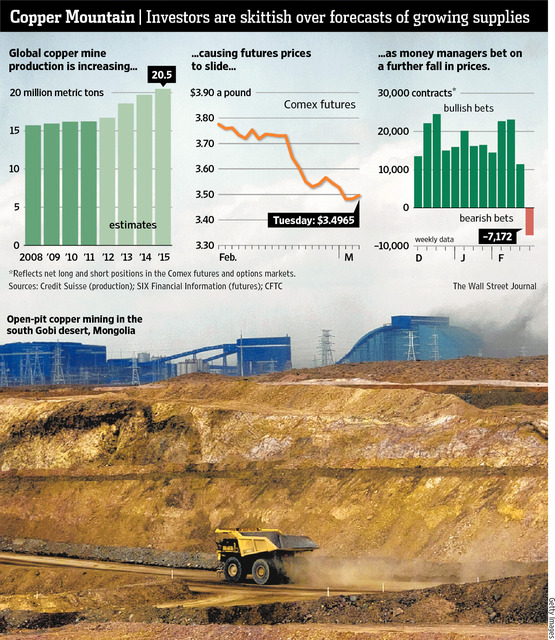
The copper market is bracing for a wave of new mine openings this year. Copper prices recently fell to three-month lows as investors and traders anticipate an onslaught of supplies, estimated to be the biggest increase in global copper mine output in 13 years. At the same time, the outlook for growth in copper demand remains dim: The No. 2 and No. 3 users of the industrial metal, Europe and the U.S., continue to face economic headwinds. Copper demand is highly correlated with manufacturing activity because it is used in many goods, from electronics to automobiles to home appliances.

MI-BU509_MKTLED_G_20130305182411

Read more of this post