Treasury Wine Estates Ltd. (TWE), Australia’s largest winemaker, plans to boost Chinese gift sales with trophy products similar to its $168,000 bottle of 2004 Penfolds Cabernet Sauvignon

Treasury Wine Readies China Gifts Modeled on $168,000 Ampul

Treasury Wine Estates Ltd. (TWE), Australia’s largest winemaker, plans to boost Chinese gift sales with trophy products similar to its $168,000 bottle of 2004 Penfolds Cabernet Sauvignon released last year. The Cabernet, contained in a glass ampul mounted inside a wooden cabinet, is “the sort of gifting that we really want to go out there” in Asia, David Dearie, chief executive officer, said in an interview yesterday. Treasury rose to a record today in Sydney trading. The company spent several hundred thousand dollars last year researching China’s wine-buyers, said Dearie. Treasury is using its findings to tailor products to Chinese consumers after success targeting Hispanic drinkers with Beringer’s Los Hermanos label in the U.S., he said. Read more of this post

Why some cells survive strokes while others don’t; “Medical science is often concerned with working out why cells die. We thought we’d look at why some seem to survive.”

Why some cells survive strokes while others don’t

Mar 2nd 2013 |From the print edition

WHEN dealing with a stroke—a loss of blood supply to the brain—time is of the essence. If the cause is a blocked artery, blood flow can often be restored using clot-busting drugs. If those drugs are swallowed too late, however, they can do more harm than good. In one of nature’s crueller ironies, the metabolic changes that take place in cells after about three hours without oxygen or glucose mean that restoring blood flow becomes damaging in itself. This is called a “reperfusion” injury. Doctors have long searched for ways to extend the period during which clot-busting pills might help. They have tried drugs and even artificially induced hypothermia to help the brain protect itself from the consequences of oxygen and sugar deprivation. Now, in a paper inNature Medicine, a group of researchers led by Alastair Buchan, a neurologist at the University of Oxford, describe a new idea. Dr Buchan’s team began with an old medical mystery. It has been known since the 1920s that some nerve cells, or neurons, are more susceptible to stroke damage than others. In particular, a group of neurons called CA3 cells that live in the hippocampus—a seahorse-shaped chunk of brain tissue involved in forming memories—are much hardier than another sort called CA1 cells, even though the two types are neighbours. “Medical science is often concerned with working out why cells die,” says Dr Buchan. “We thought we’d look at why some seem to survive.” The researchers compared versions of both types of cells taken from rats, looking for differences in their chemistry after they had been subjected to an artificial stroke. One conspicuous difference involved a protein called hamartin, which was present in larger amounts in the hardy CA3 cells than in the fragile CA1 cells.  Read more of this post

Wage Recession Hits 5 Years; Worse Than Jobs Drought

Wage Recession Hits 5 Years; Worse Than Jobs Drought

By JED GRAHAM , INVESTOR’S BUSINESS DAILY
Posted 02/28/2013 08:05 AM ET

IBD Wages

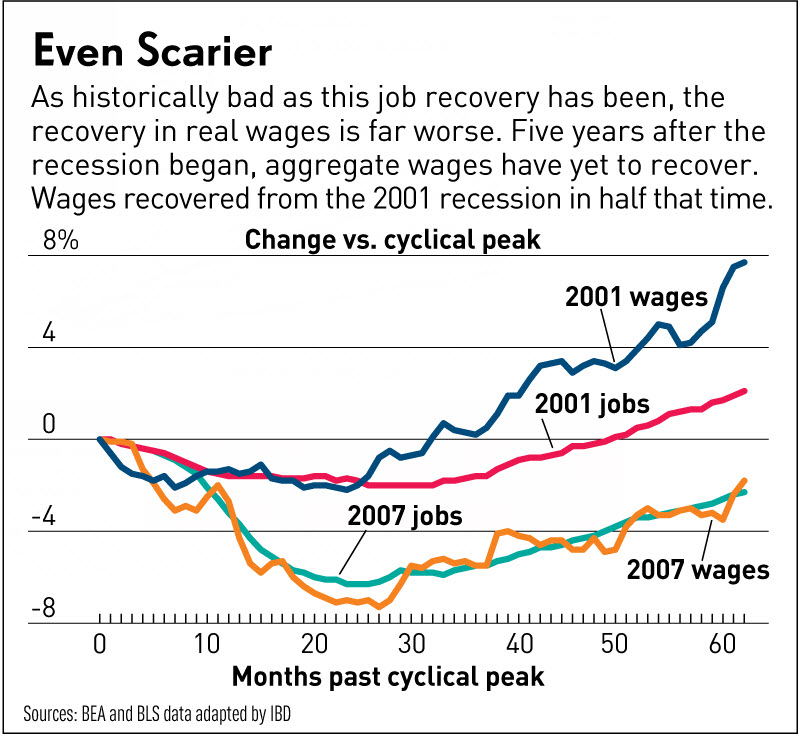
As bad as the current job recovery has been — and it’s by far the weakest since World War II — the recovery in wages has been far worse.

Five years after the recession began in December 2007, total wages in the economy have yet to fully recover in real terms, Commerce Department data show. In other words, the wage recession continues. Read more of this post

Warren Buffett may be souring on stocks; The Oracle of Omaha still likes the market — but he’s hardly pounding the table

Warren Buffett may be souring on stocks

By Stephen Gandel, senior editor March 1, 2013: 4:03 PM ET

The Oracle of Omaha still likes the market — but he’s hardly pounding the table.

chart-stocks-gdp2

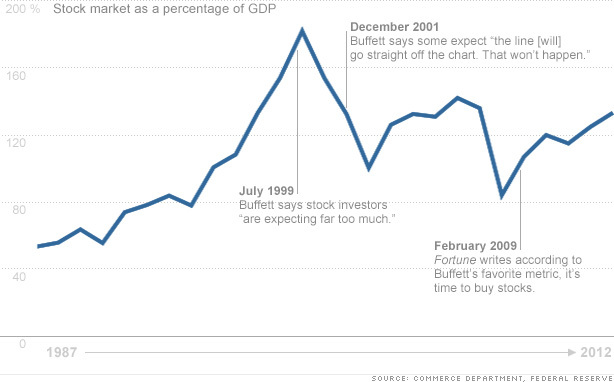
FORTUNE — In his annual letter to Berkshire Hathaway (BRKA) shareholders, released Friday afternoon, Buffett says he still believes U.S. stocks will “do well.” He notes that he made his first stock purchase during the bleakest part of World War II, so even if things look not so great right now, you should end up doing fine as well. But compare that to last year’s letter. Buffett devoted three and a half pages – over 1,900 words – to a detailed explanation of why he thought stocks were a much better investment than say gold or bonds. (See Warren Buffett: Why stocks beat gold and bonds.) He also said he was bullish on U.S. housing. This time around he devotes four paragraphs to the case for stocks. And even in that small space, Buffett says that investors should expect periodic setbacks, and he includes two statistics that could signal one may be coming up sooner rather than later. Buffett points out that the Dow Jones Industrial Average rose “a staggering” 17,320% in the 20th century — despite “four costly wars, a Great Depression and numerous recessions.” Here’s the problem: During nearly the same period, Buffett says GDP per capita rose much less about 500%. Buffett has used this comparison of the economy to stock market valuations before. He featured the metric in a story he wrote for Fortune back in 2001. (See Warren Buffett on the stock market) By that time, stocks had already fallen a bit from their dot-com infused highs. But they still weren’t a buy, Buffett said at the time. Despite their fall, stocks collectively were trading at a value of 133% of the gross national product of the U.S. (Buffett used GNP because it goes back 80 years, but for recent history using GDP works just fine.)

So where are stocks trading today? You guessed it. 133% of GDP. The metric hit a high of 190% back in 1999. So we are a little ways from panic territory, but that doesn’t mean the market is a safe place to be right now. Far from it. Back in 2001, Buffett said investors who buy when the relationship of stock values to the economy falls in the 70% to 80% range should do well. That means stocks would have to plummet 43% before we are back in Buffett buy territory. Even so, Buffett doesn’t appear to be worried. In his own portfolio, Buffett in the past year has added to his stakes in Wal-Mart (WMT) and Wells Fargo (WFC), two companies that are likely to go up only if the economy and the rest of the market does as well. It’s hard to tell if that’s because Buffett believes stocks are cheap, or just because he believes the other investing options are worse. “The risks of being out of the [stock market] game are huge compared to the risks of being in it,” writes Buffett in the letter. “Every tomorrow has been uncertain.”

It’s a Dog’s Life for Singapore’s Pampered Pets; “A lot of people wouldn’t bat an eyelid on spending several thousand dollars on a dog. The litmus test is whether the dog stays with them for the rest of its life or not,”

It’s a Dog’s Life for Singapore’s Pampered Pets
March 01, 2013

The guests lean over the side of the boat to catch the morning breeze as their catamaran eases off from a jetty in Singapore. A typical cruise, except for the fact that the passengers are dogs. “Actually, this is their third cruise,” said Andy Pe, 43, the doting owner of two Black Labrador Retrievers, a Yellow Labrador, a Golden Retriever and two mongrels. “They enjoy the sea breeze and water so much.” From boat cruises and spas to their own obituary section in the leading newspaper, pets are pampered in a big way in Singapore, a city-state with one of Asia’s highest standards of living. Read more of this post

The Tyranny of the Queen Bee: Women who reached positions of power were supposed to be mentors to those who followed, writes Peggy Drexler—but something is amiss in the professional sisterhood

March 1, 2013, 3:17 p.m. ET

The Tyranny of the Queen Bee

Women who reached positions of power were supposed to be mentors to those who followed—but something is amiss in the professional sisterhood.

By PEGGY DREXLER Read more of this post

In Sweden, TV Tax Comes to Smartphones

March 1, 2013, 3:12 p.m. ET

In Sweden, TV Tax Comes to Smartphones

By GUSTAV SANDSTROM

Sweden’s public broadcaster, feeling pressure as streaming heavyweights like NetflixNFLX +0.69% and HBO gain ground with their newly-founded Nordic services, is taking the nation’s television license fees to a new level by asking smartphone and tablet users to pay up.

License fees have been in place for years as state-backed broadcasters look to fund commercial-free programming, including the BBC. In Sweden’s case, anyone owning a television is forced to pay a SEK173 ($27) tab per month for Sveriges Television, Sveriges Radio and educational broadcasting known as Utbildningsradion. That fee hardly looks like a bargain compared with the SEK79 ($12) monthly fee that Netflix Inc. and Time Warner Inc.’s TWX +0.85% HBO each charge subscribers in Sweden. Read more of this post

Dear Apple, Amazon, Google: Here’s Why Chinese Consumers Hate Your Ecosystems; Be formless, shapeless, like water. (And be flexible towards your ecosystem users)

Dear Apple, Amazon, Google: Here’s Why Chinese Consumers Hate Your Ecosystems

Mar 1, 2013 at 14:10 PM by Steven Millward, in AsiaMobileOpinion

Chinese consumers love your gadgets – that’s great news. But the bad news for Apple, Amazon, Google, and many more companies is that Chinese netizens hate your ecosystems. They really don’t want to be trapped in your walled garden. In an age of platforms and extended web services, that’s a huge monetization problem for tech companies entering the world’s biggest market.

Android, without the Google bits

This aversion to tech ecosystems in China is seen most starkly with Google’s mobile OS, Android. An estimated 189 million smartphones were sold in China in 2012, and as many as 86 percent of those were Android devices. But that huge user-base hasn’t translated into popularity for Google’s other apps and services. Read more of this post

How State-owned Shipper Sailed into Stormy Seas; Analysts blame a shortsighted strategy, a bad bet on a financial derivative and poor management for COSCO Holdings’ woes

03.01.2013 12:23

How State-owned Shipper Sailed into Stormy Seas

Analysts blame a shortsighted strategy, a bad bet on a financial derivative and poor management for COSCO Holdings’ woes

By staff reporters Liu Ran and Wu Jing

(Beijing) – One of the country’s most prominent liner shipping operators, China COSCO Holdings Co. Ltd., is struggling to avoid being kicked out of the Shanghai Stock Exchange five years after its debut. It lost 6.5 billion yuan in the first three quarters of 2012 after a 10.4 billion yuan loss the previous year. Analysts expect it to post a loss of under 10 billion yuan for all of 2012. If it is in the red again in 2013, it will be forced to temporarily suspend trading until a profit can be turned. If losses continue for a fourth straight year, it will be delisted. However, the chances it can turn the tide this year seem to be long. Analysts say management is more incompetent than it cares to admit. Problems have arisen because of strategic miscalculations and bungled investments with hedging tools. Read more of this post

Chinese companies are struggling to translate their economic might into a worldwide reputation, according to a study released by Fortune magazine

Chinese firms still short of ‘global admiration’: Poll

Updated: 2013-03-02 02:42

By HE WEI ( China Daily)

Chinese companies are struggling to translate their economic might into a worldwide reputation,

according to a study released by Fortune magazine. Not a single Chinese company was ranked in the top 50 in its annual

“World’s Most Admired Companies List” for 2013, widely considered among the most definitive report cards on global corporate reputation.

Read more of this post

Heavy tax to dampen speculation; China’s cabinet ordered on Friday that a 20 percent individual income tax be levied on capital gains by home sellers

Heavy tax to dampen speculation

Updated: 2013-03-02 02:45

By Hu Yuanyuan ( China Daily)

20% levy on capital gains by sellers to rein in housing prices

In one of its sternest measures to hold back the rise of housing prices in major cities, the State Council, or China’s cabinet, on Friday ordered that

a 20 percent individual income tax be levied on capital gains by home sellers. This is the latest regulation following

the cabinet’s meeting on Feb 20 about the urban residential housing market. Currently, only a 1 percent individual income tax

is levied on the sale price, much lower than the 20 percent tax on the difference between the sale and purchase prices.

“The measure will definitely lead to a sharp drop in property transactions and change people’s expectations,”

said Ji Gang, a senior director in the investment department of real estate service provider Savills Property Services (Beijing) Co.

Read more of this post

Buffett: $24 Billion Gain ‘Subpar’; Berkshire Boss Says He Is Donning His ‘Safari Outfit’ as He Continues the Hunt for Big Acquisitions

Updated March 1, 2013, 6:58 p.m. ET

Buffett: $24 Billion Gain ‘Subpar’

Berkshire Boss Says He Is Donning His ‘Safari Outfit’ as He Continues the Hunt for Big Acquisitions

By ANUPREETA DAS And ERIK HOLM

Warren Buffett bemoaned Berkshire Hathaway Inc.’s BRKB -0.11% failure to land a major acquisition during 2012 to use its swelling cash hoard, and in his annual letter to shareholders called his company’s performance “subpar” despite a $24 billion increase in its net worth. The value of the Omaha, Neb., company rose 14% in 2012, Berkshire said Friday, compared with a 16% total return in the Standard & Poor 500-stock index, including dividends. But Berkshire’s ballooning size means that keeping up with the market continues to get tougher, as Mr. Buffett has long warned it would.

“When the partnership I ran took control of Berkshire in 1965, I could never have dreamed that a year in which we had a gain of $24.1 billion would be subpar,” Mr. Buffett, Berkshire’s chairman and chief executive, said. “But subpar it was.” The lagging performance is just the company’s ninth in the 48 years that Mr. Buffett has steered the company, but the third in four years. If the stock market continues to advance in 2013, it could jeopardize his streak of beating the S&P on a rolling five-year basis, as Mr. Buffett said Berkshire’s relative performance is stronger when the market is down or flat.

Not landing a large deal in 2012 was another disappointment, Mr. Buffett said: “I pursued a couple of elephants, but came up empty-handed.” Two years ago, he said he was on the prowl for big deals as a way to boost returns on Berkshire’s billions of dollars in cash. At the time, Mr. Buffett said, “Our elephant gun has been reloaded, and my trigger finger is itchy.” Read more of this post

You can influence your return on luck

Saturday March 2, 2013

You can influence your return on luck

By ROSHAN THIRAN

Luck and success: Datuk Seri Idris Jala during a conversation said he had six key points to leadership success and his final point was about having good luck.

THESE past few weeks, with the Chinese New Year celebrations in full swing, many friends wished me “luck” many times. Everyone was hoping for a great year with lots of luck. Most believe that luck happens by chance. Luck, we believe is something you cannot plan for or obtain by design. Luck is fated, or is written in the stars. Or is it?

I remember a conversation I had with Datuk Seri Idris Jala many years ago when he explained the secret to his success as a leader. He had six key points to leadership success and his final point was about having good luck. He did not term it “luck” but called it “divine intervention.” He believed that you could control about 40% of things you were working on. The remaining 60% were things beyond your control where you had little influence. However, Idris believed that if you were a good human being, operating with ethics and spending time in solitude and reflection, you could “influence” the divine to be on your side and bring yourself good “luck.” Read more of this post

World Bank calls Malaysia a regional leader in corporate governance, but there’s more to be done

Saturday March 2, 2013

World Bank calls Malaysia a regional leader in corporate governance, but there’s more to be done

By ERROL OH

malaysia-assessment-averages-chart-b03

IT’S like a report card you can proudly bring home to show mum and dad. On Tuesday, the World Bank released the findings of its assessment of corporate governance in Malaysia, and the numbers indicate that we have done well. Read more of this post

Family Fortunes: How to Build Family Wealth and Hold on to It for 100 Years; Why family money should NOT be invested in “safe, conservative” investments; Why you can’t trust wealth “professionals” and why you should never entrust your money to money managers; why most celebrity CEOs are a threat to the businesses they run; Why giving your children as much education as possible is NOT a good idea

Family Fortunes: How to Build Family Wealth and Hold on to It for 100 Years (Agora Series) [Hardcover]

Bill Bonner (Author), Will Bonner (Contributor) Read more of this post

Robert Hagstrom: What Is the Difference between Investing and Speculation?

Investing is the relentless process of translating and refining tacit knowledge into a distinctive and unique investment framework or mental model that is scalable beyond one single person and adaptable in different relevant contextual situation, particularly in dealing with what we do not know. Investors write with a framework as the north star to guide and navigate the marketplace jungle where dangerous animals, poisonous creatures and alluring sirens lurk at the corner. Speculators never bother to write. Investors care deeply about ideas and research. Speculators care solely about “making money”. Writing, research, ideas, knowledge – these are frivolous/useless pursuits with no immediate or short-term profits to Speculators. Investors have an instinctive longing to weave outside our own skin some reflection of our mind. Investors uphold the notion of responsibility, which emphasizes the active nature of the agent/knower, as well as the element of choice involved in the activity of the agent/knower, who can be assessed to be responsible or irresponsible as having fulfilled his obligations to fellow enquirers as part of membership in a community. Getting closer to the truth as a result of one’s virtues is more valuable for Investors than getting it on the cheap for Speculators.

KB

What Is the Difference between Investing and Speculation?

Robert Hagstrom, CFA

27 February 2013

Editor’s note: Today, we are doing something different. Robert approached us with a question that we found interesting, so we decided to pose it to some professional investors. In addition to our regular coverage, we are pleased to feature his framing of an interesting debate. We will be publishing select responses to the question over the next few days. If you are compelled, we invite you to comment below, tweet us @cfainvestored, or reach out to us via email.

What is the difference between investing and speculation? At first, you think the answer is simple because the distinction is obvious — that is, until you actually put pen to paper and try to answer the question.

Go ahead; take a few seconds and think about it. Write down “investing.” Now write the definition. Do the same for “speculation.” If you are like me, frustration quickly builds because the answers do not come quickly or easily, and they should. After all, these terms have been a part of the financial lexicon since Joseph de la Vega wroteConfusion of Confusions in 1688, the oldest book ever written on the stock exchange business. In his famous dialogues, de la Vega observed three classes of men. The princes of business, called “financial lords,” were the wealthy investors. The merchants, the occasional speculators, were the second class. The last class was called the “persistent speculators” or the “gamblers.” Read more of this post
If you had listened to Warren Buffett on gold a year ago you would have made a lot of money; The great thing about Warren Buffett is that all of his writing stands the test of time

If you had listened to Warren Buffett on gold a year ago you would have made a lot of money

Joe Weisenthal, Business Insider | Mar 1, 2013 10:05 AM ET
Warren Buffett‘s annual must-read shareholder letter is supposed to come out today, according to reports.

But the great thing about Buffett is that all of his writing stands the test of time.

Last year in his letter he made a great call on gold, explaining famously that for $9.6 trillion, you could buy all the gold in the world, and it would fit into a nice cube inside of a baseball field diamond.

Or for that money, you could buy all US cropland (400 million acres) + 16 ExxonMobils, and still have another $1 trillion in pocket money left over. Read more of this post

Breakfast with AQR’s Billionaire Hedge Fund Manager Cliff Asness; AQR could not be the success it is if David Kabiller did not have skills that complement the acute personality and thinking of Asness. Turning ideas into a money-making reality requires a partnership

Breakfast with AQR’s Cliff Asness

Posted By AMANDA WHITE On 01/03/2013 @ 1:37 pm In IN CONVERSATION

Having a breakfast meeting with Cliff Asness is a wake-up call. He will let you know if you’re late – something he holds in very little regard. He admits he has to constantly remind himself that just because he’s 20 minutes early to everything that others are not automatically then 20 minutes late. Asness is open, he’s entertaining, even funny. And he also possesses the rare combination, at least in this industry, of intellectual genius and social libertarianism. It’s very engaging and you quickly get the feeling that you’re only scratching the surface of his intellect as he changes from political activist to quantitative mathematician to social philosopher.

Social justice is also good business

Having two sets of twins is an almost perfect justice for a man who revels in the competitive game of statistics – he’s clearly an overachiever. But while he boasts about the competitive achievements particular to quantitative investment managers, his intellectual reach doesn’t stop there. His social and political interests include gay marriage and tax.

“I believe in all forms of small government, not just economic. Read more of this post

David Brooks: The Learning Virtues; A book on education cultures finds that the Chinese tend to define learning morally while Westerns define it cognitively

February 28, 2013

The Learning Virtues

By DAVID BROOKS

Jin Li grew up in China during the Cultural Revolution. When the madness was over, the Chinese awoke to discover that far from overleaping the West, they were “economically destitute and culturally barren.” This inspired an arduous catch-up campaign. Students were recruited to learn what the West had to offer. Li was one of the students. In university, she abandoned Confucian values, which were then blamed for Chinese backwardness, and embraced German culture. In her book, “Cultural Foundations of Learning: East and West,” she writes that Chinese students at that time were aflame — excited by the sudden openness and the desire to catch up. Li wound up marrying an American, moved to the States and became a teacher. She was stunned. American high school students had great facilities but didn’t seem much interested in learning. They giggled in class and goofed around.

This contrast between the Chinese superstudent and the American slacker could be described with the usual tired stereotypes. The Chinese are robots who unimaginatively memorize facts to score well on tests. The Americans are spoiled brats who love TV but don’t know how to work. But Li wasn’t satisfied with those clichés. She has spent her career, first at Harvard and now at Brown, trying to understand how Asians and Westerners think about learning. The simplest way to summarize her findings is that Westerners tend to define learning cognitively while Asians tend to define it morally. Westerners tend to see learning as something people do in order to understand and master the external world. Asians tend to see learning as an arduous process they undertake in order to cultivate virtues inside the self. Read more of this post

Jonah Berger On The Power Of Scarcity; Contagious: Why Things Catch On

Jonah Berger On The Power Of Scarcity

BY JONAH BERGER

MARCH 1, 2013

In Fast Company’s April issue, we’ll profile Jonah Berger, the 32-year-old Wharton professor who has become one of the world’s foremost experts on what goes viral and why. It’s easy to find examples of products or ideas that have spread and become popular, but as he writes, “It’s much harder to actually get something to catch on. Even with all the money poured into marketing and advertising, few products become popular.” His new book Contagious: Why Things Catch On, being published next week by Simon & Schuster, tries to answer the question, Why do some products, ideas, and behaviors succeed when others fail? In this exclusive excerpt, which will be serialized in five parts, he explores the concept of social currency, one of the six elements Berger says helps unravel the mysteries of virality.

In 2005, Ben Fischman became CEO of the discount shopping website SmartBargains.com. The business model was straightforward: companies wanting to offload clearance items or extra merchandise would sell them cheap to SmartBargains, and SmartBargains would pass the deals on to the consumer. There was a broad variety of merchandise, and prices were often up to 75% lower than retail. But by 2007 the website was floundering. Margins had always been low, but excitement about the brand had dissipated, and momentum was slowing. A year later Fischman started a new website called Rue La La. It carried high-end designer goods but focused on “flash sales” in which the deals were available for only a limited time–24 hours or a couple of days at most. And the site followed the same model as sample sales in the fashion industry. Access was by invitation only. Sales took off, and the site did extremely well. So well, in fact, that in 2009 Ben sold both websites for $350 million.

Rue La La’s success is particularly noteworthy, given one tiny detail. It sold the exact same products as SmartBargains. How come Rue La La was so much more successful? Because it made people feel like insiders.

Read more of this post

Maker’s Schedule, Manager’s Schedule; Most powerful people are on the manager’s schedule. It’s the schedule of command

Maker’s Schedule, Manager’s Schedule

Paul Graham

July 2009
One reason programmers dislike meetings so much is that they’re on a different type of schedule from other people. Meetings cost them more.

There are two types of schedule, which I’ll call the manager’s schedule and the maker’s schedule. The manager’s schedule is for bosses. It’s embodied in the traditional appointment book, with each day cut into one hour intervals. You can block off several hours for a single task if you need to, but by default you change what you’re doing every hour. When you use time that way, it’s merely a practical problem to meet with someone. Find an open slot in your schedule, book them, and you’re done.

Most powerful people are on the manager’s schedule. It’s the schedule of command. But there’s another way of using time that’s common among people who make things, like programmers and writers. They generally prefer to use time in units of half a day at least. You can’t write or program well in units of an hour. That’s barely enough time to get started.

When you’re operating on the maker’s schedule, meetings are a disaster. A single meeting can blow a whole afternoon, by breaking it into two pieces each too small to do anything hard in. Plus you have to remember to go to the meeting. That’s no problem for someone on the manager’s schedule. There’s always something coming on the next hour; the only question is what. But when someone on the maker’s schedule has a meeting, they have to think about it. Read more of this post

McDonald’s to open on Zhangjiajie mountaintop; Zhangjiajie received 35.9 million visitors from home and abroad and had a tourism revenue of 20.87 billion yuan last year.

McDonald’s to open on Zhangjiajie mountaintop

English.news.cn   2013-03-01 15:32:17

CHANGSHA, March 1 (Xinhua) — American fast-food giant McDonald’s is expected to open an outlet on the top of the Tianmen Mountain of Zhangjiajie scenic spot in central China’s Hunan Province before May 1. McDonald’s has signed a 20-year rental contract with the owner of the Tianzi fast-food restaurant located atop the 1,518-meter-high peak, an official with the scenic spot’s infrastructure construction headquarters said on Friday. McDonald’s will invest 20 million yuan (3.2 million U.S. dollars) in renovating the outlet, a staff member of the retailer’s public relations department added, while confirming the targeted timeline for opening.

Zhangjiajie, classified by UNESCO as a World Geopark and also a World Heritage Site, was formally warned by the organization in January for inadequately disseminating knowledge of earth sciences to the public. It has also been criticized for over-commercializing in the past decade. A total of 124 hotels and 1,791 residents on the mountain have been relocated in the government’s renovation campaign. Zhangjiajie received 35.9 million visitors from home and abroad and had a tourism revenue of 20.87 billion yuan last year.

Robots are getting more powerful. That need not be bad news for workers

Robocolleague

Robots are getting more powerful. That need not be bad news for workers

Mar 2nd 2013 |From the print edition

WATSON, an IBM supercomputer, spectacularly beat its human rivals in a 2011 edition of “Jeopardy!”, an American quiz show. It has got smarter since then. Its components have shrunk from room-size to briefcase-size; its processing speed has more than tripled. The sleeker, faster Watson is now being put to commercial use: its first application is suggesting treatments in cancer clinics. Many people fear that Watson exemplifies a trend toward the displacement of human workers by machines.

In a 2011 e-book called “Race against the Machine”, Erik Brynjolfsson and Andrew McAfee of the Massachusetts Institute of Technology (MIT) worried that human workers would fail to adapt to the quickening pace of technological change. “The Lights in the Tunnel”, a 2009 book by Martin Ford, a software entrepreneur, painted a bleaker picture still. Mr Ford noted that about 40% of Americans work in old-fashioned occupations—as nurses, book-keepers and the like. He argued that innovation will soon allow firms to eliminate millions of jobs, like the 3m-plus cashiers whose positions are threatened by automated cash registers, but will create few new opportunities for displaced workers.

But plenty of research suggests that innovation need not translate into a shrinking role for human labour. Read more of this post

Luxottica Billionaire Del Vecchio Says ‘Why Not’ to Grillo as Premier

Billionaire Del Vecchio Says ‘Why Not’ to Grillo as Premier

Billionaire Leonardo Del Vecchio, the second-richest Italian, praised Beppe Grillo for taking a novel approach to public policy in Italy and said he could support the ex-comic as a prime minister.

“Grillo the premier, why not?” Del Vecchio told Italian newswire Ansa today in Milan. A spokeswoman for Del Vecchio’s Luxottica SpA (LUX) confirmed the comments and said the entrepreneur’s remarks were made off the cuff after he was approached by journalists on his way to lunch.

Grillo, 64, is at the center of negotiations over the formation of Italy’s next government after his upstart political party won more than 160 seats in the Feb. 24-25 general election. Grillo, who ran on a platform of anti-austerity and more robust social safety nets, is jockeying with established politicians like Pier Luigi Bersani and three-time premier Silvio Berlusconi for influence over the next administration.

“I don’t think Grillo is stupider than the ones we have had up to now,” Del Vecchio told Ansa. “I don’t mind the way he has of reasoning over ideas.” Read more of this post

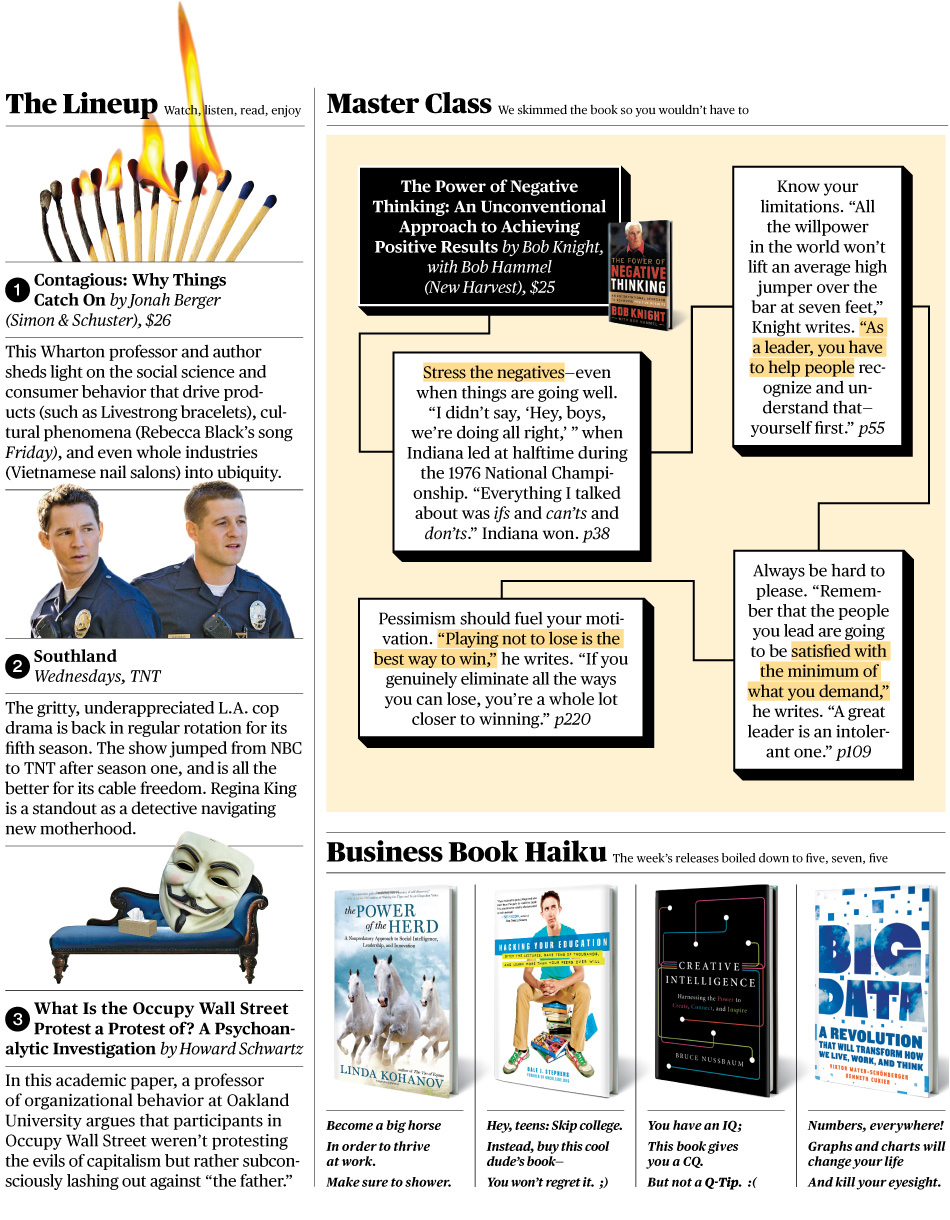
Bob Knight’s ‘The Power of Negative Thinking’ and More

etc_roundup10__01__950

Blood and Wine: An 11th generation Riedel with his own ideas assumes the helm of the family-owned Austrian wine glass company beloved by oenophiles

February 28, 2013, 11:48 A.M. ET

Blood and Wine

This article was written by Carrie Coolidge.

It was the suit that announced a new chief executive, with his own distinct style and ideas, was taking charge at Riedel, Austria’s 1756-founded family firm that makes the fine-stem wine glasses beloved by oenophiles across the globe.

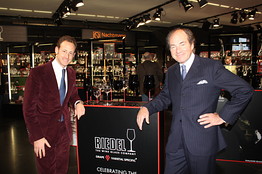
Dressed in a burgundy-colored velvet suit, the 35 year-old Maximilian J. Riedel strode purposefully through his company’s showroom in search of the Bloomingdale’s buyer who had flown to Frankfurt, Germany, to see the latest designs offered by his family’s eponymous company. At the world’s largest consumer goods fair that recently took place at Messe Frankfurt, the Riedel firm had constructed an elaborate if temporary stage to present its wine glasses and decanters to wholesale customers coming from around the world to place orders for their retail stores.

ON-BA151_Riedel_D_20130228112400

Max and Georg Riedel Read more of this post

L’Oreal’s Lessons From Indian Homes L’Oréal India’s Pierre-Yves Arzel says home visits helped him understand Indians’ relationship with water, what beauty products they use and why

L’Oreal’s Lessons From Indian Homes

by Pierre-Yves Arzel | Mar 1, 2013

topimg_21297_pierre_yves_arzel_300x400

L’Oréal India’s Pierre-Yves Arzel says home visits helped him understand Indians’ relationship with water, what beauty products they use and why

I had never come here [India] before—not even on vacation. I definitely had a very wrong impression of India, the kind you get by reading books. When you don’t know a country, you are always influenced by the clichés that tell you only a part of the truth.

I’ve been very surprised. I knew there are plenty of languages and different states, but I wasn’t aware of the amazing diversity of the country, of the different types of people [here]. L’Oréal has studied all skin types in the world and we have found 66 skin types, of which 44 are in India.  Read more of this post

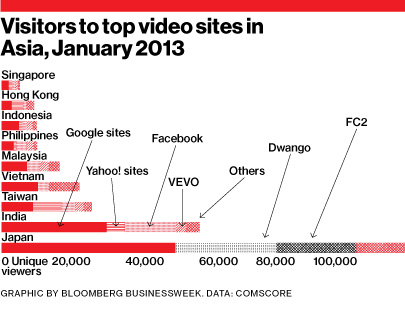
YouTube’s Search for the Next ‘Gangnam Style’

YouTube’s Search for the Next ‘Gangnam Style’

By Bruce Einhorn on February 28, 2013

tech_youtubechart10_405

One of the ritziest addresses in Tokyo is Roppongi Hills, a vast commercial, retail, and residential complex with two art galleries, the Grand Hyatt Tokyo, and tenants including Goldman Sachs (GS) and Barclays (BCS). There are also bald vampires clad in tighty-whities and body paint filming in Google’s (GOOG) new video studio.

The Roppongi Hills studio is central to YouTube’s first significant effort at audience-building in Asia. The online video giant’s other two studios, in Los Angeles and London, help popular creators develop original programming for its online video channels. In Japan, YouTube’s biggest regional success story in Asia, the company is recruiting online video stars to bolster its local-language channels with more targeted original programming and higher production values. YouTube only launched dedicated local-language channels for Southeast Asia last year, and censorship still keeps Google’s video service out of China. Compared with the U.S., “Asia has come a little bit later” for YouTube, says David Macdonald, head of the video service’s Asia-Pacific content operations.

Local programming is important for advertisers who want to reach Asian audiences, says Trevor Healy, Singapore-based chief executive officer of mobile advertising agency Amobee. “You can get more creative in who you target,” he says. Videos like the Korean rapper Psy’s smash hit Gangnam Style (with more than 1.3 billion YouTube views) or smaller successes like the 600-odd “Eat Your Kimchi” clips by Simon and Martina Stawski, a Canadian couple who live in Seoul and have close to 500,000 YouTube subscribers, could be the breakthroughs YouTube needs. Psy’s overnight global fame demonstrated the potential of Asian-made content, says Healy: “When something goes viral in Asia, it really goes viral.” Read more of this post

Computer Interfaces: Tech’s Next Great Frontier

Computer Interfaces: Tech’s Next Great Frontier

By Drake Bennett on February 28, 2013

tech_interface10__01__630x420

Consider the tongue. It’s sensitive yet muscular, packed with taste buds and nerves, and without its acrobatic ability humans wouldn’t be able to eat or talk. It’s also our most versatile sense organ, and some computer engineers say it’s underused. Wicab, a Middleton (Wis.)-based company, has designed a small, square array of electrodes for the blind. When placed on the tongue like a lollipop, it turns the feed from a video camera into a pointillist pattern of tactile stimulation. The sensation is like sparkling water, or Pop Rocks candy, but after time and practice, blind users report the paradoxical sensation of seeing with their tongues.

Massachusetts Institute of Technology graduate student Gershon Dublon is trying to broaden Wicab’s idea. He’s made a cheap ($10 to $40, he estimates), bare-bones version of the device that can be connected to any set of sensors. He encourages fellow engineers to hook their tongues up to other inputs—microphones, pressure sensors, even a magnetometer, which would give a person a migratory bird’s unerring sense of direction. The device, which Dublon calls the Tongueduino, wouldn’t be just for the blind, or the deaf, but for anyone looking to augment his senses. “It would be useful,” he says, “for anyone who wants a better sense of direction.” Read more of this post

How grandparents are being replaced by Google

How grandparents are being replaced by Google

Grandparents are being replaced by the internet as rising numbers of children ignore family advice for answers online instead, a new survey has found.

The survey of 1,500 grandparents found that children are instead increasingly using the internet to answer simple questions Photo: AFP

By Telegraph Reporters

7:30AM GMT 28 Feb 2013

Researchers found that older generations are being replaced by Google, Wikipedia and YouTube, with their grandchildren not asking them basic questions that they can look up themselves. According to the survey, fewer than one in four grandparents say they have been asked for advice on basic domestic chores such as washing clothes, learning to cook a family recipe or sewing a button. Only a third of those surveyed said they had been asked “what was it like when you were young?”. Read more of this post