The world’s greatest bazaar Alibaba, a trailblazing Chinese internet giant, will soon go public

The world’s greatest bazaar

Alibaba, a trailblazing Chinese internet giant, will soon go public

Mar 23rd 2013 | HANGZHOU AND HONG KONG |From the print edition

20130323_FBD001_0

IN 1999 Trudy Dai used to spend all night sending e-mails from her friend Jack Ma’s apartment, trying to answer queries from American customers without letting on that she was Chinese. Ms Dai was one of the first dozen employees of Alibaba, an online listings service Mr Ma, a teacher, had just started. It was already having some success connecting small Chinese manufacturers to potential customers, including the overseas ones Ms Dai was reassuring over e-mail. But the friends and students who made up the workforce were earning just 550 yuan (then $66) a month.

Mr Ma, though, already had big dreams. That year he said: “Americans are strong at hardware and systems, but on information and software, all of our brains are just as good…Yahoo’s stock will fall and eBay’s stock will rise. And maybe after eBay’s stock rises, Alibaba’s stock will rise.”

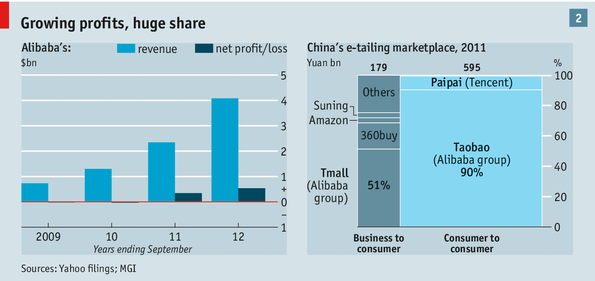
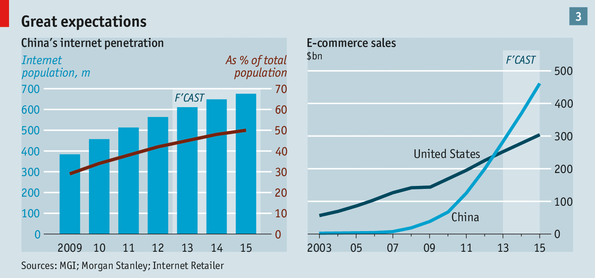
Since then, Alibaba has come to dominate internet retailing in China, which will soon be the biggest e-commerce market in the world. It has moved beyond its original remit of connecting businesses to each other to ventures that let companies sell directly to the public (Tmall) and enable members of the public to sell to each other (Taobao). Between them, Taobao and Tmall processed 1.1 trillion yuan ($170 billion) in transactions last year, more goods than passed through Amazon and eBay combined (see table 1).
20130323_FBC28020130323_FBC285

20130323_FBC284

Read more of this post

The Fall of the “Taobao Village”

The Fall of the “Taobao Village”

By Tracey Xiang on March 22, 2013

The Shanghai-based Xin Wen Chen Bao (Morning News) visited Qing Yan Liu, the village that has been referred to as “Taobao Village” since 2008 when it was crowded with thousands of Taobao sellers who were making a good living. But this time the journalist finds some store owners there having a hard time and some left. Golden times are gone.

Liu Wengao, a Qing Yan Liu villager and current deputy head of Zhejiang e-commerce merchants association, says currently only a dozen out of one hundred entrepreneurs can survive in the Taobao ecosystem. But years back almost every Taobao store set up ran by people in the village was successful.

Qing Yan Liu, with about two hundred local households, is located in Yiwu, a city in central Zhejiang province and where  has been known as one of the biggest small commodity wholesale markets in the world. For years merchants from all over the world flied into this city. There was a wholesale market next to Qing Yan Liu till 2008 when merchants doing business in the market were asked to move to a bigger and farther commercial area, leaving with rental village houses empty.

At that time several young villagers set up Taobao stores. Liu Wengao saw potential in it reasoning that most goods sold on Taobao then were what Yiwu markets could provide with at low prices.

To make their stores look fancier, Liu got designers from Yiwu Industrial & Commercial College. Later, the help of Liu and support from the school, students at Yiwu Merchant School were encouraged to run Taobao stores. They were allowed to do business at school time or move out of campus altogether to register companies for their Taobao stores. The school even provided a classroom with Internet access and inventory warehouse for those students. Even better, students can get a credit for running a Taobao store.

Those empty houses were filled in and crowded again. It is said that the Yiwu Industrial & Commercial College alone, with an accumulated two thousand students involved, have set up fifteen hundred stores since 2008.

Liu Wengao said that they created a variety of marketing approaches and got well experienced in operating online stores. Then everyone made a fortune from it.

Now  the village accommodates over eight thousand people who run a total of one thousand Taobao stores.

Even local grocery stores feel the decline in business and find the familiar faces disappeared. Read more of this post

72% Of Professors Who Teach Online Courses Don’t Think Their Students Deserve Credit

72% Of Professors Who Teach Online Courses Don’t Think Their Students Deserve Credit

GREGORY FERENSTEIN

posted 13 hours ago

This is not a good sign for online education: 72 percent of professors who have taught Massive Open Online Courses (MOOCs) don’t believe that students should get official college credit, even if they did well in the class. More importantly, these are the professors who voluntarily took time to teach online courses, which means the actual number of professors who discount the quality of MOOCs is probably much (much) higher. The survey reveals the Grand Canyon-size gap between the higher-education establishment and the coalition of tech companies and lawmakers that are mandating college credit  for online courses. Read more of this post

E-gadgets distract from literacy, critical thinking

E-gadgets distract from literacy, critical thinking

Created: 2013-3-21

Author:Wan Lixin

20130321_526492_01

THE other day I was going down the elevator in my apartment building. It stopped at another floor, where a boy of about five was busy touching the panel of an iPad, with his mother beside him.

The mother shouted: “Get in!” The boy marched in without taking his eyes off the panel.
While the elevator was going down, the mother gave the boy a severe dressing-down, but there was no knowing if the boy heard the diatribe, for he was so concentrated on his toy.
Then the elevator stopped at the ground floor, and the mother shouted: “Get out!” and the boy exited, his eyes still glued to the screen. Read more of this post

Watch Nokia CEO Stephen Elop Throw A Reporter’s iPhone On The Floor

Watch Nokia CEO Stephen Elop Throw A Reporter’s iPhone On The Floor

Steve Kovach | Mar. 22, 2013, 1:12 PM | 4,673 | 9

In an interview with a Finnish television reporter, Nokia CEO Stephen Elop took a moment to verbally and physically bash the iPhone. A lot of people are passing the clip around today, so we thought we’d share it with you too. The reporter asked Elop about the Lumia 928, a device that’s rumored to launch on Verizon soon. Elop refused to comment on the rumor, so the reporter pulled out his iPhone and said he’s rooting for Nokia to make a new phone.

“I don’t want to have an iPhone,” the reporter said. “Oh, how embarrassing,” Elop said when he saw the iPhone. “I can take care of that for you.”

Then he snatched the iPhone from the reporter’s hand and chucked it off camera. You can hear the iPhone make thud on the floor. The reporter, to his credit, didn’t even blink. He kept asking about the rumored Lumia 928. Elop said he’d replace the discarded iPhone with a Nokia phone.

Lockheed Martin Says This Desalination Technology Is An Industry Game-Changer; The problem is that current filters use plastic polymers that require an immense amount of energy (800 to 1,000 pounds per square inch of pressure) to push water through. Lockheed has developed a special material (graphene) that doesn’t need as much energy to drag water through the filter.

Lockheed Martin Says This Desalination Technology Is An Industry Game-Changer

Dina Spector | Mar. 22, 2013, 12:45 PM | 9,777 | 33

The latest technology for removing salt from seawater, developed by Lockheed Martinwill be a game-changer for the industry, according to Ray O. Johnson, senior vice president and chief technology officer of the jet and weapons manufacturer.

Desalination technology is used in regions of the world, particularly developing countries, where fresh water is not available. Water from oceans or rivers is diverted into treatment plants where the salt is removed and clean drinking water is produced through a process called reverse osmosis.

Imagine a tank with seawater on one side and pure water on the other, separated by a filter with billions of tiny holes. Lots of pressure on the salty side pushes water through faster than the salt, so fresh water comes out the other end.

The problem is that current filters use plastic polymers that require an immense amount of energy (800 to 1,000 pounds per square inch of pressure) to push water through.

Lockheed has developed a special material that doesn’t need as much energy to drag water through the filter.

Graphene is a substance made of pure carbon. Carbon atoms are arranged in a regular hexagonal or honeycomb pattern in a one-atom thick sheet. Read more of this post

Apple is finally making money on content

Apple is finally making money on content

By Christopher Mims — 11 hours ago

screen-shot-2013-03-22-at-3-22-2-39-55-pm-620x516

A few percent of a huge volume of transactions is a tried and true business model.Asymco

Apple has long said that it wants to run its its app and media stores at break-even, but the volume of transactions on iTunes has become so huge (check out the graph, above) that even at a tiny margin, Apple appears to be making a substantial profit on content. This data comes from mobile analyst Horace Dediu. Here’s his breakdown of Apple’s profits on bits, not atoms:

  • Apple’s iTunes revenue has quintupled in the past seven years. (Mind you, its overall revenue has quintupled in just the last four.)
  • 23 billion items were sold sold through iTunes in 2012.
  • At a hypothetical (and not unlikely) margin for Apple of 2% on apps and 1% on music, Apple could be making $150 million a year on content alone.
  • Throw in Apple’s software business (it’s easy to forget that Apple also makes its own, from Pages and OS X to Final Cut Pro) which is now sold entirely through the company’s desktop and mobile app stores, and Dediu estimates that “iTunes inclusive of Apple’s own Software generates as much as 15% operating margin on gross revenues. That’s over $2 billion a year.”

Now, next to a net income of over $40 billion in 2012, that’s still hardly game-changing. But it appears that the well-worn trope—that Apple is a hardware company that practically gives away everything else—is no longer true.

Rakuten: The biggest e-commerce site you haven’t heard of with a market cap of $13.5 billion and annual sales of over $4 billion

Rakuten: The biggest e-commerce site you haven’t heard of

March 22, 2013: 10:50 AM ET

130322100643-hiroshi-mikitani-rakuten-614xa

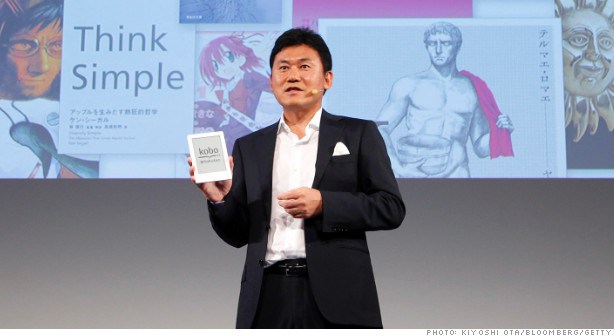
Rakuten CEO Hiroshi Mikitani heads one of the oldest and largest e-commerce sites in the world. He stopped by Fortune to talk about its unique model, plans for expansion and its battle with Amazon in the global market.

By Omar Akhtar, reporter

FORTUNE —  Hiroshi Mikitani, CEO of the Japanese e-commerce site Rakuten stopped by theFortune offices to promote his new book Marketplace 3.0: Rewriting The Rules Of Borderless Business, where he outlines his company’s strategy for globalization.  Founded by Mikitani in 1997, Rakuten is the largest e-commerce site in Japan and with a market cap of $13.5 billion and annual sales of over $4 billion; it is one of the biggest Internet companies in the world.  In the U.S., it bought Buy.com for $250 million and rebranded it to “Rakuten.com Shopping” earlier this year. Read more of this post

Nassim Taleb: Lectures on Risk and(Anti)fragility

https://docs.google.com/file/d/0B_31K_MP92hURjZxTkxUTFZnMVk/edit?pli=1

KidZania, the world’s fastest growing “edutainment” brand from Mexico, on Friday inaugurated its largest indoor site in the world in Bangkok

KidZania opening largest indoor site

Published: 22 Mar 2013 at 17.13

484349

KidZania, the world’s fastest growing “edutainment” brand from Mexico, on Friday inaugurated its largest indoor site in the world in Bangkok.

Developed at a cost of 810 million baht, the attraction will officially open to the public on Martch 29.

The 10,000-square-metre park for children between four and 14 years old, located on the fifth floor of Siam Paragon, offers role play for real-world professions among its attractions.

Xavier Lopez Ancona, KidZania’s global CEO and founder, said he expected the company’s 12th location in the world to become a new landmark attraction for Bangkok, increasing the capital’s appeal as a regional destination with a sophisticated family entertainment and educational product. Read more of this post

A Daring Designer of Snazzy Snacks; Jim Goldberg founded Deep River Snacks, whose kettle chips are sold in high-end delis from Darien to Dubai. How he bags aficionados

March 22, 2013, 9:00 p.m. ET

A Daring Designer of Snazzy Snacks

By AMY GAMERMAN

RV-AK004_CREATI_DV_20130322175033RV-AK028_CREATI_G_20130322181316

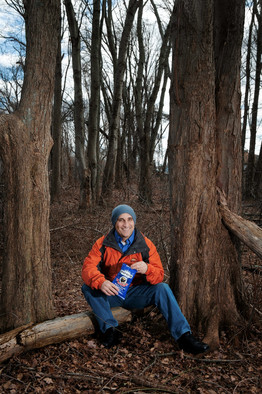
Jim Goldberg found one of his best potato-chip ideas in a pickle bowl. The founder of Deep River Snacks, whose kettle chips are sold in high-end delis from Darien to Dubai, was eating lunch at Katz’s Delicatessen in New York one day when he bit into a pickled green tomato.

“I said, ‘Holy crap, someone’s got to make something this good,’ ” he recalls. “We gotta do this!”

What Mr. Goldberg does is turn taste sensations into potato chips: chips that taste like they’ve come off a mesquite grill or bathed in a dish of olive oil and rosemary. So as soon as he had finished his pastrami sandwich, Mr. Goldberg made calls to four seasoning companies. “I said, ‘I want it to be a little bit spicy. It’s got to have good dill flavor—it’s really got to taste like the pickle.’ ”

After six months of experimentation, Deep River’s New York Spicy Dill Pickle kettle-cooked chip hit store racks last year. Unlike conventional “flat” chips, which are fried as they move along a production line, kettle chips are cooked in vats of oil. Mr. Goldberg makes 11 varieties.

“For the price and value, it’s the best chip,” says Charlie Moore, grocery buyer for the Fairway chain of stores. A 2-ounce bag of Sweet Maui Onion or Sea Salt & Vinegar retails for between 99 cents and $1.39. Mr. Goldberg says that he sold more than 24 million bags of his chips last year: a crumb compared with Lay’s, but not bad for an 11-year-old company with headquarters above a varicose-vein clinic in Old Lyme, Conn. Read more of this post

Sleeping Like a Baby, Learning at Warp Speed

March 22, 2013, 8:45 p.m. ET

Sleeping Like a Baby, Learning at Warp Speed

By ALISON GOPNIK

Babies and children sleep a lot—12 hours a day or so to our eight. But why would children spend half their lives in a state of blind, deaf paralysis punctuated by insane hallucinations? Why, in fact, do all higher animals surrender their hard-won survival abilities for part of each day?

Children themselves can be baffled and indignant about the way that sleep robs them of consciousness. We weary grown-ups may welcome a little oblivion, but at nap time, toddlers will rage and rage against the dying of the light.

Part of the answer is that sleep helps us to learn. It may just be too hard for a brain to take in the flood of new experiences and make sense of them at the same time. Instead, our brains look at the world for a while and then shut out new input and sort through what they have seen.

Children learn in a particularly profound way. Some remarkable experiments show that even tiny babies can take in a complex statistical pattern of data and figure out the rules and principles that explain the pattern. Sleep seems to play an especially important role in this kind of learning. Read more of this post

A refugee economist created an irresistibly useful approach to understanding how dissent shapes organizations

March 22, 2013, 7:40 p.m. ET

The Choice: To Squawk or to Go?

A refugee economist created an irresistibly useful approach to understanding how dissent shapes organizations

By ROGER LOWENSTEIN

Four decades ago, an economist named Albert O. Hirschman prophesied a rising gap in the quality of schools. As he reasoned: If the quality of public schools deteriorated, affluent families would switch to private schools. Hirschman labeled this the “exit” option. The parents of the remaining kids would try to restore quality via “voice”—that is, by appearing at school board meetings, speaking out, writing letters.

But these activists would be doubly handicapped. Public schools—being insensitive to profit—are less responsive to voice. And the desertion of wealthier parents would tend to deprive the public schools of influential voices.

Once you start looking at the world through the Hirschman lens, the paradigm of exit and voice is all around. Suppose you are unhappy at work: Should you complain to the boss or simply quit? Or maybe you are the boss: How much should you mollify employees—or customers—to keep them from leaving? It might depend on the presence of a third Hirschman factor: loyalty.

Broadly speaking, markets are all about exit: If the stock is a lemon, sell it. Politics deals in voice (just listen to talk radio).

What Hirschman grasped is that the strongest organizations (in either sphere) foster exit as well as voice. Both corporations and school districts have customers or members whom they need to retain—though at some point, it’s best to let the dissenters go. Read more of this post

No single government or nation deserves blame for World War I. But the question remains: How could such a calamity have occurred?

March 22, 2013, 4:57 p.m. ET

When the Lamps Went Out

No single government or nation deserves blame for World War I. But the question remains: How could such a calamity have occurred?

By WILLIAM ANTHONY HAY

The historian Fritz Stern described World War I as “the first calamity of the twentieth century, the calamity from which all other calamities sprang.” It takes only the barest knowledge of the war to grasp his point. The war and its appalling slaughter strained combatant nations to the breaking point. By the end, it had overthrown dynasties, shattered empires and reconfigured the map of Europe—unleashing all sorts of political forces and intensifying sympathies and resentments that would themselves wreak havoc on history. In various ways, as we now know in retrospect, World War I helped to bring about the Russian Revolution and yet another world war.

How could such a calamity have occurred? Or to put the matter more pointedly: Who caused the war, and for what reasons? Such questions have made the origins of World War I the great whodunit of modern history. The political implications of assigning blame have only heightened the importance of the answer. Read more of this post

Low-Quality Stocks Have Zoomed. Time to Shift Gears?

March 22, 2013, 6:22 p.m. ET

Low-Quality Stocks Have Zoomed. Time to Shift Gears?

By MARK HULBERT

BF-AE633_HULBER_G_20130322160304

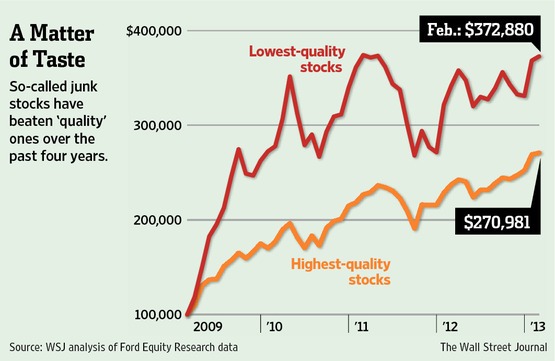
“Junk” continues to beat “quality” on Wall Street. Nearly four years after the end of the recession of 2007-09, it should be the other way around.

The Federal Reserve’s monetary stimulus is a big reason for this unexpected outcome.

Because the Fed’s easy-money policies won’t continue indefinitely, however, investors might want to begin reducing their holdings of low-quality stocks—which will be among the biggest casualties when the Fed turns off the spigot. Read more of this post

The Brains of the Animal Kingdom; New research shows that we have grossly underestimated both the scope and the scale of animal intelligence. Primatologist Frans de Waal on memory-champ chimps, tool-using elephants and rats capable of empathy

March 22, 2013, 7:15 p.m. ET

The Brains of the Animal Kingdom

New research shows that we have grossly underestimated both the scope and the scale of animal intelligence. Primatologist Frans de Waal on memory-champ chimps, tool-using elephants and rats capable of empathy.

By FRANS DE WAAL

Who is smarter: a person or an ape? Well, it depends on the task. Consider Ayumu, a young male chimpanzee at Kyoto University who, in a 2007 study, put human memory to shame. Trained on a touch screen, Ayumu could recall a random series of nine numbers, from 1 to 9, and tap them in the right order, even though the numbers had been displayed for just a fraction of a second and then replaced with white squares.

I tried the task myself and could not keep track of more than five numbers—and I was given much more time than the brainy ape. In the study, Ayumu outperformed a group of university students by a wide margin. The next year, he took on the British memory champion Ben Pridmore and emerged the “chimpion.”

How do you give a chimp—or an elephant or an octopus or a horse—an IQ test? It may sound like the setup to a joke, but it is actually one of the thorniest questions facing science today. Over the past decade, researchers on animal cognition have come up with some ingenious solutions to the testing problem. Their findings have started to upend a view of humankind’s unique place in the universe that dates back at least to ancient Greece.

Aristotle’s idea of the scala naturae, the ladder of nature, put all life-forms in rank order, from low to high, with humans closest to the angels. During the Enlightenment, the French philosopher René Descartes, a founder of modern science, declared that animals were soulless automatons. In the 20th century, the American psychologist B.F. Skinner and his followers took up the same theme, painting animals as little more than stimulus-response machines. Animals might be capable of learning, they argued, but surely not of thinking and feeling. The term”animal cognition” remained an oxymoron.

A growing body of evidence shows, however, that we have grossly underestimated both the scope and the scale of animal intelligence. Can an octopus use tools? Do chimpanzees have a sense of fairness? Can birds guess what others know? Do rats feel empathy for their friends? Just a few decades ago we would have answered “no” to all such questions. Now we’re not so sure. Read more of this post

Volvo Says Chinese Dealers Inflated Sales to receive cash incentives

March 22, 2013, 9:07 a.m. ET

Volvo Says Chinese Dealers Inflated Sales

By ANNA MOLIN and COLUM MURPHY

STOCKHOLM—Volvo Car Corp. said Friday some of its Chinese dealers inflated sales figures to receive cash incentives in 2011 skewing annual comparisons that led the company to disclose it lost ground in China last year when it had actually increased sales in the key market.

The struggling Swedish auto maker launched an internal investigation last year and found that dealers reported more retail sales than they conducted during 2011, Volvo Cars spokesman Per-Åke Fröberg said on Friday. To make the books match, the dealers didn’t report the sales executed in 2012 that were falsely booked in 2011. Read more of this post

Here Comes the Slow-Stock Movement; Global investors will meet to discuss whether companies should offer special shares to reward long-term holders in a short-term world

March 22, 2013, 6:00 p.m. ET

Here Comes the Slow-Stock Movement

By JASON ZWEIG

When you are loyal to a drugstore, airline or credit card, you get points, miles, cash back and other rewards. Should investors also get a bonus for being loyal to a stock?

Next week in London, two dozen global investors will meet to discuss whether companies should offer special shares to reward long-term holders in a short-term world.

Investors who hold a stock continuously for years might earn a higher dividend or receive “warrants” entitling them to purchase more shares.

“It’s a way of rewarding long-term behavior and taxing short-term behavior,” says Patrick Bolton, an economist at Columbia Business School who has spent several years developing the idea.

Patience is a rare virtue in today’s high-speed markets. Read more of this post

The Secrets of Happy Families: How to Improve Your Morning, Rethink Family Dinner, Fight Smart, Go Out and Play, and Much More

March 15, 2013

The Stories That Bind Us

By BRUCE FEILER

I hit the breaking point as a parent a few years ago. It was the week of my extended family’s annual gathering in August, and we were struggling with assorted crises. My parents were aging; my wife and I were straining under the chaos of young children; my sister was bracing to prepare her preteens for bullying, sex and cyberstalking.

Sure enough, one night all the tensions boiled over. At dinner, I noticed my nephew texting under the table. I knew I shouldn’t say anything, but I couldn’t help myself and asked him to stop.

Ka-boom! My sister snapped at me to not discipline her child. My dad pointed out that my girls were the ones balancing spoons on their noses. My mom said none of the grandchildren had manners. Within minutes, everyone had fled to separate corners.

Later, my dad called me to his bedside. There was a palpable sense of fear I couldn’t remember hearing before.

“Our family’s falling apart,” he said.

“No it’s not,” I said instinctively. “It’s stronger than ever.”

But lying in bed afterward, I began to wonder: Was he right? What is the secret sauce that holds a family together? What are the ingredients that make some families effective, resilient, happy? Read more of this post

Beijing, We Have A Problem: Warehoused Asian Copper Hits Record High

Beijing, We Have A Problem: Warehoused Asian Copper Hits Record High

Tyler Durden on 03/22/2013 11:18 -0400

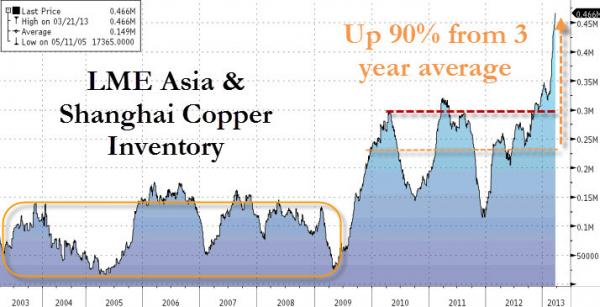
A rather well-known problem for those who have tracked the warehousing woes of assorted industrial medals in China as an indication of the true state of the Chinese economy: as of right now, the stocks of copper in Asia (as determined by deliverable LME CLS and Shanghai copper) are at an all time high and up 90% from the previous three year average.

20130322_copperall_0

SAP to Become European Corporation to Speed Up Decisions; SAP will ask shareholders to approve a change of its legal status from an Aktiengesellschaft (AG) to a Societas Europaea, or SE

SAP to Become European Corporation to Speed Up Decisions

By Cornelius Rahn  Mar 22, 2013

SAP AG (SAP), the German business- management software maker, plans to turn itself into a European corporation to enable faster decision-making as it focuses on grabbing database customers from Oracle Corp. (ORCL)

SAP will ask shareholders to approve a change of its legal status from an Aktiengesellschaft to a Societas Europaea, or SE, at next year’s annual meeting, it said yesterday. One aim is to speed up decisions on the supervisory board, said a person familiar with the matter, who asked not to be named because the discussions are private.

The SE structure, already adopted by companies including BASF SE (BAS)Allianz SE (ALV) and Puma SE (PUM), was created by the European Commission to simplify regulatory and legal requirements for companies with subsidiaries in more than one European country. Previously, multinationals had to follow each of the EU members’ own legal system where they had a subsidiary. Read more of this post

AustralianSuper begins testing its new internal investment-management systems this month to manage its first money in house from zero to $40 billion in 4 years

Inhouse target: zero to $40 billion in 4 years

Posted By SIMON HOYLE On 22/03/2013 @ 3:16 pm In INVESTOR PROFILE

If everything continues on schedule, the $60-billion AustralianSuper will begin testing its new internal investment-management systems this month, with a view to managing its first money in house in the third quarter of 2013.

Within four years the fund expects to manage as much as $40 billion in house, funded primarily from cash flow, and to have built an investment management capability the equal of any in the world. Read more of this post

Cherry trees reach full bloom in Tokyo; The spectacle marks the second earliest blossoming in the capital on record; Japanese culture prizes the perfect but delicate blossom, whose transience – they only last a week – is a reminder of the fragility of life.

Cherry trees reach full bloom in Tokyo

20130322.183308_che

The spectacle marks the second earliest blossoming in the capital on record. -AFP 

Fri, Mar 22, 2013
AFP

TOKYO – Tokyo’s cherry trees were in stunning full bloom on Friday, Japan’s weather agency said, marking the second earliest blossoming in the capital on record. Read more of this post

How Franklin Roosevelt Secretly Ended the Gold Standard

How Franklin Roosevelt Secretly Ended the Gold Standard

On March 4, 1933, Franklin D. Roosevelt became president for the first time, promising an “adequate but sound” currency. The next day, a Sunday, he closed the nation’s banks. “We are now off the gold standard,” he privately declared to a group of advisers. Goldbugs in the president’s circle immediately began prophesying doom. One of his aides, Lewis Douglas, proclaimed “the end of Western civilization.”

How Roosevelt took this fateful step has been the subject of debate among historians, many of whom believe that the president flailed his way through his first weeks in office, and only gradually came to the decision to take the country off gold that April. But the evidence suggests that Roosevelt intended to do so from Day One for very specific reasons, although he delayed letting the rest of the country in on his plans.

Minutes after FDR had made his unsettling private disclosure, a secretary told him that reporters were clamoring to know if the U.S. had left the gold standard. “Tell them to ask a banker,” Roosevelt said. He clearly did not yet wish to say the truth publicly. First, he needed depositors to return the gold they had withdrawn in panic in the weeks preceding his inauguration. Read more of this post

China’s Poison Air Is Becoming Its Leading Export

China’s Poison Air Is Becoming Its Leading Export

Sitting on a Tokyo runway last week, the captain announced that our flight would be delayed for reasons few of us could believe: sandstorms.

Chuckles filled the aircraft. The woman next to me quipped: “What, are we in Egypt?” As we all craned our necks to look out the windows, it really did feel as if we were taxiing in Cairo or Marrakesh, not the capital of a Group of Seven nation.

The sand is compliments of China’s boom. Thanks to deforestation and overgrazing, more and more of the Gobi Desert’s grit, along with industrial pollution, is being carried by prevailing winds to Japan. In recent weeks, people in Japan have been Googling “PM2.5,” or fine airborne particulates that cause disease and premature death in high concentrations. They also are loading up on air purifiers as China’s environmental crisis becomes Japan’s.

The geopolitics of pollution has the potential to turn toxic. If you thought Asia’s territorial disputes were a barrier to peace and cooperation, just wait until blackened skies dominate summit meetings. And they will, as nationalists in Japan, South Korea and Taiwan use pollution as a rallying point to gin up anti-China sentiment; business leaders in Hong Kong express anger about having trouble recruiting foreign talent; China lashes out at independent reports on health risks; and the world points fingers at the Communist Party as climate change accelerates. Read more of this post

IBM Works for Free to Build Relationships With African Cities; “We’re not just walking in and saying, ‘Throw us our money’”

IBM Works for Free to Build Relationships With African Cities

International Business Machines Corp. (IBM), which makes most of its money from high-end technology contracts, is betting that some of its growth will come from customers who don’t pay anything — yet.

The company has developed an application to track the water system in Tshwane, South Africa, where more than half the population lives in slums that often aren’t connected to plumbing. IBM is letting the community use the app for free, after it sent a team of executives to evaluate the system as part of a corporate service project in October.

The benefit to IBM is it can use the city as a testing ground for the application, while gaining favor with the local government. It also may catch the attention of other cities with similar problems. Relationships are key to building the company’s business in Africa, where it now has offices in more than 20 countries, compared with just four in 2006.

“We’re not just walking in and saying, ‘Throw us our money,’” said Perry Hartswick, an architect of IBM’s Smarter Planet program, which tries to fix civic problems with tracking technology. “We’re walking in to say we’re here to be a part of Africa. That’s a very important part of the way we approach any new geography.” Read more of this post

Russian Gynecologist Becomes Billionaire in Cyprus Entity

Russian Gynecologist Becomes Billionaire in Cyprus Entity

Mark Kurtser, a 59-year-old Russian gynecologist, has become a billionaire after shares of his MD Medical Group Investment Plc, Russia’s largest private provider of women’s and children’s health care, surged 42 percent in five months.

Kurtser, MD Medical’s chairman, controls 68 percent of the operation through Cyprus-based investment entity MD Medical Holding. The company sold shares in a London initial public offering in October, raising $154 million for expansion. The billionaire collected another $135 million from the IPO.

“I did not imagine it when I was starting this business,” Kurtser, who is worth $1 billion, according to the Bloomberg Billionaires Index, said in a telephone interview. “I am a doctor first.”

Kurtser founded the company as a private Moscow hospital in 2006. Today, MD Medical runs 13 medical centers in Russia and Ukraine, offering childbirth, gynecological and in vitro fertilization services. It generated 3.5 billion rubles ($117 million) in revenue in the 12 months ended June 30, 2012, up 48.6 percent in a year. The company’s net income doubled to 1.2 billion rubles in three years. Read more of this post

The Effect of CEO and CFO Resignations on Going Concern Opinions

The Effect of CEO and CFO Resignations on Going Concern Opinions

Joseph Beams University of New Orleans

Yun-Chia Yan University of New Orleans – Department of Accounting

February 5, 2013

Abstract: 
Anecdotal evidence suggests that the resignation of a top executive increases a firm’s likelihood of failure. When auditors perceive an increased likelihood of failure, a going concern modified audit opinion is issued. This study tests the relationship between top management resignations and the issuance of going concern audit opinions. Firms in which a CEO or CFO resigned were more likely to receive a going concern audit opinion than firms in which the CEO or CFO did not resign. The study uses financially distressed firms from 2008-2010 and a logistic regression model to test the relationship. The findings show a positive relationship between CFO resignations and firms receiving a going concern audit opinion. However, no significant relationship is found between CEO resignations and receiving a going concern audit opinion. Firm size, cash flow from operations, stock return, and investments also had a significant relationship with going concern opinions.

US Begins Regulating BitCoin, Will Apply “Money Laundering” Rules To Virtual Transactions

US Begins Regulating BitCoin, Will Apply “Money Laundering” Rules To Virtual Transactions

Tyler Durden on 03/21/2013 21:22 -0400

Last November, in an act of sheer monetary desperation, the ECB issued an exhaustive, and quite ridiculous, pamphlet titled “Virtual Currency Schemes” in which it mocked and warned about the “ponziness” of such electronic currencies as BitCoin. Why a central bank would stoop so “low” to even acknowledge what no “self-respecting” (sic) PhD-clad economist would even discuss, drunk and slurring, at cocktail parties, remains a mystery to this day. However, that it did so over fears the official artificial currency of the insolvent continent, the EUR, may be becoming even more “ponzi” than the BitCoins the ECB was warning about, was clear to everyone involved who saw right through the cheap propaganda attempt. Feel free to ask any Cypriot if they would now rather have their money in locked up Euros, or in “ponzi” yet freely transferable, unregulated BitCoins.

For the answer, we present the chart showing the price of BitCoin in EUR terms since the issuance of the ECB’s paper:

BitCoin Nov Now_0 Read more of this post

Price wars and the destruction of China’s e-consumer confidence

Price wars and the destruction of China’s e-consumer confidence

Staff Reporter 2013-03-22

The constant price-cutting competition between China’s online shopping sites has been the source behind a growing number of consumer complaints, the Chinese-language Economic Information Daily reports.

Some 93,600 complaints regarding online commerce were filed in 2012, with most of them being made against leading shopping sites Taobao, TMall and Dangdang. The number of complaints had not gone down significantly from 2011, according to a report recently published by the China e-Business Research Center. Major players making the list of 10 most complained-about sites in 2012 also include Amazon China, Gome, Tencent’s QQ online shopping service and Jingdong 360Buy, according to other consumer data. Over half of these complaints — 55.40% — involved online shopping, while 21.3% concerned transactions made with group-buying sites, which offer daily deals with heavy discounts. The center noted in its report that at least 10 large-scale price wars occurred in 2012 and the number of complaints often peaked during the half-month period following these cutthroat sales.

Such price wars were blindly aimed at grabbing market share, experts said, often leading to customer disputes when websites fail to stock sufficient merchandise and cancel orders placed by shoppers. The websites can cancel orders under their terms of use, which often stipulate that a contract is not established prior to confirmation of the sale transaction. Read more of this post