How to Argue Like a Pundit, by PR Expert Rich Masters

How to Argue Like a Pundit, by PR Expert Rich Masters

By Rich Masters on April 11, 2013

3ht_arguelikeapundit16__01__630x420

There are two schools of thought on how to win an argument on television. You can memorize the talking points that the DNC or the RNC sends you and spit ’em out at whoever you’re up against. We call that rip and read, which gets a little stale. The other school is the Joe Biden school of extemporaneous blather. It has the virtue of appearing more genuine and helps you connect with your audience. Face it, Biden is everybody’s favorite D.C. interview. But message discipline and Joe? Oxymoronic.

So how do you combine the message discipline of school No. 1 with the spontaneity of school No. 2? By using something I call the message diamond. When the host asks a question, the very first thing you do is answer it. Don’t duck it, don’t hide, don’t run from it. Then pivot to your message, and back that with a little Biden: an interesting anecdote, an example that amplifies the major point you’re making. Then you close out by restating your message. That way, no matter how it’s edited, no matter how it comes out, you’ve hammered home your message and added a story to make it stick.

Now, for debate shows, it takes a little something extra. First: Smile while you swing. If folks don’t like you, they won’t care if you win. Next: You want to know your opponents’ arguments as well as your own. If you know what they’re going to say in advance—and 99 percent of the time you know exactly what they’re going to say—you’ll be able to take their own argument, twist it around their neck, and kick ’em off the bridge with their own words. And finally: a big zinger, something unusual that they weren’t anticipating. That’s what viewers will take away, that something special. In Louisiana, where I cut my teeth debating, it’s what we call a lagniappe.

• Masters is a partner at public relations agency Qorvis Communications. As told to Joshua Green

How to Reinvent a Brand, by Coach CEO Lew Frankfort; Coach (COH) was a $550 million business in 2000 when it went public and a $5 billion one a decade or so later

How to Reinvent a Brand, by Coach CEO Lew Frankfort

By Lew Frankfort on April 11, 2013

Coach (COH) was a $550 million business in 2000 when it went public and a $5 billion one a decade or so later. Now we’re transforming it again into a lifestyle brand for women, with shoes, outerwear, and capsule collections of tops and bottoms. A transformation has to be careful, nurtured. You have to understand what’s distinctive about your brand and build on who you are. Consumers are smart—if you try to be something you’re not, they’ll see you as an impostor. Modify your product first and build interest and loyalty into what is coming. Understand your consumers and what motivates them. It’s generally a fatal mistake to believe you can leave your customers behind and find new ones. The opportunity is to bring them along with you. You should also know your employees and what they’re capable of. To help pull off our current transformation, we brought in three additional creative leaders from Paul Smith, Nike (NKE), and Selfridges. We do an enormous amount of research. Don’t bet the ranch without any consumer insights or experience. We triangulate between research and instincts, or gut feelings. If we do research that doesn’t reinforce our instincts, we go back and do more research. We pause. We might take a different turn. A full transformation generally takes five times what you think it will. Not time, not money, but reach. It has to be comprehensive. And you’re never done. You can’t accept any applause for things that are going well. You have to fear failure.

• Frankfort is the chairman and chief executive of Coach. As told to Susan Berfield

Ten-Year Old Girl Appeals for Help from China’s First Lady

Ten-Year Old Girl Appeals for Help from China’s First Lady

Posted on April 11, 2013 by Yaxue Cao

e5ae89e5a6ae e5bca0e5ae89e5a6aee7bb99e5bdade4b8bde5aa9be79a84e4bfa1

In my recent blog “Lock Up and Lock Down” about crackdowns on dissidents and activists during the Two Meetings, I mentioned an incident about a ten-year-old girl whose father is a dissident in Hefei, Anhui (安徽合肥):

“In a particularly egregious episode of this year’s clamping down on dissidents, on February 27 in Hefei, Anhui (安徽合肥), four men kidnapped Zhang Anni (张安妮), the 10-year-old daughter of Zhang Lin (张林), after the school let out, and took her to the local police station. There she was detained for 20 hours without being given food or water, or even a blanket to stay warm. Later, the police also searched Zhang Lin’s home, taking away his computer, cell phone, cash, and other important necessities. The father and daughter have since been deported to Bengpu (蚌埠) where Anni, scared and refusing to talk for days, has no school to go for the time being.

“A Tsinghua-trained nuclear physicist, Zhang Lin is a veteran dissident who has served three prison terms since the 1980s, totaling 13 years.”

Anni (安妮) still has not been able to go back to school. Before the Two Meetings, Zhang Lin lived in Hefei where Anni went to Hupo Elementary School (琥珀小学) and Anni’s older sister attends college in the same city. For Zhang Lin, a single father now (I believe), Hefei is where he wants to live to be close to both children, but he has been repeatedly forced out of the city and back to Bengbu (安徽蚌埠), his hometown. For Anni, she has made it clear to her dad that she wants to go back to Hupo ES because “there are only 23 kids in my class!” (the typical class size in China is twice as big.)

Monday, in an action called “Sending Anni Back to School,” 40 some lawyers and netizens from across China arrived in Hefei to protest on behalf of Anni, demanding that the child be allowed to resume school in Hupo ES. The school’s representative came out on Monday telling the father to go to the “relevant organ” to get a guarantee that the child will never be taken away from school by unidentified people. Today the school said that Zhang Anni does not meet the requirements for enrollment. The crowd protested in front of various government sites in Hefei, including the Public Security Bureau and the Education Bureau, but no one has come out to speak to them except for scores of plain clothes and uniformed policemen watching over the crowd, videoing taping them, getting into a couple of scuffles with them, and taking some to police stations to interrogate. Having no place to turn, Anni wrote a letter today to Peng Liyuan, China’s first lady, appealing for help:

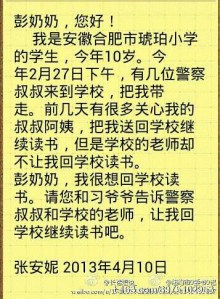
“Grandma Peng, how do you do? I’m a student at Hupo Elementary School in Hefei, Anhui. I’m ten years old. In the afternoon on February 27 this year, several policemen came to my school and took me away. A few days ago, many uncles and aunties who are concerned about me wanted to send me back to school, but the teachers in my school won’t let me. Grandma Peng, I really want to go back to school. Please, can you and Grandpa Xi tell uncle policemen and the teachers to let me go back? Zhang Anni, April 10, 2013.”

The letter is a hot topic on Tencent Weibo and has been re-posted many times. Will Grandma Peng hear Anni and help her out? We shall see. Meanwhile, I’ll let out a deep sigh: China Dream.

Boomers Push Doctor-Assisted Dying in End-of-Life Revolt

Boomers Push Doctor-Assisted Dying in End-of-Life Revolt

Claudia Burzichelli doesn’t want to die like her dad. Nine years ago, her father, already afflicted with Parkinson’s, killed himself with a gunshot to the head days after his release from a hospital where he had been treated for a heart attack.

Burzichelli, 54, now suffering from kidney and lung cancer, is haunted by her father’s violent death, even more so as she contemplates her own mortality. She hopes to find a more peaceful way to end her life, if it comes to that.

“On those days when I’ve struggled to breathe, when I think about the stresses on my family, I would hope that I might have more options than starving myself or taking my life in a violent way,” she told a panel of New Jersey lawmakers during a hearing in February on a bill to legalize assisted dying. “It comforts me to think there could be a process, a way to offer options that would not hurt my family.”

Baby boomers, like Burzichelli, a former eduction manager at Rutgers University, are at the forefront of a new movement. They brought on the sexual revolution, demanded natural childbirth, fought for legalized abortion and turned the mid- life crisis into a force for self-improvement. Now they’re engaged in transforming how Americans experience death. Read more of this post

Orphan Drugs Could Lose Their Government Subsidies; The $86 billion market for drugs that treat diseases affecting relatively few patients faces pressure from cost-conscious governments.

Orphan Drugs Could Lose Their Government Subsidies

By Simeon Bennett on April 11, 2013

comp_orphangraphic16_405

Treatments for rare diseases are hot properties for drugmakers, who covet the medicines for their tax breaks, through-the-roof prices, and the exclusive marketing rights granted by government regulators. Lately, though, those orphan drugs—so named because they treat rare conditions for which there are no other approved treatments—are being slammed by an unlikely culprit: the European economic slump. As more medicines win approval to treat such diseases, affecting no more than 5 in 10,000 people, Europe’s austerity-conscious governments are applying the same pricing scrutiny to orphan drugs that they do to widely prescribed medicines for heart disease and diabetes. That’s putting the brakes on an $86 billion sector of the pharmaceutical industry that’s been growing twice as fast as the market as a whole.

“We have seen countries which were providing good access to orphan medicinal products now questioning the continuation of reimbursement,” says Yann Le Cam, chief executive officer of Eurordis, a Paris-based group that represents patients with rare diseases. Read more of this post

EU Sounds Alarm on Spain; Portugal to Request Extension on Bailout Loans; Momentum Seen Slipping in Madrid; Slovenia, France, Italy Also Raise Concern

Updated April 10, 2013, 2:00 p.m. ET

EU Sounds Alarm on Spain

Momentum Seen Slipping in Madrid; Slovenia, France, Italy Also Raise Concern

By MATINA STEVIS

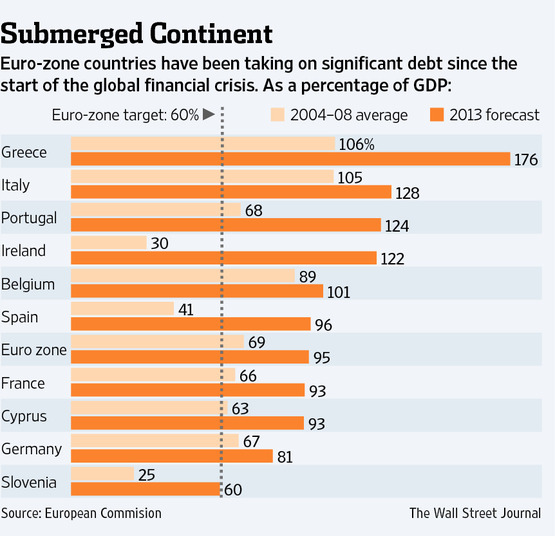
BRUSSELS—Spain’s efforts to rein in spending and improve its economic performance are running out of steam despite much work yet to do, the European Commission warned Wednesday in a report that also singled out Slovenia as a potential trouble spot. “Spain should…maintain the reform momentum” to deal with “formidable challenges ahead,” Commissioner for Economic and Monetary Affairs Olli Rehn said after presenting an annual health check of the competitiveness of several countries in the European Union.

WO-AN345_EUCOMP_G_20130410181206 Read more of this post

In Japan, Politics Propels a Stock Market Rally

In Japan, Politics Propels a Stock Market Rally

By Nick Summers on April 11, 2013

mf_japanchart_inline

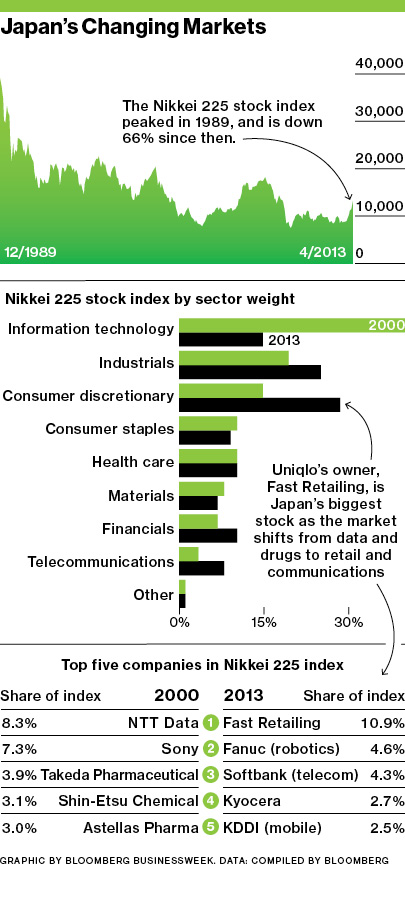
“Let’s do it,” Yoshihiko Noda, Japan’s prime minister, said Nov. 14, during a political debate with his opponent Shinzo Abe. Noda meant that it was time to dissolve parliament and hold a new election. Investors heard it as the kickoff to a rally that hasn’t stopped, with the Nikkei 225 stock index gaining more than 50 percent and returning the market to levels not seen since before the 2008 financial crisis. The Nikkei’s best performer since Nov. 14, with a 194 percent gain through April 10, is Tokyo Tatemono, a real estate developer. Nomura (NMR), the $445 billion financial-services company, has advanced 146 percent.

Politics and prices are deeply entwined in the rally. Abe and his Liberal Democratic Party won a landslide victory in December on the strength of his “Abenomics” stimulus proposals, which aim to jolt Japan out of decades of lethargy. Even at a four-year high of just over 13,000, the Nikkei is worth only a third as much today as it was at the end of 1989, when Japanese corporations seemed poised to take over the globe. What felt like a permanent recession followed, with years of deflation and anemic growth. Read more of this post

The Age of Bite-Size Entertainment; As the world goes mobile, get ready for more movies, books and music that can be snacked on in a single sitting

April 11, 2013, 11:06 p.m. ET

The Age of Bite-Size Entertainment

As the world goes mobile, get ready for more movies, books and music that can be snacked on in a single sitting.

By JOHN JURGENSEN

When soap operas “All My Children” and “One Life to Live” come back to life online later this month, episodes will run for 30 minutes, about half as long as the hourlong blocks that ran on broadcast television for most of the shows’ 40-year run. Why? Because they’re likely to be watched on the go. Everyone is talking about the binge-viewing craze, but as people increasingly consume TV, movies, books and music on mobile devices, briefer is better. Shorter formats “are in-betweeners, the cream in the middle of the Oreo,” says Jeffrey Katzenberg, chief executive of DreamWorks Animation. Some of the biggest forces in entertainment are rushing out bite-size portions, not just to adapt to mobile technology but to test the appetite for heartier versions. If a serialized e-book catches fire, publishers will print the novel. A short film that goes viral on YouTube can lead to a feature film or television series. A well-received EP might prompt an album. Here’s a look at efforts underway across the entertainment industry to capitalize on the new snack-size portions.

AR-AC095_Cover1_G_20130411163735

Two Firms Amass Much of World’s Copper Supply

Updated April 11, 2013, 10:06 p.m. ET

Two Firms Amass Much of World’s Copper Supply

Commodities Traders Pay to Divert Shipments From Other Warehouses; Manufacturers Worry About Access

By MATT DAY

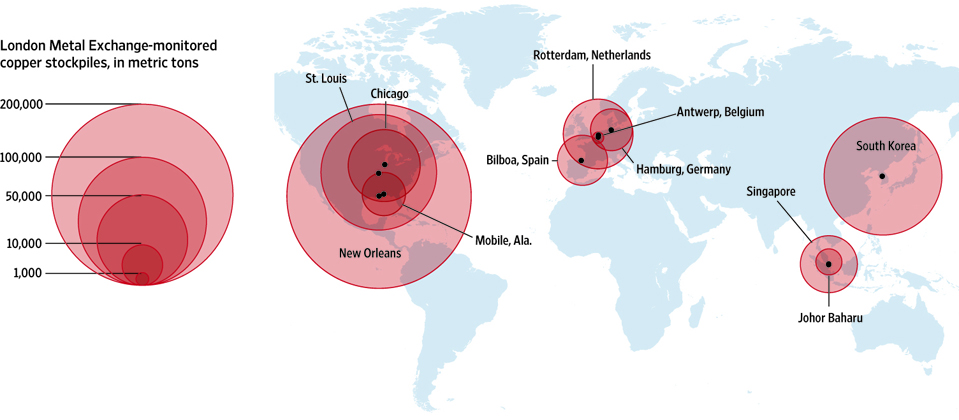
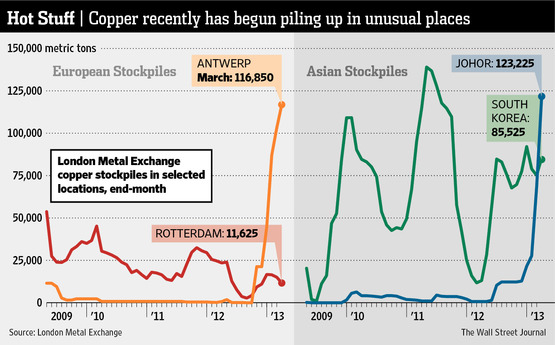
Two major commodities-trading firms have amassed much of the world’s copper supplies in their warehouses, partly by paying to divert shipments away from other storage hubs, traders and analysts say.

Red Alert: Some trading firms have stashed the world’s copper supply in warehouses in New Orleans, Antwerp and Johor. The moves have sparked worries about the possibility of delayed deliveries and higher costs for industrial consumers.

This concentration of copper supplies has sparked concerns among industrial consumers of the metal. Some manufacturers and builders say they are worried that those stockpiles of copper—which is used in goods including automobiles, circuit boards and plumbing fixtures—could prove tough to procure if demand were to pick up sharply or output from mines were disrupted.

TAYLOR_TEMPLATEMI-BV316_COPPER_G_20130411170905 Read more of this post

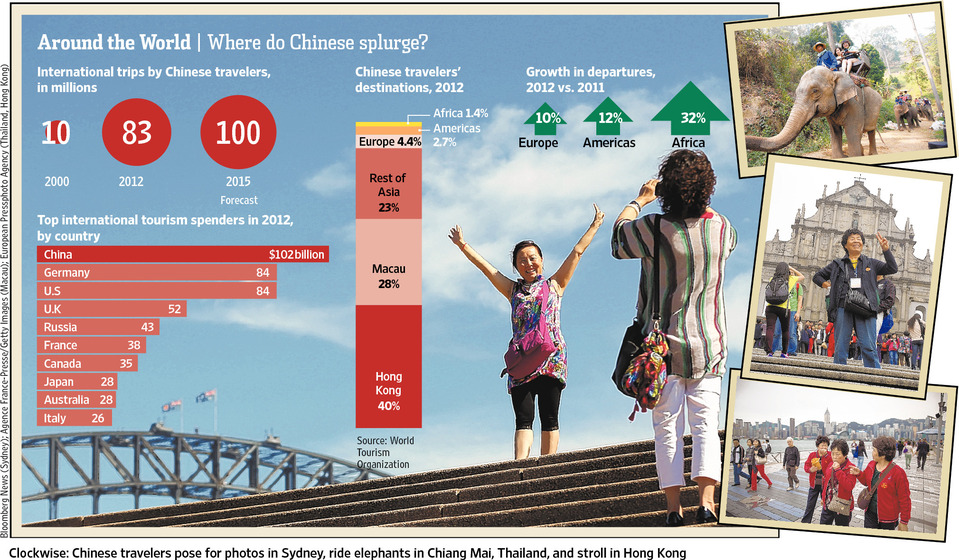
Mainland Chinese are the fastest growing tourist population in the world, spending $102 billion in 2012

April 11, 2013, 9:31 a.m. ET

China’s Travelers Bring Gifts Abroad

By WEI GU

AM-AY030_WEICOL_G_20130411055120

Mainland Chinese are the fastest growing tourist population in the world, spending $102 billion in 2012. The WSJ’s Wei Gu tells Deborah Kan how spending patterns are changing as more Chinese travel abroad.

Bad air, a new strain of bird flu at home and easier visa rules in countries like Japan and the U.S. are adding to the incentives for Chinese to take an overseas holiday.

Those who do will join the millions of Chinese tourists already remaking the global travel industry.

Chinese travelers have become the world’s top source of tourist spending, according to the World Tourism Organization, with outlays of $102 billion in 2012. That flood seems likely to keep swelling. Less than 3% of China’s 1.4 billion people are passport holders, according to China’s Ministry of Public Security. By contrast, U.S. Travel Association figures show, 30% of Americans and 75% of Britons are.

As the Chinese numbers climb, there will be some surprising winners and losers. Read more of this post

Boom-Bust Vietnam Beats Emerging Stocks as State Considers Role

Boom-Bust Vietnam Beats Emerging Stocks as State Considers Role

Vietnam, the world’s most volatile stock market since 2009, is leading developing-nation gains this year as the Communist government slows inflation and considers easing its grip on the economy.

The benchmark VN Index (VNINDEX) posted more 20 percent swings than every major equity market in the past four years as policy makers grappled with consumer prices, currency devaluations and bad bank loans. Their efforts helped cut inflation to 6.6 percent in March from 23 percent in 2011 and produced the first annual trade surplus since 1992.

Now the government is preparing to remove bad debt from lenders, ease restrictions on foreign ownership of listed businesses and change the constitution to limit the “leading role” of state companies that comprise about a third of gross domestic product. The VN Index has climbed 22 percent in 2013, the most among equity gauges in 47 frontier and emerging markets. After adjusting for volatility, the measure had the 16th-biggest gain, data compiled by Bloomberg show. Read more of this post

Brazilian oil services provider Lupatech missed interest payments on $275 million of perpetual bonds two weeks after reporting annual losses doubled from a year earlier

Brazil’s Lupatech Misses Dollar Bond Payment After Loss Doubles

Lupatech Ezion

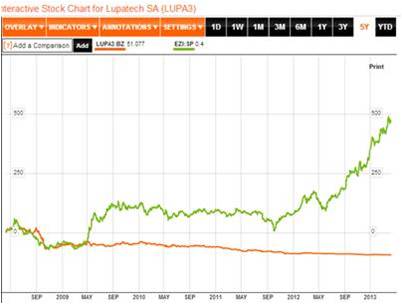
Brazilian oil services provider Lupatech SA (LUPA3) missed interest payments on $275 million of perpetual bonds two weeks after reporting annual losses doubled from a year earlier. Read more of this post

Bitcoin Trade Halted by Mt. Gox Exchange After Price collapsed by 46 percent to $123.40 from $230 in the past 24 hours

Bitcoin Trade Halted by Mt. Gox Exchange After Price Drop

Mt. Gox, a Tokyo-based exchange that handles bitcoin transactions, halted trading of the virtual currency to let the market “cool down” after a plunge in price.

The price of bitcoins collapsed by 46 percent to $123.40 from $230 in the past 24 hours, according to quotes on Mt. Gox’s website. In a statement, the company cited an increase in trade volume and not a cyber-attack, which has caused shutdowns in the past.

Bitcoin is a virtual currency that can be used to buy and sell a broad range of items — from cupcakes to electronics to illegal narcotics. Online exchanges across the world offer a market for bitcoins to be bought and sold against dollars, euros, yen and other currencies. Bitcoin has been subject to large swings in value in recent days.

“People started to panic, started to sell bitcoin in mass (panic sale) resulting in an increase of trade that ultimately froze the trade engine,” Mt. Gox said in the statement. Read more of this post

Meet the Bitcoin Millionaires; As of April 2, there were about 250 wallets with more than $1 million worth of Bitcoins

Meet the Bitcoin Millionaires

By Max Raskin on April 10, 2013

mf_bitcoin16__01__630x420

Many people have lost some data while reformatting a computer hard drive. Jered Kenna lost more than that. In 2010 he erased from his computer 800 Bitcoins that have been worth more than $200,000. Kenna isn’t upset: He has plenty more. He says he bought his first batch of virtual currency, 5,000 coins, at 20¢ each. On April 10, Bitcoins traded for as much as $258 each, according to Tradehill, a Bitcoin exchange in San Francisco, before plunging more than $100. Like other enthusiasts, Kenna shrugs off the volatility. While he won’t disclose his total holdings, he says, “I’m happy to be considered a member of the Bitcoin millionaires’ club.” Read more of this post

Tata’s Nano, the World’s Cheapest Car, Is Sputtering

Tata’s Nano, the World’s Cheapest Car, Is Sputtering

By Siddharth Philip on April 11, 2013

comp_nano16cargraphic_405

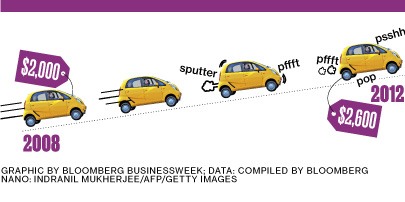
The old adage says a person can’t be too rich or too thin. Given Tata Motors’ (TTM) disappointing experience with the Nano, the $2,000 compact it introduced with great fanfare in 2008, it’s clear a car can be too cheap—at least for consumers who don’t want to be associated with a low-end ride. Ratan Tata, then chairman of parent Tata Group, made headlines a decade ago when he ordered up a “people’s car” that would appeal to Indian families who previously could only afford to travel by scooter. But Tata Motors has sold just 229,157 Nanos since deliveries began in 2009, and sales in March were off by 86 percent from a year earlier.

Tata Managing Director Karl Slym insists the company won’t kill the tiny, egg-shaped car. It will soon add improvements to breathe new life into the model, a move that would ultimately bring its price closer to those of rivals. The Nano’s marketing “didn’t jell with anybody,” Slym says. Scooter drivers weren’t attracted because others “don’t think I’m buying a car, they think I’m buying something between a two-wheeler and a car. Anyone who had a car didn’t want to buy it, because it was supposed to be a two-wheeler replacement.”

Slym points to the Pixel, a Nano-based concept vehicle Tata first showed in 2011, as an example of how the brand could evolve. The two-door hatchback takes the skeleton of the Nano and adds innovative doors that rotate up rather than open out, automatic transmission, and a diesel engine. Yet Haritha Saranga, an associate professor at the Indian Institute of Management in Bangalore, says in an e-mail that “just creating variations is not going to help increase sales. It is important to change the current image of Nano as a cheap car.” Read more of this post

Vaccine to Fight New Bird Flu Strain Could Be Elusive

April 11, 2013, 8:09 p.m. ET

Vaccine to Fight New Bird Flu Strain Could Be Elusive

By BETSY MCKAY

Developing a vaccine to protect people from the new H7N9 flu virus that recently emerged in eastern China could prove to be especially difficult, flu experts from the U.S. Centers for Disease Control and Prevention reported in a paper Thursday.

As with many new flu viruses, it isn’t clear yet whether the new flu will create only “sporadic human infections from an animal source” or whether it will “signal the start of an influenza pandemic,” CDC flu scientists Timothy Uyeki and Nancy Cox wrote in an article published online in the New England Journal of Medicine.

In addition, they wrote, “there are many challenges to making H7N9 vaccines available.” Vaccines against H7 avian flu viruses that have already been studied haven’t produced a strong immune response in humans, they wrote. And like any new vaccine, it would likely take many months to produce and distribute, they wrote, adding “extensive efforts” to develop vaccines are under way. Read more of this post

UN fears bird flu virus may spread

UN fears bird flu virus may spread

BEIJING — Another person died from a new strain of bird flu in China yesterday, state media said, bringing to 10 the number of deaths from the H7N9 virus, as a United Nations body said it was concerned the virus could spread across borders in poultry.

5 HOURS 52 MIN AGO

BEIJING — Another person died from a new strain of bird flu in China yesterday, state media said, bringing to 10 the number of deaths from the H7N9 virus, as a United Nations body said it was concerned the virus could spread across borders in poultry.

The latest victim was in the commercial hub of Shanghai, the official Xinhua news agency reported, where several of the 38 cases to date have been found. All of the cases so far have been found in eastern China. Read more of this post

Surge in Loans Puts Beijing in a Quandary; Stubborn Lending Spree Confronts Leaders With Choice of Cracking Down, and Risk Slowing Growth—or Face Crisis Later

Updated April 11, 2013, 3:33 p.m. ET

Surge in Loans Puts Beijing in a Quandary

Stubborn Lending Spree Confronts Leaders With Choice of Cracking Down, and Risk Slowing Growth—or Face Crisis Later

By BOB DAVIS and TOM ORLIK

WO-AN357_CDEBT_G_20130411171209

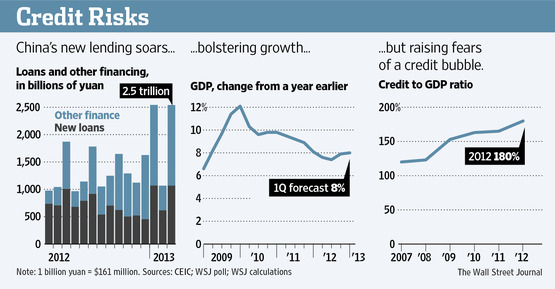
BEIJING—A surge in lending that defied Beijing’s efforts to mop up liquidity presents China’s new leaders with the tough prospect of risking a budding growth revival by cracking down too hard to head off a bad-loan crisis.

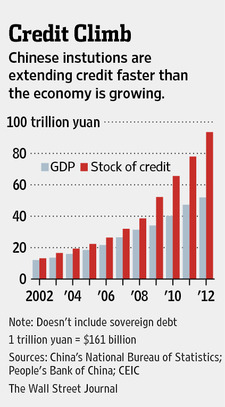
China has been on a credit binge since the global financial crisis of 2008, initially a deliberate strategy by leaders to finance investment and support economic growth. But the growing level of debt—domestic debt has topped 200% of gross domestic product, by some estimates—has prompted concerns that China faces a banking bust in the coming years. To forestall that prospect, Chinese regulators have tried to get banks and other financial institutions to somewhat dial back credit.

So far, those efforts have failed. Data Thursday showed that bank loans rose sharply in March to 1.06 trillion yuan ($171 billion) from 620 billion yuan a month earlier. A broader measure of credit that includes bonds and nonbank lending—also called total social financing—hit 2.54 trillion yuan in March, up from 1.07 trillion yuan the month before and just shy of January’s record.

“This is a reflection of the fact that China now has a much more diverse credit system” than it once did, said Charlene Chu, a Fitch Ratings Inc. senior director. “In the past, the authorities could give guidance to banks and it would be quickly followed. Now there are many other financial institutions out there” that don’t necessarily follow informal directions of the regulators. Read more of this post

A global shakeup of share markets, flow of funds and indices looms with the opening up of China’s US$3 trillion mainland share market, one of the world’s last big investment frontiers

Published: Friday April 12, 2013 MYT 8:37:00 AM

A global shakeup of share markets, flow of funds and indices looms

LONDON: The opening up of China’s US$3 trillion mainland share market, one of the world’s last big investment frontiers, is setting the stage for a huge shake up of equity indices and global fund flows.

The A-shares of the giant stock markets of Shanghai and Shenzhen have long been no-go areas for international investors, who have been largely confined to the offshore, Hong Kong-listed H-shares that represent China in global equity indices.

These have taken most of the $50 billion or so that EPFR Global estimates has flowed to China equity funds since 1995.

That is about to change. Beijing is expanding its QFII and RQFII quotas, schemes that allow foreigners to buy local assets. Just under 200 foreign money managers now hold total quotas worth nearly $42 billion. Regulators signalled earlier this year that a 10-fold quota increase is on the cards. Read more of this post

The True Chinese Credit Bubble: 240% Of GDP And Soaring

The True Chinese Credit Bubble: 240% Of GDP And Soaring

Tyler Durden on 04/11/2013 15:54 -0400

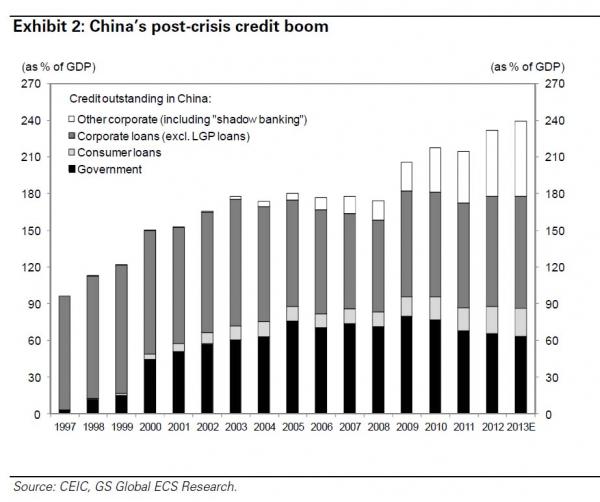
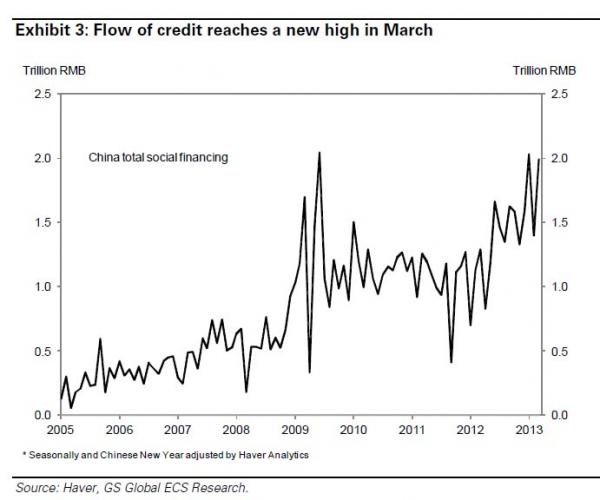
Several months ago we pointed out something not fully grasped by the broader public: the Chinese corporate debt bubble is the largest of any developed and developing country, and at 151% of GDP (and rising rapidly) is the biggest in the world. What is better known is that corporate debt is just one part of the total debt picture, which also includes consumer loans, government debt and other “shadow debt” credit in the case of China. So how does China’s true debt picture as a percentage of debt look? As the chart below from Goldman shows, in 2013 the total credit outstanding in China is expected to rise to a whopping 240% of GDP, and continue rising from there at an ever faster pace. What is even more concerning is that in order to maintain its breakneck economic “growth” of ~8% per year, China has to continue injecting massive amounts of debt, the so called “credit impulse” or “flow” which according to assorted views, is what is the true driver of an economy, and where GDP growth is merely a reflection of how much credit is entering (or leaving) the system. The chart below shows that total Chinese social financing flow just hit a record for the month of March. Completing the picture is the estimated economic response to a surge in credit. As the last chart shows, in China the biggest benefit to a surge in flow is felt in the quarter immediately following the credit injection, as one would expect, with the effect tapering off and even going negative in future quarters, thus requiring even more debt creation to offset the adverse impacts of prior such injections. What should become obvious is that in order to maintain its unprecedented (if declining) growth rate, China has to inject ever greater amounts of credit into its economy, amounts which will push its total credit pile ever higher into the stratosphere, until one day it pulls a Europe and finds itself in a situation where there are no further encumberable assets (for secured loans), and where ever-deteriorating cash flows are no longer sufficient to satisfy the interest payments on unsecured debt, leading to what the Chinese government has been desperate to avoid: mass corporate defaults. At that point it will be up to the PBOC to do what the Fed, the ECB, the BOE and the BOJ have been doing: remove any pretense of money creation via the commercial bank complex (even if these are merely glorified government-controlled entities), and proceed to outright monetization of de novo created assets, thus flooding the system with as much money as is needed to preserve the illusion of growth. Naturally, with the Chinese stock market having proven itself to be a horrible inflation trap (and as a result the bulk of new levered money creation goes into real estate), the inflation explosion that would result would be epic. At that point the chart of the price of gold (in any currency) due to on the ground demand for capital preservation will make the Bitcoin chart pre-bubble pop, seem outright flat.

China Credit_0China flow of credit_0China response to credit surge_0

A Chinese government spokesman said he gave “incorrect” and “groundless” investment data sourced from the Internet, underscoring concern at the credibility of official numbers.

China Customs Official Apologizes for Incorrect Data

A Chinese government spokesman said he gave “incorrect” and “groundless” investment data sourced from the Internet at a briefing yesterday, underscoring concern at the credibility of official numbers.

Zheng Yuesheng, spokesman and head of the statistics department at the Beijing-based General Administration of Customs, said in a statement today that he “expresses deep apologies” for citing unconfirmed investment data from online sources he didn’t identify.

Zheng was referring to remarks he made at a customs administration press conference yesterday where he also acknowledged concerns that China’s export data may be overstated. During the briefing, held to discuss March and first-quarter trade figures, Zheng said the National Development and Reform Commission, the nation’s top economic planning agency, had approved about 7 trillion yuan of investment projects in the fourth quarter of 2012, including new roads, railroads and airports.

He gave the figure when discussing the improvement in first-quarter trade to illustrate the recovery in China’s economic growth.

“The information was sourced from relevant reports on the Internet, which were groundless and must be corrected,” Zheng said in a seven-line statement on the agency’s website. Read more of this post

Pentagon Says Nuclear Missile Is in Grasp for North Korea

April 11, 2013

Pentagon Says Nuclear Missile Is in Grasp for North Korea

By THOM SHANKERDAVID E. SANGER and ERIC SCHMITT

WASHINGTON — A new assessment by the Pentagon’s intelligence arm has concluded for the first time, with “moderate confidence,” that North Korea has learned how to make a nuclear weapon small enough to be delivered by a ballistic missile.

The assessment by the Defense Intelligence Agency, which has been distributed to senior administration officials and members of Congress, cautions that the weapon’s “reliability will be low,” apparently a reference to the North’s difficulty in developing accurate missiles or, perhaps, to the huge technical challenges of designing a warhead that can survive the rigors of flight and detonate on a specific target.

The existence of the assessment was disclosed on Thursday by Representative Doug Lamborn, Republican of Colorado, three hours into a budget hearing of the House Armed Services Committee with Defense Secretary Chuck Hagel and the chairman of the Joint Chiefs of Staff, Gen. Martin E. Dempsey. General Dempsey declined to comment on the assessment because of classification issues. Read more of this post

How to Defeat North Korea

How to Defeat North Korea

Let’s start with the bad news: The North Korean problem has no simple or quick solution. The North’s weapons-grade plutonium and nuclear devices have already been manufactured, and are now safely hidden in underground facilities. China, and to a lesser degree Russia, remains unwilling to support a truly rigorous (read: efficient) sanctions regime. More narrow financial sanctions that target the money used to reward regime insiders with perks, like bottles of Hennessy cognac and Mercedes cars, won’t have much impact. Most of the North Korean elite believe that regime stability is a basic condition for their survival. No doubt, they would be willing to put up with locally produced liquor and used Toyotas if the alternative was being strung from the lampposts.

More international aid would be most welcome in Pyongyang, no doubt — but not enough for the regime to give up its nuclear program. Once the money was spent (and it would be spent quickly), a nonnuclear North Korea would be just another impoverished country, competing for attention with places such as Sudan and Zimbabwe. A U.S. security guarantee — another carrot held out by some in Washington — wouldn’t be any more enticing. North Koreans don’t believe in the value of foreigners’ promises, especially when such promises are made in democratic systems where leaders and policies change every few years. Read more of this post

Tepco Faces Decision to Dump Radioactive Water in Pacific Ocean

Tepco Faces Decision to Dump Radioactive Water in Pacific Ocean

Tokyo Electric Power Co. (9501)’s discovery of leaks in water storage pits at the wrecked Fukushima atomic station raises the risk the utility will be forced to dump radioactive water in the Pacific Ocean.

Leaks were found in three of seven pits in the past week, reducing the options for moving contaminated water from basements of reactor buildings. Water in the basements is from the months after the earthquake and tsunami disabled the plant two years ago, when disaster teams used hose pipes and pumps to try and cool the reactors.

While the company has since built a makeshift sealed cooling system, underground water is breaching basement walls at a rate of about 400 tons a day and becoming contaminated, according to Tepco’s estimate. With Japan’s rainy season approaching, contaminated water levels are likely to increase at the plant 220 kilometers (137 miles) northeast of Tokyo.

Reducing radiation levels in the water and pouring it into the sea is one of two options the utility has, said Kazuhiko Kudo, a research professor of nuclear engineering at Kyushu University. The other option is “to keep building above-ground storage tanks,” said Kudo. That’s a fight Tepco can’t win without stopping the underground water that’s pouring into the basements, Kudo said.

“It is like a well. No matter how much water you draw from a well, underground water keeps seeping into the well,” said Kudo, who also served on a safety advisory board for the Fukushima plant after the disaster for the now defunct Nuclear and Industrial Safety Agency. Read more of this post

Rahul Gandhi’s Bumbling, Befuddling `Beehive Speech’; He offered, according to a member of the audience, “no road map, no plan, no solution.”

A Gandhi’s Bumbling, Befuddling `Beehive Speech’

The young Indian politician Rahul Gandhi, whose bloodline includes three former prime ministers, is widely expected to be his party’s nominee for that post when elections are held in the first half of 2014. But even Gandhi’s supporters within his Congress Party were frequently bemused by a speech he made to more than 1,000 prominent members of the Indian business community last week.

At a meeting organized by the Confederation of Indian Industry, the 42-year-old Gandhi stood out among the elegant suits and saris of businessmen and women. He chose to wear the male Indian politician’s traditional garb of a simple white kurta-pajama. His words, however, were less distinctive. It was always going to be difficult to recover from a beginning as hokey as:

“There is a tendency to look at India as a country. In our everyday life we see India as a national structure. But if you go back slightly more than that, go back a hundred, two hundred years, you would find that India is energy, it is a force.”

Holding the stage for more than an hour, he presented a vision of the state of the nation and its future that was a grab bag of disjointed metaphors and rambling platitudes. (“Embracing the excluded is essential to the wealth of the nation. If we do not embrace them, we will all suffer.”) He offered, according to a member of the audience, “no road map, no plan, no solution.” Read more of this post

IPhone Outpaced in Surging India by Less Costly Rivals

IPhone Outpaced in Surging India by Less Costly Rivals

Apple Inc. (AAPL) and Samsung Electronics Co. (005930) are being beaten in the fast-growing Indian smartphone market by a couple of aggressive local competitors.

Sales growth at Bangalore-based Karbonn Mobiles India Pvt. and Micromax Informatics Ltd. is being fueled by Indians buying their first smartphone to surf the Internet, which will be accessed by more than 300 million people by 2017. Their secret: the price.

In a country where about 800 million people live on less than $2 a day, Karbonn handsets start from 3,599 rupees ($66) and Micromax’s from 3,999 rupees, less than the cheapest Apple and Samsung smartphones. The iPhone 4 is available for 26,500 rupees and Samsung’s Galaxy Y Duos Lite for 6,110 rupees.

“India is poised for a smartphone boom; just look at the Internet penetration and potential,” Deepak Mehrotra, chief executive officer of Gurgaon-based Micromax, said in an interview. “But we don’t see any point to offering a Ferrari.” Read more of this post

Bird Flu Causing Suffocation Shows Severe Spectrum of New Virus; Bird flu turned fatal for a 52- year-old Shanghai woman whose lungs became so damaged that she began to suffocate, causing her vital organs to rapidly shut down; “The big question here is, are these severe cases the tip of a very big iceberg or do most cases get really ill like this?’

Bird Flu Causing Suffocation Shows Severe Spectrum of New Virus

Bird flu turned fatal for a 52- year-old Shanghai woman whose lungs became so damaged that she began to suffocate, causing her vital organs to rapidly shut down, doctors in China said.

The retiree became ill March 27, with a fever that soared as high as 40.6 degrees Celsius (105.1 Fahrenheit), doctors at Huashan Hospital in Shanghai wrote in a report on the case in the journal Emerging Microbes & Infections. Treatment with intravenous antibiotics, steroids, antibody therapy, and mechanical ventilation failed to help, and she died April 3.

Her illness, the first H7N9 avian influenza case to be described in a medical journal, highlights the seriousness of the new strain, which has sickened at least 35 people in eastern China, killing 10, in the past two months. Hospital doctors didn’t know the cause of the woman’s illness when she was admitted. Tests identified the H7N9 virus after she died.

“What they had here was a seriously ill patient and they didn’t know what was going on,” said Dominic Dwyer, director of the Institute of Clinical Pathology and Medical Research at Sydney’s Westmead Hospital, who reviewed the case report. “This person was so ill, they just threw everything” at her. Read more of this post

Alibaba’s Taobao Bans Live Poultry Trading on Bird Flu

Alibaba’s Taobao Bans Live Poultry Trading on Bird Flu

(Corrects that Alibaba hasn’t banned poultry trading.)

Alibaba Group Holding Ltd. and other Chinese e-commerce sites are taking steps to protect against the spread of bird flu as concerns rise the H7N9 variant that’s killed nine people could spur an epidemic.

Alibaba’s e-commerce platform Taobao Marketplace said it would shut down online trading of live poultry “under necessary circumstances” this week. Shanghai-based Tony’s Farm and Beijing-based www.tootoo.cn have halted the sales. Web retailer 360buy Jingdong Inc. will cut down on face-face meetings with suppliers, and stop offering pork and poultry at its employee cafeteria, Richard Liu, chief executive officer of Jingdong, said in a letter to employees last week.

The H7N9 cases may become an opportunity for e-commerce companies as fears of infection prompt more people to stay home and shop online. A 2003 outbreak of Severe Acute Respiratory Syndrome helped make e-commerce popular just as it was getting started, said Cao Lei, a director at Hangzhou-based China e- Business Research Center. Read more of this post

Swedish Banks Make Money Ditching Cash as Krona Goes Virtual

Swedish Banks Make Money Ditching Cash as Krona Goes Virtual

If you’re looking for Swedish cash, don’t go to a Swedish bank.

Most of the country’s biggest lenders, SEB AB, Swedbank AB (SWEDA) and Nordea Bank AB (NDA), have stopped manual cash-handling services in 65 percent to 75 percent of their local branches. They say cash is out as Swedes rely on credit cards, the Internet and mobile phones to make all their payments.

The country’s bank notes, which are adorned with images of famous Swedes including botanist Carl Linnaeus and will soon also feature legendary actress Greta Garbo, are only used in about 20 percent of shop transactions, according to data from the Swedish Trade Federation. In the U.K., whose capital London is a global hub for high finance, all banks still offer cash at their branches.

“We’ve removed the manual cash handling simply because we’re seeing a change in behavior among our customers,” Swedbank spokeswoman Anna Sundblad said in an e-mailed reply to questions. “Only 5 percent of our customers make over-the- counter cash transactions.”

Customer demand for cash services at Nordea, Scandinavia’s biggest bank, is dropping by about 20 percent a year, spokesman Erik Durhan said. According to Nordea Chairman Bjoern Wahlroos, the end of cash is a natural next step in an evolutionary process that has already led to the extinction of cheque books. In this respect, Scandinavia is far ahead of the U.K. and the U.S., he said. Read more of this post

China’s New Leaders, New Credit Binge; China’s economy has new leaders, not yet new ways. A surge in lending and capital inflows in the first quarter may be a precursor for tightening down the road.

April 11, 2013, 3:13 a.m. ET

China’s New Leaders, New Credit Binge

By TOM ORLIK

WO-AN328A_CRATI_NS_20130409150005

China’s economy has new leaders, not yet new ways.

The first quarter brought a surge in credit creation. Total social finance, a measure that includes new loans as well as bond issuance and other forms of credit, increased 6.2 trillion yuan ($1 trillion)—a record high. China’s stash of foreign exchange came in at $3.44 trillion at the end of March—up $128.4 billion for the quarter after tepid increases in 2012.

It all looks like a throwback to China under its previous set of leaders. The People’s Bank of China is in the markets buying dollars, resulting in larger foreign-exchange reserves and more liquidity in the financial system. That should certainly allay fears about China’s growth. A 58% year-on-year increase in new finance will surely prop up an expansion in output above the government’s 7.5% target.

By extending the policies of previous Chinese leaders, though, Beijing exacerbates the risk of inflation and asset-price bubbles. Consumer price inflation for March came in at a moderate 2.1% year on year. But massive increases in credit can only add to the upward pressure on prices.

Equally worrying is the rapid rise in the ratio of credit to gross domestic product. That measure has moved from 120% in 2007 to about 180% at the end of 2012. On the current trajectory, it will end 2013 at 200%. Such a sharp shift raises concerns about the possible misallocation of credit on a grand scale, and a buildup of bad assets in the banking sector.

The central bank’s recent efforts to restrain credit growth have been limited to timid attempts to drain liquidity from the financial system. To head off problems down the road, much more aggressive moves will be required. A surge in lending and capital inflows in the first quarter may be a precursor for tightening down the road.