Kibbutz to Kardashian Turns Caesarstone, Maker of Kitchen Countertops, Into World Beater

Kibbutz to Kardashian Turns Caesarstone Into World Beater

The kibbutz that controls Caesarstone Sdot Yam Ltd. (CSTE), the maker of Kim Kardashian’s quartz kitchen countertops, is taking advantage of a 34 percent surge in profit since selling shares in New York last year to build a factory in the U.S. and start paying residents’ salaries.

Instead of the socialist ideals of its founders, the northern Israeli community has joined kibbutzim courting investors and listing on stock exchanges in Tel Aviv, London and New York (ISRA25BN). The farm collectives central to establishing the state in 1948 now make everything from drip irrigation systems to home furnishings for reality TV stars, contributing about 7 percent of industrial output in an economy growing faster than the average of advanced economies since 2003.

Caesarstone rose 44 percent in 2012, the second-best return among foreign initial public offerings in the U.S. after Guangzhou, China-based Vipshop Holdings Ltd. (VIPS) It’s up 83 percent this year and was named the exclusive provider of non-laminate countertops for the U.S. unit of Ikea Group. The combination of the 1980s financial crisis that bankrupted hundreds of kibbutzim and the country’s move to an export-led economy forced collectives to embrace free market strategies, said Gal Maharshak, the head of the non-profit organization desk at Excellence Nessuah Asset Management in Ramat Gan. Read more of this post

Mothers Turn Breadwinners for 40% of U.S. Households With Kids

Mothers Turn Breadwinners for 40% of U.S. Households With Kids

Mothers are the primary or only breadwinners in a record 40 percent of U.S. households with children, according to a study released today.

About 5.1 million of those workers are married women earning more than their spouses, boosting median family income in this group to almost $80,000, compared with the nationwide figure of $57,100 for all families with children, according to the Pew Research Center. Another 8.6 million households are headed by single mothers who report an annual median family income of just $23,000.

The report from Washington-based Pew highlights an economic divide between married and single mothers that has grown amid a steady decline in the fortunes of U.S. households. Median household income in the U.S. in 2011 was $50,054, its lowest level since 1995 and the fourth drop since 2007. Read more of this post

S.Korea’s Pension Fund Lowers Return Target as Economy Slows

S.Korea’s Pension Fund Lowers Return Target as Economy Slows

South Korea’s National Pension Service, the nation’s biggest investor, cut its five-year target for investment returns to account for slowing economic growth.

The agency, which had about $359 billion in assets as of March, is targeting returns on its stock, bond and property investments of 6.1 percent for 2014-2018, down from 6.6 percent announced last year for 2013-2017, according to a statement released today by the Ministry of Health & Welfare, which oversees the NPS.

The lower objective comes after the government cut its forecast for 2013 gross domestic product on March 29 to 2.3 percent from 3 percent. The Finance Ministry unveiled a $15 billion supplementary budget on April 16 to support exporters pressured by a weaker Japanese yen and revive an economy that grew last year at the slowest pace since 2009. Read more of this post

Gold Diverging From Fine Wine as Bullion Investors Lose Faith

Gold Diverging From Fine Wine as Bullion Investors Lose Faith

Gold and wine prices that tracked each other in the past decade amid demand for alternative assets are now diverging after bullion slumped into a bear market as some investors lost faith in the metal as a store of value.

The Liv-ex Fine Wine 100 Index (LIVX100) tripled in the past 10 years and gold advanced fourfold. The wine gauge rose 5.9 percent this year as bullion slid 17 percent. Credit Suisse Group AG said May 16 that the metal may drop to $1,100 an ounce in a year, or 21 percent less than now. The Wine Investment Fund, which manages about $50 million of assets, expects the Liv-ex gauge to rise by about another 7.6 percent by the end of December. Read more of this post

Brazil World Cup Kick-Starts Billionaire Boon as Farmers Lose

Brazil World Cup Kick-Starts Billionaire Boon as Farmers Lose

Monica Piaia’s catering company in downtown Cuiaba, the capital of the Brazilian grain-belt state of Mato Grosso, is doing so well that she has tripled her staff and acquired a third building since 2010 to handle a sixfold increase in demand.

The reason for her success is clear. A stone’s throw from her headquarters, where industrial-sized kettles bubble and delivery vans are loaded, 500 workers are toiling to finish one of the 12 stadiums nationwide that will host the 2014 soccer World Cup.

Three times a day, Piaia delivers food to workers there and at several of the 56 construction sites that will give Cuiaba new roads, a trolley and an airport terminal by June 2014, Bloomberg Markets magazine will report in its July issue. Read more of this post

Latin America Disappoints After Squandering Commodity-Boom Era

Latin America Disappoints After Squandering Commodity-Boom Era

Latin America is disappointing investors, economists and businesses with slower-than-forecast growth as waning commodity prices and strong currencies hit nations that failed to diversify and become more competitive.

The five biggest investment-grade markets in the region — magnets for foreign capital as rich countries stalled — expanded below projections or show signs of weakness. Mexico’s gross domestic product missed estimates in a Bloomberg survey, while economists polled by Brazil’s central bank cut the country’s 2013 outlook this week for the second time in seven days, anticipating the worst three-year period in a decade. Read more of this post

Investment consultants and institutional corruption

Investment consultants: the heart of systemic failure?

Posted By STAFF WRITER On 29/05/2013 @ 1:18 pm In RESEARCH

In this engaging Edmond J Safra Research Lab Working Paper, Investment consultants and institutional corruption, lawyer Jay Youngdahl looks candidly at investment consultants in the United States. Describing them as gatekeepers between institutional investors and the peddlers of financial products, the author identifies ethically dodgy and widespread practices, and suggests they are at the heart of failure in the financial system. While he points to “a reimagined investment consulting industry”, Youngdahl declines to sell readers a solution, sticking instead to a highly personable litany of consultants’ avarice and the widely held warped perceptions that allow it to continue.

Investment consultants and institutional corruption

Abstract

Analyses of the financial crisis of 2007-2009 and the continuing effects of a difficult investing environment have largely focused on factors such as the roles of failed and complex financial products, inadequate credit rating agencies, and ineffective government regulators. Nearly unexamined, however, is a key group of actors in the financial landscape, investment consultants. Investment consultants stand as gatekeepers between large investors, such as private and public retirement funds, and those from “Wall Street” who design and sell financial products. Investment consultants hired by these asset owners practically control many investment decisions. Yet, as a whole the profession failed to protect asset owners in the recent financial crisis and has yet to engage in serious self-examination. Much of the reason for the failure can be traced to institutional corruption, which takes the form of conflicts of interest, dependencies, and pay-toplay activity. In addition, a claimed ability to accurately predict the financial future, an ambiguous legal landscape, and a tainted financial environment provide a fertile soil for institutional corruption. This institutional corruption erodes the confidence and effectiveness of the retirement and investment systems today. While not proposing a comprehensive system of reform, this article illuminates a way forward for those in the industry who have the desire to address and implement necessary corrective activity.

Disclosure and Firm Separation: A Text-Based Examination

Disclosure and Firm Separation: A Text-Based Examination

Christopher Ball Meta Heuristica, LLC

Gerard Hoberg University of Maryland – Department of Finance

Vojislav Maksimovic University of Maryland – Robert H. Smith School of Business

May 1, 2013

Abstract: 
We examine the hypothesis that high value firms use the Management’s Discussion and Analysis in the 10-K to separate from low value firms. We further hypothesize that high quality firms disclose a highly granular set of managerial policies that low quality firms cannot emulate due to high emulation, reputational and punishment costs in a regulated environment. We implement a standard computational linguistics approach to score MD&A disclosures in a high dimensional space, and find strong support for these central separation and granularity hypotheses. We also find that verbal content is most informative about more distant future outcomes, separation is stronger within industry groups, and content relating to high-growth entrepreneurial policies is especially relevant to separate firms. The value relevance of MD&A also increased following a 2003 SEC guidance release which likely increased the emulation costs faced by low value firms.

Did Analysts Contribute to the Disappearance of the Accrual Anomaly? Our results conflict with the widely-held notion that analysts are sophisticated information intermediaries who improve market efficiency

Did Analysts Contribute to the Disappearance of the Accrual Anomaly?

Sami Keskek University of Arkansas – Sam M. Walton College of Business

Senyo Y. Tse Texas A&M University – Lowry Mays College & Graduate School of Business

May 20, 2013

Abstract: 
We use the recent disappearance of the accrual anomaly to investigate analysts’ contribution to improved information processing by investors. Prior research finds that investors and analysts made similar accrual-related pricing and forecast errors, respectively, in the anomaly period. As sophisticated information intermediaries, analysts could have initiated the disappearance of the anomaly by issuing forecasts that are free of accrual-related bias. We find, however, that both expert (e.g., all-star) and non-expert analysts continue to issue forecasts with predictable accrual-related bias after the disappearance of the accrual anomaly. Furthermore, the accrual anomaly is similar for firms followed by analysts and for non-followed firms, and disappears at the same time for both. Thus, investors began to correctly incorporate accruals information in security prices even though analysts continued issuing earnings forecasts that have predictable accrual-related bias. Our results conflict with the widely-held notion that analysts are sophisticated information intermediaries who improve market efficiency.

Investing in Connections: Corporate Jets and Firm Value

Investing in Connections: Corporate Jets and Firm Value

Lian Fen Lee Boston College – Carroll School of Management

Michelle Lowry Pennsylvania State University – Mary Jean and Frank P. Smeal College of Business Administration

Susan Shu Boston College – Carroll School of Management

May 1, 2013

Abstract: 
Executives’ connections have been shown to benefit firms, yet we know little about firms’ efforts to foster connections. Using corporate jet flight data, we examine firms’ efforts to foster connections via face-to-face interactions. Such interactions can increase firm value by enhancing information flow. However, they can decrease firm value if individuals devote firm resources to pursue connections that further their own agendas. We find jet flights increase firm value if the information role prevails, such as when jets fly to subsidiaries. In contrast, flights to external locations decrease firm value, but they appear to yield personal benefits for the executives.

The most famous brand states have produced

tumblr_mmxqdtoglu1rasnq9o1_1280 (1)

Mission vs Ambition: Our vision in life defines the quality and direction of your thoughts; Mother Teresa at a tender age of 12 years, took a vow to commit herself to a religious life

Mission vs Ambition

by Ashu Khanna | May 29, 2013

Our vision in life defines the quality and direction of your thoughts

mother-teresa-wallpapers

“The very essence of leadership is that you have vision. You can’t blow an uncertain trumpet.” Hesburg

Our vision in life defines the quality and direction of your thoughts. If our vision in life is to be successful, every action will be directed from the need to be successful. Similarly, if our vision in life is being happy and peaceful, the quality of our thoughts will be governed by this need. Based on our circumstances and desires, we all have a different vision for our life. The vision for life often changes with stages of life. In the early years, we are driven by fun and learning and gradually, this changes to ambition and success.

Mother Teresa at a tender age of 12 years, took a vow to commit herself to a religious life. Having established a higher ideal for her life at such an early age, all her actions from thereon gravitated towards learning the order of the nuns and the language of the mission.  Read more of this post

Creative companies: What are the 10 secrets of innovative offices? Allow Time for Ideas to Emerge; Improvise at the Edge of Chaos; Manage Knowledge for Innovation; Ditch the Organizational Chart; Build Decentralized Networks

Creative companies: What are the 10 secrets of innovative offices?

by Eric Barker

What do creative companies do right?

Keith Sawyer got his PhD studying under Mihaly Csikszentmihalyi — the researcher who coined the idea of Flow. I’ve posted about his research on top creative teams and how brainstorming is broken. What did he find when he studied creative companies?

1) Keep Many Irons in the Fire

“In 1997, Shona Brown of McKinsey and Company, working with Kathleen Eisenhardt of Stanford University’s business school, compared three collaborative organizations with three organizations that didn’t innovate. The collaborative organizations constantly experimented, and they always had several different low-cost projects in the works. But instead of a grand plan that organized all the projects, they responded to what emerged. The contrast with the noninnovative companies couldn’t have been more stark— those companies didn’t have any experimental projects under way. And their managers dealt with the future by planning the future— spending months on elaborate strategy and product development plans. The problem was that if the future didn’t unfold according to plan, they were doomed to fail.” Read more of this post

How to build an “agile” culture

How to build an “agile” culture

BY BOB GOWER 
ON MAY 28, 2013

In 1987, when Paul O’Neill took over as CEO of Alcoa — a once great giant of American industry — he vowed to put all his energy behind improving one metric and one metric only: worker safety. When his tactics were questioned by a group of concerned investors, he explained, “If we bring our injury rates down, it won’t be because of cheerleading or the nonsense you sometimes hear from other CEOs. It will be because the individuals at this company have agreed to become part of something important: They’ve devoted themselves to creating a habit of excellence.”

O’Neill chose safety as his metric — instead of profits, efficiency, inventory or cost of goods sold — because he recognized that safety is core to culture and that culture in turn is core to success. Transform the culture, he believed, and you’d transform the bottom line. Read more of this post

Enduring lessons from the legend of Rothschild’s carrier pigeon

May 28, 2013 5:58 pm

Enduring lessons from the legend of Rothschild’s carrier pigeon

By John Kay

In an era of high-frequency trading, it is differences in perception that offer opportunities

In 1815, the combined forces of Britain and Prussia defeated Napoleon’s army at the Battle of Waterloo. It was, said the Duke of Wellington, a damn close run thing. But even before the dust had settled on the battlefield, a carrier pigeon belonging to the House of Rothschild was on its way across the Channel to London. Nathan Rothschild, informed ahead of other traders that the country was not to be over-run by the French, consequently made a killing by buying British government bonds.

Little of this legend is true but there are elements that are accurate. There was a battle at Waterloo, which ended Napoleon’s career. Wellington did not say it was a damn close run thing but there is evidence he thought so. The Rothschilds used carrier pigeons but that was not how they learnt the battle’s outcome. Rothschild did have early knowledge of the outcome, and may have used it to advantage, but that knowledge was not the source of the house of Rothschild’s fabled wealth. It did, however, earn a great deal, helping governments of all complexions to fund the Napoleonic wars. Read more of this post

Self-made millionaire and Pimlico Plumbers founder Charlie Mullins shares how he made his first million and how he’s grown his business significantly despite the economic gloom

Charlie Mullins: How I made my first million

Self-made millionaire and Pimlico Plumbers founder Charlie Mullins shares how he made his first million.

pimlico-plumbers_15

By Emma Wall

3:45PM BST 28 May 2013

Charlie Mullins was Britain’s first “millionaire plumber”. Pimlico Plumbers was started from a basement of a London estate agent in 1979; it now employs 200 people and has an £18m turnover.

Charlie decided at the age of nine that he wanted to be a plumber, after noticing that his local plumber was well respected, had a great lifestyle and money. So, he took to ‘bunking off’ school to earn “two bob a day”’ working with the local plumber.

After leaving school at 15 with no qualifications – “a big mistake, I should have left at 14,” he said – and completing a four year apprenticeship in plumbing Charlie started out with a second hand van and a bag of tools. In 1979 he started Pimlico Plumbers from a basement of an estate agent in Pimlico. Read more of this post

Export Champions: My Carry Potty is an overseas hit; Amanda Jenner, founder of My Carry Potty, explains how she turned her “back of a cigarette packet” sketch into a business that’s exporting to 30 markets

Export Champions: My Carry Potty is an overseas hit

Amanda Jenner, founder of My Carry Potty, explains how she turned her “back of a cigarette packet” sketch into a business that’s exporting to 30 markets.

potty2_2575398b

Amanda Jenner started My Carry Potty four years ago

By James Hurley

6:05PM BST 28 May 2013

A fledgling exporting strategy can go too well. Just ask Amanda Jenner. Three years ago, when she took the children’s travel potty she had designed to an overseas trade show for the first time, she was overwhelmed by interest and orders.

“We had an astronomical response – I was shocked at the strength of it. It was just me and one product next to all these established businesses but we got orders from South Korea, America, Germany and Italy.”

“Hugely exciting”, the Bournemouth-based entrepreneur recalls, yet she admits she was “naive” to take on “everyone who said yes”. “People will order 1,000 units but don’t want to build the brand. Now we’ve realised exporting is not all about volume.” Read more of this post

JCPenney Forced To Deny Tea Kettle Looks Like Hitler

JCPenney Forced To Deny Tea Kettle Looks Like Hitler

Jim Edwards | May 28, 2013, 2:56 PM | 16,439 | 17

JCPenney has officially denied that a tea kettle being advertised on a billboard on the 405 Interstate near Culver City, Calif., is intended to represent Adolf Hitler, the Nazi dictator during World War II. The notion that the kettle looked a bit like the architect of the Holocaust caught on after someone posted a photo on Imgur, the photo sharing site, showing what the image of the kettle looks like if you squint at it. Sure enough, a black sweep of hair, a moustache and a saluting “arm” appear, sort of. The Telegraph wrote a story about it, and JCP responded in a tweet that said, “Certainly unintended. If we’d designed the kettle to look like something, we would’ve gone w/a snowman.” (It’s a rare day when a major retailer can get away with tweeting a Hitler joke — but JCP has pulled this off.) Here’s the Imgur photo:

pcnsqt3


25 Psychological Traps That Lead ‘Good’ People To Commit Fraud

25 Psychological Traps That Lead ‘Good’ People To Commit Fraud

Max Nisen and Aimee Groth | May 28, 2013, 1:27 PM | 18,389 | 3

Former Enron CEO Jeff Skilling (R) was convicted for conspiracy and securities fraud

Many white collar crimes aren’t committed by hardened criminals. It’s often normally moral people under financial strain, those under severe pressure from their bosses or shareholders, or people who get away with something minor then try to to test their limits.

So what exactly leads otherwise normal and hardworking people to cross the line? That’s the subject of a paper by Dr. Muel Kaptein of the Rotterdam School Of Management.

We’ve collected some of the key insights and cognitive biases as a guide of what to look out for in a workplace.  Read more of this post

To disrupt an industry, it’s best to know it well

To disrupt an industry, it’s best to know it well

BY ERIN GRIFFITH 
ON MAY 27, 2013

The word “disruption” gets tossed around so often in the tech blogosphere that it’s become practically meaningless. But there’s plenty of room in the world for legit disruption, i.e., starting a company that eats away at, and maybe even topples, a dominant industry.

The problem is that too many people set out to disrupt industries that they don’t understand.Often VCs worship the idea of a naive 20-year-old engineer who is unfamiliar how an old industry is set in its ways. It takes that kind of naiveté to shake up the old dominant players who aren’t incentivized to innovate, the thinking goes. Execs in the hospitality industry can list thousands of reasons why something like Airbnb would never work. It took a crazy, determined and somewhat desperate group of recent college grads to build something like Airbnb; now those same hotel execs are wondering if their businesses are under threat from the site and its many copycats. Read more of this post

Museums, long reluctant to post good-quality images of their artworks online, are rethinking that strategy as innovators like the Rijksmuseum in Amsterdam make a range of copying and clipping services available

May 28, 2013

Masterworks for One and All

By NINA SIEGAL

AMSTERDAM — Many museums post their collections online, but the Rijksmuseum here has taken the unusual step of offering downloads of high-resolution images at no cost, encouraging the public to copy and transform its artworks into stationery, T-shirts, tattoos, plates or even toilet paper.

The museum, whose collection includes masterpieces by Rembrandt, Vermeer, Mondrian and van Gogh, has already made images of 125,000 of its works available through Rijksstudio, an interactive section of its Web site. The staff’s goal is to add 40,000 images a year until the entire collection of one million artworks spanning eight centuries is available, said Taco Dibbits, the director of collections at the Rijksmuseum. Read more of this post

Talent Management: Boards Give Their Companies an “F”

Talent Management: Boards Give Their Companies an “F”

by Boris Groysberg and Deborah Bell  |  12:00 PM May 28, 2013

talentbyregion3-thumb-396x419-4096talentbyindustry-thumb-580x419-4067

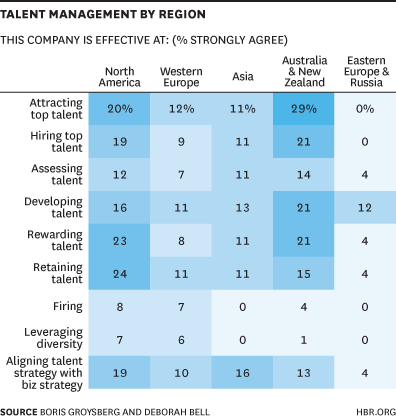
What is top of mind for corporate boards worldwide? In one of the most comprehensive global surveys of corporate directors to date, we found that they were very worried about developing and enacting strategic plans that will enable their organizations to succeed. And what did they say was their biggest concern? Not competitive threats. Not rising costs. Not innovation, risk management, technology, debt, or the regulatory environment. Corporate directors identified talent management as their single greatest strategic challenge.

In our survey, conducted in partnership with WomenCorporateDirectors and Heidrick & Struggles, we asked over 1,000 board members across the globe to rate their companies’ performance in each of nine dimensions of talent management: attracting top talent; hiring top talent; assessing talent; developing talent; rewarding talent; retaining talent; firing; aligning talent strategy with business strategy; and leveraging diversity in company’s workforce. Read more of this post

NYC Commuters Ride to Work as Public Bikeshare Begins

NYC Commuters Ride to Work as Public Bikeshare Begins

New York City’s newest public-transit option, which allows commuters to rent bicycles to get to work, got its first real road test today as businesses reopened after the Memorial Day holiday weekend.

Tim McGlinn, a 44-year-old equities analyst at U.S. Steel & Carnegie Pension Fund, stuck his blue plastic key in the docking station outside Pennsylvania Station this morning to release one of 25 gleaming new two-wheelers for the first time. He takes the train from Maplewood, New Jersey, each day and had longed for the opportunity to swap his subway trip for a bike ride on the two-mile trek uptown to his office. Read more of this post

Bayern Ousts Manchester United From Soccer Brand-Value Throne

Bayern Ousts Manchester United From Soccer Brand-Value Throne

Bayern Munich, which won the Champions League title four days ago, has ousted Manchester United from first place in brand value, according to a survey of the world’s top soccer teams.

Brand Finance Plc gave Bayern a brand valuation of 668 million euros ($860 million), up 8 percent from last year, the company said in an e-mailed statement, citing its annual report. Manchester United, which won a record 20 English league titles, fell to second place with a brand estimated at 650 million euros.

“Bayern Munich is still very much a story of domestic dominance, however its continued presence in the Champions league has provided the club with access to a global audience,” Dave Chattaway, London-based Brand Finance’s Head of Sports Valuation, said in the statement. “The challenge now for all Bundesliga clubs and the league itself, is to see if they can export their domestic brand strength into global opportunities.” Read more of this post

What is the difference between Sunni and Shia Muslims?

What is the difference between Sunni and Shia Muslims?

May 28th 2013, 23:50 by S.B.

CLASHES between Islam’s two big sects, the Sunni and the Shia, take place across the Muslim world. In the Middle East a potent mix of religion and politics hassharpened the divide between Iran’s Shia government and the Gulf states, which have Sunni governments. Last year a report by the Pew Research Centre, a think tank, found 40% of Sunnis do not consider Shia to be proper Muslims. So what exactly divides Sunni and Shia Islam and how deep does the rift go?

The argument dates back to the death in 632 of Islam’s founder, the Prophet Muhammad. Tribal Arabs who followed him were split over who should inherit what was both a political and a religious office. The majority, who would go on to become known as the Sunnis, and today make up 80% of Muslims, backed Abu Bakr, a friend of the Prophet and father of his wife Aisha. Others thought Muhammad’s kin the rightful successors. They claimed the Prophet had anointed Ali, his cousin and son-in-law—they became known as the Shia, a contraction of “shiaat Ali”, the partisans of Ali. Abu Bakr’s backers won out, though Ali did briefly rule as the fourth caliph, the title given to Muhammad’s successors. Islam’s split was cemented when Ali’s son Hussein was killed in 680 in Karbala (modern Iraq) by the ruling Sunni caliph’s troops. Sunni rulers continued to monopolise political power, while the Shia lived in the shadow of the state, looking instead to their imams, the first twelve of whom were descended directly from Ali, for guidance. As time went on the religious beliefs of the two groups started to diverge. Read more of this post

Fed’s 100-Year Roots Grew From Virginia Congressman

Fed’s 100-Year Roots Grew From Virginia Congressman

As Carter Glass began to sketch out plans for a central bank in 1913, all the U.S. representative from Virginia had to do was read his mail to know he had nationwide support.

“As soon as money is needed in business in larger amounts than usual, the banks and business men begin to wonder if it is going to be possible to get the funds necessary to see us through,” Chas. K. Gleason of Edwin P. Gleason & Son, “Converters of Cotton Goods,” wrote from Philadelphia on March 26, 1913. “Currency Legislation is of utmost importance to business men and all the people connected with them.”

Gleason was just one of thousands of American bankers, coffee roasters, shoemakers, bed manufacturers, coal jobbers and hardware-store owners who were fed up with the way the financial system was strangling an otherwise booming economy at the turn of the 20th century.

The correspondence — in an archive of Glass’s papers at the University of Virginia’s Albert and Shirley Small Special Collections Library — leaves little doubt about why the Federal Reserve Act became a law 100 years ago. The public demanded it. Read more of this post

Bill Gates Fattens Wealth Gap Over Slim as Family Office Cascade’s Investments in Ecolab Surges

Bill Gates Fattens Wealth Gap Over Slim as Cascade Surges

Microsoft co-founder Bill Gates extended his lead yesterday over Mexico’s Carlos Slim as the world’s richest person to $5.1 billion, according to the Bloomberg Billionaires Index.

Almost all of Gates’s investments, including a 4.8 percent stake in Redmond, Washington-based Microsoft, have soared this year while Slim’s main holding, a 44 percent stake in America Movil SAB, the largest mobile-phone operator in the Americas, has fallen 14 percent.

One of the biggest gainers in Gates’s portfolio, which he controls through his Kirkland, Washington-based investment vehicle Cascade Investment LLC, is Ecolab Inc. (ECL) The St. Paul, Minnesota-based provider of sanitation and health services is up 22 percent this year, a performance that has added $423 million to the billionaire’s fortune.

“Ninety percent of what they produce gets flushed down the drain and you have to rebuy it,” Shlomo Rosenbaum, an analyst at Stifel Nicolaus & Co.’s Baltimore office, said in a telephone interview. “They have repositioned their portfolio of assets to be much more exposed to the energy market. That’s something that I think will help their top-line growth for years to come.” Read more of this post

Burton G. Malkiel: You’re Paying Too Much for Investment Help

May 28, 2013, 6:41 p.m. ET

Burton G. Malkiel: You’re Paying Too Much for Investment Help

Index funds have far outperformed the average active manager, and at a far lower cost to the investor.

ED-AQ827_malkie_G_20130528183857

By BURTON G. MALKIEL

From 1980 to 2006, the U.S. financial services sector grew from 4.9% to 8.3% of GDP. A substantial share of that increase represented increases in asset-management fees.

Excluding index funds (which make market returns available even to small investors at close to zero expense), fees have risen substantially as a percentage of assets managed. In my judgment, investors have received no benefit from this increase in expense ratios.

The increase in fees could be justified if it reflected increasing returns for investors from active management, or if it improved the efficiency of the market. Neither of these arguments holds. Actively managed funds of publicly traded securities have consistently underperformed index funds—by roughly the differential in fees charged.

Passive portfolios that held all the stocks in a broad-based market index have substantially outperformed the average active manager since 1980. Therefore, the increase in fees likely represents a deadweight loss for investors. Read more of this post

I BLEW IT: 11 VCs Regret The Huge Companies They Said “No” To

How One VC Completely Blew A Meeting With A Startup Founder, And How Another Nailed It

Alyson Shontell | May 28, 2013, 12:14 PM | 8,014 | 6

Cash is king, so venture capitalists often have the upper hand when it comes to meeting with early-stage entrepreneurs. But when startups become big and awesome, the tables turn. Some venture capitalists get that. Others don’t seem to. One frustrated entrepreneur, Andy Dunn, has met with a number of investors for his clothing startup, Bonobos. He wrote a rant that described “dumb VCs” he and other entrepreneurs have dealt with. Bonobos is an e-commerce company that has raised more than $70 million. Its clothing is sold online and nationwide in Nordstrom stores. Dunn raised $30 million in March, and that fundraising process may have inspired the rant. Dunn described one “dumb” investor he met with six times. That person never offered to invest but he also never turned Dunn down. Instead, he just wasted Dunn’s time. Later, when Dunn didn’t inform him about his funding round, the investor acted confused. “Dear Dumb VC, it’s not my job to call you. It’s your job to call me,” Dunn writes. “And the fact that we spent all that time together, and you never got me a term sheet is a strong indicator that you’d rather do what’s in your worst interests than what’s in my best.” Jeremy Lieu of Lightspeed, however, wowed Dunn. Lieu came into his first two meetings visibly prepared. “One of the reasons Jeremy Liew from Lightspeed is an investor in Bonobos is he showed up in our first two meetings wearing my pants!” Dunn writes. It proved Liew had tried Dunn’s product. Dunn concludes his post with another anecdote from a fellow entrepreneur. The founder is now working on a billion-dollar startup, but early on, he was blown off by a VC. “This VC was seventy-five minutes late to meeting with me. He never called to say he was running late. When he got to the office, I wouldn’t meet with him. He groveled to get into meeting with me, and my team was pressuring me to just take the conversation, but I told them to politely tell him that he missed the meeting. That night, as he had flown into town to see me, he kept offering drinks or dinner to make up for it via email. He then went so far as to say his partners would be livid with him for screwing this up. I never took the meeting with him and I never rescheduled. I’d never get another meeting with him if I blew off his time like this, so why should he get another meeting with me?” “Dumb VCs” aside, even good VCs have botched great startup deals. Here are some of their biggest regrets.

I BLEW IT: 11 VCs Regret The Huge Companies They Said “No” To

Alyson Shontell | Aug. 8, 2011, 12:26 PM | 96,026 | 3

We asked angel investors and venture capitalists to tell us about the startups that got away. That is, the startups they could have invested in early, but ultimately passed on for whatever reason. Even the best investors make mistakes. They overlook opportunities, aren’t aggressive enough, or miss out rounds. From Ron Conway to Fred Wilson, we have some good stories about who missed what and why. Read more of this post

Korean chaebol CJ Group Chairman Lee Jay-Hyun Faces up to 10 years in Prison if HE is convicted of Tax Evasion, Illegal Capital outflow, stock manipulation and Breach of Trust, prosecutors said

2013-05-28 17:01

CJ chairman faces up to10 years

Kim Jae-won by
CJ Group Chairman Lee Jay-Hyun Faces up to 10 years in Prison if HE is convicted of Tax Evasion, Illegal Capital outflow, stock manipulation and Breach of Trust, prosecutors said.  The prosecution plans to Summon The 53-year -Old food and Entertainment industry mogul as Early as this week for Questioning.  Read more of this post