Sony’s Bread and Butter? It’s Not Electronics; selling life, auto and health insurance accounts for 63 percent of Sony’s total operating profit

May 27, 2013

Sony’s Bread and Butter? It’s Not Electronics

By HIROKO TABUCHI

TOKYO — Sony is best known as a consumer electronics company, making PlayStation game consoles and televisions. And it loses money on almost every gadget it sells.

Sony has made money making Hollywood movies and selling music. That profitable part of the business is what Daniel S. Loeb, an American investor and manager of the hedge fund Third Point, wants Sony to spin off to raise cash to resuscitate its electronics business.

But as Mr. Loeb pressures Sony executives to do more to revive the company’s ailing electronics arm, some analysts are asking, Why bother?

Sony, it is suggested, might be better off just selling insurance. Or just making movies and music. But not electronics. Read more of this post

Financial innovation for once works for the investor

Financial innovation for once works for the investor

Posted by: abnormalreturnsMay 27th, 2013 at 4:08 pm

True, long-lasting innovations ares a rare thing in the world of finance. In my book I argue that the introduction of the ETF or exchange-traded fund was exactly that. It has taken two some decades but we are now seeing real changes in how people invest due to ETFs. I wrote:

Like all upheavals, the ETF revolution has both its benefits and its drawbacks. On the whole, ETFs have made investing easier, more diverse, and cheaper. On the other hand, the introduction of ETFs has changed the actual underlying nature of some markets, and the rapid introduction of new ETFs has diluted the benefits seen early on. Unlike many revolutions, we are not likely to see a counterrevolution unseating the ETF regime any time soon.

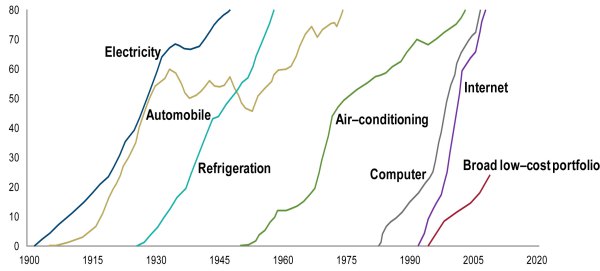
You can see how the introduction of ETFs has driven the adoption of “broadly diversified, low-cost portfolios.”Joe Davis and Andy Clarke at the Vanguard Blog compare the rise of these portfolios to other “great ideas. They write:

The adoption of great ideas typically follows an “S” curve, starting slowly, then accelerating. Eventually, the great idea becomes commonplace. The adoption of the “broad low-cost portfolio” seems to be following this pattern.

MPR_0513

Source: Vanguard. Adapted from Visualizing Economics and The New York Times. Vanguard calculated the growth in the low-cost portfolio based on data from Morningstar, Inc. The calculation represents the percentage of U.S. mutual fund and ETF assets under management with annual expense ratios of less than 25 basis points.

They note that we are still in the “second or third” inning of this process. Of course there is a limit as to just how much of the asset management industry can (or will) shift towards this approach. To be clear the definition of these portfolios is low cost, not necessarily indexed. In any event if too much money becomes indexed there should be a resulting increase in opportunities to generate alpha. Read more of this post

U.S. securities regulators are turning back toward Main Street, renewing their focus on accounting fraud and other financial-disclosure failings

May 27, 2013, 5:56 p.m. ET

Accounting Fraud Targeted

With Crisis-Related Enforcement Ebbing, SEC Is Turning Back to Main Street

By JEAN EAGLESHAM

U.S. securities regulators are turning back toward Main Street, renewing their focus on accounting fraud and other financial-disclosure failings.

Such cases were long a staple of the Securities and Exchange Commission’s enforcement efforts, leading to more than 25% of civil-enforcement actions filed by the agency in its 2003 to 2005 financial years. The financial crisis shifted attention and money elsewhere. In the year ended last September, accounting fraud and financial-disclosure problems made up just 11% of SEC enforcement actions. Read more of this post

Over-optimism raises risk of global recession

Over-optimism raises risk of global recession

In April 2010, the International Monetary Fund’s World Economic Outlook offered an optimistic assessment of the global economy, describing a multi-speed recovery strong enough to support roughly 4.5 per cent annual GDP growth for the foreseeable future — a higher pace than during the bubble years of 2000-2007.

27 MAY

In April 2010, the International Monetary Fund’s World Economic Outlook offered an optimistic assessment of the global economy, describing a multi-speed recovery strong enough to support roughly 4.5 per cent annual GDP growth for the foreseeable future — a higher pace than during the bubble years of 2000-2007.

But, since then, the IMF has steadily pared its economic projections. Indeed, this year’s expected GDP growth rate of 3.3 per cent — which was revised downward in the most recent WEO — will probably not be met.

Persistent optimism reflects a serious misdiagnosis of the global economy’s troubles. Most notably, economic projections have vastly underestimated the severity of the eurozone crisis, as well as its impact on the rest of the world. And recovery prospects continue to depend on the emerging economies, even as they experience a sharp slowdown. The WEO’s prediction of a strengthening recovery this year continues the misdiagnosis. Read more of this post

Li Says China Confronts ’Huge Challenges’ as Growth Levels Slow

Li Says China Confronts ’Huge Challenges’ as Growth Levels Slow

Chinese Premier Li Keqiang said his country is confronted by “huge challenges” as it opens up the economy and that the new government’s reform measures will be accompanied by tapered-off levels of growth.

Speaking in Berlin during his first trip abroad as premier, Li said the Chinese government will move forward with market-oriented reforms to generate stable growth after the economy unexpectedly slowed in the first quarter. Read more of this post

Asia seen as least creditworthy relative to their global peers

‘Asia seen as least creditworthy relative to their global peers’

Published: 2013/05/28

BEIJING: Borrowers in Asia are seen as the least creditworthy relative to their global peers in almost a year on signs of faltering growth in China.

The Markit iTraxx Asia index of credit-default swaps traded as much as 20 basis points higher than the average of four others from around the world this month, the biggest premium since June, according to data provider CMA. As recently as March, Asian borrowers were seen as better credits than the rest of the world.

Confidence in Asia is being dented by slowing growth in the region’s biggest economy, where manufacturing is contracting for the first time in seven months.  Read more of this post

Idea Entrepreneur: The New 21st Century Career

Idea Entrepreneur: The New 21st Century Career

by John Butman  |  10:00 AM May 27, 2013

There is a new player emerging on the cultural and business scene today: the idea entrepreneur. Perhaps you are one yourself — or would like to be. The idea entrepreneur is an individual, usually a content expert and often a maverick, whose main goal is to influence how other people think and behave in relation to their cherished topic. These people don’t seek power over others and they’re not motivated by the prospect of achieving great wealth. Their goal is to make a difference, to change the world in some way.

Idea entrepreneurs are popping up everywhere. They’re people like Sheryl Sandberg (Facebook COO and author of Lean In), who is advocating a big new idea from within an organization. And like Atul Gawande (the checklist doctor), who is working to transform a professional discipline. Or like Blake Mycoskie (founder of TOMS shoes), who has created an unconventional business model. In my research into this phenomenon (which forms the basis of my book, Breaking Out), I have been amazed at how many different kinds of people aspire to be idea entrepreneurs. I have met with, interviewed, emailed or tweeted with librarians, salespeople, educators, thirteen-year-old kids, marketers, technologists, consultants, business leaders, social entrepreneurs — from countries all over the world — who have an idea, want to go public with it, and, in some cases, build a sustainable enterprise around it.

Read more of this post

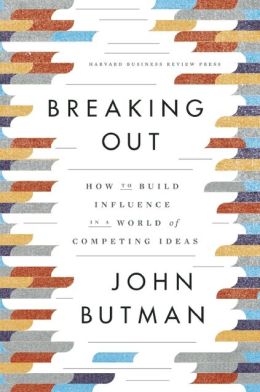
Breaking Out: How to Build Influence in a World of Competing Ideas

Breaking Out: How to Build Influence in a World of Competing Ideas [Hardcover]

John Butman (Author)

9781422172803_p0_v2_s260x420

Publication Date: May 21, 2013

How do you gain influence for an idea?
In Breaking Out, idea developer and adviser John Butman shows how the methods of today’s most popular “idea entrepreneurs”—including dog psychologist Cesar Millan, French lifestyle guru Mireille Guiliano (French Women Don’t Get Fat), TOMS founder Blake Mycoskie, and many others—can help you take an idea public and build influence for it.
It isn’t easy. Butman argues that the rise of the “ideaplex” (TED, Twitter, NPR, YouTube, online learning, and all the rest) has caused such an explosion in the creation and sharing of ideas that it has become much easier to go public—yet much harder to gain influence. But it can be done.
Based on his own experience in advising content experts worldwide, Butman shows how the idea entrepreneur breaks out—by combining personal narrative with rich content, creating many forms of expression (from books to live events), developing real-world practices, and creating “respiration” around the idea such that other people can breathe it in and make it their own. The resulting idea platform can reach many different audience groups and continue to build influence for many years and even decades.
If you have an idea and want to make a difference in your organization, build a change movement in your community, or improve the world in some way—this book will get you started on the journey to idea entrepreneurship. Read more of this post

Mudslinging in China’s Heavy-Machinery Sector

May 27, 2013, 9:21 a.m. ET

Mudslinging in China’s Heavy-Machinery Sector

By DUNCAN MAVIN

Digging for dirt on China’s machinery sector can be productive, especially when the economy’s stuck in the mud. Several companies that supply excavators, loaders and other construction equipment ran into trouble in 2012 and in the first few months of this year. The main problem was slowing economic growth, though oversupply of equipment was a big factor too. That led to slumping sales, rising inventory levels and a sharp uptick in accounts receivable as hard-up customers took longer to pay. Read more of this post

Why Extravagant New HQs Planned At Apple, Google, Amazon And Facebook Are Negative Indicators

Why Extravagant New HQs Planned At Apple, Google, Amazon And Facebook Are Negative Indicators

Bill Rigby and Alistair BarrReuters | May 27, 2013, 8:41 AM | 2,027 | 1

SEATTLE/SAN FRANCISCO (Reuters) – While much of corporate America is retrenching on the real estate front, the four most influential technology companies in America are each planning headquarters that could win a Pritzker Architecture Prize for hubris.

Amazon.com this week revealed plans for three verdant bubbles in downtown Seattle, joining Apple’s circular “spaceship,” Facebook’s Frank Gehry-designed open-office complex and a new Googleplex on the list of planned trophy offices.

“It signals a desire, a statement, to say that we’re special, we’re different. We have changed the world and we are going to continue to change it,” said Margaret O’Mara, associate professor of history at the University of Washington, who has written about the building of Silicon Valley. Read more of this post

GeoPay used the messaging ability that led to the earliest cellphones to create a mobile-banking platform in Central Asia

Reston firm turns to decades-old technology to set up mobile banking in Central Asia

By Abha Bhattarai, Monday, May 27, 5:31 AM

Not all new ideas for technology have to be, well, new.

As the start-ups around it tinkered with the cutting edge, a Reston company called GeoPay stuck by decades-old technology — the same used in messaging systems that led to the earliest cellphones — to create a mobile-banking platform.

The start-up, founded in 2011, provides cellphone-based banking services for people who might not otherwise have accounts at financial institutions. The simpler the interface, the more people the system could reach in the developing world, GeoPay said. Read more of this post

Advice on Life and Creative Integrity from Calvin and Hobbes Creator Bill Watterson

May 20, 1990: Advice on Life and Creative Integrity from Calvin and Hobbes Creator Bill Watterson

by Maria Popova

billwattersoncalvinandhobbes1

“The truth is, most of us discover where we are headed when we arrive.”

‘Tis the season for glorious life advicedispensed by cap-and-gown-clad elders to cap-and-gown-clad youngsters, emanating a halo effect of timeless wisdom the rest of us can absorb any day, at any stage of life. On May 20, 1990, Bill Watterson, creator of the beloved Calvin and Hobbes comic strip, took the podium at Kenyon College — the same stage David Foster Wallace would occupy 15 years later to deliver one of history’s most memorable commencement addresses — and gave the graduating class a gift of equally remarkable insight and impact.

Watterson begins the speech by articulating the same sentiment at the heart ofthe most unforgettable commencement addresses: the notion that not-knowing is not only a part of the journey, but an integral part:

I have a recurring dream about Kenyon. In it, I’m walking to the post office on the way to my first class at the start of the school year. Suddenly it occurs to me that I don’t have my schedule memorized, and I’m not sure which classes I’m taking, or where exactly I’m supposed to be going.
As I walk up the steps to the postoffice, I realize I don’t have my box key, and in fact, I can’t remember what my box number is. I’m certain that everyone I know has written me a letter, but I can’t get them. I get more flustered and annoyed by the minute. I head back to Middle Path, racking my brains and asking myself, “How many more years until I graduate? …Wait, didn’t I graduate already?? How old AM I?” Then I wake up.

Experience is food for the brain. And four years at Kenyon is a rich meal. I suppose it should be no surprise that your brains will probably burp up Kenyon for a long time. And I think the reason I keep having the dream is because its central image is a metaphor for a good part of life: that is, not knowing where you’re going or what you’re doing. Read more of this post

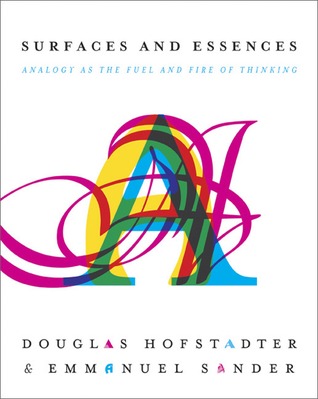
Surfaces and Essences: Analogy as the Fuel and Fire of Thinking

Surfaces and Essences: Analogy as the Fuel and Fire of Thinking [Hardcover]

Douglas Hofstadter (Author), Emmanuel Sander (Author)
7711871

Release date: April 23, 2013

Analogy is the core of all thinking.

This is the simple but unorthodox premise that Pulitzer Prize–winning author Douglas Hofstadter and French psychologist Emmanuel Sander defend in their new work. Hofstadter has been grappling with the mysteries of human thought for over thirty years. Now, with his trademark wit and special talent for making complex ideas vivid, he has partnered with Sander to put forth a highly novel perspective on cognition.

We are constantly faced with a swirling and intermingling multitude of ill-defined situations. Our brain’s job is to try to make sense of this unpredictable, swarming chaos of stimuli. How does it do so? The ceaseless hail of input triggers analogies galore, helping us to pinpoint the essence of what is going on. Often this means the spontaneous evocation of words, sometimes idioms, sometimes the triggering of nameless, long-buried memories.

Why did two-year-old Camille proudly exclaim, “I undressed the banana!”? Why do people who hear a story often blurt out, “Exactly the same thing happened to me!” when it was a completely different event? How do we recognize an aggressive driver from a split-second glance in our rearview mirror? What in a friend’s remark triggers the offhand reply, “That’s just sour grapes”? What did Albert Einstein see that made him suspect that light consists of particles when a century of research had driven the final nail in the coffin of that long-dead idea?

The answer to all these questions, of course, is analogy-making—the meat and potatoes, the heart and soul, the fuel and fire, the gist and the crux, the lifeblood and the wellsprings of thought. Analogy-making, far from happening at rare intervals, occurs at all moments, defining thinking from top to toe, from the tiniest and most fleeting thoughts to the most creative scientific insights.

Like Gödel, Escher, Bach before it, Surfaces and Essences will profoundly enrich our understanding of our own minds. By plunging the reader into an extraordinary variety of colorful situations involving language, thought, and memory, by revealing bit by bit the constantly churning cognitive mechanisms normally completely hidden from view, and by discovering in them one central, invariant core—the incessant, unconscious quest for strong analogical links to past experiences—this book puts forth a radical and deeply surprising new vision of the act of thinking. Read more of this post
Uncommon Genius: Stephen Jay Gould On Why Connections Are The Key to Creativity; “The trick to creativity is to identify your own peculiar talent and then to settle down to work with it for a good long time.”

Uncommon Genius: Stephen Jay Gould On Why Connections Are The Key to Creativity

by Maria Popova

“The trick to creativity, if there is a single useful thing to say about it, is to identify your own peculiar talent and then to settle down to work with it for a good long time.”

“Originality often consists in linking up ideas whose connection was not previously suspected,” wrote W. I. B. Beveridge in the fantastic 1957 tomeThe Art of Scientific Investigation“The role of the imagination is to create new meanings and to discover connections that, even if obvious, seem to escape detection,” legendary graphic designerPaul Rand seconded. Indeed, longer ago than I can remember, I intuited the conviction that creativity is a combinatorial force — it thrives on cross-pollinating existing ideas, often across divergent disciplines and sensibilities, and combining them into something new, into what we proudly call our “original” creations. Paula Scher has likened the process to a slot machine; Dorion Sagan has asserted that science is about connections; Gutenberg has embodied it. And some of history’s most celebrated creators have attested to it with the nature of their genius. Read more of this post

Good Writing vs. Talented Writing; “Talented writing makes things happen in the reader’s mind — vividly, forcefully — that good writing, which stops with clarity and logic, doesn’t.”

Good Writing vs. Talented Writing

by Maria Popova

“Talented writing makes things happen in the reader’s mind — vividly, forcefully — that good writing, which stops with clarity and logic, doesn’t.”

The secrets of good writing have been debatedagain and again and again. But “good writing” might, after all, be the wrong ideal to aim for. In About Writing: Seven Essays, Four Letters, and Five Interviews (public library), celebrated author and literary critic Samuel Delany — who, for a fascinating factlet, penned thecontroversial 1972 “women’s liberation” issue of Wonder Woman — synthesizes his most valuable insights from thirty-five years of teaching creative writing, a fine addition tobeloved writers’ advice on writing. One of his key observations is the crucial difference between “good writing” and “talented writing,” the former being largely the product of technique (and we know from H.P. Lovecraft that “no aspiring author should content himself with a mere acquisition of technical rules”), the other a matter of linguistic and aesthetic sensitivity:

Though they have things in common, good writing andtalented writing are not the same. Read more of this post

The Essayification of Everything: Why has the form invented by Montaigne — searching, sampling, notoriously noncommittal — become a talisman of our times?

MAY 26, 2013, 3:00 PM

The Essayification of Everything

By CHRISTY WAMPOLE

Lately, you may have noticed the spate of articles and books that take interest in the essay as a flexible and very human literary form. These include “The Wayward Essay” and Phillip Lopate’s reflections on the relationship between essay and doubt, and books such as “How to Live,” Sarah Bakewell’s elegant portrait of Montaigne, the 16th-century patriarch of the genre, and an edited volume by Carl H. Klaus and Ned Stuckey-French called “Essayists on the Essay: Montaigne to Our Time.”

It seems that, even in the proliferation of new forms of writing and communication before us, the essay has become a talisman of our times. What is behind our attraction to it? Is it the essay’s therapeutic properties? Because it brings miniature joys to its writer and its reader? Because it is small enough to fit in our pocket, portable like our own experiences? Read more of this post

Brewing fortunes are not uncommon. But few of these fortunes have been turned into such a successful family office as Quilvest

BEER MONEY

ARTICLE | 23 MAY, 2013 02:43 PM | BY JEREMY HAZLEHURST

When Otto Bemberg set up a brewery in the Argentine town of Quilmes after leaving his native Cologne in 1850, he would no doubt have been pleased that a century and a half later the business he started would produce Argentina’s biggest selling beer, with 75% of the market, that it would sponsor the national football team, and appear in trendy bars the world over. He’d also be chuffed to see a family business in its seventh generation. As a savvy businessman, he might have been even happier that, through its investment arm, the family firm would also spawn one of the world’s largest family offices.

Quilvest, which has $22 billion (€17.1 billion) under management, including $4 billion in the private equity arm, almost 400 employees and 13 offices globally, started life in 1917 in Paris to look after the family’s wealth. These days, Quilvest is divided into two. One side is a multi family office with around 4,000 clients – around 100 of them use it as a one-stop-shop family office, while most of the others use it for individual investments. The other is a private equity house, which has been investing since 1972. And interestingly, the family, which now consists of around 150 members, is still intimately involved with all aspects of Quilvest. Read more of this post

Why People Hate The Google Bus

Why People Hate The Google Bus

Rory CarrollThe Guardian | May 26, 2013, 8:54 AM | 20,507 | 57

google-bus-7

Every morning and every evening the fleet glides through the city, hundreds of white buses with tinted windows navigating San Francisco’s rush hour. From the pavement you can see your reflection in the windows, but you can’t see in. The buses have no markings or logos, no advertised destinations or stops.

It doesn’t matter. Everyone knows what they are. “Transport for a breed apart. For a community that is separate but not equal,” said Diamond Dave Whitaker, a self-professed beat poet and rabble-rouser.

The buses ferry workers to and from Apple, Facebook, Google and other companies in Silicon Valley, an hour’s drive south. They hum with air-conditioning and Wi-Fi. They are for the tech elite, and only the tech elite. Read more of this post

HSBC’s $1.9bn money laundering settlement with US authorities could be rejected, leaving the bank open to criminal prosecution and a ban from operating in America

HSBC’s $1.9bn money laundering settlement could be rejected

HSBC’s $1.9bn settlement deal with US authorities over money laundering charges could be rejected, it was reported on Thursday night.

By Andrew Trotman

10:41PM BST 23 May 2013

Judge John Gleeson is considering cancelling December’s so-called deferred prosecution agreement that gave HSBC immunity from claims it allowed terrorists to move at least $881m (£584m) around the financial system. This could leaving the bank open to criminal prosecution and a ban from operating in America. However, HSBC disputes this. The US Department of Justice (DoJ) is reportedly challenging Mr Gleeson’s need to sign off on the deal. The judge last mentioned the case in February, stating that he had not yet approved nor disapproved of the settlement. Read more of this post

Bitter Election Creates Long-Term Headache for Malaysia’s Najib

Bitter Election Creates Long-Term Headache for Malaysia’s Najib

By Niluksi Koswanage on 10:07 am May 26, 2013.

Demonstrators hold up lighters during a protest against recent election results in Petaling Jaya, outside Kuala Lumpur, in this May 25, 2013 file photo. Malaysia’s divisive election has left a bitter taste for millions of people that risks creating a long-term problem of legitimacy for Prime Minister Najib Razak’s long-ruling Barisan Nasional (BN) coalition. (Reuters Photo/Bazuki Muhammad)

Kuala Lumpur. Malaysia’s divisive election has left a bitter taste for millions of people that risks creating a long-term problem of legitimacy for Prime Minister Najib Razak’s long-ruling Barisan Nasional (BN) coalition.

The outrage was clear at a busy intersection across from one of Kuala Lumpur’s fanciest shopping malls, where a huge poster of Najib and his deputy had been defaced – a rare display of public disrespect in the Southeast Asian nation.

One of the scrawled comments poked fun at the unconvincing share of the votes won by Najib’s ruling coalition in its May 5 election victory: “47 percent PM,” it said. Read more of this post

Robots to drones, Australia eyes high-tech farm help to grow food

Robots to drones, Australia eyes high-tech farm help to grow food

Sun, May 26 2013

By Colin Packham

SYDNEY (Reuters) – Moving carefully along a row of apple trees, two of Australia’s newest agricultural workers check if the fruit is ripe or the soil needs water or fertilizer.

Meet “Mantis” and “Shrimp”, agricultural robots being tested to do these tasks and more in a bid to cut costs and improve productivity in Australia’s economically vital farm sector, which exported A$39.6 billion ($38.8 billion)of produce in 2012.

Australia is one of the leaders in the field and, with a minimum wage of A$15.96 per hour and a limited workforce, has a big incentive to use robots and other technology such as unmanned aircraft to improve efficiency. Read more of this post

The world’s biggest energy companies have warned Australia has less than two years to fix the high cost of building big projects or risk being frozen out of a new $150 billion wave of global investment in LNG

LNG costs risk $100 billion of projects

PUBLISHED: 10 HOURS 39 MINUTES AGO | UPDATE: 0 HOUR 45 MINUTES AGO

GEMMA DALEY AND ANGELA MACDONALD-SMITH

The world’s biggest energy companies have warned Australia has less than two years to fix the high cost of building big projects or risk being frozen out of a new $150 billion wave of global investment in liquefied natural gas ­supply.

Senior executives said Australia needed to reduce the world’s most expensive labour costs, cut regulation and deliver a stable tax and political ­environment to have a chance of competing against East Africa, West Canada and the United States to fill ­­in a looming 160 million tonne annual ­global shortfall in LNG supply.

Projects hanging in the balance include Woodside Petroleum’s Browse venture, Shell and PetroChina’s Arrow project in Queensland, the Scar­borough floating plant proposed by ExxonMobil and BHP Billiton and the GDF Suez-Santos Bonaparte floating venture. Read more of this post

Boom or bust? Bras cost more than properties, says Chinese developer

Boom or bust? Bras cost more than properties, says Chinese developer

Staff Reporter

2013-05-27

When Peggy Yu, executive chairwoman of Chinese online retailer Dangdang, complained about expensive property prices to the chairman of Beijing-based developer Huayuan Group, Ren Zhiqiang, at a meeting held by China Entrepreneur Magazine on May 18, Ren replied by saying that bras are in fact more expensive than properties.

“A property project takes several years to complete, but how long does it take for you to make a suit of clothes?” Ren said. “A small bra may cost hundreds of yuan, so it’s much more expensive than a house, if you go by price per square meter.” Ren’s “bra theory” triggered widespread debate online, with some internet users asking Ren if he would be willing to sell his smallest house to exchange for three good bras. Read more of this post

How much is an apology worth? Ge Wenyao, chairman of Shanghai Jahwa United Co, just paid more than 300 million yuan ($50 million) to make one

Argument prompts introspection

Updated: 2013-05-27 05:34

( China Daily)

f04da2db1122130ccba915

How much is an apology worth? Ge Wenyao, chairman of Shanghai Jahwa United Co, just paidmore than 300 million yuan ($50 million) to make one. Read more of this post

China’s second-largest construction equipment maker Zoomlion Bonds Fall, Stock Trading Halted After Media Report accusing it of falsifying sales

Zoomlion Bonds Fall, Stock Trading Halted After Media Report

Zoomlion Heavy Industry Science and Technology Co., China’s second-largest construction equipment maker, halted stock trading and saw its bonds decline after a report on Sina.com accused it of falsifying sales. The Shenzhen-listed shares were halted because of the report and trading will resume after the company posts a filing on the issue, Changsha-based Zoomlion said in a statement. The Hong Kong-traded stock was also suspended. Zoomlion’s $600 million of 6.125 percent bonds due December 2022 slumped 2.1 cents on the dollar to 95.4 cents as of 11:21 a.m. in Hong Kong, the lowest level since March 6 and heading for the biggest daily decline since Feb. 4, Bloomberg prices show. Zoomlion’s Hong Kong-traded stock has slumped 31 percent this year as its first-quarter profit plummeted 72 percent. Construction-equipment makers, including bigger rival Sany Heavy Industry Co. (600031), face a drop in orders as slowing economic growth and government curbs on the property market sap demand. Hong Xiaoming, a Zoomlion vice president in charge of the finance department, said in a mobile-phone text message that the company will issue a clarification today. She didn’t elaborate.

To contact the reporters on this story: Jasmine Wang in Hong Kong at jwang513@bloomberg.net; Rachel Evans in Hong Kong at revans43@bloomberg.net

President Xi Joins Premier Li in Indicating China Tolerance for Slower Growth Rate

Xi Joins Li in Indicating China Tolerance for Slower Growth Rate

China’s President Xi Jinping indicated a tolerance for slower expansion to avoid environmental degradation, adding to signs that the government will limit temporary boosts for the economy as officials map out plans for market-based changes to drive long-term expansion.

The country won’t sacrifice the environment to ensure short-term growth, Xi said during a study session of the Communist Party’s top leadership on May 24. His comments follow a statement issued on the same day that the State Council, or cabinet, which is chaired by Premier Li Keqiang, approved a series of measures aimed at revamping the economy.

China’s new leaders may be reluctant to implement stimulus to reverse an unexpected slowdown in first-quarter growth after a 4 trillion yuan ($586 billion at the time) package to support the economy during the global financial crisis led to inflation, a housing bubble and industrial overcapacity. Since taking office in March, Li has pledged to cut government interference in the economy, give market forces more power and boost the role of private companies. Read more of this post

Korea eyes Western model for funding ecosystem

2013-05-26 14:52

Korea eyes Western model for funding ecosystem

By Kim Da-ye

The word “venture” is in vogue again. Tech start-ups thrived in the late 1990s and early 2000s. Internet portal Naver, game developers Nexon and NCsoft, and set-top box manufacturer Humax are the so-called first-generation ventures from this era. Along with the worldwide burst of dot.com bubbles, the domestic venture culture disappeared, and Korea Inc. became dominated by large conglomerates.

The wide distributions of smartphones and ubiquitous connectivity in the past few years have reignited interests in venture firms. The trend is, however, limited to creating apps and mobile games. For a real start-up culture to form, ventures should also look into other serious areas of technology and science such as medical equipment, biotechnology and clean energy. The new government says it is determined to turn the trend into a second venture boom. Read more of this post

South Korea’s ‘export’ crisis; South Korea’s business and government circles were shocked to read a OECD report that said their nation ranked at the bottom of OECD member nations in terms of “technology trade balance”

South Korea’s ‘export’ crisis

MAY 27, 2013

On the streets of Seoul, there has lately been a conspicuous increase in the number of high-end imported cars with brand names like BMW, Mercedes-Benz and Lexus, in stark contrast to five years ago when the country’s auto market was virtually monopolized by the two domestic names of Hyundai and Kia. Statistically imports in 2012 surpassed 10 percent of the South Korean car market for the first time in terms of volume and accounted for 23.2 percent in value. BMW, in particular, became the fourth-largest automaker in the Korean market in terms of sales value. This growth of imported cars can be attributed to a shift in South Korean car buyers’ tastes toward more sophisticated designs, performance characteristics and brand images. More important, this reveals the local manufacturers’ inability to design and build products with high added value and attractive brand images. This is true not only of automobiles but also of electronic products. Samsung Electronics, for example, did succeed in overwhelming all of its Japanese competitors but has no technologies or products of its own development that can be called the “first in the world.”

The South Korean manufacturing industry as a whole may well be entering the twilight years at an unexpectedly rapid pace due to this lack of innovative skills, coupled with recent cost increases, the rising value of the won currency and mounting instability on the Korean Peninsula. Read more of this post

Videogame industry legend Peter Molyneux says the time is right for people to play God on smartphones.

Videogame console icon turns mobile play god

Molyneux praised mobile devices for the intimacy of touchscreens and rapid-fire innovation compared to years-long cycles for generations of videogame console hardware. -AFP

download (2)

Mon, May 27, 2013
AFP

SAN FRANCISCO – Videogame industry legend Peter Molyneux says the time is right for people to play God on smartphones. The former Lionhead Studio chief and Microsoft Game Studios executive has teamed with Japan-based DeNA to get his latest project – GODUS – on the array of mobile devices powered by Android or Apple software. “There is something incredible happening on these devices,” Molyneux said while hefting a smartphone in one hand. “This is where the home of gaming should really exist.” Molyneux, whose background in the computer game industry stretches back to the early 1980s, left Microsoft Studios last year and founded startup 22Cans.

He revealed his latest project, which 22Cans is building and DeNA will distribute, the same week that Microsoft unveiled a new Xbox One console designed to be at the heart of home entertainment in the Internet Age. “When I decided to leave Microsoft and come to this space, the first thing I had to do is think in a completely different way,” Molyneux said of the shift to play on smartphones and tablets. “Console games are the equivalent of making films, whereas mobile is much more like television soap operas,” he continued. Read more of this post

Flash sales have taken hold in the book business, helping older books soar from the backlist to the best-seller list

May 26, 2013

One-Day Deals Making E-Books Brief Best Sellers

By JULIE BOSMAN

One Sunday this month, the crime thriller “Gone, Baby, Gone,” by Dennis Lehane, sold 23 e-book copies, a typically tiny number for a book that was originally published in 1998 but has faded into obscurity.

The next day, boom: it sold 13,071 copies.

“Gone, Baby, Gone” had been designated as a Kindle Daily Deal on Amazon, and hundreds of thousands of readers had received an e-mail notifying them of a 24-hour price cut, to $1.99 from $6.99. The instant bargain lit a fire under a dormant title. Read more of this post