Levying the land: Governments should make more use of property taxes
July 1, 2013 Leave a comment
Levying the land: Governments should make more use of property taxes
Jun 29th 2013 |From the print edition
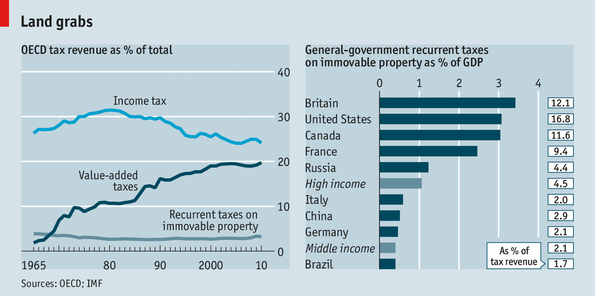
TAXES on property go back a long way. Ancient civilisations from Greece to China had levies on land. In 11th-century England the Domesday Book, a record of who owned what land, documented William the Conqueror’s tax base. Britain had a window tax in the late 17th century, well before it introduced an income tax. In America local governments have raised money from property taxes since the colonial era; the federal income tax has been in place only since 1913.But property taxes are much less prominent than they once were. To fund rising government spending, far more cash is raised from other sources, particularly income taxes, payroll taxes and value-added taxes (see left-hand chart). A new studyby John Norregaard of the International Monetary Fund suggests that the average rich country, including all levels of government, raises under 5% of total tax revenue from annual levies on land or the buildings on it. The norm in middle-income emerging economies is lower still, at around 2% of all tax revenue (see right-hand chart). Including property-transaction taxes like stamp duty raises the total a bit but not by much.
These averages mask big differences. Property taxes loom largest in Anglo-Saxon economies. In America they still account for 17% of all government revenue; in Britain and Canada the figure is around 12%. Only 2% of revenues come from annual property taxes in Germany and Italy; in Switzerland it is a mere 0.4%. A small share of national tax revenue can belie the importance of property taxes for the local governments that tend to levy them. In Australia and Britain taxes based on property are the only source of local-government tax revenue. America’s local authorities get around 70% of their revenue from property taxes. But, overall, property taxation plays a relatively small role.
That’s a pity. Taxing land and property is one of the most efficient and least distorting ways for governments to raise money. A pure land tax, one without regard to how land is used or what is built on it, is the best sort. Since the amount of land is fixed, taxing it cannot distort supply in the way that taxing work or saving might discourage effort or thrift. Instead a land tax encourages efficient land use. Property developers, for instance, would be less inclined to hoard undeveloped land if they had to pay an annual levy on it. Property taxes that include the value of buildings on land are less efficient, since they are, in effect, a tax on the investment in that property. Even so, they are less likely to affect people’s behaviour than income or employment taxes. A study by the OECD suggests that taxes on immovable property are the most growth-friendly of all major taxes. That is even truer of urbanising emerging economies with large informal sectors.
Property taxes are a stable source of revenue in a globalised world where firms and skilled people can easily move. They are also less prone to cyclical swings. In the financial bust America’s state and local governments saw smaller declines in property taxes than other forms of revenue, largely because the valuations on which tax assessments are based were adjusted more slowly and less dramatically than actual prices. Property taxes may even restrain housing booms by making it more expensive to buy homes for purely speculative purposes.
Given these advantages, why don’t governments raise more money from property? A few are trying to. Mr Norregaard cites almost 20 countries that have recently introduced new property taxes, or are considering doing so. Namibia recently introduced a land tax on agricultural land; Ireland is reintroducing a tax on residential property that was abolished in 1997. Britain’s opposition Labour Party has suggested taxing developers who sit on land and don’t build on it. But given the scale of the fiscal crunch, surprisingly few governments have gone down this route.
Like it or lump it
One explanation is that many governments lack the information to exploit these sorts of taxes. Lots of emerging economies (and some supposedly emerged ones such as Greece) do not have the modern equivalent of the Domesday Book, a clear cadastre of who owns what. But the big reason is that these taxes are wildly unpopular, often spawning opposition quite out of proportion to their scale. Mario Monti, Italy’s former technocrat prime minister, lost the election earlier this year for many reasons but his much-loathed decision to raise a tax on property played a substantial part. Asked in surveys what is the worst or least fair tax, Americans consistently cite property taxes.
Economists are more divided about the “fairness” of property taxes than they are about their efficiency. For a long time the prevailing consensus was that property taxes were regressive because the burden would be passed on to tenants and workers. Today another school of thought is more popular. It argues that in an efficient capital market the burden of property taxes is borne by owners of capital across the economy; and since capital owners tend to be richer, the tax is likely to be progressive.
Nuanced judgments about progressivity are not what drive political opposition to these taxes. Voters hate property taxes because they are what economists call “salient”: the burden is obvious, easy to calculate and hard to avoid. An intriguingnew paper by Marika Cabral and Caroline Hoxby at Stanford University shows what a difference this makes. Most American homeowners pay their property taxes in one or two lump sums during the year. Around a third (mainly those with mortgages) have their tax payments bundled in with monthly mortgage payments. The economists find that how people pay their property taxes affects their tolerance for them. The more people pay in lump sums, the lower property taxes are likely to be. For property taxes to become a much bigger source of revenue, governments must apparently ensure people don’t realise how much they are paying.
Sources
“Taxing Immovable Property. Revenue Potential and Implementation Challenges”, by John Norregaard. IMF Working Paper WP/13/129. May 2013
“The Hated Property Tax: Salience, Tax Rates, and Tax Revolts”, by Marika Cabral and Caroline Hoxby. November 2012
“Tax Policy Reform and Economic Growth”. OECD. November 2010.
 About bambooinnovator
 Bamboo Innovator