Early Calculator: The Sad Story of an Inventor at Buchenwald; A Viennese engineer worked meticulously in a concentration camp on the world’s first pocket calculator. After the war, others profited from his invention
July 4, 2013 Leave a comment
07/03/2013 04:49 PM
Early Calculator: The Sad Story of an Inventor at Buchenwald
By Frank Thadeusz
A Viennese engineer worked meticulously in a concentration camp on the world’s first pocket calculator. After the war, others profited from his invention.
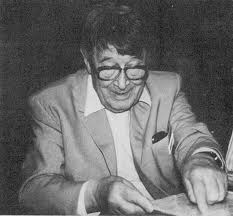
Curt Herzstark’s fate seemed to be sealed in 1943 when the Nazis sent him to Buchenwald concentration camp. But then Herzstark, the son of a Jewish industrialist, received the unexpected opportunity to become an Aryan. “Look, Herzstark,” one of the camp commandants said to him, “we know that you are working on a calculating machine. We will permit you to make drawings. If the thing is worth its salt, we’ll give it to the Führer after the final victory. He’ll certainly make you an Aryan for that.”
The engineer had made a pact with the devil. Night after night, after daily forced labor in the camp, Herzstark made detailed design plans for the world’s smallest mechanical calculating machine. He was given special rations as motivation, and he eventually survived the concentration camp. But there was no final victory, and Hitler was never able to enjoy the invention.Herzstark’s life should have turned to fame and fortune after the end of the war, because the Viennese inventor was something of a Steve Jobs of the mechanical age. His design was revolutionary. At a time when bookkeepers and counting house owners used heavy office machines and pencils to cope with monstrous columns of numbers, he surprised the professional world with a small, elegant device that performed the four basic arithmetic operations and fit into the pocket of every work coat.
In fact, the highly talented man became one of the unluckiest people in the history of technology. Now Herbert Bruderer, an expert on the history of computer science at ETH Zurich, wants to rescue the brilliant Herzstark from oblivion. In the course of his research, Bruderer delved deeply into the story of “this sad life.”
A Rising Star
It all began very optimistically. Herzstark achieved what had eluded many engineers before him. He solved the mystery of how to place the various stepped reckoners for the individual arithmetic operations in a tiny case. The inventor resorted to radical simplification.
He achieved a design in which, for example, the reckoner for addition could also compute subtractions when a lever was shifted. In 1938 Herzstark patented his mechanical pocket calculator, which looked like a cross between a pepper mill and a hand grenade.
It could have marked the beginning of a success story, but a few months after Herzstark had gone to the patent office, the Nazis invaded Austria and annexed the Alpine republic. Herzstark was only allowed to keep his Vienna company because his mother was a Catholic. But from then on the company was required to build precision instruments for German tanks. For the time being, the miniature calculator remained nothing but theory.
After a dispute with a senior member of the Gestapo who had two of his employees arrested for alleged espionage, Herzstark ended up at Buchenwald. Astoundingly, it was under the inhuman conditions at the concentration camp that Herzstark managed to turn his concept of a mechanical pocket calculator into concrete reality. But the liberation from the Nazi dictatorship, a godsend for the oppressed inmates, also put an end to Herzstark’s efforts.
A Bad Run of Luck
When he returned to Vienna after the war, Herzstark discovered that his brother Ernst had taken over the family business while he was in the concentration camp. In the 1930s, Ernst was known for little more than shooting clay pigeons and owning expensive cars.
“He wasn’t particularly knowledgeable,” Herzstark said about his younger brother, which is why the gifted engineer didn’t want to share his valuable patent with him. Herzstark also had a bad run when it came to choosing his future business partners. The world’s smallest mechanical calculator went into series production in 1948 under the name “Curta,” but for Herzstark, there was no reason to celebrate.
Businessmen working with Liechtenstein’s royal family had used every trick in the book to rip off the unsuspecting Herzstark, who suffered from intermittent bouts of tuberculosis. Instead of becoming an equal co-owner of the calculating machine factory, the engineer was soon essentially forced out of production.
In 1952, after a grueling battle, Herzstark agreed to be paid off with a ridiculously small sum of money. The mechanical pocket calculator remained his opus magnum. He did not produce any other major invention up to his death in 1988.
The “Curta” met an abrupt end with the dawn of a new era. When the first electronic pocket calculators, with their red and green LED letters, came on the market in 1971, the mechanical mini-computer from Vienna was suddenly obsolete.
 About bambooinnovator
 Bamboo Innovator