Quebec rail disaster shines critical light on oil-by-rail boom
July 8, 2013 Leave a comment
Quebec rail disaster shines critical light on oil-by-rail boom
6:59pm EDT
By Scott Haggett, Dave Sherwood and Cezary Podkul
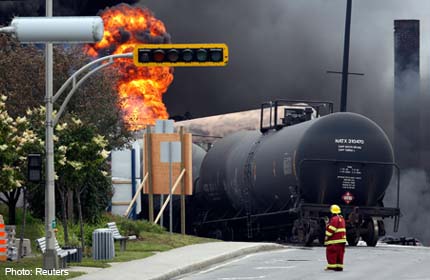
(Reuters) – The deadly train derailment in Quebec this weekend is set to bring intense scrutiny to the dramatic growth in North America of shipping crude oil by rail, a century-old practice unexpectedly revived by the surge in shale oil production. At least five people were killed, and another 40 are missing, after a train carrying 73 tank cars of North Dakota crude rolled driverless down a hill into the heart of Lac-Megantic, Quebec, where it derailed and exploded, leveling the town center. It was the latest and most deadly in a series of high-profile accidents involving crude oil shipments on North America’s rail network. Oil by rail – at least until now – has widely been expected to continue growing as shale oil output races ahead far faster than new pipelines can be built.Hauling some 50,000 barrels of crude, the train was one of around 10 such shipments a month now crossing Maine, a route that allows oil producers in North Dakota to get cheaper domestic crude to coastal refiners. Across North America, oil by rail traffic has more than doubled since 2011; in Maine, such shipments were unheard of two years ago.
“The frequency of the number of incidents that have occurred raises legitimate questions that the industry and government need to look at,” said Jim Hall, managing partner of consultants Hall & Associates LLC, and a former chairman of the U.S. National Transportation Safety Board.
“The issue here is: are they expanding too rapidly?” he said. “Are they in a rush to accommodate and to make the economic advantage of carrying these?”
MUCH AT STAKE
There are many unanswered questions about the Quebec disaster that will likely shape the public and regulatory response, including why a parked freight train suddenly began rolling again, and why carloads of crude oil – a highly flammable but not typically explosive substance – caused such widespread disaster.
“There may have been some vapors, maybe? I don’t know. We don’t know exactly what happened,” Edward A Burkhardt, chairman of Montreal, Maine & Atlantic Railway, said in an interview on Saturday when asked about why the tankers may have exploded.
Apart from the human toll, the disaster will draw more attention to environmental risks of transporting oil.
Much is at stake: Oil by rail represents a small but important new source of revenue for big operators like Canadian Pacific Railway Ltd and Warren Buffett’s BNSF, which have suffered a drop in coal cargo. It is also a flexible and cheaper option to more expensive European or African crude for refiners like Irving Oil, which confirmed on Sunday that the train was destined for its 300,000 bpd plant in Saint John, New Brunswick.
And for producers like Continental Resources Inc which have pioneered the development of the Bakken fields in North Dakota, railways now carry three-quarters of their production; new pipelines that can accommodate more oil are years away.
Saturday’s train wreck may also play into the rancorous debate over the $5.3 billion Keystone XL pipeline from Canada to the U.S. Midwest, which is hinging on President Barack Obama’s decision later this year.
Obama said last month that approval for the line would ultimately depend on its impact on carbon-dioxide emissions. An earlier draft report from the State Department suggested that rejecting the project would not affect emissions because crude would still be shipped by rail.
As a result, the incident may strengthen the resolve of those opposed to the Keystone pipeline rather than soften resistance. The oil industry at large is already broadly supportive of both rail and pipeline transport.
“Committed critics … could conceivably seize upon the Lac-Megantic incident – in tandem with recent pipeline spills – to argue against oil production, irrespective of its mode of transport,” said Kevin Book, managing director of Research at ClearView Energy Partners.
MOVE IT BY RAIL
The railway industry has this year mounted a more robust effort to counter the suggestion that rail is a riskier way to transport crude than pipelines.
The American Association of Railroads has declined to comment on Lac-Megantic, but previously said its spill rate – based on the number of gallons of crude oil spilled versus every million miles of transport per barrel – is less than half that for pipelines.
The AAR also said the number of train accidents involving the release of hazardous material has dropped by 26 percent since 2000, and by 78 percent since 1980.
Since the beginning of the year, U.S. railroads moved nearly 360,000 carloads of crude and refined product, 40 percent more than in 2012, according to the AAR. In Canada, year-to-date traffic is up 24 percent.
With that growth has come a number of high-profile spills and accidents, many on Canadian Pacific Railway’s network, which runs through Alberta, the largest oil exporter to the United States, and the Bakken field.
Canadian Pacific suffered the industry’s first serious spill in late March, when 14 tanker cars derailed near Parkers Prairie, Minnesota, and leaked 15,000 gallons of crude. Regulators have not released the results of their investigation into the incident, and Canadian Pacific declined to comment.
Even before Saturday’s disaster, the practice of shipping oil by rail was stirring opposition in Maine.
“It’s a wake-up call of the worst kind,” said Meaghan LaSala, an organizer with 350 Maine, a group that opposes the hydraulic fracturing – or “fracking” – technology that makes shale production possible. “They say rail is the safest method, but there simply is no guaranteed way to transport such highly toxic and explosive materials.”
TOO SOON TO SAY
Many observers say it is too soon to say if the Lac-Megantic disaster will quell the crude-by-rail boom. Refiners not connected to the Midwest pipeline network will still use rail to access the cheapest crudes.
“On the face of it this should be a boost for pipeline solutions, especially given the improvements in pipeline technology over the past five decades,” said Ed Morse, managing director of commodity research at Citi Group.
But he and other analysts noted that not every devastating tragedy leads to new policy.
“We need all forms of transportation for oil, whether they’re rail, whether they’re pipeline, and no system is failsafe,” Charles Drevna, president of American Fuel and Petrochemical Manufacturers, said in a phone interview.
For Montreal, Maine & Atlantic Railway, crude oil shipments are a relatively new phenomenon. With just 510 miles of line, the small railway primarily carried paper and forest products until the financial crisis, and had suffered in the years after until the shale boom came along.
In the first four months of the year, it carried about 16,500 barrels per day (bpd) of crude, 10 times more than a year before and up from zero in early 2011, according to data from the Maine Department of Environmental Protection.
“In the 10 years or so we’ve been in business, this is the only serious derailment we’ve ever had,” Burkhardt told Reuters in the interview.
Henry Posner III, a former business partner who invested with Burkhardt in a railroad in Estonia, said he could not recall any incidents similar to what happened in Quebec during the 5-1/2 years they were in business together.
“Safety is the most important component of railway culture in North America and that’s one of the things we’re most proud of having exported to Estonia,” said Posner, who chairs Railroad Development Corporation, a Pittsburgh-based company that invests in railroads.
Oil-laden runaway train derails and explodes in Canadian town
The driverless train hauling tankers of crude oil derailed and exploded in the middle of a small Canadian town, destroying dozens of buildings and killing several people. -Reuters
Mathieu Belanger
Sun, Jul 07, 2013
Reuters
LAC-MEGANTIC, Quebec – A fast-moving, driverless train hauling tankers of crude oil derailed and exploded into a sky-high fireball in the middle of a small Canadian town early on Saturday, destroying dozens of buildings and killing several people.
The disaster took place soon after 1 a.m. (0500 GMT) when the runaway freight train with 72 cars and five locomotives hurtled into Lac-Megantic, a lakeside town of about 6,000 in the province of Quebec, and left the tracks.
Police spokesman Guy Lapointe said one person had died, and that toll would rise, but he declined to comment on media reports that anywhere between 40 and 80 people were missing.
“We have already confirmed one death and we expect there will be others,” he told a news conference. “We also expect that the number of people reported missing will be greater than the final death toll.”
Crude oil shipments by rail have become increasingly popular in North America as pipelines fill to capacity and more and more oil is produced in western regions like Alberta and North Dakota. But accidents on this scale are rare.
Four of the cars – which each carried 30,000 gallons of North Dakotan crude oil – caught fire and blew up in a fireball that mushroomed many hundreds of feet into the air.
It destroyed dozens of buildings, many of them totally flattened, included stores, a library and the popular Musi-Cafe music bar, eyewitnesses said. The town centre was crowded with weekend partygoers at the time.
Lapointe said it was hard to calculate the number of possible victims because the area was still too dangerous for police to examine properly. Some people had been reported missing more than once, and some were nowhere near the town.
The blast ruptured a water main, creating a shortage of drinking water, forcing the town to bring in special tankers.
The centre of town remained blocked off, but from the air, it was clear that many buildings had been reduced to little more than piles of bricks and wood. Residents’ photos showed the burnt out hulks of cars next to smashed houses.
After the blast, burning crude spilled into the storm sewers and rose up through street manholes, setting buildings on fire, the head of the rail company that ran the train told Reuters.
Edward Burkhardt, chairman of Montreal, Maine & Atlantic Railway, said an engineer had parked the train some distance from the town a few hours before the disaster.
“He claims he set the brakes on all five of the engines. He also claims he set the brakes on a sufficient number of cars on the train,” he told Reuters in an interview.
Officials said they had few reports of injured victims, suggesting that people caught up in the blast either died on the spot or managed to escape. One woman told Radio-Canada that she had been unable to contact around 15 of her friends.
Stunned town residents cried in the streets as the impact of the blast sank in. Some hugged each other for comfort.
The rail tracks pass next to the Musi-Cafe, which is popular with young people. Eyewitness Yvon Rosa said he had just left when he saw the train speeding into the middle of the town.
“I have never seen a train traveling that quickly into the centre of Lac-Megantic,” he told Radio-Canada, saying he watched as the train careened around a bend. “I saw the wagons come off the tracks … everything exploded. In just one minute the centre of the town was covered in fire.”
Residents said they had heard five or six large blasts. More than 21 hours after the derailment, one car was still burning and firefighters, some of them from the United States, were still spraying cold water from the lake on five unexploded tanker cars they said posed a particular danger.
CENTER OF TOWN ‘ALMOST DESTROYED’
Police imposed a 1/2-mile (1-km) security zone around the blast and evacuated a total of about 2,000 people from their homes.
“When you see the centre of your town almost destroyed, you’ll understand that we’re asking ourselves how we are going to get through this event,” a tearful Town Mayor Colette Roy-Laroche told a televised news briefing earlier in the day.
The Canadian Transportation Safety Board, which probes all accidents, said it was looking for the train’s “black box” data recorder.
Lac-Megantic is part of Quebec’s Eastern Townships region, an area popular with tourists that borders both Maine and Vermont. Quebec is a predominantly French-speaking province in the eastern half of Canada.
Montreal, Maine & Atlantic owns some 510 miles (820 km) of track in Maine and Vermont in the United States and in Quebec and New Brunswick in Canada.
The debate over shipping oil by rail is becoming increasingly topical as US President Barack Obama decides whether to approve TransCanada Corp’s proposed Keystone XL pipeline from the oil sands of Alberta to the Texas coast.
Backers of Keystone XL – a project that environmentalists strongly oppose – say transporting oil by pipeline is safer than using rail cars.
There have been a number of high-profile derailments of trains carrying petroleum products in Canada recently, including one in Calgary, Alberta, last week when a flood-damaged bridge sagged toward the still-swollen Bow River. The derailed rail cars were removed without spilling their cargo.
 About bambooinnovator
 Bamboo Innovator