‘Abenomics’ Brings an IPO Flood
July 10, 2013 Leave a comment
Jul 9, 2013
‘Abenomics’ Brings an IPO Flood
By Kana Inagaki
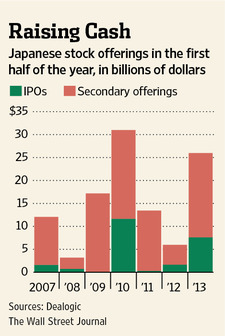
As equity fundraising slows in other Asian markets, Japanese companies such as Suntory Beverage & Food Ltd. 2587.TO +2.37% are raising billions of dollars by issuing shares, pushing capital raising in Japan during the first half of 2013 to a three-year high. Olympus Corp. 7733.TO +2.36% said Monday that it would seek to raise as much as $1.2 billion through a new share offering. Last week, advertising company Dentsu Inc. 4324.TO -0.31%and home builder Daiwa House Industry Co. 1925.TO +0.22% said they would look to raise $1.2 billion and $1.4 billion, respectively. And Suntory Beverage & Food Ltd. listed in Tokyo last week after raising $3.9 billion in Asia’s biggest initial public offering this year.In all, Japanese companies raised a total of $26 billion in the stock market during the first half of this year—the most in any first half since 2010. That included $7.6 billion via IPOs, putting Tokyo in second place globally, behind the U.S., according to Dealogic. Follow-on offerings, in which listed companies issue new shares, rose fourfold from the same period a year earlier to $18.3 billion, Dealogic said.
Underpinning the jump in issuance has been “Abenomics,” the pro-growth policies of Prime Minister Shinzo Abe. Hopes that his efforts will succeed have fueled big gains on the Tokyo Stock Exchange over the past eight months, greatly improving sentiment among investors and corporate financial officers.
Takuya Yamada, a senior fund manager at Astmax Asset Management Inc., which has around $1 billion in assets under management, said he expects the surge in offerings to continue at least through the end of the year. “One big positive is that offerings are being priced at levels that investors find acceptable,” he said.
To be sure, fundraising hasn’t returned to levels seen in the early and mid-2000s. But despite a harsh selloff in late May and early June, the Nikkei Stock Average is still up more than 60% since mid-November, helping to support solid demand for new shares.
All 21 Japanese companies, excluding real-estate investment trusts, that listed during the first half saw their shares open higher in their trading debuts. And five of the six IPOs that came out after May 23—the day the selloff began—are trading above their offering prices.
Suntory priced its IPO at the low end of the range it had indicated to investors due to the market volatility, but its shares have risen every day since their debut last week. They now sit 8.9% above the offering price.
Fund managers and bankers say that barring an external shock, they expect investors, especially Japanese retail investors, to continue buying new offerings and Japanese companies to go on issuing shares.
Bankers say there are no IPOs the size of Suntory’s in the pipeline for the second half of the year, but smaller companies in the biotechnology and smartphone sectors will continue to hold new offerings. More retail and service-sector IPOs are expected to emerge as Japan’s economy regains its footing.
The market’s recent decline isn’t expected to deter companies from holding secondary offerings either, said Makoto Ito, co-head of the Japan financing group at Goldman Sachs Group Inc. GS +2.03% “Despite the market volatility, corporate sentiment appears to be intact,” he said.
Retail Japanese investors, who are key to smaller companies’ offerings, remain active in the market, said Norimi Omura, executive director of the IPO department at Nomura Securities Co., the biggest player in Japan’s IPO market. “As long as the market is active, the IPO popularity is expected to continue for some time,” he said.
If market conditions hold up, there is a chance that cash-strapped Sharp Corp. 6753.TO -0.93%, for one, could issue new shares to bolster its balance sheet, bankers said. A Sharp spokeswoman said the company is considering all options to bolster its capital.
To be sure, the market remains vulnerable to the possibility that trouble could come from outside Japan, such as a slowdown in China and other emerging markets. Many investors cite that possibility as the biggest risk in the months ahead.
The recent raft of big follow-on offerings has also raised concerns among some investors. Shares in Dentsu, Daiwa and Olympus have all tumbled more than 5% since they announced their offerings. Investors have worried about dilution, the prospect that the issuance of new shares will reduce the value of existing stock.
Koji Nakatsuka, a Tokyo-based fund manager at Allianz Global Investors who manages around ¥8.5 billion invested in small and medium-sized Japanese stocks, said companies that hold dilutive share offerings without convincing plans to use the money to grow risk a poor reception from investors.
“One thing I’m concerned about is the tendency for companies to carry out equity issuances that are not necessary and just because shares are rising,” he said.
 About bambooinnovator
 Bamboo Innovator