NHN, operator of Korea’s dominant online portal Naver, is emerging as a public enemy for destroying the cyber ecosystem by expanding its territory to non-core businesses at the expense of smaller players
July 18, 2013 Leave a comment
2013-07-17 17:14
‘Naver the online predator’
Big portal dominates, dictates flow of information on cyberspace
By Kim Yoo-chul
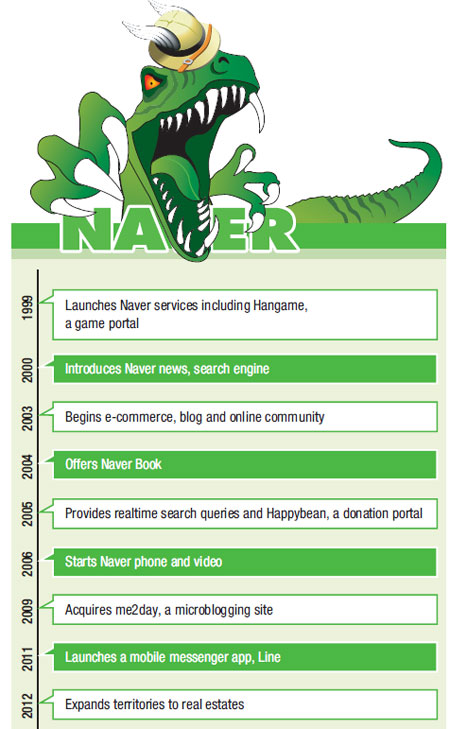
NHN, operator of Korea’s dominant online portal Naver, is emerging as a public enemy for destroying the cyber ecosystem by expanding its territory to non-core businesses at the expense of smaller players.
It has become a principal target of monitoring by the Park Geun-hye administration which has pursued “shared growth” to ensure a level playing field.
The Fair Trade Commission (FTC) is currently investigating NHN for abusing its bargaining power and distorting the market.FTC officials and other sources told The Korea Times that the regulator will heavily fine NHN for monopolizing the market, which it believes damages significantly the soundness of the local online content industry.
“NHN may insist that its dominance is due to consumer choice, and that’s understandable. But the fact is that we don’t see many small-scale content providers with strong competitiveness. The government needs to actively intervene in the industry to ensure fair competition and a better business ecosystem,” said an FTC official, asking not to be named.
He said that the FTC has collected evidence of the firm’s illegal business practices. FTC Chairman Noh Dae-lae has also vowed to punish the portal operator for excessively dominating the market and limiting consumer choices.
The ruling Saenuri Party plans to introduce a bill to address monopoly issues created by NHN in September.
In a recent speech during a parliamentary session, Saenuri’s floor leader Choi Kyung-hwan pointed out that major Internet portal operators are pressuring their content suppliers and monopolizing investment, production and distribution of content.
Rep. Kim Yong-tae of the ruling party echoed the view, saying, “Small firms are often being abused by large portal sites. We are mulling submitting a bill in September after thorough investigation and discussion.”
NHN controls around 80 percent of the local online search market. Small and medium content firms said survival has already been their focus because competition is impossible under the current market situation. Daum and Nate account for much of what remains in the market, according to data by the two companies.
The FTC said NHN has been forcing several content developers with which it has business contracts not to open business accounts with rival portals including Daum and Nate.
FTC officials said that the government agency found some evidence to support this claim.
“Local competitors such as Gmarket and 11th Street were not allowed to upload their services on NHN’s open market, Shop N. Only the N is allowed to sell goods and services on the online market, and this limits consumer choice and goes against fair market competition,” said the official
Will NHN surrender?
NHN officials said it is considering dropping some of its non-core businesses such as real estate, web cartoons, web fiction and music-related services, though a spokesperson said nothing has been decided yet.
CEO Kim Sang-hun admitted that technically his company enjoys this market dominance. However, he stressed it’s unfair that NHN is being criticized because of this.
“A monopoly isn’t bad in itself. It’s the side effects that come from monopoly that could be really bad. Consumers chose to use our portal. In today’s wired world, a user will see other similar services with a simple click,” the chief executive told reporters in an industry meeting in Seoul last month.
Citing Google and YouTube, Kim, a former judge, claimed any active intervention by the government in the market will hurt companies’ efforts to produce innovative products and discourage evolution in businesses.
Regarding NHN’s real estate- and media-related services, the executive insisted they contributed to the local market by providing more business opportunities to small- and medium-sized enterprises (SMEs).
However, small companies do not buy the CEO’s words.
“NHN had promised earlier that it will help small local ventures generate revenue under a new Internet ecosystem. But it failed to follow its pledge,” said Kim Min-seong, a 35-year-old businessman who is the CEO of a local content provider, which has been struggling to survive in the past few years.
Kim insisted that the Internet giant has so far been trying to improve its negative image by offering increased returns to developers, which he said was only a “tactical and one-off effort.”
“I think NHN should announce some comprehensive measures to help grow local SMEs. I believe it can join the ranks of other local conglomerates including Samsung, LG and Hyundai in terms of investing more to create better business ecosystems,” said Kim.
Despite the CEO’s defense of his company, however, it appears that the government will not change its stance and will continue to pressure the operator.
Choi Moon-ki, head of the Ministry of Science, ICT and Future Planning, expressed his concerns about NHN’s dominant market position at his first press conference last month as the minister.
He said NHN focused too much on external growth under the helm of a young CEO and urged the firm to think more about making a contribution to society.
2013-07-17 16:38
NHN’s expansion forces out small players
By Park Ji-won
NHN is facing growing Criticism for monopolizing Not Only The Web Portal market but also The app Business for Mobile Phones and Tablets, using its dominant status as The Country’s Largest Search Engine. The operator of Korea’s dominant Online Portal Naver has expanded its Business areas to Online information Services Markets, Including Shopping, Real Estate, Web fiction and music, marginalizing many Small Players in The Process. About 89.8 percent of smartphone subscribers visited NHN’s Portal, Naver, or USED its Search app at least once between June 30 and July 6, According to Mobile Firm Rankey.com research.Most Searched information by users of The Visiting Naver’s Online site. “In The Mobile Search segment, Naver does not have as much influence as IT does on The Internet. Share It Struggles to Expand its market in The Mobile industry, “said an Official at NHN, who declined to be named. however, Naver Requires users to install apps for its Various Services, Including Games, cartoons, and even Real Estate Brokerage. The Corresponding Figures for Visitors During The same period were 57.6 percent for Google, 47.6 percent for Daum and 25.8 percent for Nate. According to market Insiders, some 90 percent of smartphone users in Korea have Phones with Google’s Android System, such as Samsung’s Galaxy Phones. People Believe That makes that Google is in a position to Better Compete with other app is its readily Because Search engines Available in Android Phones.however, NHN is unrivaled. Researchers say More than 80 percent of smartphone subscribers are using Naver in Korea. Instant Messenger In The segment, NHN’s The Line attracted 180 million users at end of June, Only One year and Seven months after its Launch. It easily broke the record of Kakao Talk, the No. 1 instant messenger service in Korea, which reached 100 million users in three years and three months. Line Insiders say market is expected to reach 200 million users by August. “Naver Mobile Search The market was able to dominate its Chief competitor Because Very easily, Daum, was slow in reacting to The fast-changing market, especially in segment The Search app , “said Analyst ST Hwang at Hana Daetoo Securities. “Even though Google’s Search Engine app is readily installed in Android Devices, English users feel Naver Provide More user-friendly Services Because they are USED to Naver’s Integrated Search System.” Commenting on NHN’s Future Business Strategies, Hwang said that The Firm Will Allocate Resources to More of its Kakao Talk Line to surpass. “Even though NHN is Drawing Criticism for its Aggressive Business Expansion Media, IT does not Listen. It thinks it still has many businesses to do, including the instant messaging one, “he said.
2013-07-17 15:51
Stricter checks needed to weaken dominance
By Kim Yoo-chul
The nation’s regulator should beef up monitoring on NHN, the operator of the nation’s dominant Web portal, Naver, in order to prevent the dominance from killing smaller players in the industry, according to an IT expert, Tuesday.
But he also pointed out that the control will be carried out in a very sophisticated manner to avoid infringing on consumers’ rights of choice.
In an interview with The Korea Times, Kim Il-tae, a senior fund manager at Taurus Investment Management, said that the government needs to closely monitor NHN for any potential wrongdoings.
He added it’s not desirable for the portal operator to extend its significant power into non-core businesses such as real estate and wholesale because doing so may kill smaller firms in those industries.
“What I want to say is that NHN needs to find measures to increase its corporate awareness. Giving developers a higher ratio of returns over earnings, holding forums for developers and providing visible support to SMEs are possible actions NHN can take,” he said.
NHN is now under siege as lawmakers and regulators are joining forces to urge the firm to reduce its tremendous power over advertisers and software developers and promote balanced growth with local small and medium enterprises (SMEs) in order to produce diversified content.
Kim, however, pointed out that the government should be more prudent in regulating the firm because its excess interference in the mobile content industry can hurt consumers’ rights.
“Basically, ‘winner takes all’ is the formula in the Internet portal business. Users search for information they need via Internet portals, and this means popular and big portals have greater user numbers. This is the nature of the business,” said Kim.
Citing similar situations in other countries ― Google dominating in the United States with a 67 percent share, Baidu in China with 78 percent and Yahoo in Japan with 54 percent ― the fund manager said NHN’s 74 percent local market share is not a surprise.
“When you talk about mobile messengers, you may claim that NHN controls too much of the market. But users are generally inclined to frequency rates. Kakao Talk here, NHN in Japan and WeChat in China each control 70 percent of the national market. That’s why the bargaining power should be centralized,” Kim said.
About Seoul’s recent announcement to release a set of measures to limit the accessibility of web board games, the fund manager said the measures will hurt what he claims are the basic rights of game users.
The proposed policies, which include limiting monthly game money purchases, activating playing bans for daily losses and mandating identification certification for access, have triggered an industry backlash.
“The regulatory stance doesn’t make any sense,” Kim said.
Finally, Kim pointed out the government needs to reconsider implementing the above “mobile shutdown” measures because he believes the measures will hurt NHN’s global competitiveness.
“The local mobile gaming industry is just starting to take off. Still, local gamers already prefer games that run on Apple iOS and Google Play software. If the government pushes to implement the regulatory measures, the related industries will lose more value.”
The Fair Trade Commission (FTC), the nation’s top antitrust agency, is still investigating NHN for possible unfair business practices. The FTC recently visited NHN’s headquarters to inspect their offices and collect documents.
Naver wields monopoly to squeeze self-employed
By Choi Yong-seong, Jeong Seok-ooh, Won Yo-hwan
2013.07.09 11:07:07
South Korea’s largest web portal Naver is running a monopoly with a 70 percent market share. The search ad price for flower delivery on Naver (based on “power link” ad price) tripled to 26 million won ($22,665) from 7.8 million won in 2008 in the past five years, according to information obtained by Maeil Business Newspaper. In addition to flower delivery, most of small-scale self-employed businesses covering tailored uniform, Korean-English translation, and souvenirs are forced to pay exorbitant search ad prices as there is no competitor matching the Naver’s presence.The problem runs deeper. The search engine is accused of diverting users to advertiser-paid contents, blocking users’ access to other contents. Some argued such practice of exploiting its dominant market position and confining users within its domain derails the government’s drive for “creative economy.” Kim In-seong, a computer science professor at Hanyang University, said “an online service that fulfills brilliant ideas is the most optimal model for implementing the creative economy.” The professor said “Naver’s strategy of luring users to a narrow spectrum of contents puts the domestic contents industry at the risk of collapse.”
 About bambooinnovator
 Bamboo Innovator