Once a Bridge to Renewable Energy, Shale Gas Is Now Cheap and Widely Available
July 19, 2013 Leave a comment
July 18, 2013, 8:46 p.m. ET
So What’s the Matter With Shale Gas, Anyway?
Once a Bridge to Renewable Energy, Shale Gas Is Now Cheap and Widely Available
JOHN BUSSEY
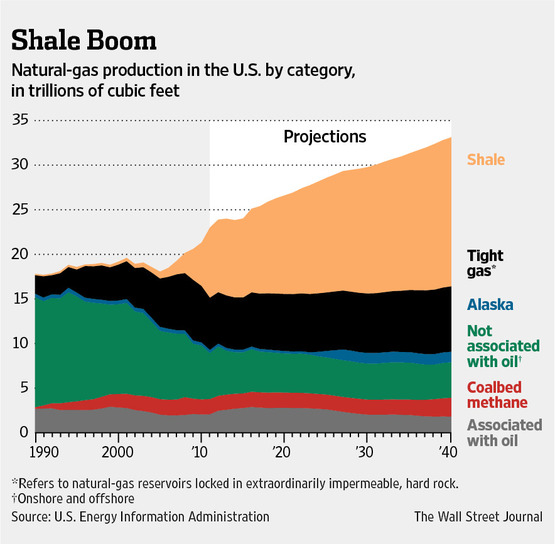
Sometimes it seems as if the environmental movement has been left behind by the sheer speed of America’s shale energy revolution. That may be because a resource—natural gas—that environmental groups once saw as part of the solution has become part of the problem, at least as they see it. Shale gas and oil are widely viewed as one of the biggest forces to hit the U.S. economy in modern history. Total U.S. gas production has rocketed 33% since 2008 and oil 46%, driving down energy costs. The expanding shale industry supported 1.7 million jobs in 2012 and produced $62 billion in state and federal tax revenue, according to IHS/CERA, the energy consultancy.
“The new narrative about shale gas is about jobs, economic growth, global competitiveness, and a U.S. manufacturing renaissance,” says Dan Yergin, the energy expert and author of “The Quest.”
The public gets the narrative. A Pew Research poll found 48% of respondents favor increased use of hydraulic fracking of shale; 38% are opposed.
Where does this leave the environmental movement? Trying to change the conversation about shale gas.
For years, environmental groups saw gas as something of an ally in the cause. Gas has half the carbon footprint of coal. It was the ideal substitute for coal and a “bridge” to greater use of renewable energy such as wind and solar.
But as shale gas production soared, the price of natural gas plummeted. Environmental groups now worry that gas is moving in to stay, taking the momentum out of the shift to nonpolluting renewables, slowing conservation, and creating new environmental problems.
“To the extent that we’re locking in new gas power plants, it’s not the best way to build a cleaner society,” says Fred Krupp, president of the Environmental Defense Fund.
“The pace of development caught everyone by surprise, and environmental groups and our laws and regulators are playing catch-up,” says Dan Lashof of the Natural Resources Defense Council. “In a lot of cases, the gas industry has run roughshod over local communities.”
Gas, adds Michael Brune, head of the Sierra Club, “should be used as little as possible for as short a time as possible.” Renewables are the answer.
The broader environmental argument now goes like this: There’s an under-appreciation of how much methane leaks into the atmosphere when natural gas is fracked, piped and stored.
Methane, the chief component of natural gas, is many times more damaging to the environment than carbon. Sloppy production can erase the advantage gas has over coal. (The Environmental Protection Agency, however, recently found that industry pollution controls have reduced production-related gas leaks by 20% from previous estimates, even though more gas is being drilled.)
Meanwhile, the cost of energy produced from renewables is falling. States such as California and Colorado are expanding their targets for energy generated by renewable sources, and policy makers should do more to encourage this trend nationally, environmental groups say. Communities, they add, are increasingly bristling over pollution at drilling sites and the chemicals pumped underground to extract the gas.
And there’s the matter of climate change. Global limits on emissions, environmentalists contend, will inevitably crimp use of fossil fuels. Best to constrain the expanding use of gas now.
“The fundamentals of the industry are bad,” says the Sierra Club’s Mr. Brune. “You have a resource that’s becoming less competitive and more controversial over time.”
That said, “The reality now is that, for better or worse, gas is here,” says Mr. Krupp of the EDF. “It’s hard to imagine that Texas, Oklahoma, or Pennsylvania is going to stop pumping gas.”
So his organization has joined with Chevron, CVX +0.90% Shell, Consol Energy,CNX +2.86% and other environmental groups to construct voluntary best practices for shale development.
“There is a big opportunity now for more of the companies to step up and lead,” he says.
Narratives do change. It may not be wishful thinking for environmental groups to contend that a comprehensive shift to renewable energy is not only necessary but inevitable.
But for the moment at least, it’s also tough to argue with the transformative power of price. Dow Chemical DOW -0.43% and other big manufacturers are adding to operations in the U.S. to take advantage of the new low cost of gas energy.
That trend is speeding up, not slowing.
 About bambooinnovator
 Bamboo Innovator