Book Publishers Try to Sell Chinese Fiction in Translation

Book Publishers Try to Sell Chinese Fiction in Translation

By Christina Larson on July 18, 2013

AR-AD076_Picass_G_20130718212721

Although China is now the world’s second-largest economy, few Chinese writers are read outside the country or inform the global conversation. In 2012, American publishers purchased translation rights for just 453 foreign titles, about 3 percent of the total books published in the U.S. Of those, just 16 were books first published in Chinese, according to records kept by Chad Post, publisher of New York-based Open Letter Books press. (The percentages for translated books in the U.K. are similar, according to Open Letter.) “China has the largest reading public in the world, but until recently we’ve had relatively little access to its literary scene,” says Post. Yet he is optimistic about the future of translated Chinese works in America. “People are more familiar with China. The pitch for a book doesn’t have to rely on painting China as exotic and crazy anymore.” Read more of this post
SEC staff morale low, atmosphere marked by distrust: study

SEC staff morale low, atmosphere marked by distrust: study

Thu, Jul 18 2013

By Sarah N. Lynch

(Reuters) – The Securities and Exchange Commission is not the best place to work among federal agencies in Washington, according to a new study by a government watchdog. The SEC’s organizational structure “has not been conducive to motivating and encouraging a high level of performance,” concluded the Government Accountability Office in a report released on Thursday. “Many staff indicated that morale is low and a significant percentage characterize the atmosphere of the agency as one of distrust,” the GAO said. Read more of this post

Pot-Based Diabetes Drug Maker GW Sees Slowing of Illness

Pot-Based Diabetes Drug Maker GW Sees Slowing of Illness

The marijuana plant contains at least 60 different chemical compounds, only one of which gets a smoker high. GW Pharmaceuticals Plc (GWP) says one of the other 59 shows promise in treating Type 2 diabetes.

In a mid-stage study, an experimental drug, currently known by its candidate name GWP42004, helped improve the pancreas’s ability to produce insulin and led to a drop in blood sugar levels between meals, among other findings, according to the London-based company. GW plans to publish the results of that trial this year. Read more of this post

China Communist Party Fate Seen Resting on Farmers’ Land Rights

China Communist Party Fate Seen Resting on Farmers’ Land Rights

China’s growth and the future of the Communist Party rest on giving farmers their land and allowing equal rights for migrants in cities, according to the state researcher who wrote a reform road-map.

“Land and hukou reform is the cornerstone for future economic growth and political-system reform,” said Yuan Xucheng, of the China Society of Economic Reform, who was the lead author of a report submitted to top officials. Yuan spoke in an interview in Singapore last week. Hukou is the term for a household registration system which limits migrants’ rights. Read more of this post

Chipotle under attack by noodles and clones

Chipotle under attack by noodles and clones

7:43pm EDT

By Lisa Baertlein

LOS ANGELES (Reuters) – Chipotle Mexican Grill (CMG.N:QuoteProfileResearchStock Buzz) is one of the restaurant industry’s hottest stocks, but fickle diners and an ever-expanding selection of entrepreneurial eateries threaten to make it harder for the upscale burrito seller to keep delivering the explosive growth investors savor.

After two decades without significant direct challenges in the “fast-casual” category, Chipotle is bumping up against a bevy of new rivals that also sell $10 meals made right before diners’ eyes in the open assembly-line kitchens it popularized. Read more of this post

Oreo, Meet Dorito: Does Merging PepsiCo and Mondelez Make Sense? Nelson Peltz Thinks So

Updated July 18, 2013, 8:43 p.m. ET

Oreo, Meet Dorito

Does Merging PepsiCo and Mondelez Make Sense? Nelson Peltz Thinks So

MIKE ESTERL and JULIE JARGON

MK-CE866B_PEPSI_G_20130718182708

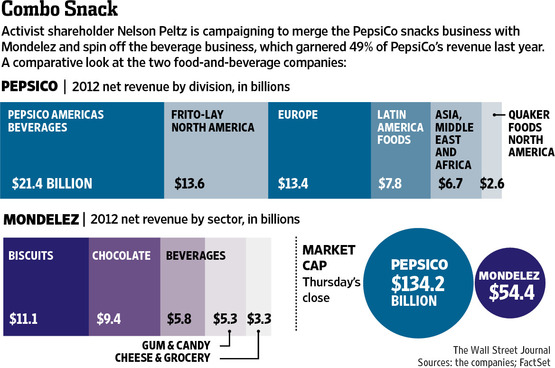
Activist investor Nelson Peltz thinks PepsiCo Inc.’s PEP +1.83% salty snacks go better with the sweet snacks at Mondelez International Inc. than soda and Gatorade. Wall Street isn’t as enthusiastic about Mr. Peltz’s suggestion, made Wednesday, that PepsiCo buy Mondelez in an $80 billion deal and then spin off PepsiCo’s beverage business. Shares of Mondelez inched up 0.3% to $30.58 on Thursday, still far below the $35 to $38 a share that Mr. Peltz said PepsiCo should pay for Mondelez, indicating investors see such a deal as far from certain. PepsiCo shares rose 1.8% to $86.80, a sign that investors are chewing over Mr. Peltz’s idea but not too sure of where it might go. The megadeal—envisioned in a white paper from Mr. Peltz’s Trian Fund Management LP—could generate synergy and scale by putting PepsiCo chip brands such as Lay’s, Doritos and Tostitos on the same trucks as Mondelez’s Cadbury chocolate bars, Oreo cookies and Trident gum around the world. Read more of this post

Why is it so damn hard to understand China’s mobile market? Introducing the China App Index.

Why is it so damn hard to understand China’s mobile market? Introducing the China App Index.

by KAI LUKOFF on 07/18/2013 · LEAVE A COMMENT

Two things stand out when I talk to foreign app developers about China:

They’re very excited about the opportunity;

They know almost nothing about the market.

If they’re so eager, then why is still so hard for them to understand the China market? First, to investigate a new market, a developer starts by reviewing the top app rankings on Google Play or the iTunes App Store. This works for nearly every market in the world, except for China. While Google Play is dominant in the rest of the world, it’s a small player in China, where Android is the vast majority of the market. The major mobile analytics firms (AppAnnie, Distimo, etc.) rely upon Google Play data, so they don’t really cover China either. Second, just as in PC internet, China is very different. If you look at the top apps in China, there’s nary a foreign app to be found. In other countries, there are many more global apps (Facebook, Instagram, WhatsApp, etc.) in those rankings. But foreign developers still have great opportunities in China. Among top games, foreign developers makeup roughly half. And the distribution channels (app stores), are far more open to foreign developers than the PC internet was. In the PC era, foreign game developers had to be represented by local Chinese publishers, which handicapped their access to the market (see the debacle between Blizzard & The9). Today, a foreign developer still needs to invest time to understand the market, but the regulatory barriers are not as great. So to help foreign developers understand the market, I launched at initiative at our China app store, Wandoujia. The China App Index is a monthly report with data for our top new and fastest-growing apps. But since lists alone can be a little dry, we’ve decided to pull out three catchy trends each month. For example, My WeChat ‘Moments’ (朋友圈) feed was recently flooded with pictures from the Baidu PhotoWonder celeb photo-comparison feature, so it made sense to highlight that as a trend among our fastest-growing apps.

Google’s Revenue Reignites Mobile Worries

July 18, 2013, 5:56 PM

Google’s Revenue Reignites Mobile Worries

By Amir Efrati

Google GOOG -0.86% reported lower-than-expected second-quarter revenue, reigniting concerns about the impact of mobile devices on online advertising prices and the Web giant’s push into lower-margin businesses. The Mountain View, Calif., company reported a 20% rise in revenue from its core business in the three months that ended June 30, slightly lower than the 22% revenue rise seen in the prior two quarters. The company also reported a 16% rise in profit for the second quarter in a row. Read more of this post

Microsoft Takes $900 Million Writeoff on Tablet

July 18, 2013, 5:15 PM

Microsoft Takes $900 Million Writeoff on Tablet

By Don Clark

Microsoft took a $900 million charge related to slashing the price of its struggling Surface RT tablet, contributing to fourth-quarter results that missed revenue and profit expectations by a wide mark. The software giant, which also cited effects of the soft personal computer market, reported earnings per share excluding the Surface writedown of 66 cents a share, well below Wall Street expectations on that basis of 75 cents. It reported revenue of $19.9 billion, compared with analyst expectations of $20.7 billion. Microsoft’s shares tumbled 5% in after-hours trading on the news to $33.55, off $1.89. Read more of this post

Yahoo’s Rally: Made in China by Alibaba

July 17, 2013, 1:00 p.m. ET

Yahoo’s Rally: Made in China

In CEO Marissa Mayer’s Efforts to Turn Around the Company, Alibaba Is Buying Her Time

ROLFE WINKLER

MI-BX268_ALIHOO_G_20130717180605

The typical honeymoon doesn’t last too long before the hard work of marriage begins. And so it normally is with new corporate chief executives and their shareholders. Lucky for Marissa Mayer, as well as Yahoo YHOO 0.00% shareholders, growth at Alibaba Group is extending the vacation. Yahoo’s second-quarter results, released late Tuesday, were unimpressive at best. Sales shrank 1% year over year, and the company forecasts no improvement in the third quarter. Ms. Mayer has little to show for her efforts a year after becoming CEO. Still, Yahoo shareholders didn’t seem to mind: The stock jumped 7% on Wednesday and now trades at a five-year high. Read more of this post

IBM’s Unexceptional Exceptionals; Big Blue’s reported earnings are “earnings before bad stuff.”

July 17, 2013, 7:02 p.m. ET

IBM’s Unexceptional Exceptionals

A Lot of Work Goes Into Big Blue’s Earnings—but Not Necessarily the Most Inspiring Kind

ROLFE WINKLER

If International Business Machines IBM +1.77% engineered products as well as it engineers its earnings, maybe its revenue growth wouldn’t be so anemic. Never mind that second-quarter results, reported late Wednesday, showed sales declining 3% from the prior year. IBM’s stock still increased 2.6% in after-hours trading, suggesting that investors are more focused on earnings, which are still rising. IBM said earnings per share for the full year will now amount to at least $16.90, up from guidance given last quarter of at least $16.70. That figure, though, isn’t calculated according to U.S. accounting standards—in colloquial terms, it is effectively “earnings before bad stuff.” It ignores, for instance, a $1 billion charge in the second quarter for “workforce rebalancing.” Include that charge, as well as other costs like amortization of intangible assets arising from IBM’s acquisitions, and the company’s forecast for 2013 earnings per share based on U.S. accounting standards actually falls to at least $15.08 from at least $15.53. IBM is both a serial acquirer and a serial cost cutter. In other words, these charges are a regular feature of how IBM does business. This raises the question: Why are they treated as one-time items? Just because tech rivals like Oracle ORCL -0.47%also publish an earnings-before-bad-stuff figure doesn’t mean it makes sense. IBM also boosted its earnings per share in the second quarter with the help of a lower tax rate and by buying back shares. Holding those two constant with where they were the prior year would have reduced quarterly earnings by 23 cents a share, or 8%. Investors won’t complain about IBM paying lower taxes while buying back stock. But it would inspire more confidence if the company could boost earnings by boosting its business.

Buffett’s Washington Post is buying Forney Corp., a supplier of products for industrial boilers, an usual acquisition for a media and education company

Updated July 18, 2013, 7:35 p.m. ET

Washington Post Diversifies… Into Boilers

Publishing Company Buys Industrial Unit from United Technologies

WILLIAM LAUNDER

MK-CE861_WASHPO_D_20130718181829

It’s not uncommon for an industrial company to seek some glitz by buying into media and entertainment. Washington Post Co. WPO -0.11% may be the only media company going in the other direction—adding soot and grease. The company on Thursday said it is buying a maker of parts for industrial furnaces from United TechnologiesCorp. UTX +0.48%. The decidedly un-glitzy deal is in keeping with a strategy of investing in companies that have strong earnings potential, said Post Chairman Donald Graham. Read more of this post

Once a Bridge to Renewable Energy, Shale Gas Is Now Cheap and Widely Available

July 18, 2013, 8:46 p.m. ET

So What’s the Matter With Shale Gas, Anyway?

Once a Bridge to Renewable Energy, Shale Gas Is Now Cheap and Widely Available

JOHN BUSSEY

MK-CE853_THEBIZ_G_20130718180604

Sometimes it seems as if the environmental movement has been left behind by the sheer speed of America’s shale energy revolution. That may be because a resource—natural gas—that environmental groups once saw as part of the solution has become part of the problem, at least as they see it. Shale gas and oil are widely viewed as one of the biggest forces to hit the U.S. economy in modern history. Total U.S. gas production has rocketed 33% since 2008 and oil 46%, driving down energy costs. The expanding shale industry supported 1.7 million jobs in 2012 and produced $62 billion in state and federal tax revenue, according to IHS/CERA, the energy consultancy. Read more of this post

Detroit Failed Because It Didn’t Do What Cities Do; Detroit forgot the economic case for cities: When you put different industries and different people with different ideas in close contact with another, magical things happen

Detroit Failed Because It Didn’t Do What Cities Do

Detroit’s city government filed today for Chapter 9 bankruptcy after years of financial trouble and industrial contraction. It’s easy to think that the city’s fault was going all in on auto manufacturing. Detroit made a bet, and the bet went bad. No surprise, then, that Detroit went bad, too. Including, in this case, its municipal debts.

Detroit’s dependence on cars, though, wasn’t exactly the problem. It was dependence itself. Cities should never go all in on any industry, cars or otherwise. It didn’t realize that until it was too late.

Detroit forgot the economic case for cities: When you put different industries and different people with different ideas in close contact with another, magical things happen.

“Magical things” is, of course, the technical term economists use for a number of spillover benefits created by urban areas. Their work suggests that the magic happens mainly from the mix of ideas. Read more of this post

Frustrated by Indian Policy, Foreign Investors Pull Back; Frustrated With Indian Policies, Wal-Mart, Berkshire Hathaway, Others Pull Back on Investment

July 18, 2013, 3:22 p.m. ET

Frustrated by Indian Policy, Foreign Investors Pull Back

Frustrated With Indian Policies, Wal-Mart, Berkshire Hathaway, Others Pull Back on Investment.

SEAN MCLAIN, SHEFALI ANAND and BIMAN MUKHERJI

NEW DELHI—A series of high-profile withdrawals of foreign investment across several industries this week have highlighted growing frustration with the Indian government over weak public policy as the economy slows.

Global retail giant Wal-Mart Stores Inc., WMT +0.18% insurer Berkshire HathawayInc. BRKB +0.79% and steel companies Posco 005490.SE -0.80% and ArcelorMittalMT +2.18% all pulled back on Indian investment plans this week. Read more of this post

Buyouts Grow Harder for U.S.-Listed Chinese Firms; Tighter Credit, Rising Valuations Are Barriers to Deals

July 18, 2013, 2:02 p.m. ET

Buyouts Grow Harder for U.S.-Listed Chinese Firms

Tighter Credit, Rising Valuations Are Barriers to Deals

CHAO DENG

The number of Chinese companies going private after being publicly traded on U.S. exchanges has been rising in recent years, but buyers are facing headwinds from higher valuations and tighter credit. Doubts about U.S.-listed Chinese companies’ bookkeeping and disclosures a few years ago caused their shares to tumble, paving the way for company executives and private-equity firms to take these companies private in the hope of profiting by relisting them elsewhere. Read more of this post

The Myth of China’s Economic Reform

The Myth of China’s Economic Reform

Can we please have a moratorium on the word “Likonomics”? Premier Li Keqiang’s plans to overhaul the Chinese economy have hardly earned such a grand moniker yet.

Say what you will about “Thatchernomics” or “Reaganomics,” but Margaret Thatcher and Ronald Reagan fundamentally altered the British and American economies. No one is rolling their eyes at “Aquinomics,” President Benigno Aquino’s thus-far successful prescription for the Philippines, the onetime “sick man of Asia.” By contrast, Likonomics is a ridiculously premature nod to ideas that are, at best, still on the drawing board and might never come off it. Read more of this post