The Innovation Mindset in Action: Sir Peter Jackson who has transformed much more than the movie industry in New Zealand—he has also transformed filmmaking globally.

The Innovation Mindset in Action: Sir Peter Jackson

by Vijay Govindarajan and Srikanth Srinivas  |   1:00 PM July 22, 2013

Pater Jackson

Peter Jackson is a game changer who transformed the practice of filmmaking. Like Jerry Buss, who revolutionized basketball, Jackson and other effective innovators share a common set of qualities that we call the innovation mindset: they see and act on opportunities, use “and” thinking andresourcefulness, focus on outcomes, and act to “expand the pie.” Regardless of where they start, innovators persist till they successfully change the game. As an only child, Jackson was often left to entertain himself. His parents bought him an 8-mm movie camera when he was 8 years old. At 16, he left school to work as a full time photo-engraver, saving as much money as he could for film equipment. He began making short films with his friends. These were amateurish horror movies, but they won awards and had a cult following. Read more of this post

Maybe Silicon Valley companies succeed because their founders care more about what they do than where they do it

Maybe Silicon Valley companies succeed because their founders care more about what they do than where they do it

BY SARAH LACY 
ON JULY 22, 2013

bill-gates-desk-picture

Michael has a great story this morning on why big companies tend to come out of Silicon Valley. It’s in response to a story aboutwhy they don’t come out of Canada. Meanwhile there’s still handwringing going on over my post about why Waze shouldn’t be the exit Israelis’ are high-fiving about. (Still.) My guess is on any given day there are posts like these on blogs all over the world. I’m not aware of a city that doesn’t want to be “the next Silicon Valley.” And yet, New York may have come the closest — and it’s still a gulf away in terms of jobs, exits, and economic impact. Read more of this post

What Bill Gates is reading this summer

What Bill Gates is reading this summer

By Ritchie King @RitchieSKing July 20, 2013

If you’re in the market for a light, sunshine-friendly novel—something with an up tempo narrative and relatable characters—then Bill Gates’s summer reading list is not for you. But if you’re a non-fiction buff with a wide range of interests, then it might be the perfect place to look for a new book. The list, which the Microsoft chairman posted on his blog Gates Notes, is his own personal reading agenda for the season—not a collection of books that he’s already read and feels inspired to promote (with the exception of one of them). It includes eight titles in all, and seven are non-fiction. “I don’t generally read a lot of fiction,” Gates writes next to the entry for Robert Cook’s Patriot & Assassin, the sole novel in the list. Taken together, the lineup reveals Gates to be a total intellectual omnivore. Notably, there isn’t a single book about computing or technology. The non-fiction titles range from a psychologist’s exploration of stereotypes to a history of the shipping container and its impact on globalization. He’s already finished reading the first book on the list—Jared Diamond’s The World Until Yesterday—and hasposted his own review of it. Here’s the list in full: Read more of this post

How Criticism Creates Innovative Teams

How Criticism Creates Innovative Teams

by David Burkus  |   9:00 AM July 22, 2013

It’s tough to find examples of successfully challenging the boss, even tougher to find stories of leaders who specifically ask to be challenged. The most common is a tale of Alfred P. Sloan at General Motors. During a meeting in which GM’s top management team was considering a weighty decision, Sloan closed the meeting by asking.” “Gentlemen, I take it we are all in complete agreement on the decision here?” Sloan then waited as each member of the assembled committee nodded in agreement. Sloan continued, “Then, I propose we postpone further discussion of this matter until our next meeting to give ourselves time to develop disagreement and perhaps gain some understanding of what this decision is about.” Read more of this post

Brazilian Billionaire Who Lost A Massive Fortune Wonders Where It All Went Wrong

Billionaire Who Lost A Massive Fortune Wonders Where It All Went Wrong

LINETTE LOPEZ JUL. 22, 2013, 12:51 PM 21,037 11

Things are worse for Brazilian billionaire Eike Batista than they have ever been before. Now he has written an open letter in the journal Valor International to express his intense regret to the public. Over the last year Batista’s gone from being the 7th richest man in the world, to hemorrhaging $2 million a day. His fortune comes from his holding company, EBX. Under its umbrella are six companies that all deal with Brazil’s natural resources and logistics. The Brazilian resource industry has gotten crushed as part of the overall emerging market slowdown. They’ve lost a combined $10 billion over the last year, says Bloomberg. What Batista wants is to be the country’s champion again, and to have investors believe in him. To regain their trust he wrote:

More than anyone, I wonder where I went wrong. What should I have done differently? A first question might be linked to the funding model I chose for the companies. Today, if I could go back in time, I would not have resorted to the stock market. I would have a structured private-equity firm that would allow me to create from scratch and develop over at least 10 years each company. And they would all remain private until I was sure that it was time to go public. In the projects that I conceived, time proved a vital stress factor for the reversal of expectations on companies bearing broadly satisfactory results and valuable assets. Read more of this post

How To Self-Publish A Bestseller: Publishing 3.0

How To Self-Publish A Bestseller: Publishing 3.0

AMES ALTUCHER

Saturday, July 20th, 2013

104 Comments

Editor’s note: James Altucher is an investor, programmer, author, and several-times entrepreneur. His latest book, “Choose Yourself!” (foreword by Dick Costolo, CEO of Twitter) came out on June 3. Follow him on Twitter @jaltucher.

My most recent book, “Choose Yourself!” sold 44,294 copies in its first month out, hit the Wall Street Journal Bestseller list, was No. 1 on Amazon for all non-fiction books for a few days and is still flirting with No. 1 in its various categories. This post is about what I did differently, why I did it differently, and how I think anyone can do this to self-publish a bestseller. I describe all the numbers, who I hired and why, and how I made the various choices I did.

Every entrepreneur should self-publish a book, because self-publishing is the new business card. If you want to stand out in a world of content, you need to underline your expertise. Publishing a book is not just putting your thoughts on a blog post. It’s an event. It shows your best curated thoughts and it shows customers, clients, investors, friends and lovers what the most important things on your mind are right now. Read more of this post

The House That Lego Built

July 22, 2013, 6:15 p.m. ET

The House That Lego Built

Lego balked at licensing warlike ‘Star Wars’ toys. But then anthropological research convinced company executives that kids like to compete.

DAVID A. PRICE

The patents on the core product of the Lego Group—its famous build-it-yourself bricks—expired decades ago, yet the company seems to be thriving: Its gross profit margin of 71% is far higher than that of other major toy companies and, for that matter, Apple. It was not always thus. Only 10 years ago, Lego was posting record losses; retailers were backlogged with unsold Lego toys; and it was unclear whether Lego would survive as an independent company. An internal review discovered that 94% of the sets in its product line were unprofitable. The turnaround story that followed is well told by Wharton professor David Robertson in “Brick by Brick.” Read more of this post

Advances That Regrow Babies’ Hearts; Pediatric surgeons are developing a new strategy to tackle one of cardiology’s most challenging congenital defects

July 22, 2013, 7:30 p.m. ET

Advances That Regrow Babies’ Hearts

Surgeons develop a new strategy to tackle one of cardiology’s most challenging congenital defects.

RON WINSLOW

Pediatric surgeons are developing a new strategy to tackle one of cardiology’s most challenging congenital defects: babies born with only one heart ventricle. The doctors are enlisting the body’s own regenerative powers in an effort to grow the missing ventricle or strengthen the remaining one. At Boston Children’s Hospital, doctors are beginning to see the fruits of a 10-year effort to use biology instead of new technology to help children born with the condition, called hypoplastic left heart syndrome, grow a second ventricle. Among 34 patients treated so far, 13 are now living with two working ventricles, according to Sitaram Emani, the surgeon heading the effort. Read more of this post

How an Introvert Can Be Happier: Act Like an Extrovert

July 22, 2013, 6:57 p.m. ET

How an Introvert Can Be Happier: Act Like an Extrovert

Extroverts are generally happier, studies show. And research shows introverts feel happier when they act extroverted.

SUMATHI REDDY

PJ-BP481_YHEALT_F_20130722192003

Both introverts and extroverts can be adept at public speaking. But whereas an extrovert might afterward want to interact with others in a large group, introverts might feel the need for self-reflection and time alone, such as by taking a walk. Extroverts, those outgoing, gregarious types who wear their personalities on their sleeve, are generally happier, studies show. Some research also has found that introverts, who are more withdrawn in nature, will feel a greater sense of happiness if they act extroverted. Experts aren’t entirely sure why behaving like an extrovert makes people feel better. One theory is that being talkative and engaging influences how people respond to you, especially if that response is positive. Others speculate that people get more satisfaction when they express their core self and opinions. Another possibility: Happiness might come simply from having successfully completed a goal, such as giving a speech. Read more of this post

From Hello Kitty to Harajuku Girls, Japan’s kawaii culture isn’t just about being “cute”; contrary to popular belief, kawaii products need to be cute, but not too cute – otherwise they won’t sell.

July 23, 2013, 10:24 AM

5 Things You Didn’t Know About Kawaii

Top of Form

By MANAMI OKAZAKI

If you’ve ever been to Japan, whether you know it or not, you will have encountered multiple examples of kawaii, the country’s dominant pop-cultural aesthetic. That bus stop shaped like a watermelon? Kawaii. Adorable police mascots? Kawaii. Harajuku fashionistas with pink tutus and purple bangs, Hello Kitty TV sets, fish cakes that look like pandas, girls in manga with sparkly eyes, construction signs that take the form of frogs? All kawaii. Kawaii culture has many guises, but what exactly is it? If it’s just the Japanese word for “cute,” as it’s usually translated, why not just call it that? In my book, “Kawaii!: Japan’s Culture of Cute,” I spoke to product designers, manga artists, fashion luminaries, event organizers, scholars and artists who deal in kawaii. One thing they made clear is that contrary to popular belief, kawaii products need to be cute, but not too cute – otherwise they won’t sell. Conflicting views abound as to what kawaii is and isn’t. In light of this, below are five things about kawaii that go against common misperceptions. I hope they help you look at kawaii in a different light. Read more of this post

Why Buffett Bailed on India

Why Buffett Bailed on India

India has long been viewed as a value investor’s dream: rapid growth, 1.2 billion people pining for a taste of globalization, and underdeveloped industries ripe for turnarounds. So it surprised few when the genre’s guru, Warren Buffett, placed a bet on the world’s ninth-biggest economy.

What did come as a surprise, though, was last week’s decision by the billionaire’s Berkshire Hathaway Inc. to give up on India’s insurance market after just two years. Adding to the drama, the withdrawal came the same week India unveiled plans to open the economy as never before to foreign-direct investment. Read more of this post

The ’India Story’ Is a Fantasy Written in New Jersey

The ’India Story’ Is a Fantasy Written in New Jersey

U.S. Vice President Joe Biden is visiting India this week to, among other things, drum up fresh business for American companies. The magnitude of his task can be judged by the fact that a few days before his arrival, steelmakers Posco and ArcelorMittal (MT) SA canceled huge projects in India because of land disputes. Wal-Mart Stores Inc. (WMT) has shown signs of pulling out as well, despite new laws supposedly allowing foreign ownership in the retail sector. The Indian government’s latest desperate attempt to reverse the flight of foreign investment and the fall of the rupee — by opening up telecommunications to 100 percent foreign ownership — doesn’t look any more likely to change minds. Read more of this post

China’s Zhejiang banks hacking away at mounting non-performing loans

Zhejiang banks hacking away at mounting non-performing loans

Staff Reporter

2013-07-23

Zhejiang, which has the highest non-performing loans and NPL ratio of any province in China, hopes to take a softer approach to cutting its ratio than it did 10 years ago. Whether it can be successful depends on whether the Chinese economy can smoothly pop its market bubbles, the Guangzhou-based Southern Weekly reports.

As of the end of 2012, Zhejiang banks had combined outstanding NPLs at 79 billion yuan (US$12.8 billion), accounting for 16% of the country’s total, statistics showed. In Zhejiang and the southeastern coastal region, asset preservation and cutting NPLs have become major initiatives of the banks in the region. Read more of this post

KFC, McDonald’s Ice Cubes in China Found Dirtier than Toilet Water

KFC Ice Cubes Found Dirtier than Toilet Water

07-22 14:43 Caijing

CCTV said test results of samples from stores of KFC, McDonalds and the Chinese brand the Kung Fu at the same location found excessive levels bacteria colonies in their ice.

Global fast food chain KFC apologized Sunday over a central television report that ice cubes supplied in stores were found even dirtier than the public toilet water. “We are sorry about this,” KFC (China) said in the entries of its verified official micro blog on Sina Weibo, “Our quality department has inspected the restaurant and urged the staff to immediately clean and sterilize the ice-makers and other equipment strictly in accordance with our standards.” The China Central Television (CCTV) revealed on Saturday in a program that test results of samples from stores of KFC, McDonalds and the Chinese brand the Kung Fu at the same location, found excessive levels of bacteria colonies in their ice. The amount of bacteria colonies was 19 times higher than allowed under China’s national standard, and 12 times than that in the toilet water, the report said. Ice cubes in the Kung Fu were also dirtier than toilet water but not in the McDonalds, although the bacterial level there also exceed the national standard. Read more of this post

Megastore for Thai Monks Brings One-Stop Retail to Buddhism; Big Box Is a Draw for Men in Robes; Air Conditioning a Blessing to Shoppers; “Even when the economy slows down and political crisis [hits], people still want to make merit,” or do good deeds. “They want to be happy and have good fortune.”

Updated July 22, 2013, 11:13 p.m. ET

Megastore for Thai Monks Brings One-Stop Retail to Buddhism

Big Box Is a Draw for Men in Robes; Air Conditioning a Blessing to Shoppers

WILAWAN WATCHARASAKWET

P1-BM405_MONK_P_20130722165207 P1-BM406_MONK_2_P_20130722170536

Sakol Sangmalee has the biggest monk-supply store in the country.

One Bangkok megastore is making it easier for monks to find supplies as Buddhist Lent season begins in Thailand this week. WSJ’s Wilawan Watcharasakwet reports.

BANGKOK—On the western outskirts of town here, Hang Sangkapan sells everything the well-turned out Buddhist acolyte could need. At the store, which translates as “Monk Supply,” aisles are stocked with candles, Buddha statuettes (both seated and standing) as well as altar tables, CDs, books and innumerable odds and ends for monks—be they novice or abbot. Thailand has 61.5 million Buddhists among its 65.9 million people, nearly all of them practicing in the Theravada tradition. Males are expected to take the robe at least once in their lives. With heads shaved, they spend a few weeks seeking offerings and learning the Buddha’s teaching, disciplines and meditation. Read more of this post

Japanese animators look abroad as home market ages; The animation market was worth about $14 billion in 2011, of which $2.7 billion was from the overseas market

Japanese animators look abroad as home market ages

Kwanchai Rungfapaisarn
The Nation July 23, 2013 1:00 am

Hiromichi Masuda, right, chairman of the database working group of the Association of Japanese Animations, and Panida Dheva-aksorn, left, managing director of Byte In A Cup, join the signing ceremony yesterday for Video Market Corporation

Thailand’s byte in a cup gets foot in door with licensing deal for “The Salads” Faced with a rapidly greying society at home, Japan’s animation industry has taken a dramatic turn to exports, especially to emerging markets such as Brazil, Chile, Columbia and some African nations. “Our strategy is to increase revenue for Japanese animations via market expansion to new foreign countries,” said Hiromichi Masuda, chairman of the database working group at the Association of Japanese Animations. In Japan, animation series on television have been gradually losing popularity because of the fall in births and rise in the elderly population. About 20 per cent of the population there is over 60. The animation market was worth about 1.4 trillion yen (Bt430 billion) in 2011, of which 270 billion yen was from the overseas market. About 220 titles of Japanese animations were produced last year, particularly for TV series and films.  Read more of this post

Drug Research in China Falls Under a Cloud

July 22, 2013

Drug Research in China Falls Under a Cloud

By KATIE THOMAS

Executives at the British drug maker GlaxoSmithKline were warned nearly two years ago about critical problems with the way the company conducted research at its drug development center in China, exposing it to potential financial risk and regulatory action, an internal audit found.

The confidential document from November 2011, obtained by The New York Times, suggests that Glaxo’s problems may go beyond the sales practices that are currently at the center of a bribery and corruption scandal in China. They may extend to its Shanghai research and development center, which develops neurology drugs for Glaxo. Read more of this post

Korea’s BC Card expands overseas business; charges no fee on overseas card use

2013-07-22 18:56

BC Card expands overseas business

By Park Ji-won

BC card is expanding, aiming to become the world’s leading payment services provider by bolstering its “Global Card” service. Global Card is the first Korean card that can be used around the world. 3.3 million of these cards have been issued as of last month. Like Visa, Master and JCB credit cards, BC is the only Korea-based card to offer this service. BC says it introduced the Global Card in response to the high fees that other cards charge Korean customers, even in their own country. While the BC charges no commission, Visa and Master impose fees on Korean customers even when they are using the cards inside the country. Read more of this post

The slow, steady progress of Google+, Cloud, Maps and more in the enterprise

The slow, steady progress of Google+, Cloud, Maps and more in the enterprise

BY FRITZ NELSON 
ON JULY 22, 2013

This is Part 2 of our inside look at how Google is starting to compete in the enterprise. Read Part 1, “Google wants to own enterprise, but it’ll do it Google style.

Most of Google’s visible activity around the enterprise has centered on Google Apps for Business, which has gone toe-to-toe with Microsoft Office and made admirable progress, with some 5 million customers. Nevertheless, Microsoft Office maintains a 90 percent market share. Google’s less visible work-in-progress revolves around the success of Google+, Android, Google Maps, and even Google Drive in the enterprise; and of course, the newly available Google Compute Engine (GCE). Read more of this post

Tapping into the smart beer market; Weissbeerger’s Alcohol Analytics provides real-time data from hundreds of flow meters on beer taps to reveal consumption statistics and trends

Tapping into the smart beer market

Weissbeerger’s Alcohol Analytics provides real-time data from hundreds of flow meters on beer taps.

16 July 13 16:23, Tzahi Hoffman

Israeli start-up Weissbeerger Ltd. has embarked on the path taken by mobile phones, television, and cars, and plans making the beer tap smart. The company’s product enables bars and pubs to save money, boost beer revenue, and to better manage the supply chain. Weissbeerger is a unique start-up that offers an alcohol monitoring system. Its Alcohol Analytics, which is already in use at pubs and breweries, is a kind of EKG that provides breweries with real-time data from hundreds of flow meters on beer taps in bars and restaurants, to reveal consumption statistics and trends. Read more of this post

Growing online businesses on wobbly management grounds

Growing online businesses on wobbly management grounds

Staff Reporter

2013-07-23

Several stores, which became famous on Taobao, are facing a crisis as traditional brands have also opened their stores on other online shopping platforms, according to QQ.com. Only brands such as Handuyishe, Liebo and Afu have remained strong. Spanish clothing retailer Zara and British fashion chain Topshop are expected to open their official flagship online stores on Tmall. Clothing chains such as Gap, Uniqlo and Forever 21 have already started selling their products on the online platform. Handuyishe CEO Zhou Yingguang told QQ.com that the competition on Taobao.com would intensify during the next decade, especially in the clothing industry.

Read more of this post

Software eats the world, charges for the privilege

Software eats the world, charges for the privilege

Cardiff Garcia

| Jul 22 17:24 | 3 comments | Share

Debatepic1-e1374509582850 Debatepic2-e1374509600410 Debatepic3-e1374509621703

Charlie Warzel writes at Buzzfeed:

Since its beginning, the internet and a broad, loose conception of “freedom” have been inextricably linked. The “first web page,” authored by Tim Berners Lee, described the web as a “wide-area hypermedia information retrieval initiative aiming to give universal access to a large universe of documents.” The notion of a “free and open internet” has animated some of the web’s biggest movements, from open-source software to Wikipedia to, in some cases, outright theft. Broadband connections grew popular, leaving users continuously logged on. Regular internet users soon came to expect that almost every type of media they once paid for — music, movies, news — would be available for free, legally or otherwise. Read more of this post

3D printing will explode in 2014, thanks to the expiration of key patents

3D printing will explode in 2014, thanks to the expiration of key patents

By Christopher Mims @mims July 21, 2013

Here’s what’s holding back 3D printing, the technology that’s supposed to revolutionize manufacturing and countless other industries: patents. In February 2014, key patents that currently prevent competition in the market for the most advanced and functional 3D printers will expire, says Duann Scott, design evangelist at 3D printing company Shapeways. These patents cover a technology known as “laser sintering,” the lowest-cost 3D printing technology. Because of its high resolution in all three dimensions, laser sintering can produce goods that can be sold as finished products. Read more of this post

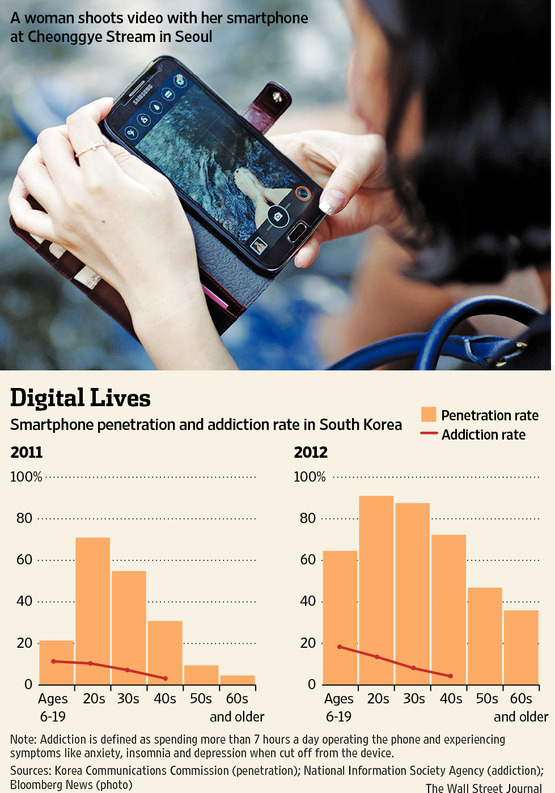
A Rising Addiction Among Youths: Smartphones; In many South Korean schools, teachers routinely collect mobile devices from their students during school hours

July 22, 2013, 5:44 p.m. ET

A Rising Addiction Among Youths: Smartphones

By IN-SOO NAM

PJ-BP480_SKADDI_G_20130722144632 AI-CC415_SKADDI_G_20130722224505

In many South Korean schools, teachers routinely collect mobile devices from their students during school hours. The government said it plans to train teachers how to deal with students who suffer smartphone addiction.

SEOUL—Lee Yun-soo has some regrets that she replaced her faded old clamshell phone with a smartphone six months ago. The South Korean high-school student enjoys tweeting funny photos, messaging friends and playing online games. But she said her smartphone is increasingly disrupting her life at school and home. “I hate doing it but I can’t help it,” she said as she fiddled with the palm-size gadget. Ms. Lee is among the roughly 1 in 5 students in South Korea who the government said is addicted to smartphone use. This addiction is defined as spending more than seven hours a day using the phone and experiencing symptoms such as anxiety, insomnia and depression when cut off from the device.  Read more of this post

Emotions High Over ParknShop Sale Talk; Superman Li Ka-Shing may have been influenced by the city’s pivot away from its traditionally laissez-faire stance

July 23, 2013, 11:27 AM

Emotions High Over ParknShop Sale Talk

Top of Form

As a deeply unequal city, Hong Kong both reveres and fiercely resents its local boy-made-good Li Ka-shing, who from his early days running a plastic flower business has since built up an empire worth some $120 billion. Nowhere was this more evident this week than in reactions to the fact that the tycoon may be planning to sell ParknShop, his Hong Kong-based grocery chain.

News that Asia’s richest man is planning the sale prompted mixed reviews in his hometown on Monday, attracting full-page spreads in local newspapers. While some celebrated the move, others expressed apprehension. “The rich are scared, and once again using their feet to vote,” wrote one user on Sina Weibo, China’s popular Twitter-like microblogging service. “The hatred of the rich and their businesses has been spreading…of course it will disrupt the appetite for investment,” ran an editorial in the Hong Kong Commercial Daily. Read more of this post

Large Loans Are Highlight of Mediocre Asian Deal Environment

Jul 22, 2013

Large Loans Are Highlight of Mediocre Asian Deal Environment

By Cynthia Koons, Reuters

One thing stands out in Asia’s uninspiring deal landscape this year: big loans. Acquisition financing in Asia, excluding Japan, has hit its highest year-to-date level since 2007, up 46% from the same period last year, according to Dealogic. That is despite acquisitions rising only 3% this year after a slowdown in recent months. Now as investors pull cash out of Asia in the belief that the U.S. Federal Reserve will soon start winding down its monetary stimulus, some people are saying this wave of debt-fueled deals could soon end. “I don’t think I would stand and wave my hand at this point in time and say, ‘This is the new normal,’ ” said Keith Pogson, a partner in Ernst & Young’s Asian-Pacific financial-services office. Read more of this post

‘Land of Smiles’? Not for tourists exposed to Phuket’s dark side

‘Land of Smiles’? Not for tourists exposed to Phuket’s dark side

AFP, July 22, 2013 – 4:41PM

From jet ski scams to robbery, assault and even police extortion, for the millions of tourists who flock to Thailand each year the kingdom does not always live up to its reputation as the “Land of Smiles”. Now following a flurry of complaints, governments are urging the country to do more to protect the safety of the record numbers of foreigners visiting Thailand. Its sun-drenched beaches, tranquil temples and libidinous nightlife have long been a magnet for tourists from around the world, but for some it is far from paradise. Drink spiking in bars can be a problem and sometimes people wake up to find they have been robbed. Read more of this post

Singapore’s Loss of Top MBA Program Threatens Education Ambition; “There is no doubt that Hong Kong provides a more dynamic vibrancy in Asia than Singapore does”

Singapore’s Loss of Top MBA Program Threatens Education Ambition

Singapore’s efforts to become an Asian center for higher education was dealt a blow this month when the school with the top-ranked MBA program said it will relocate to Hong Kong.

The University of Chicago, whose executive MBA program was ranked No. 1 by Bloomberg Businessweek last year, said July 10 it’s relocating to be closer to China. That came after New York University’s Tisch School of Arts and the University of Nevada, Las Vegas said there are plans to close their Singapore campuses in the next two years. Read more of this post

Alibaba Billionaire Jack Ma’s Comment Fallout Shows Fine Line on Politics

Billionaire Ma’s Comment Fallout Shows Fine Line on Politics

The fallout from comments attributed to Jack Ma about the 1989 Tiananmen Square crackdown highlights the balance business leaders need to strike in China between pleasing politicians and showing independence.

After the South China Morning Post newspaper quoted Ma as saying China’s rulers made the “most correct decision” in their handling of the deadly June 4, 1989, protests, activists started an online petition calling for an apology. The billionaire’s company, Alibaba Group Holding Ltd., disputed the accuracy of the report, which the newspaper said it stands by. Read more of this post

Hong Kong Says Loans to Mortgage Companies May Undermine Curbs

Hong Kong Says Loans to Mortgage Companies May Undermine Curbs

Hong Kong banks’ support for mortgage lending by finance companies may reduce the effectiveness of home-lending controls, the city’s banking watchdog said.

“If banks provide loans to finance companies to support their mortgage business and these finance companies do not follow the Hong Kong Monetary Authority’s guidelines on property mortgage lending, this may undermine the effectiveness of the prudential measures,” the regulator said in an e-mailed statement yesterday. The HKMA “does not encourage banks to provide loans to these finance companies,” it said. Read more of this post