Rise in mortgage rates cuts into home buyer demand

Rise in mortgage rates cuts into home buyer demand

Wed, Jul 3 2013

NEW YORK (Reuters) – Expectations the Federal Reserve will slow its economic stimulus program by the end of the year pushed mortgage rates higher last week, sapping demand from potential home buyers, data from an industry group showed on Wednesday.

Rates measured by the Mortgage Bankers Association jumped to the highest level since July 2011, which also cut into refinance activity. The share of refinance applications fell to the lowest level in more than two years. Read more of this post

Rakuten launches fashion-sharing website in Taiwan

Rakuten launches fashion-sharing website in Taiwan

CNA

2013-07-04

Japanese e-commerce giant Rakuten launched a social networking site for sharing fashion information in Taiwan Wednesday to grab a bigger share of the country’s growing online shopping market. Toru Shimada, CEO and chairman of Rakuten Asia, said his company is hoping to attract at least 1 million members in the coming year to the new site called “OSHa’Re,” which means fashion in Japanese. “Taiwan is Rakuten’s global market benchmark for new innovative technologies and services,” Shimada said at a press briefing on the new service, which has visual search technology that allows users to match photos of items they want with goods offered by Rakuten’s online shopping mall. “We are confident that OSHa’Re will become the No. 1 fashion website in Taiwan,” he said. Taiwan became in 2008 the first overseas market in which Rakuten established a presence, and the Japanese online retailer has since expanded its operations to Thailand, Indonesia and Malaysia. In the past two years, Rakuten has acquired or bought stakes in companies in the United States, France, Brazil, Germany, Canada and the United Kingdom. The global e-commerce market has grown by an average of 19% per year since 2010 and is expected to reach US$1 trillion in turnover this year, according to the Taiwan External Trade Development Council, the country’s main trade promotion body. In Taiwan alone, e-commerce turnover is expected to exceed NT$1 trillion (US$33.3 billion) in 2015, the council estimated.


Abalone price plummets in China

Abalone price plummets in China

Staff Reporter

2013-07-04

The Chinese government’s anti-corruption and frugality policy has had a significant effect on prices of luxury food products but the price of abalone and sea cucumbers have plummeted by 50%, reports the People’s Daily, the flagship newspaper of the Communist Party of China. “The food doesn’t sell well in big hotels but it is widely available, so how can it command a high price?” said a man who bought 20 abalones, a type of edible sea snails, at only 60 yuan (US$10) in a traditional market in Shanghai. In addition to abalones and sea cucumbers, other luxury items including Chinese liquor and tea leaves have seen their prices drop between 40-60% since May. An expert in aquaculture industry said that there may be two reasons to explain the drop of abalone prices, one being the government-led frugality campaign announced in December aimed at curbing consumption that uses public funds, among other purposes. While the excessive number of people raising abalones and other luxury seafood can also be seen as a cause for the oversupply this year.


Why Asian Internet Companies Struggle to Become Global

JULY 3, 2013, 11:12 AM

Why Asian Internet Companies Struggle to Become Global

By ERIC PFANNER

Asia is home to nearly half of the 2 billion Internet users in the world. It makes most of the hardware — laptops, smartphones, tablets and other gadgets — that is used to gain access to the Internet. In countries like South Korea and Japan, it has some of the fastest wired and wireless networks for carrying Internet traffic. Yet in one aspect of the high-technology economy, Asia still struggles. It has yet to create an Internet company with the global scale of a Google, Facebook or Amazon. A report published Wednesday by the Economist Intelligence Unit, a research outfit affiliated with the Economist magazine, examines some of the possible reasons for this. Read more of this post

Hong Kong Rents Push Out Mom and Pop Stores

July 3, 2013

Hong Kong Rents Push Out Mom and Pop Stores

By BETTINA WASSENER and MARY HUI

HONG KONG — Nam Kee Noodles is a typical Hong Kong restaurant: functional, popular and busy. A dozen plastic-topped tables offer room for about 40 patrons. Customers line up outside at lunchtime, waiting to consume spicy noodle soup, dumplings and iced soy milk amid the clatter of plastic bowls and chopsticks. In April, however, the little restaurant, in the heart of Causeway Bay, one of Hong Kong’s busiest shopping districts, nearly had to shut down after the landlord tripled the already-expensive rent. “We were paying around 200,000 dollars a month,” said Au Kei-hong, the shop’s manager, referring to an amount in Hong Kong dollars equivalent to about $25,800. “But the landlord then increased it to 600,000. It was too expensive. We cannot afford that.” Read more of this post

Software as a Monthly Rental; Photoshop is now the biggest-name software that you can’t actually buy, as the new version costs $30 a month, or $240 a year

July 3, 2013

Software as a Monthly Rental

By DAVID POGUE

There’s a new reason for Photoshop to be famous.

Yes, it’s still the program that just about every photographer and designer on earth uses to retouch or even reimagine photos. It’s still the only program whose name is a verb. But now, Photoshop is also the biggest-name software that you can’t actually buy. You can only rent it, for a month or a year at a time. If you ever stop paying, you keep your files but lose the ability to edit them. You have to pay $30 a month, or $240 a year, for the privilege of using the latest Photoshop version, called Photoshop CC. Or, if you want to use the full Adobe suite (Illustrator, InDesign, Premiere and so on), you’ll pay $600 a year. The price list is stunningly complex. The fees may be higher or lower depending on how many programs you rent, whether you already own an existing version and which one, whether you commit to a full year or prefer to rent one month at a time. There are also discounted first-year teaser rates, student/teacher rates and a 30-day free trial. But you get the point: the dawn of Software as a Subscription is now upon us. Read more of this post

Tencent Will Extend Payment System to Wireless Platforms

Tencent Will Extend Payment System to Wireless Platforms

Tencent Holdings Ltd. (700), China’s largest Internet company, will introduce a payment system to wireless platforms as it tries to commercialize apps including its WeChat instant messaging service to drive profit growth.

The company is seeking to tap customers who access its services on smartphones and tablet computers, Tencent President Martin Lau said at a conference in Beijing today. WeChat, with more than 300 million users, has over 70 million registered accounts outside mainland China, he said. Read more of this post

Investors are bailing out of China’s markets as fears grow over the slowing economy and Beijing discourages ideas that it might try to juice it back up

July 3, 2013, 11:52 a.m. ET

Investors Pull Back From China Assets

DANIEL INMAN

AM-AZ271_CSTOX_NS_20130703125703

Investors are bailing out of China’s markets as fears grow over the slowing economy and Beijing discourages ideas that it might try to juice it back up. Global fund managers have yanked money out of Chinese stocks for sixteen of the last 18 weeks, including a net $834 million during a five-day period ending June 5. That was the largest outflow since January 2008, when the financial crisis was getting underway, according to data provider EPFR. The gloomy mood is also spilling over into the currency market. Investors are raising their bets the yuan will fall, clashing with efforts by the central bank to keep it strong. Read more of this post

It used to be that American companies were busy expanding in Asia. These days, it is the other way around

Jul 3, 2013

Asian Acquirers Change Focus

By Cynthia Koons

It used to be that American companies were busy expanding in Asia. These days, it is the other way around.

In the space of a few weeks, Chinese meat producer Shuanghui International Holdings Ltd. struck a $4.7 billion agreement to buy Smithfield Foods Inc. and Apollo Tyres Ltd. made a $2.5 billion offer to purchase Cooper Tire & Rubber Co. Those deals, one at the end of May and the other in mid-June, are the biggest Chinese and Indian acquisitions of U.S. companies on record. Bankers say the moves show that Asian buyers not only increasingly believe they can manage foreign companies, they are also confident about the underlying U.S. economy. Read more of this post

Major Chinese shipbuilder Rongsheng Bows to Demand Slump and has laid off about 40% of its workforce in recent months

July 3, 2013, 12:12 p.m. ET

Chinese Shipbuilder Bows to Demand Slump

COLUM MURPHY And DINNY MCMAHON

AM-AZ273_RONGSH_G_20130703101505

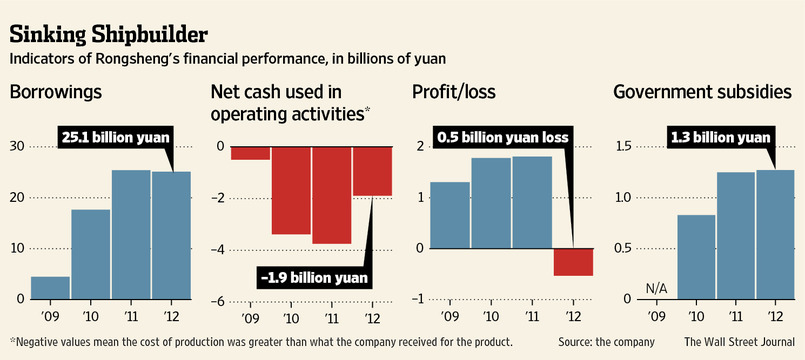
BEIJING—A major Chinese shipbuilder has laid off about 40% of its workforce in recent months, in a sign that China Inc. CHA 0.00% is under increasing strain from the slowdown in the world’s No. 2 economy.

Lei Dong, secretary to the president ofChina Rongsheng Heavy Industries Group Holdings Ltd., 1101.HK -10.17%said the company has let go of about 8,000 people, of whom more than half were subcontracted workers and the remainder full-time Rongsheng employees. He said there are currently about 12,000 employees at the shipbuilder, which is based in Rugao, Jiangsu province, north of Shanghai. Read more of this post

The Ambivalent Would-Be Hegemon: China is far too angry, lonely, mercantilist and domestically insecure to be considered a true global power

July 3, 2013, 12:55 p.m. ET

The Ambivalent Would-Be Hegemon

China is far too angry, lonely, mercantilist and domestically insecure to be considered a true global power.

DAVID ZWEIG

To what extent has China gone global in its diplomacy, support for global governance, trade and investment, soft power and military reach? David Shambaugh, a professor of political science at George Washington University and one of America’s leading China watchers, attempts to answer this question by drawing on a multitude of interviews with key players in China and around the world, as well as an extensive research effort. The result is a first-rate book that the nonacademic world will savor.

Mr. Shambaugh opens with a valuable synopsis of China’s internal debate about its global identity. Chinese academics remain uncertain about their state’s “international personae,” resulting in a conflicted identity. This scholarly elite is composed largely of a “left wing” with a strong nativist streak and a realist bent—meaning they believe security comes from across-the-board self-strengthening. Read more of this post

Indonesian Outflows Spur Pressure for Further Policy Tightening; “There was a time window in which the government could ride on the positive momentum and push through more concrete measures, but it’s now gone,”

Indonesian Outflows Spur Pressure for Further Policy Tightening

Indonesia’s policy makers delivered the country’s first benchmark interest-rate increase since 2011 and first fuel-price boost in five years in June. Capital outflows since then have spurred pressure for further moves.

The rupiah remains among the worst performers in Asia in the past year, falling about 0.8 percent after Indonesia on June 13 became the region’s first major economy to raise rates this year. Global funds sold 2.5 trillion rupiah ($250 million) of local-currency government bond holdings in the week after the June 22 fuel adjustment, aimed at containing a current-account deficit that has hurt the currency. Read more of this post

High-flying luxury: battle for Asia’s jet-set is hotting up

High-flying luxury: battle for Asia’s jet-set is hotting up

5:23pm EDT

By Anshuman Daga

SINGAPORE (Reuters) – With limousine pick-ups and on-board chefs, Asia’s premium airlines are investing hundreds of millions of dollars on luxury services in a bet on a rebound in business from the wealthy, even as low-cost carriers fly high with the booming middle class.

Although business and first-class traffic has fallen significantly in the last few years as companies cut costs, carriers such as Singapore Airlines Ltd (SIA), Cathay Pacific Airways Ltd and Qantas Airways Ltd are estimated to still earn about 35 to 40 percent of passenger revenue from the high-margin segment. Read more of this post

China’s Visit-the-Parents Law Also Affects City Buildings

China’s Visit-the-Parents Law Also Affects City Buildings

China will accelerate development of standards for functions and designs that accommodate the elderly in buildings and public facilities to comply with the same new law under which people can be forced to visit their parents.

China’s revised and broadened Law for the Protection of the Rights and Interests of the Elderly includes a chapter aimed at ensuring comfortable living environments, the official Xinhua News Agency reported yesterday. Read more of this post

China Said to Suspend Release of Steel Industry PMI Data

China Said to Suspend Release of Steel Industry PMI Data

China suspended the release of a set of data on the country’s steel industry after the National Bureau of Statistics decided to change how the figures are compiled, a person involved in producing the numbers said.

The June Purchasing Managers’ Index for the steel industry won’t be released, said the person, who asked not to be identified as he wasn’t authorized to speak publicly about the matter. It isn’t yet clear what changes will be made and in what time frame, or if the data for July would be released next month, the person said. Read more of this post

“Must-Have” vs “Nice-To-Have”: Exploiting the Sector-Company Gap in Asia. Bamboo Innovator is featured in BeyondProxy.com, where value investing lives

Bamboo Innovator is featured in BeyondProxy.com, where value investing lives:

  • “Must-Have” vs “Nice-To-Have”: Exploiting the Sector-Company Gap in Asia, July 3, 2013 (BeyondProxy)

SectorCoGap

Statue of Liberty reopens July 4

Months after Sandy, Statue of Liberty reopens July 4

2013-07-03 02:45:58 GMT2013-07-03 10:45:58(Beijing Time)  SINA.com

liberty070213e

Closed to the public since Superstorm Sandy slammed into New York last October, the Statue of Liberty will once again welcome tired and huddled masses — of tourists — on July 4. About 15,000 people are expected to flock to the landmark for a day of festivities including a morning ribbon-cutting ceremony with Mayor Michael Bloomberg and Interior Secretary Sally Jewell. More than three million people visit the 305-foot (93-meter) statue — as tall as a 22-story building — each year. The monument did not sustain damage during the mega-storm that smashed into the US East Coast on October 29. But Liberty Island, the tiny speck of land on which it sits off the southern tip of Manhattan, was devastated. Three-quarters of the island was flooded, some parts under more than five feet of water. Docks and railings were dislodged, power and phone lines damaged, and sidewalks were ripped up by the waves and wind. In the months since Sandy, hundreds of construction workers and National Park Service personnel from across the country have handled repairs. The city and the park service reached a deal to reestablish security checkpoints in Manhattan, before tourists take the short boat ride to Liberty Island. Some minor restoration work remains undone with a few days to go before the grand reopening. But the thousands of visitors expected on Thursday will largely have the same access as before the storm. Tourists who have reserved tickets in advance — and are ready to climb the 377 steps — will be able to visit the statue’s crown, which had only reopened to the public just before Sandy struck following a $30 million face lift. The total cost of post-Sandy repairs on both Liberty Island and neighboring Ellis Island — the port of entry for millions of immigrants at the start of the 20th century — has been put at $59 million. Ellis Island, hit harder by the storm, is still closed to the public, with no date set for its reopening. Power and telephone lines are still down there. Hundreds of thousands of museum items were transferred to other storage facilities due to the lack of air conditioning. The Statue of Liberty is one of the Big Apple’s most popular tourist attractions. In 2011, it drew 3.7 million visitors and generated $174 million in economic activity for the city. About 400 people usually work at the site, providing security, assistance to visitors, and operating tour boats, souvenir shops, restaurants and other small vending stands. Lady Liberty was named a UN World Heritage site in 1984. Created by French sculptor Auguste Bartholdi, with the help of Gustave Eiffel for the interior metal structure, France gave the statue to the United States as a gift and sign of friendship in 1876. That year marked the 100th anniversary of American independence. Then US president Grover Cleveland inaugurated the statue on October 28, 1886.

The Hunt for the Never-Been-Done ETF

July 2, 2013, 10:10 p.m. ET

The Hunt for the Never-Been-Done ETF

JOE LIGHT and JASON ZWEIG

MI-BW916_ETFNAM_G_20130702180904

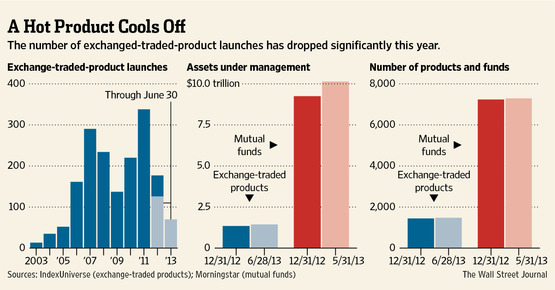
Maybe the Wall Street financial-product machine really can run out of new ideas. Just 70 exchange-traded funds and other exchange-traded products were launched from Jan. 1 to June 30, according to IndexUniverse LLC, a research firm in San Francisco. The total is down 44% from 126 in the same period a year earlier. The slide is a sign the market for ETFs—which hold a bundle of investments and boomed in the past decade as a cheaper, tax-efficient alternative to traditional mutual funds—has gotten so saturated fund companies are struggling to come up with niches that aren’t served by existing ETFs. Just this year, companies have launched ETFs that track Nigerian stocks, that use “forensic accounting” to avoid stocks with financial red flags, and that give leveraged exposure to the Brazilian market. Read more of this post

FT Summer books guide: From Bretton Woods to Britten’s century, FT writers and guests pick their books of the year so far

June 28, 2013 7:49 pm

Summer books guide: From Bretton Woods to Britten’s century, FT writers and guests pick their books of the year so far

FICTION

Life After Life, by Kate Atkinson, Doubleday, RRP£18.99, 480 pages

One character; multiple lives. Atkinson’s protagonist, Ursula Todd, sometimes senses she has travelled the same paths before. We see those other Ursulas, each born in 1910, as they live (and die). Shortlisted for the 2013 Women’s Prize for Fiction. Read more of this post

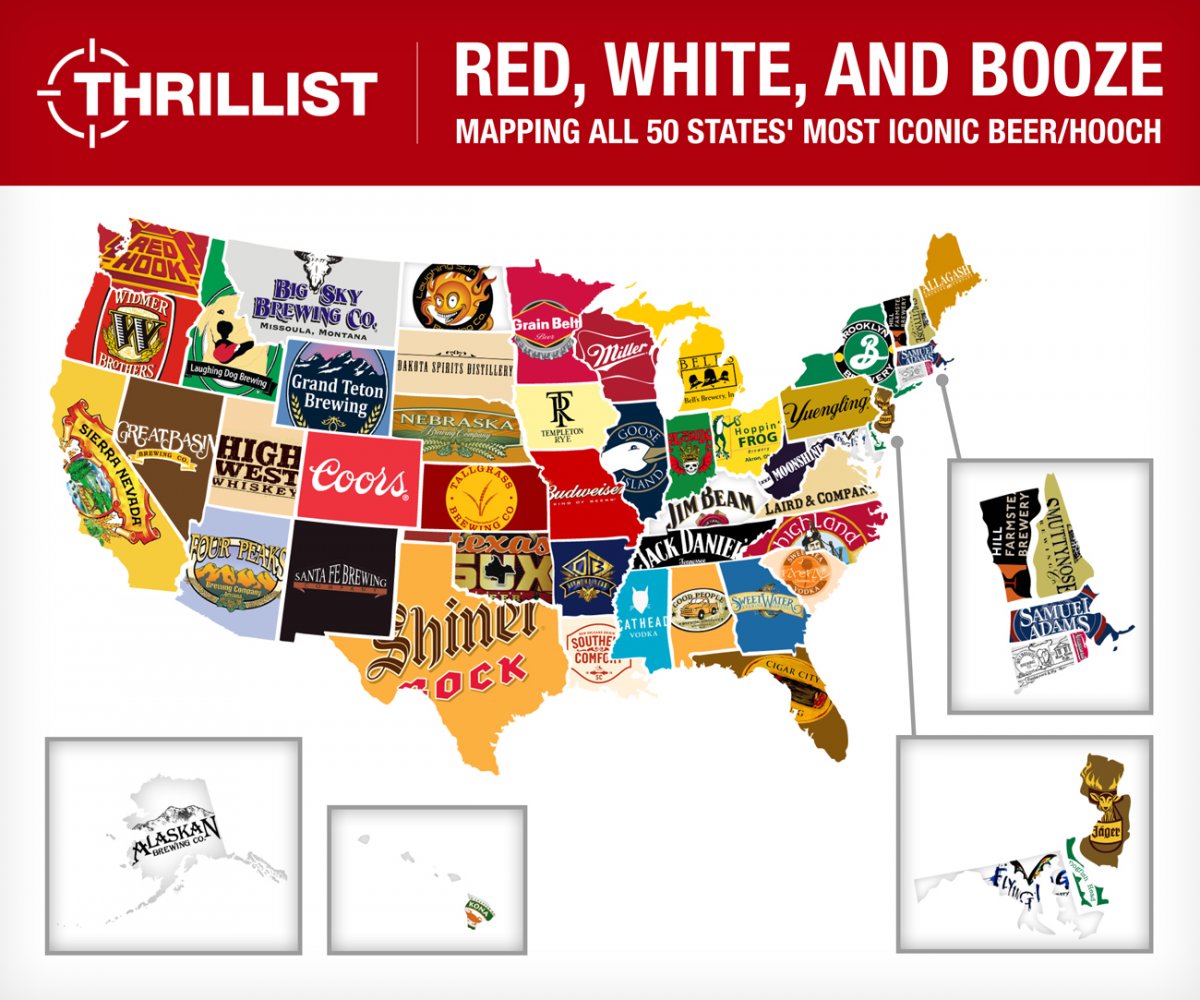
The Most Famous Booze From Every State

boozemap

11 Reasons People End Up Unhappy With Their Lives: We mistake political gain for achievement; We’re afraid of sniping or sarcasm; We equate acquisition with satisfaction

11 Reasons People End Up Unhappy With Their Lives

JEFF HADENLINKEDIN JUL. 2, 2013, 2:44 PM 6,074 4

Not happy with your professional or personal life? If that’s the case, the problem isn’t your upbringing, or a lack of opportunities, or bad luck, or the result of other people holding you back. The problem is you. If our lives suck, we’re letting it happen. Maybe the problem lies in what we believe – and in what we do.

1. We mistake political gain for achievement.

Infighting, positioning, trying to look better by making other people look worse… playing politics can help get you ahead. But if you win by politics you ultimately lose since political success is usually based on the impulses, whims, and caprices of other people – often other people you don’t even like. That means today’s success can be tomorrow’s failure – and that success or failure is largely outside your control. Real achievements are based on merit. Real achievements can’t be given or taken away by anyone. Real success is truly satisfying. Read more of this post

Early Calculator: The Sad Story of an Inventor at Buchenwald; A Viennese engineer worked meticulously in a concentration camp on the world’s first pocket calculator. After the war, others profited from his invention

07/03/2013 04:49 PM

Early Calculator: The Sad Story of an Inventor at Buchenwald

By Frank Thadeusz

A Viennese engineer worked meticulously in a concentration camp on the world’s first pocket calculator. After the war, others profited from his invention.

Herzstark

Curt Herzstark’s fate seemed to be sealed in 1943 when the Nazis sent him to Buchenwald concentration camp. But then Herzstark, the son of a Jewish industrialist, received the unexpected opportunity to become an Aryan. “Look, Herzstark,” one of the camp commandants said to him, “we know that you are working on a calculating machine. We will permit you to make drawings. If the thing is worth its salt, we’ll give it to the Führer after the final victory. He’ll certainly make you an Aryan for that.”

The engineer had made a pact with the devil. Night after night, after daily forced labor in the camp, Herzstark made detailed design plans for the world’s smallest mechanical calculating machine. He was given special rations as motivation, and he eventually survived the concentration camp. But there was no final victory, and Hitler was never able to enjoy the invention. Read more of this post

Darwin’s humbling lesson for business; The match between capabilities and environment is the key to success

July 2, 2013 4:49 pm

Darwin’s humbling lesson for business

By John Kay

The match between capabilities and environment is the key to success

Your correspondent is sitting below a large and ugly statue of Charles Darwin, overlooking the bay where the great scientist stepped ashore on Chatham, now San Cristobal, the most easterly of theGalápagos Islands. I am here to discuss the ways in which evolutionary theory can contribute to our understanding of social sciences.

It seems barely possible that careful observation of finches, mockingbirds andtortoises could fundamentally change the way we think about the world. But in the 19th century it did. The Galápagos, 700 miles from the mainland of Ecuador, contain flora and fauna that differ from those of the rest of the world and differ, but less, from island to island. The genius of Darwin was to apprehend the process by which this pattern came about. Read more of this post

How music festivals make money: From Coachella to Made In America, multi-act music festivals are big business. How do they rake in the cash?

How music festivals make money

July 3, 2013: 5:00 AM ET

From Coachella to Made In America, multi-act music festivals are big business. How do they rake in the cash?

By Melissa Locker, contributor

FORTUNE — Back in April, more than 150,000 music fans flocked to Indio, Calif., for the Coachella Valley Music and Arts festival. In mid-June, Bonnaroo drew over 100,000 people to Manchester, Tenn., to see Sir Paul McCartney and R. Kelly, among others. Sasquatch brought droves of people to a far-flung corner of Washington State for a long weekend. Every year, more and more festivals seem to pop up in addition to the dozens of music events that already exist. For every Lollapalooza, Austin City Limits or Riot Fest there’s a Governor’s Ball, which just held its third festival, or Catalpa Festival, which is in its second year. Read more of this post

The Immortal Life of the Enron E-mails; A decade after the Enron scandal, the company’s internal messages are still helping to advance data science and many other fields

The Immortal Life of the Enron E-mails

A decade after the Enron scandal, the company’s internal messages are still helping to advance data science and many other fields.

By Jessica Leber on July 2, 2013

Corporate corpus: Volumes of e-mails that were sent and received in Enron’s headquarters in Houston, seen here in 2002, are still parsed and dissected by computer scientists and other researchers. Former Enron executive Vincent Kaminski is a modest, semi-retired business school professor from Houston who recently wrote a 960-page bookexplaining the fundamentals of energy markets. His most lasting legacy, however, may involve thousands of e-mails he wrote more than a decade ago at the energy-services company. Read more of this post

Dividend Stocks Enter New Era of Caution

Updated July 2, 2013, 6:04 p.m. ET

Dividend Stocks Enter New Era of Caution

MATT JARZEMSKY

MI-BW964A_MKTLE_G_20130702182118

Jitters about Federal Reserve policy have made investors more cautious about stock sales by companies that pay high dividends, but the window is still open for new offerings. Investors may no longer be rushing to buy just about anything with a high yield at just about any price, as they seemed to be doing at times during the first five months of the year. Yet interest rates are expected to remain exceptionally low even if the Fed begins to scale back its stimulus efforts. That, many analysts and investors say, will continue to fuel a search for yield through dividend stocks, and provide an appetite for new offerings. At the same time, the kind of improved growth outlook that would lead the Fed to taper its easy-money policies could encourage stock sales by companies more sensitive to economic growth. Investors look to shares of these companies because they offer potential for price appreciation. Read more of this post

Investors buy into software-defined networks, will customers follow?

Investors buy into software-defined networks, will customers follow?

11:06am EDT

By Sayantani Ghosh

(Reuters) – As Superstorm Sandy bore down on the East coast last year, companies with data centers in its path needed another location fast. But moving computer servers is tricky, and usually planned over days or weeks. Enter a new technology: software-defined networking, or SDN. Such urgent data moves could now be done within a few hours. Investors, including some of the world’s biggest technology companies, are buying into the start-ups behind SDN, a technology that allows users to substitute some of the most complex hardware functions in server switches with software. SDN is still relatively small, generating around $300 million in annual business in a $30 billion networking industry. Customers are not yet sure how to make the most of its flexibility. Read more of this post

Painkiller Abuse Spurs Search for a Safer Opioid Therapy

Painkiller Abuse Spurs Search for a Safer Opioid Therapy

Backed by a U.S. campaign to slow abuse of prescription painkillers, drugmakers are devising new forms of the medicines that don’t lead to misuse and new products that treat dependency in a bid to change the face of a $9.4 billion market.

Orexo AB (ORX) is awaiting a July 6 U.S. ruling on a drug that blocks opiate receptors in the nervous system, potentially lessening addict dependence. Nektar Therapeutics (NKTR) on June 19 announced positive study results on an experimental medicine designed to enter the brain slowly, reducing the euphoria that can lead to addiction. And in April, the U.S. barred copies of the original form of OxyContin after Purdue Pharma LP proved its crush-resistant version made the therapy less valuable to addicts on the street. Read more of this post

This is a big deal. Hot money is now fleeing China “abruptly”

This is a big deal. Hot money is now fleeing China “abruptly”

By Matt Phillips @MatthewPhillips July 2, 2013

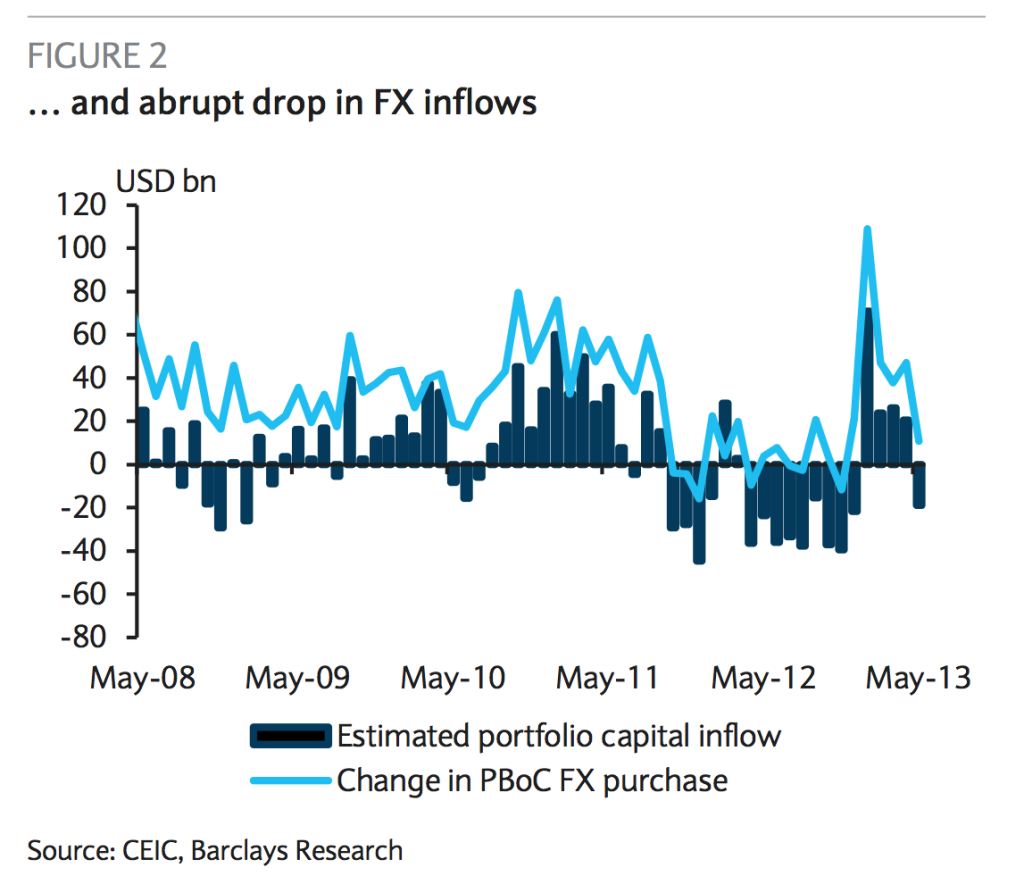
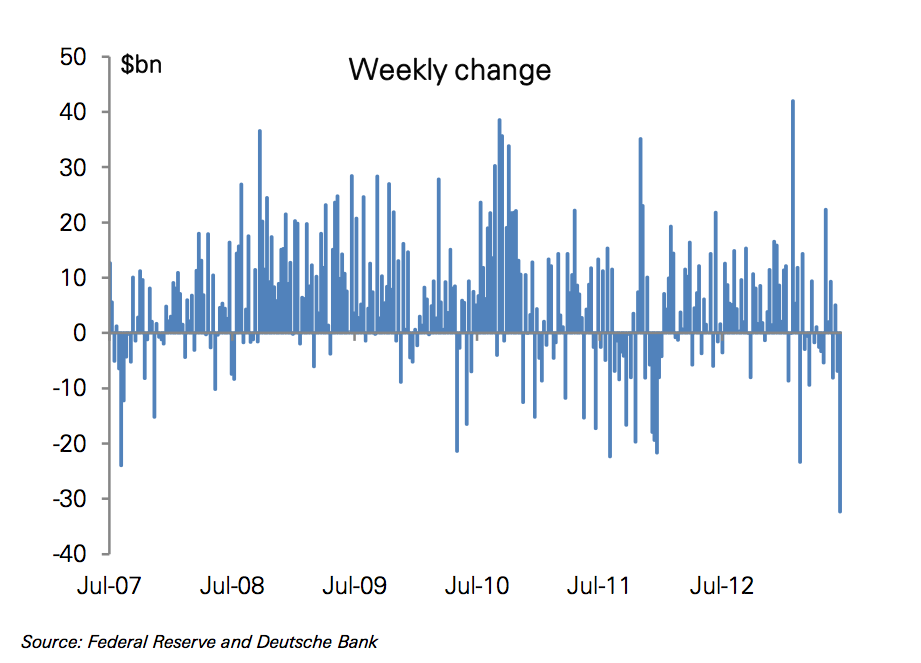
An important reason why countries like China have capital controls is to keep tidal flows of incoming foreign cash from creating destabilizing asset bubbles. But foreign capital has wormed its way into the mainland anyway. One creative method that got attention recently was phantom sales of “exports” to places like Hong Kong. Investors have salivated over opportunities—even if they are somewhat shadowy—to tap into Chinese growth. But the saliva glands seem to be drying up. Deutsche Bank FX analysts point out that flows of capital have started to change course in recent weeks, and they use so-called “over-invoiced” exports to Hong Kong as a proxy. Analyst at Barclays have also noticed the “abrupt” turn in financial flows into China. In the chart below, they’re looking at estimates of portfolio investment as well as central-bank purchases of foreign currencies. (The way China keeps capital flows in check is by forcing the private sector to convert foreign currencies in to Chinese yuan at the fixed government rate. So you can look at how much foreign currency the People’s Bank of China buys as a proxy for the amount of foreign currency that’s weaseled its way into the country.) We’re in the opening phase of this reversal. And whatever the causes of it might be—fears about the solidity of China’s financial system, slowing growth, the unwinding of the Fed’s easy-money policy—it could have wide-ranging implications. Domestically, the departure of foreign cash from China may have played a role in the recent credit crunch that sent a shiver through China’s banks. Government media minders have told the local press to tone down its coverage of financial worries (paywall), but that will only undermine confidence further. Internationally, if a decline of investment slows China’s economy, large trade partners such as Taiwan and Australia would feel it. Oh, and one other thing. Do you know where China happens to stow all that foreign cash it buy out of the markets? US government bonds. China is the largest foreign buyers of Uncle Sam’s IOUs, which helps finance the US’s persistently large current-account deficit. And coincidentally, last week saw the largest outflow on record from the Federal Reserve’s so-called “custody holdings” of Treasurys. Those are the Treasurys that the Fed holds in accounts for official entities, such as foreign central banks that use US government debt to store foreign exchange reserves. Here’s a look at a Deutsche Bank chart, which suggests that what happens in China will most definitely reverberate outward. Food for thought.

screen-shot-2013-07-02-at-11-34-29-am screen-shot-2013-07-02-at-11-39-12-am screen-shot-2013-07-02-at-12-02-27-pm

China’s Leading Baby Formula Maker Cut Prices on Sweeping Probes

China’s Leading Baby Formula Maker Cut Prices on Sweeping Probes

07-03 11:09 Caijing

The investigation, however, targets more than the six, said a person familiar with the case, adding that dozens of brands could be involved.

Beingmate, a leading Chinese baby formula brand is trimming its products prices on the heel of a sweeping anti-trust investigation targeting both foreign and home brands, in what is believed to be the second shake-up in China’s milk industry following the food scandal in 2008. Read more of this post