The move out of bonds, a trickle so far, could intensify as investors hit the reset button on their portfolios.

July 25, 2013, 3:22 p.m. ET

Bonds Could Get Swept Away by the Flow

Move Out of Bonds Could Intensify as Investors Hit Reset Button on Their Portfolios

JUSTIN LAHART

Investors’ love affair with bonds is going through a rough patch. If they don’t make up soon, things could get really rocky. With the Federal Reserve signaling that it will begin reining in its Treasury and mortgage-bond purchases later this year, the fixed-income arena has become a less-than-happy place. Bank of America Merrill Lynch’s index of U.S. corporate and government bonds fallen 3.8% since the start of May. Investors have noticed, pulling a net $78 billion from bond mutual funds in the seven weeks ended July 17, according to Investment Company Institute estimates. Read more of this post

Reality Bites for Siemens and ABB: Two of Europe’s Largest Industrial Companies Are Signaling All’s Not Well With the Global Economy

July 25, 2013, 12:09 p.m. ET

Reality Bites for Siemens and ABB

Two of Europe’s Largest Industrial Companies Are Signaling All’s Not Well With the Global Economy

ANDREW PEAPLE

If optimism about the global economy is steadily building, some of Europe’s largest industrial companies didn’t get the memo.

Siemens SIE.XE -5.98% shocked investors Thursday afternoon by revealing it won’t meet its target of a 12% margin on earnings before interest, taxes, depreciation and amortization by the end of its fiscal-year 2014, a key management aim. The German engineer’s shares slumped 6%. Swiss peer ABB‘s ABBN.VX -3.08% shares dropped 3.1% after a downbeat first-half earnings statement showed its order book declining across the globe. The message is clear: The economic climate for such companies is still very challenging. The question is which one is better placed to cope. Read more of this post

Gold Smuggling Takes Off in India; Curbs on Imports Aim at Supporting Rupee; The Case of the Golden Staples

July 25, 2013, 2:01 p.m. ET

Gold Smuggling Takes Off in India

Curbs on Imports Aim at Supporting Rupee; The Case of the Golden Staples

BIMAN MUKHERJI and ARPAN MUKHERJEE

MI-BX449_ISMUGL_NS_20130725175714

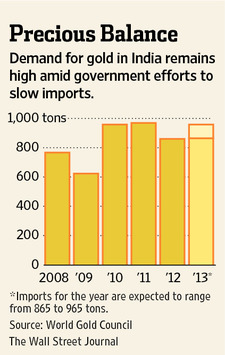
NEW DELHI—A fishing boat slid into the southern Indian coastal village of Kodikkarai late one evening in mid-June, carrying a cargo from Sri Lanka: a stack of gold bars weighing more than 40 pounds. Four men jumped off the boat and headed for waiting Jeeps. Unfortunately for them, government sleuths were there, tax officials say, nabbing the men before they could sell the gold in the nearby city of Chennai, a trading hub for the precious metal. Read more of this post

Thai Broken Rice: Bangkok’s splashy, costly subsidy scheme has been ineffective at helping poor farmers.

July 25, 2013, 12:34 p.m. ET

Thai Broken Rice

Bangkok’s splashy, costly subsidy scheme has been ineffective at helping poor farmers.

DAVID WALTER

Ask farmers in the village of Ban Laitung what they think of the Thai government’s rice subsidy scheme, and they tell you that actually, please, they’d prefer it if Prime Minister Yingluck Shinawatra stopped buying up rice harvests at prices 50% above market levels. In this corner of Isaan—Thailand’s poor northeastern region—Ms. Yingluck’s “rural development” scheme has not significantly improved residents’ lives. Read more of this post

New Zealand Dairy Giant Fonterra Has Troubles Away From Home; Seeking Solutions, Head of Unit Gets Down to Basics: Mucking Out Stalls

Updated July 25, 2013, 7:10 a.m. ET

New Zealand Dairy Giant Fonterra Has Troubles Away From Home

Seeking Solutions, Head of Unit Gets Down to Basics: Mucking Out Stalls

ROBB M. STEWART

AI-CC502_AUSFAR_NS_20130725064508

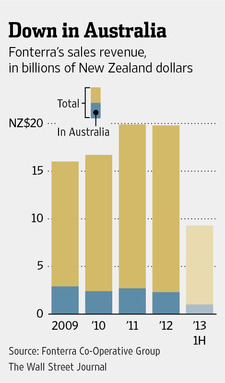
MELBOURNE, Australia—One freezing evening in June, the new boss of Fonterra Cooperative Group Ltd.’s FCG.NZ +0.27% Australian unit began an unusual fact-finding mission. She stayed overnight on a farm in Gippsland, in Australia’s Victoria state, to help discover what had gone wrong in one of the New Zealand dairy giant’s biggest markets. As if in an episode of “Undercover Boss,” a reality-TV show in which the heads of some of America’s biggest companies slip anonymously into front-line jobs, Fonterra’s Australian managing director Judith Swales rose at dawn to milk some 200 cows in temperatures hovering near zero degrees Celsius (32 degrees Fahrenheit). Ms. Swales—who as a child had often joined her milkman father on his morning rounds in Yorkshire, in the north of England—had plenty to think about as she ended the morning mucking out the dairy shed. Read more of this post

Toilet-Tissue ‘Desheeting’ Shrinks Rolls, Plumps Margins; If it seems like the toilet paper runs out more quickly, it might not be your imagination. “Desheeting” reducies the number of sheets on a roll or in a tissue box

Updated July 24, 2013, 9:39 p.m. ET

Toilet-Tissue ‘Desheeting’ Shrinks Rolls, Plumps Margins

Improved Product Means Fewer Sheets Needed to ‘Get the Job Done,’ Company Says

SERENA NG

Kimberly-Clark Corp. KMB +0.65% recently rolled out new Kleenex tissue that it says is 15% “bulkier.” It’s also stingier. Each box has 13% fewer sheets than before. Consumer products makers call this “desheeting”—reducing the number of sheets of toilet paper or tissues in each package while holding retail prices constant. Earlier this week, Kimberly-Clark executives told analysts that they expect the practice to benefit the company’s consumer-tissue unit in the second half of the year. Companies, particularly in the food business, have long shrunk packages as an alternative to hiking prices in the face of higher raw-material costs. Cereal boxes and bags of chips have in many cases become lighter over the years in what the food industry refers to as taking “weight out.” A regular Snickers bar now weighs 1.86 ounces, down from 2.07 ounces in the past, which Mars says was done to cut calories to 250 per bar. Tropicana Pure Premium orange juice is now sold in 59 ounce bottles, versus 64 ounce cartons prior to 2010. Read more of this post

GSK, corruption and the Byzantine world of Chinese politics

GSK, corruption and the Byzantine world of Chinese politics

Jul 25, 2013 12:54pm by Jamil Anderlini

Everything in China is political, even when it might not be. A series of seemingly unrelated corruption scandals in China all share a common thread that has got the political class in Beijing very excited and boosted speculation that an elite power struggle is under way within the ruling Communist party. The connections seem tenuous at first but spend enough time in the Byzantine world of Chinese politics and the logic starts to appear compelling. Read more of this post

World’s Tallest Skyscraper Remains a Hole in Chinese Ground

World’s Tallest Skyscraper Remains a Hole in Chinese Ground

Ground was broken for the world’s tallest skyscraper in an empty field in China’s Hunan Province last weekend. It was a festive and audacious occasion: the Broad Group, developer of the Sky City project, promised to build 202 floors stretched over 838 meters (2,749 feet) in a mere 10 months, using pre-fabricated modular, stackable pods that require less energy and materials than traditional construction methods.

The joy was short-lived. Read more of this post

Singapore’s CapitaLand to Alter Home Sizes to Tackle Curbs; “The fact that they are similar plots and that they are planning about 40 percent more units means they are thinking of downsizing units”

CapitaLand to Alter Home Sizes to Tackle Curbs: Southeast Asia

CapitaLand Ltd. (CAPL), Singapore’s biggest developer, may alter the size of its apartments as it seeks to improve affordability to combat government measures aimed at curbing speculation and lowering prices.

The developer sold 139 residential units in the island-state in the three months ended June, 31 percent fewer than in the same period last year, it said yesterday as it forecast “headwinds” in the near term with the housing curbs. Read more of this post

China Cuts Capacity in Some Industries to Reshape Economy

China Cuts Capacity in Some Industries to Reshape Economy

China ordered more than 1,400 companies in 19 industries to cut excess production capacity this year, part of efforts to shift toward slower, more-sustainable economic growth.

Steelmaking, ferroalloys, electrolytic aluminum, copper smelting, cement production and papermaking are among areas affected, the Ministry of Industry and Information Technology said in a statement posted on its website yesterday. Excess capacity must be idled by September and eliminated by year-end, it said. Read more of this post

Ambuja Cements fell the most in more than two decades after parent Holcim asked the Indian company to pay $593 million to buy its stake in a subsidiary. “Ambuja will be parting away with its huge cash balance without any EPS accretion”

Holcim Revamp Triggers Triggers 15% Plunge at Ambuja

Ambuja Cements Ltd. fell the most in more than two decades as analysts cut recommendations for the stock after parent Holcim Ltd. (HOLN) asked the Indian company to pay $593 million to buy its stake in a subsidiary.

Ambuja plunged 12.7 percent to 167 rupees at 11:28 a.m. in Mumbai, the sharpest slump since April 1992. Ambuja will buy Holcim’s 50.01 percent stake in ACC Ltd. (ACC) by paying 35 billion rupees ($593 million) to the world’s biggest cement maker and a share swap. ACC tumbled 4.3 percent to 1,178 rupees. Read more of this post

Bond Vigilantes Burn Sao Paulo to Whip Inflation: Brazil Credit

Bond Vigilantes Burn Sao Paulo to Whip Inflation: Brazil Credit

Protesters who forced authorities to cut bus fares last month in Brazil’s largest demonstrations in two decades are helping inflation ease to the slowest in almost three years, providing an unintended boon to the nation’s bondholders.

Yields on the government’s fixed-rate notes due in 2023 dropped 0.74 percentage point through today since reaching a 15-month high of 11.63 percent on June 21. The decline was more than three times as fast as comparable Mexican bonds as data published on July 19 showed consumer prices in Brazil rose 0.07 percent in mid-July from the prior month, the slowest increase since August 2010. Read more of this post

Brazil’s Batista Loses Billionaire Status as Debts Mount

Brazil’s Batista Loses Billionaire Status as Debts Mount

Eike Batista, ranked as the world’s eighth-richest person last year, is no longer a billionaire after Mubadala Development Co. opted to convert an investment in his Brazilian companies into debt.

Batista’s EBX Group Co. owes $1.5 billion to Mubadala after the Abu Dhabi sovereign-wealth fund restructured a $2 billion investment, said three people with knowledge of the deal. The fund no longer has equity in EBX, which paid back $500 million after renegotiating earlier this month, said two of the people, asking not to be named because terms are private. Read more of this post

Ma Rules Out Driving Down Taiwan Dollar as Growth Slows

Ma Rules Out Driving Down Taiwan Dollar as Growth Slows

Taiwan President Ma Ying-jeou ruled out driving down the Taiwan dollar to boost exports following the currency’s rally against the yen and said the government still aims for growth of at least 2 percent this year.

A decline in the Taiwan dollar would push up prices of imported commodities and hurt the livelihood of the island’s people, Ma said in an interview at his presidential office in Taipei today. Japan, which competes with the island as an exporter of electronics, was able to depreciate its currency because of entrenched deflation, he said. Read more of this post

Singapore’s largest instant-coffee maker Super is seeking its first acquisition in a decade as it battles Nestle for a bigger share of the market in Southeast Asia and China

Super Plans Deal to Rival Nestle Among Asia Coffee Drinkers

Super Group Ltd. (SUPER), Singapore’s largest instant-coffee maker, is seeking its first acquisition in a decade as it battles Nestle SA (NESN) for a bigger share of the market in Southeast Asia and China.

“We are building our war chest for acquisitions,” Darren Teo, Super’s head of corporate strategy and business development, said in an interview on July 23. “Organically, the company is doing well, but we are looking at ways we can expand faster. We are at the right time of the growth story.” Read more of this post

You don’t know as much about bonds as you think you do

You don’t know as much about bonds as you think you do

By Allan Sloan, senior editor-at-large July 25, 2013: 5:00 AM ET

Don’t feel bad if you weren’t aware of the recent plummet in long-term bond prices. Most everyone else missed it too.

FORTUNE — We hear lots of talk about the bond market these days. So let me ask you a simple question: Do you think you’d notice if a key bond-market segment took a one-day hit equivalent to a 600-point drop in the Dow? Answer: No, you wouldn’t. How do I know that? Because when such a drop took place recently, almost no one outside of a few bond experts noticed. Read more of this post

Why Chinese Companies Lack Homegrown Luxury Brand Power

July 25, 2013, 9:56 a.m. ET

Why Chinese Companies Lack Homegrown Luxury Brand Power

WEI GU

Chinese companies build iPads, high-speed trains and world-class telecom gear, but they can’t seem to make their own fancy handbag.

It’s true that global giants from Prada 1913.HK +1.27% to Apple source goods from China, but it is difficult to name a single Chinese brand that is known for its quality products. That’s true not just in luxury, but also in automobiles, smartphones and home appliances. Read more of this post

Toronto Bankers Feel Pain From Mining Slowdown

Toronto Bankers Feel Pain From Mining Slowdown: Corporate Canada

The downturn in the mining industry is beginning to ripple through brokerage firms and investment banks in Canada.

One small brokerage firm, Fraser Mackenzie Ltd., closed earlier this year. Casimir Capital Ltd., a closely held investment bank, has cut jobs on its mining team and is shifting its focus to energy companies. Read more of this post

Indian Billionaires Paying 10% for Cash Shows Muddled RBI

Billionaires Paying 10% for Cash Shows Muddled RBI: India Credit

Just when India’s biggest stimulus package in a decade was close to paying off, a cash crunch engineered by the central bank to shore up the rupee has pushed borrowing costs for leading companies back above 10 percent.

Billionaire Anil Ambani’s Reliance Capital Ltd. sold three-month commercial paper at 10.35 percent this week, compared with the 8.95 percent it paid for one-year funds in June. Three-month CP yields surged 249 basis points this month to a 16-month high of 10.91 percent yesterday, data compiled by Bloomberg show. Similar U.S. rates were at 0.23 percent. Read more of this post

World’s cheapest computer costing just $25 has astonished its British creators by selling almost 1.5 million units in 18 months

World’s cheapest computer gets millions tinkering

By Judith Evans | AFP News – Sun, Jul 21, 2013

photo_1374378770461-1-HD

Japanese engineer Shota Ishiwatari displays the humanoid robot “Rapiro” which works with a “Raspberry Pi” in Tokyo on July 8, 2013. Raspberry Pi, the world’s cheapest computer, costing just $25 (£17, 19.50 euros), has astonished its British creators by selling almost 1.5 million units in 18 months

It’s a single circuit board the size of a credit card with no screen or keyboard, a far cry from the smooth tablets that dominate the technology market. But the world’s cheapest computer, costing just $25 (£17, 19.50 euros), has astonished its British creators by selling almost 1.5 million units in 18 months. The Raspberry Pi is now powering robots in Japan and warehouse doors in Malawi, photographing astral bodies from the United States and helping to dodge censorship in China. “We’re closing in on one and and half million (sales) for something that we thought would sell a thousand,” said Eben Upton, executive director of the Raspberry Pi Foundation. “It was just supposed to be a little thing to solve a little problem. “We’ve sold many more to children than we expected to sell, but even more to adults. They’re using it like Lego to connect things up.” The device, which runs the open-source Linux operating system, was designed as an educational tool for children to learn coding. But its potential for almost infinite tinkering and customisation has fired up the imaginations of hobbyists and inventors around the world. Read more of this post

Data Sabotage to Moldy Toilets Rerate India’s Wockhardt

Data Sabotage to Moldy Toilets Rerate Wockhardt: Corporate India

Wockhardt Ltd. (WPL), India’s worst performing drug stock this year, is poised to extend its fall from a 15-month low as analysts cut recommendations following U.S. allegations that it blocked inspectors and destroyed data.

When U.S. Food and Drug Administration officials inquired about unlabeled vials at Wockhardt’s Waluj facility in Maharashtra state, employees immediately dumped the contents into drains, the regulator said in a letter dated July 18. The FDA also found torn quality control records in the trash. The note posted on the FDA’s website on July 23 prompted Macquarie Group Ltd. to cut its recommendation on the stock the same day, while CIMB Securities India Pvt. said it’s reviewing its rating. Read more of this post

How much is Fed aid to U.S. corporate profits worth?

How much is Fed aid to U.S. corporate profits worth?

1:10am EDT

By Herbert Lash

NEW YORK (Reuters) – Many on Wall Street believe the Federal Reserve’s monetary policy is behind record corporate earnings and the stock market’s surge to all-time highs this year.

But how much is a burning issue for investors who wonder how the economy and stocks will perform once the Fed eventually eases its buying of $85 billion a month in bonds and eventually allows short-term rates to climb. Read more of this post

As Canada’s junior miners flounder, long-term damage looms

As Canada’s junior miners flounder, long-term damage looms

1:07am EDT

By Allison Martell and Euan Rocha

TORONTO (Reuters) – Hundreds of small mineral exploration companies may have their stock delisted by Canada’s TSX Venture Exchange in the coming months, choking off a development pipeline that has long supplied major miners with new projects.

As commodity prices boomed in the last decade, a flood of new issuers swelled the ranks of the Venture, TMX Group Inc’s exchange for small-capitalization companies, burnishing Canada’s reputation as the center of global mining finance. Read more of this post

Hong Kong Appetite for $100 Mangoes Boosts ANA Cargo: Freight

Hong Kong Appetite for $100 Mangoes Boosts ANA Cargo: Freight

ANA Holdings Inc. (9202), Japan’s largest airline, is targeting Hong Kong’s appetite for next-day delivery of $100 mangoes and other food to boost its cargo as shipments of Panasonic Corp. (6752) and Sony Corp. televisions slump.

Hong Kong, the biggest destination for food and live animals exported by air from Japan, is buying more Japanese beef, cherries and other premium items as the number of rich in the city increases. Expanding demand is prompting the airline to add more cargo flights in the region. Read more of this post

Arctic Ice-Melt Cost Seen Equal to Year of World Economic Output

Arctic Ice-Melt Cost Seen Equal to Year of World Economic Output

The cost to the world from melting Arctic ice is equal to almost a year of global economic output as releasing methane trapped in the frozen continent leads to extreme weather, flooding and droughts, scientists said.

The methane emissions are an “economic time-bomb” that may cost $60 trillion from effects on the climate, according to research published today by the University of Cambridge and the Rotterdam School of Management at Erasmus University. Extreme weather events would mainly affect developing nations. Read more of this post

The secretive families behind some of Australia’s best known brands

The secretive families behind some of Australia’s best known brands

PUBLISHED: 2 HOURS 45 MINUTES AGO | UPDATE: 0 HOUR 0 MINUTES AGO

Despite choosing to run their $2.3 billion plumbing business as a listed company, the Wilson family are never photographed and rarely interviewed.

ANDREW HEATHCOTE

Would you recognise a member of one of the country’s richest families if you walked past them in the street? Probably not. That’s because they are a highly private group who work hard at staying that way. Self-made billionaires like Clive Palmer and Gerry Harvey may speak freely and develop prominent public profiles, but for wealthy families, ownership can be split across dozens of people, each with their own expectations and egos. Tensions mount quickly when one relation is seen to be speaking on behalf of another. Unwritten rules dictate that people from rich families keep their mouths shut. But many of the richest people you have never heard of are responsible for well-known brands. Here are some of them:

CAROMA TOILETS

Toilet makers the Anderson family have almost no public profile. They are major shareholders in GWA, a listed supplier of household fixtures and fittings. Among the brands in the GWA stable is Caroma, distributors of bathroom necessities including baths, basins and toilets.

cddd51f8-f41d-11e2-91f5-a475718987bc_syd-5zw2shw2kic10jekbghf_original--620x348

Anderson family net wealth: $335 million.

REECE PLUMBING

Despite choosing to run their Reece plumbing business as a listed company, leading members of the Wilson family are never photographed and rarely interviewed. Peter Wilson is Reece’s chief executive and son of company chairman, Alan Wilson. Alan’s brothers Bruce and John are also directors. Reece is a $2.3 billion company. The family’s fondness for secrecy has attracted criticism from corporate governance experts but investors in Reece rarely complain – under the Wilsons’ leadership, Reece shares have risen 23 per cent over the past 12 months.

Wilson family net wealth: $1.83 billion. Read more of this post
5 Weird (But Effective) Ways You Can Conquer Chronic Procrastination

JULY 24, 2013 by ERIC BARKER

5 Weird (But Effective) Ways You Can Conquer Chronic Procrastination

How to beat chronic procrastination

I’ve posted a fair amount of research related to procrastination in the past, let’s round it up so we have a useful list to refer to when willpower gets low.

1) “Positive” Procrastination

Yes, that’s right, procrastination can be a good thing. Dr. John Perry, author of The Art of Procrastination, explains a good method for leveraging your laziness: The key to productivity, he argues in “The Art of Procrastination,” is to make more commitments — but to be methodical about it. At the top of your to-do list, put a couple of daunting, if not impossible, tasks that are vaguely important-sounding (but really aren’t) and seem to have deadlines (but really don’t). Then, farther down the list, include some doable tasks that really matter. “Doing these tasks becomes a way of not doing the things higher up on the list,” Dr. Perry writes. A similar tip is described by Piers Steel, author of The Procrastination Equation“My best trick is to play my projects off against each other, procrastinating on one by working on another.” Dr. Steel says it’s based on sound principles of behavioral psychology: “We are willing to pursue any vile task as long as it allows us to avoid something worse.” Read more of this post

Family Business: How to Spot a Problem Patriarch; Sometimes it’s the most successful leaders who sow the seeds for the downfall of a family business

Family Business: How to Spot a Problem Patriarch

by Josh Baron and Rob Lachenauer  |  12:00 PM July 24, 2013

Sometimes it’s the most successful leaders who sow the seeds for the downfall of a family business. Carl was one of the most talented leaders of his generation. When he took over the family business, it was a struggling $10 million automotive parts distributor. Now after thirty years of being at the helm, Carl has developed a $2 billion company that is a leader in logistical services to hospitals in Europe, and also owns four other distribution businesses. At one point, Carl had 48 direct reports and had personally hired each one. At the same time, he cared deeply about his family and made sure that everyone was well taken care of. But there was a darker side to Carl’s success. Read more of this post

Charlie Munger: Energy Independence Is A Dumb Idea

CHARLIE MUNGER: Energy Independence Is A Dumb Idea

ROB WILE JUL. 24, 2013, 11:15 AM 3,820 16

Some surprising people, including the CEO of Exxon, think true American energy independence is actually a bad idea. Add Berkshire Hathaway Vice-Chairman Charlie Munger’s name to that list. Munger recently spoke at the Committee of 100 U.S.-China relations conference (via Farnam Street Blog’s Shane Parrish notes and Tim Harford). The moderator asked Munger a basic question about which sectors Berkshire believes are ripe for growth. He responded by begging off that question and launched instead into a critique of America’s energy policy, especially the continued insistence on independence. But unlike other commentators who’ve refuted the concept, Munger approached the question from a more apocalyptic angle: Read more of this post

After Billionaire Steven Cohen’s Hedge Fund Turned Focus to Market-Moving Info to ramp up “Deep Value” Investing, Regulators Grew Wary

July 24, 2013, 6:40 p.m. ET

For SAC, a Shift in Investing Strategy Later Led to Suspicions

After Steven Cohen’s Hedge Fund Turned Focus to Market-Moving Info, Regulators Grew Wary

JAMES STERNGOLD and JENNY STRASBURG

As SAC Capital Advisors LP was preparing for the 2004 launch of a new division,Steven A. Cohen had a number of portfolio managers and traders driven up from the firm’s New York offices in private cars for a gathering at SAC’s Stamford, Conn., headquarters. At a catered dinner, Mr. Cohen explained his desire to ramp up the firm’s “deep value” investing, according to people familiar with details of the gathering. He floated ideas, and traders asked questions about how money would be allocated and research teams organized. The gathering led to the formation of a new unit within SAC called CR Intrinsic—and marked the continuation of a striking shift in the firm’s investing style. Read more of this post