Bond Investors Turn to Cash; Investors are cashing out of bonds but remain hesitant to plunge into stocks

July 24, 2013, 8:28 p.m. ET

Bond Investors Turn to Cash

Investors are cashing out of bonds but remain hesitant to plunge into stocks

CHRIS DIETERICH

MI-BX420_MKTLED_G_20130724152022 MI-BX418_MKTLED_G_20130724181506

Investors are cashing out of bonds but remain hesitant to plunge into stocks, preferring instead to buy money-market mutual funds despite their low returns. The surprise move highlights persistent investor anxiety with equities even as stock indexes reach new highs. Investors withdrew an estimated $43 billion from taxable bond mutual funds last month, the largest-ever monthly outflow, according to the Investment Company Institute. The debt-market swoon was fueled by worries that the Federal Reserve was softening its commitment to keeping interest rates low. Rising interest rates mean lower bond prices. Read more of this post
Finance group McMillan Shakespeare’s share price has almost halved after it said the Rudd government’s flagged changes to fringe benefit tax (FBT) laws had created uncertainty

The business of loopholes

July 22, 2013

Nathan Bell

On just about every number you care to inspect, McMillan Shakespeare is a stunningly effective business. In the float in 2004 the company raised $10.5 million at 50¢ a share. It last traded at $15.36, an increase of about 3000 per cent in nine years. The company’s return on equity has consistently been around 40 per cent, juiced up somewhat by debt, and it makes operating margins in the high 20s. Revenue since listing has increased from about $66 million a year to more than $300 million in 2012. It’s written in the stars that such businesses become darling stocks, and McMillan duly did – at least until last Tuesday. On that day it was announced that, horror of horrors, salary-packaged new cars will only get a fringe benefits tax break if a logbook can prove they are used for, you know, business. Before entering a trading halt, the company’s share price tumbled. McMillan is in the salary-packaging business, exploiting loopholes cleverly, systematically and legally. Read more of this post

Up to 9,000 Singapore private property owners could be forced to sell their homes if interest rates rise in the city-state

9K units of private property could be forced sold if interest rates rise

July 24th, 2013 |  Author: Contributions

Up to 9,000 Singapore private property owners could be forced to sell their homes if interest rates rise in the city-state, according to an analyst report published today.

On the back of news that up to 10 percent of Singapore households may have already over-leveraged their private property purchases beyond the new 60 percent limit that was recently imposed by the Monetary Authority of Singapore (MAS), wealth management firm Religare Enterprises has cautioned its clients to avoid investing in Singapore property developers. Read more of this post

Stalled Project Shows Why China’s Economy Is Wobbling; The $91 Billion Caofeidian Industrial Zone in Beijing Is Mired in Debt and Unfulfilled Promise

July 24, 2013, 5:41 p.m. ET

Stalled Project Shows Why China’s Economy Is Wobbling

The $91 Billion Caofeidian Industrial Zone Is Mired in Debt and Unfulfilled Promise

By DINNY MCMAHON and BOB DAVIS

AI-CC477_CBANG_G_20130724141837 WO-AO688A_CBANG_G_20130724184217

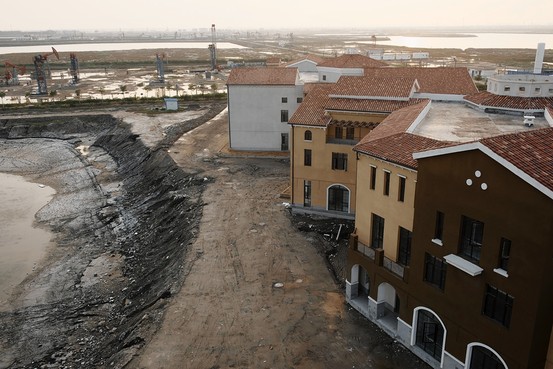
Buildings, some incomplete, in China’s Caofeidian industrial park.

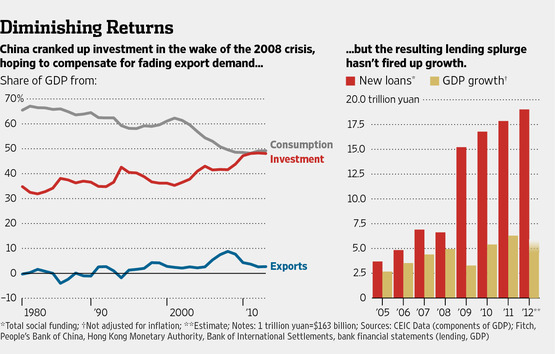
CAOFEIDIAN, China—A $91 billion industrial project here, mired in debt and unfulfilled promise, suggests part of the reason why China’s economy is wobbling – and why it will be hard to turn around. The steel mill at the heart of Caofeidian, which is outside the city of Tangshan, about 225 kilometers (140 miles) southeast of Beijing, is losing money. Read more of this post

Is China’s debt nightmare a province called Jiangsu?

Is China’s debt nightmare a province called Jiangsu?

5:16pm EDT

By Koh Gui Qing

WUXI, China (Reuters) – The nightmare scenario for China’s leaders as they try to wean the country off a diet of easy credit and breakneck expansion is a local government buckling under the weight of its own debt. Few provinces fit that bill quite like Jiangsu, home to China’s most indebted local government.

Hefty borrowings through banks, investment trusts and the bond market by Jiangsu’s provincial, city and county governments have saddled the province north of Shanghai with debt far higher than its peers, public records show.

Read more of this post

Inner Mongolia Property Mogul Bites the Dust; The real estate empire Li Guomin built in Bayan Nur has withered in the heat of a corruption scandal

07.24.2013 19:13

Inner Mongolia Property Mogul Bites the Dust

The real estate empire Li Guomin built in Bayan Nur has withered in the heat of a corruption scandal

By staff reporter Wang Heyan

1374664401193511

Bayan Nur is a city nestled in the crook of a crescent-shaped valley, between the Yellow River and a desert, and surrounded by productive farms. It’s name is Mongolian for “fertile lake,” owing to the swampy Lake Wuliangsu on the crescent’s eastern edge. Bayan Nur is also an economic hub for north-central Inner Mongolia Autonomous Region that’s prospered in recent years on the back of a local real estate boom. But these days, unlike the fertile crescent’s well-watered farms, Bayan Nur’s real estate industry as well as its economy are gathering dust in the dry heat of a corruption scandal. Read more of this post

Private Retirement Funds Find Malaysia a Tough Sell

July 24, 2013, 9:40 a.m. ET

Private Retirement Funds Find Malaysia a Tough Sell

People Are Slow to Sign Up to Program Meant to Supplement Government Pension Plan

JASON NG

Malaysia’s voluntary private-retirement savings program has gotten off to a slow start since being launched last year, despite lures of tax breaks for contributions and a high overall savings rate in the country. Employees in Malaysia are required by law to contribute to the separate Employees Provident Fund, or EPF, which holds assets valued at more than 536 billion ringgit ($169 billion). Returns on that government-run pension fund have been at least 4.5% annually over the past decade, while one-year fixed deposits in banks earn up to 3.2%. Read more of this post

IMAX to Build Up to 120 New Theaters in China

July 25, 2013

IMAX to Build Up to 120 New Theaters in China

Deal With Dalian Wanda Follows Pact With South Korean Partner

BEIJING—IMAX Corp. IMX.T -0.15% is joining with China’s largest cinema chain to build as many as 120 new theaters in the country, dwarfing a deal that the company announced with a Korean partner last week. The Chinese deal is IMAX’s latest to target Asian consumers’ increasing demand for watching Hollywood blockbusters on bigger, more immersive screens. Under the agreement, IMAX will add between 40 and 120 theaters. At most, it would bring to 381 the number of IMAX theaters open or planned in China, with Wanda Cinema Line Corp. running up to 210 of them. Read more of this post

The next Google: LeadBolt dominates app advertising, serving five billion ads a month in 100 different countries. Now, Microsoft has come knocking

Found: the next Google

July 19, 2013

Christopher Niesche

Andrew-Scarborough-300x0

LeadBolt dominates app advertising, serving five billion ads a month in 100 different countries. Now, Microsoft has come knocking.

Andrew Scarborough is driving LeadBolt’s domination of the global market for app ads. Google might rule the massive online advertising market at the moment. But Australian company LeadBolt is hot on its heels and starting to dominate the fast-growing app advertising market. The business is a mobile advertising network that runs a platform that allows advertisers to put ads into free mobile phone apps. The advertising revenue goes to the app developers with LeadBolt taking a commission along the way. This year, smart phone users around the world will download 80 billion (yes, billion) apps, and that number is forecast to double to 160 billion by 2017. Read more of this post

Online Shopping Site ModCloth’s Vintage Threads Lift Sales Past $100 Million

ModCloth’s Vintage Threads Lift Sales Past $100 Million

For Eric and Susan Koger, the husband-and-wife duo who founded online shopping site ModCloth Inc. as high school sweethearts, a division of labor has always been clear: he’s tech and she’s fashion.

That balance helped ModCloth stand out in a sea of e-commerce rivals and expand sales to “well over” $100 million last year, according to Chief Executive Officer Eric Koger, 29. It also informed a push into wireless devices, which now account for nearly half of visits to its store, he said. Read more of this post

Google’s New $35 Chromecast Device Streams to TVs; Google gets deeper into hardware with new tablet, TV gadget

July 24, 2013, 1:40 PM

Google’s New $35 Chromecast Device Streams to TVs

OB-YH628_0724ch_D_20130724134000

Mario Queiroz, Vice President of Product Management at Google, holds up a new Google Chromecast SDK as he speaks during a special event at Dogpatch Studios on July 24, 2013 in San Francisco.

By Amir Efrati and Greg Bensinger

Google GOOG -0.10% unveiled a device to help people connect their TVs to mobile devices so that they can view and listen to Web content on the biggest screen in their homes. The two-inch device, called Chromecast, looks like a thumb drive and is based on Google’s ChromeOS software. The device, available today for $35 at Bestbuy.com Amazon.com AMZN -0.70% and the Google Play store, also works with Apple mobile devices. Chromecast will allow people to select YouTube video content using their Web-connected tablet, for instance, and have it play on their television. It echoes similar technology from Apple called Airplay and from Microsoft MSFT +0.44% called Smartglass. Read more of this post

Chinese Consumption Goes Digital; In the U.S., e-commerce is the icing for retailers. In China it is the cake

July 24, 2013, 12:46 p.m. ET

Chinese Consumption Goes Digital

In the U.S., e-commerce is the icing for retailers. In China it is the cake.

FRANK LAVIN

Speculation over when Chinese online giant Alibaba will launch its initial public offering is again drawing attention to the country’s burgeoning e-commerce industry. Alibaba’s sales are larger than Amazon’s and eBay‘s EBAY +0.89% combined, and its retailing site Tmall boasts more than 500 million registered customers. If China is going to rebalance its economy toward domestic consumption, clearly the Internet will play a big role. This poses a challenge for foreign firms: How can they get in on this act, too? In important respects, e-commerce will fuel China’s greater opening to foreign consumer products. There is no simpler, faster or less expensive way for foreign firms to establish a national retail presence in this sprawling continental market. But online retailing can also be a trap for the unwary. Read more of this post

Cracking the Mysteries of the Male Shopper; As More Men Shop Online, Retailers Like East Dane Try to Understand Them

July 24, 2013, 7:06 p.m. ET

Cracking the Mysteries of the Male Shopper

As More Men Shop Online, Retailers Like East Dane Try to Understand Them

CHRISTINA BINKLEY

The male clothes shopper, long an enigma, is increasingly being spotted online, and the folks at ShopBop are ready for the chase. The women’s-clothing site, owned by Amazon, has been observing the way guys shop online. As a result, its new men’s site, East Dane, which is to debut in September, will look and function very differently from ShopBop. For instance, it will show models mostly from the neck down, present bigger product photos, and include in every order a strip of packing tape to ease a potential return. Read more of this post

Mining Silicon Valley’s Culture: Big Companies Set Up Outposts in Search of New Ideas but Some Falter

July 24, 2013, 7:49 p.m. ET

Mining Silicon Valley’s Culture

Big Companies Set Up Outposts in Search of New Ideas but Some Falter

RACHAEL KING and STEVEN ROSENBUSH

In roughly the past two years, Target Corp., TGT +0.10% General Electric Co.,GE -0.36% Ford Motor Co., F +2.54% Johnson & Johnson JNJ -0.06% and other big companies have opened outposts in or near Silicon Valley in search of ideas and exposure to new technologies not likely to be created in places like Fairfield, Conn., or Detroit. Such companies spent decades watching from the sidelines as Silicon Valley startups developed into some of the fastest-growing and most influential companies of their time. Not surprisingly, companies from around the world—including retailers and old-line industrial giants—ventured to California to tap some of Silicon Valley’s culture based on risk taking, speed, innovation and both hypercompetition and collaboration. Read more of this post

Corporate investment: A mysterious divergence; Experts are struggling to explain a great puzzle of the US economy

July 24, 2013 7:09 pm

Corporate investment: A mysterious divergence

By Robin Harding

Experts are struggling to explain a great puzzle of the US economy, writes Robin Harding

Robert Grant made a solid career out of Botox and breast implants. With a broad smile, he looks like Hollywood’s version of a US corporate executive, perhaps because he admits to using some of the rejuvenating products he sold. Treatments to tauten an ageing population are the quintessential – and highly profitable – products of the US economy in the 21st century. Mr Grant has flown high at some of the industry’s top companies, such as Allergan and Bausch & Lomb, which have operations, together with their most ardent customers, in California’s Orange County. Read more of this post

Banks should keep out of mines and warehouses; When Goldman Sachs bought the commodity trading house J Aron in 1981, it also took on Lloyd Blankfein, then a salesman of silver coins

July 24, 2013 6:49 pm

Banks should keep out of mines and warehouses

By John Gapper

When Wall Street launches into unlikely enterprises, it is time, once again, to start worrying

When Goldman Sachs bought the commodity trading house J Aron in 1981, it also took on Lloyd Blankfein, then a salesman of silver coins. Thirty-two years later, Mr Blankfein is Goldman’s chairman and chief executive and the bank owns, among other commodity assets, some aluminium warehouses near the ailing city of Detroit.

The process by which some of the biggest US banks came to own not only physical commodities but infrastructure such as oil tankers and pipelines is a fine example of mission creep since they were split up by the Glass-Steagall Act of 1933. One can see how they got there, but it is a peculiar – and not very desirable – outcome. Read more of this post

Monumental ambitions: Efforts are afoot to tackle the poor planning that busts budgets and wastes time on big projects

July 24, 2013 5:26 pm

Monumental ambitions

By Andrew Hill

Thinking ahead: better Olympics planning has cut budget over-runs, although the London games overshot by 100%

Frank Gehry, the architect, does not like project managers, but over his career he has learnt a lot about project management. His acclaimed Walt Disney Concert Hall in Los Angeles, completed in 2003, fell into a mire of lawsuits about cost overruns, settled five years later with none of the parties admitting blame. The Guggenheim Museum in Bilbao, however, came in 18 per cent under budget and, as important, has yielded greater benefits for the Spanish city than forecast. Mr Gehry urges fellow architects to take more control of the execution of their work: “Don’t be the baby, be the parent and better things will happen,” he said in a 2010 lecture in Oxford. Read more of this post

Billion-Dollar E-Commerce Flash Sales Startup Zulily Hires Banks For Possible IPO

Billion-Dollar E-Commerce Startup Zulily Hires Banks For Possible IPO

ALISTAIR BARRREUTERS JUL. 24, 2013, 3:40 PM 1,286

SAN FRANCISCO (Reuters) – Zulily hired investment banks in recent weeks to advise the fast-growing e-commerce company on a possible initial public offering, according to two people familiar with the situation.

Zulily, a “flash sales” company founded by former Blue Nile executives Mark Vadon and Darrell Cavens, tapped Goldman Sachs, Citigroup’s investment bank and Bank of America Merrill Lynch, for the IPO push, according to one of the people. Read more of this post

How Microsoft spent a decade asleep on the job

How Microsoft spent a decade asleep on the job

BY JOHN NAUGHTON

THE OBSERVER

JUL 23, 2013

LONDON – Once upon a time, a young man named Bill had a vision. He saw “a PC on every desk, and every machine running Microsoft software.” And lo, it came to pass, and the company Bill cofounded became a gigantic machine for making money, and Bill became the richest man on Earth.

This agreeable outcome was arranged in a most ingenious way. The tedious business of making computer hardware was left to others — so-called “original equipment manufacturers” (OEMs), who sweated away in Taiwanese and other jungles manufacturing machines that attracted ever-smaller profit margins. All Microsoft did was to write the software for the operating system and the Office applications that transformed OEM hardware from expensive paperweights into something that could do useful corporate work. Read more of this post

Moves to rein in online portals for perpetrating unfair business practices are gaining momentum in Korea

2013-07-24 17:06

Reining in portals

Moves to rein in online portals for perpetrating unfair business practices are gaining momentum. On Tuesday, the ruling Saenuri Party organized a meeting to listen to small venture companies that complained about damage from Naver’s dominance in the Internet search engine market. The governing party is introducing a bill to tackle antitrust issues raised by the nation’s largest portal which has a 75 percent share of the local online market. Read more of this post

America spends more on health care than any other country in the world. What is more, spending within America varies dramatically from one region to the next. This is well known. Less understood is how best to change it

The high cost of health care

Searching for a diagnosis

Jul 24th 2013, 18:24 by C.H. | NEW YORK

AMERICA spends more on health care than any other country in the world. What is more, spending within America varies dramatically from one region to the next. This is well known. Less understood is how best to change it. The health system is enormously complex. Differing views on reform inspire rowdy protests and send pundits into frothy-mouthed rants. To lower health spending, it would help to know what drives it up. A huge new report from America’s Institute of Medicine (IOM) helps provide an answer. In the study, commissioned by Congress, the IOM looked at the geographic variation in spending within Medicare, the health programme for the old, and within the commercially insured population. It is the biggest ever analysis of why some regions spend more than others. Crucially, the factors driving the variation in Medicare spending are different from those affecting private coverage. Read more of this post

To avoid paying taxes, the rich are emptying their bank accounts in Switzerland and investing in art. This has spawned a new business of storing such works tax- and duty-free in warehouses across the world

07/24/2013 12:10 PM

(Sm)art Investing

Rich Move Assets from Banks to Warehouses

By Christoph Pauly

To avoid paying taxes, the rich are emptying their bank accounts in Switzerland and investing in art. This has spawned a new business of storing such works tax- and duty-free in warehouses across the world.

One of the world’s most valuable art treasures is being stored in an extremely ugly place, a six-story concrete building known as the Geneva free port. Instead of windows, much of the façade of this giant safe for the world’s wealthy is covered with gray panels. Anyone hoping to get into the walk-in lock boxes of this very special Swiss tax haven must first surmount a number of hurdles. At the first door, an employee has to type the right combination of numbers into a small screen. The next hurdle is a large steel barrier that has to be rotated counter-clockwise until it snaps into place, followed by a heavy steel door that resembles a submarine bulkhead. Behind it is a drab corridor with doors on both sides. Only the renters have keys to these doors. Read more of this post

Google Translate now supports handwriting input in 45 languages

Google Translate now supports handwriting input in 45 languages

By EMIL PROTALINSKIWednesday, 24 Jul ’13, 11:02pm

pngbase6442d71369feb6ecca-730x563

Google today launched handwriting input for Google Translate. The feature, which currently support 45 languages, lets you translate a written expression even if you don’t know how to type it out on a keyboard. If you’re getting a feeling of déjà vu, don’t worry: Google brought handwriting input to Google Translate for Android back in December 2012. Earlier this year, Google updated its Google Input Tools for the desktop by adding new virtual keyboards, input method editors, and transliteration input tools. Now it’s time to bring handwriting to the Web. Read more of this post

Chinese films gain box office edge with reality-based films

Chinese films gain box office edge with reality-based films

Xinhua

2013-07-25

Already topping US box office charts, action sequel Fast & Furious 6 and sci-fi flick Pacific Rim are also poised to cash in on the flourishing Chinese film market. These Hollywood blockbusters, which are scheduled to debut in Chinese theaters on July 26 and July 31, respectively, will face fierce competition from their Chinese counterparts, including a sequel to a popular coming-of-age drama Tiny Times that will hit screens early next month. Tiny Times, a film inspired by author-turned-director Guo Jingming’s novel of the same name, has raked in 475.6 million yuan (about US$77.5 million) in the Chinese mainland since its debut on June 27, according to figures released by China Film News on Tuesday. Read more of this post

Japan’s Temples, Universities, Hospitals Haunted By Yen Bets; Ryusho Soeda, 66, has taken on a job for which his career as a Buddhist priest never prepared him: forensic accounting

Japan’s Temples, Universities, Hospitals Haunted By Yen Bets

By Hideyuki Sano on 1:36 pm July 24, 2013.
Koya, Japan. Ryusho Soeda, 66, has taken on a job for which his career as a Buddhist priest never prepared him: forensic accounting.

Soeda’s temple is the 1,200-year-old Koyasan, a World Heritage site deep in the mountains of western Japan and long prized as a haven for quiet contemplation. But in recent months monks here have been debating a very worldly question: How did a complex bet on the yen go so horribly wrong?

Soeda, who was picked to head Koyasan in June after his predecessor was forced out, has promised a full accounting of the temple’s losses, which at one point last year threatened to wipe out half of its endowment. Read more of this post

As growing numbers of Indonesians become frustrated with the rising price of basic foods, such as chili, onion, chicken and eggs, the government faces scrutiny

Hot Seat on Chili Cost

By Yanto Soegiarto on 9:40 am July 24, 2013.
As growing numbers of Indonesians become frustrated with the rising price of basic foods, such as chili, onion, chicken and eggs, the government faces scrutiny.

Not only are citizens upset, but President Susilo Bambang Yudhoyono also recently expressed anger over the public outcry and incapability of his ministers to stabilize food prices.

Based on official statistics obtained from the Central Statistics Bureau (BPS) during the first week of July, the price of red chili (bird’s eye chili) went up to Rp 41,000 ($4) a kilogram — nearly 50 percent higher than the normal price. Read more of this post

Tide Turns Against Private Equity in India

Jul 24, 2013

Tide Turns Against Private Equity in India

By Kenan Machado

AM-AZ574_AMONEY_NS_20130724132404

The rupee’s slump to a record low is adding to the woes of foreign private-equity firms invested in India even as they deal with slowing economic growth and a big drop in initial public offerings this year. Those firms piled into the country in 2007 and 2008, when the economy was expanding at 8% to 9%. Since then, growth has fallen, sliding to a 10-year low of 5% in the fiscal year that ended in March. The rupee has fallen by around 52% since hitting a multiyear high in late 2007. It reached a record low of 61.20 to the dollar this month before strengthening to trade at around 59.40 on Wednesday. Read more of this post

No Menstrual Hygiene For Indian Women Holds Economy Back

No Menstrual Hygiene For Indian Women Holds Economy Back

Sushma Devi, a mother of three in Northern India, stores her “moon cup” on the window sill of the mud-brick veranda that shelters the family goats.

In a village where few have indoor toilets and the Hindi word for her genitals is a profanity, 30-year-old Sushma struggles to talk about how she manages her period and the changes brought by the bell-shaped device she inserts in her vagina to collect menstrual blood.

“It’s a thing from hell,” she says of the malleable, silicone cup, which she received from a Massachusetts Institute of Technology research group. “I have to keep it far from the house, from where I pray.” Read more of this post

China Wrings Price Cuts in Public Campaign on Graft-to-Collusion

China Wrings Price Cuts in Public Campaign on Graft-to-Collusion

When GlaxoSmithKline Plc (GSK) sent a top executive to Beijing this week to apologize in person for alleged corruption, he delivered a second pledge: cheaper drugs.

“We fully support the efforts of the Chinese authorities in their reforms of the medical sector,” Abbas Hussain, the London-based drugmaker’s president overseeing emerging markets, said in a statement on the website of the Ministry of Public Security, the country’s top law enforcer. Any savings in the way Glaxo operates, he said, will be passed to consumers, “ensuring our medicines are more affordable to Chinese patients.” Read more of this post

What about the workers … and their share of income?

What about the workers … and their share of income?

10:33am EDT

By Alan Wheatley, Global Economics Correspondent

LONDON (Reuters)- Nothing lasts forever but a global trend that set in 30 years ago shows no sign of ending: a steep rise in the share of income that goes to profits and a corresponding decline in labor’s slice of the economic pie.

The imbalance, which is driven by technical change, the waning clout of unions and the rise of financial markets, raises issues that are primarily political.

At what point will public opinion decide that the pendulum has swung too far towards the owners of capital? Should taxes and transfers be tweaked to redistribute income more fairly? Read more of this post