Washington Post Co.’s Real Star Asset: A Massive Pension Fund
August 8, 2013 Leave a comment
August 5, 2013, 6:45 PM
Washington Post Co.’s Real Star Asset: A Massive Pension Fund
By Tom Gara
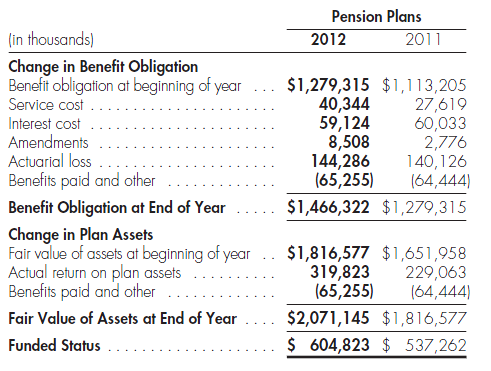
The Washington PostWPO -0.91% Company is best known for its flagshipnewspaper title sold today to a company controlled by Amazon founder Jeff Bezos, but it makes its big money from less prominent sources: A for-profit education business, cable television, and local TV stations. But while all these assets have their merits, here is one asset that gets much less attention: its hugely over-funded pension. At a time when pension obligations are becoming giant financial drag on some of America’s best known companies – such a drag, in some cases, that the pension funds end up owning significant chunks of the business — having a hugely over-funded pension plan is a pretty sweet spot to be in. Here are the details, via the company’s 2012 annual report: That’s a pension plan that owes its recipients just under $1.47 billion, but has $2.07 billion in assets — in other words, it is over-funded by a cool $604 million.
Why is the Washington Post Company in that position? Here’s CEO and Chairman Donald Graham, speaking at an investor presentation in September 2011:
So why am I calling your attention to the free cash flow at The Washington Post Company? Because, again, if you want to understand the value of what you own as a shareholder in this company, you have to focus on the fact that we have an overfunded pension plan. Now this is not something shareholders in many other companies have to focus on. Our pension plan is significantly overfunded. I’m smiling at Rick Wagoner as I say this. This was a new experience for Rick coming here. But the reason we have an overfunded pension plan is summed up in the two words, Warren Buffett…
Note the shout-out to Rick Wagoner, who was pushed out as chairman of General Motors in the wake of its government bailout. He knows all about under-funded pensions: GM has one of the biggest pension shortfalls of them all.
But thanks to Warren Buffett, the Washington Post Co. has no such problem. And Mr. Graham continued, explaining that the company takes a credit each year based on the over-funded pension:
Again, Kay Graham describes in personal history how in the late 1970s, Warren sent her an extensive memo about corporate pension funds, urging that we change from our then investors to two investors he recommended, who just knocked it out of the park for the ensuing 35 years. The result is that if you look at the segments, the segment reporting in the back of our 10-K, you will see that the Post reports overall a pension credit owing to the fact that the pension fund is overfunded. It is a lesser pension credit that we reported in past years, but it is overall — we have not put money, have not put cash into our pension fund for years because it is so overfunded.
Nice advice there, Warren. How the pension fund will work in relation to the sale of the newspaper is not yet clear, but will likely come up in conference calls explaining the deal.
But worth noting: When Mr. Graham says the company hasn’t needed to contribute to its pension fund for “years,” he really means it: In an investor presentation last December, he said management “haven’t put a dollar into it since I became the CEO in 1991 and for years before that.”
 About bambooinnovator

