China graft crackdown hits Hong Kong’s “Dried Seafood Street”

China graft crackdown hits Hong Kong’s “Dried Seafood Street”

POSTED: 25 Aug 2013 12:43 PM
In a narrow Hong Kong street filled with the tang of dried sea creatures, shopkeepers are blaming China’s recent corruption crackdown for falling sales of expensive banquet foods such as shark fin and abalone. HONG KONG: In a narrow Hong Kong street filled with the tang of dried sea creatures, shopkeepers are blaming China’s recent corruption crackdown for falling sales of expensive banquet foods such as shark fin and abalone. Such items have fallen off the menu since China’s new leadership came to power demanding austerity from Communist Party and military officials as a means of reigning in graft and dampening public anger over corruption. Read more of this post

9 out of top 10 Korean conglomerates’ market capitalization tumble down

9 out of top 10 conglomerates’ market capitalization tumble down

2013.08.25

South Korea’s 10 biggest family-owned conglomerates saw their stock market capitalization plummet this year, with the sole exception of SK Group. The combined market capitalization of the conglomerates’ 90 listed subsidiaries came to 630.9 trillion won ($567 billion) as of Friday, the latest trading day, said the Korea Exchange (KRX) and local financial data provider FnGuide Sunday. This is 9.4 percent, or 65.6 trillion won, down from 696.5 trillion won early this year. During the same period, the benchmark KOSPI retreated 7.9 percent. Of the top 10 conglomerates, Samsung Group suffered the largest market capitalization loss worth 46 trillion won, or 14.1 percent, followed by LG Group (6.6 trillion won), GS Group (2.9 trillion won), and Lotte Group (2.8 trillion won). Samsung Electronics’ share prices tumbled down, accounting for the biggest of proportion of Samsung Group’s market value loss. The market capitalization of Samsung Electronics declined 17.8 percent, or 41.4 trillion won, from 232.1 trillion won early this year to 190.8 trillion won as of now. LG Group’s market value fell, driven by LG Chem’s loss of 4.3 trillion won and that of LG Household & Health Care worth 2.3 trillion won. GS Group was mainly hurt by GS E&C, as the construction subsidiary has won contracts with lower profitability and remained in red ink for a prolonged period, and as a result its market capitalization tumbled down 47.2 percent, or 1.4 trillion won. SK Group was the single conglomerate whose market value increased. Most of the group’s subsidiaries fared poorly in the stock market, yet the market value of SK Telecom jumped 38.2 percent, or 4.6 trillion won, from that of early this year, contributing to a modest increase in market capitalization at a group-wide level.

Outdoor brands target ‘glampers’ in Korea

2013-08-25 18:50

Outdoor brands target ‘glampers’

By Rachel Lee

The country’s market for outdoor sporting goods has become ever more diversified and competitive as it has grown over the last few years. As more people enjoy “naports” and “glamping,” fashion and lifestyle companies are striving to attract those outdoor and leisure enthusiasts by launching new products that are made with unusual materials. The naports, a combination of night and sports, refers to a group of people who play sports at night after work due to their tight schedules. Glamping, in which glamor meets camping, straddles two worlds: the rough outdoors and the keep-your-hands-clean comfort of home. “People who go glamping like me use canvas tents and a real bed instead of a bedroll,” said Kim Jung-hyun, a 32-year-old office worker. Kim goes glamping with his friends twice a month. “I think the glamping group cares more about the quality of the vacation while getting the most from the outdoor experience.” Read more of this post

The Strike That Rattled Singapore: A WSJ Investigation

August 26, 2013, 8:00 AM

The Strike That Rattled Singapore: A WSJ Investigation

Top of Form

By Chun Han Wong

singstrike_GINI_NSsingstrike_foreign_NS

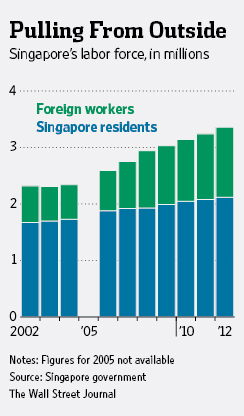
This story of a strike by Chinese bus drivers in Singapore offers a close-up look at a major issue facing the Southeast Asian city-state today: The growing number of migrant workers who underpin Singapore’s economy and the social tensions that their presence can generate. What happened over two days in late November 2012 rattled the foundations of Singapore’s economic success – its business-friendly governance and industrial harmony – and prompted a robust response from the government. The strike, a rarity in Singapore, resonated across Asia, where other countries are grappling with a growing dependence on foreign labor, too. And it provided a window into ordinary lives seldom-seen: the migrants who fan out from China in search of a fatter paycheck abroad. How to balance the need for new workers from overseas with the preservation of established ways, presents a major dilemma that policymakers and citizens will wrestle with for years to come. Read more of this post

‘RM1.23 billion Iskandar intra-city rail line plan scrapped’

‘Iskandar intra-city rail line plan scrapped’

By Sharen Kaur

Published: 2013/08/26

KUALA LUMPUR: The RM1.23 billion intra-city rail line for Iskandar Malaysia in Johor, as proposed by a private party, will be scrapped, said people with first hand knowledge on the matter.

This is because the government wants to focus on the high-speed rail system linking Kuala Lumpur and Singapore, which will likely have a stop in Iskandar Malaysia, and the Rapid Transit System from Johor Baru to Woodlands, Singapore.  “It does not make sense to have too many railway lines in Johor. It will be congested. We also have the Gemas-Johor Baru double-tracking project coming up,” a source told Business Times. Metropolitan Commuter Network (MCN), a 60:40 joint venture between Malaysia Steel Works (KL) Bhd (Masteel) and KUB Malaysia Bhd, had proposed to build the intra-city rail project. The joint venture first mooted the idea in 2009.  Read more of this post

Why do shadow banking activities always need a backstop?

What is shadow banking?

Stijn Claessens, Lev Ratnovski, 23 August 2013

There is much confusion about what shadow banking is and why it might create systemic risks. This column presents shadow banking as ‘all financial activities, except traditional banking, which require a private or public backstop to operate’. The idea that shadow banking is something that needs a backstop changes how we think about regulation. Although it won’t be easy, regulation is possible.

There is much confusion about what shadow banking is. Some equate it with securitisation, others with non-traditional bank activities, and yet others with non-bank lending. Regardless, most think of shadow banking as activities that can create systemic risk. This column proposes to describe shadow banking as ‘all financial activities, except traditional banking, which require a private or public backstop to operate’. Backstops can come in the form of franchise value of a bank or insurance company, or a government guarantee. The need for a backstop is a crucial feature of shadow banking, which distinguishes it from the “usual” intermediated capital market activities, such as custodians, hedge funds, leasing companies, etc. It has been very hard to ‘define’ shadow banking. The Financial Stability Board (2012) describes shadow banking as “credit intermediation involving entities and activities (fully or partially) outside the regular banking system”. This is a useful benchmark, but has two weaknesses: Read more of this post

Trades from 1990s come back to haunt Wall Street

Trades from 1990s come back to haunt Wall Street

7:04am EDT

By Lauren Tara LaCapra and Dan Wilchins

(Reuters) – In the 1990s, U.S. banks came up with a clever idea: using life insurance to bet that their employees would eventually die. Now those wagers are coming back to haunt Wall Street banks for reasons that have little to do with their employees’ longevity. For more than a decade, the lenders purchased life insurance policies, known as “bank-owned life insurance,” on employees in bulk. These policies were unusual: banks chose how the premium would be invested; and were on the hook for investment losses or gains over time, unlike typical policies where the insurer invests the premium. Read more of this post

Stagnant Wages Are Crimping Economic Growth

August 25, 2013, 4:19 p.m. ET

Stagnant Wages Are Crimping Economic Growth

Employers Seem Wary to Raise Pay

NEIL SHAH

Americans are spending enough to keep the economy rolling, but don’t expect them to splurge unless their paychecks start to grow. Four years into the economic recovery, U.S. workers’ pay still isn’t even keeping up with inflation. The average hourly pay for a nongovernment, non-supervisory worker, adjusted for price increases, declined to $8.77 last month from $8.85 at the end of the recession in June 2009, Labor Department data show. Stagnant wages erode the spending power of consumers. That means it is harder for them to make purchases ranging from refrigerators to restaurant meals that account for most of the nation’s economic growth. Read more of this post

Multiples Expanding Fastest Since Dot-Com Bubble as Rally Ages

Multiples Expanding Fastest Since Dot-Com Bubble as Rally Ages

Price gains of stocks in the Standard & Poor’s 500 Index (SPX) are outpacing profits by the fastest rate in 14 years as the bull market extends beyond the average length of rallies since Harry S. Truman was president.

The benchmark gauge for U.S. equities has risen 14 percent relative to income over the past 12 months to 16 times earnings, according to data compiled by Bloomberg. Valuations last climbed this fast in the final year of the 1990s technology bubble, just before the index began a 49 percent tumble. The rally that started in March 2009 has now outlasted the average gain since 1946, the data show. Read more of this post

Long leash for shadow banks

Updated: Monday August 26, 2013 MYT 6:46:56 AM

Long leash for shadow banks

LONDON: World leaders are expected to take a softly-softly approach to regulating the so-called shadow banking sector when they meet in Russia next month to avoid damaging the flow of finance to the global economy. While governments have cracked down on risk-taking by traditional banks in the wake of the financial crisis, the shadow banking sector, an assortment of financial intermediaries that handle US$60 trillion of transactions a year – roughly the same size as the world economy – remains a source of systemic risk for taxpayers. Read more of this post

Fed Officials Rebuff Coordination Calls as Stimulus Taper Looms

Fed Officials Rebuff Coordination Calls as Stimulus Taper Looms

Federal Reserve officials rebuffed international calls to take the threat of fallout in emerging markets into account when tapering U.S. monetary stimulus.

The risk that the Fed’s trimming of bond buying will hurt economies from India to Turkey by sparking an exodus of cash and higher borrowing costs was a dominant theme at the annual meeting of central bankers and economists in Jackson Hole, Wyoming, that ended Aug. 24. An index of emerging-market stocks last week fell 2.7 percent, the steepest in two months, compared with a 0.5 percent gain in the Standard & Poor’s 500 Index. Read more of this post

Bond Yields Show Selloff Beating ’09 Peaking Until Rate Rise

Bond Yields Show Selloff Beating ’09 Peaking Until Rate Rise

As the U.S. bond market suffers its worst rout since 2009, the gauge that historically signals more pain for fixed-income investors is instead suggesting yields (USGG10YR) are near their peak.

The gap between two- and 10-year Treasury yields widened to 2.55 percentage points this month, double the median of 1.23 points since 1990 and approaching the record 2.93 points in February 2010, data compiled by Bloomberg show. The yield curve is steepening at the fastest pace since 2009 as the Federal Reserve signals its intent to keep the target interest rate for overnight loans between banks at about zero into 2015 while reducing the bond-buying economic stimulus that drove 10-year yields to the highest level in more than two years. Read more of this post

Best Banks ‘Barely’ Covering Capital Cost in Risk-Weight Study

Best Banks ‘Barely’ Covering Capital Cost in Risk-Weight Study

Scandinavia’s biggest banks, which rank highest in a Bain & Co. a study comparing returns on risk-weighted assets, are still hardly making enough money to cover the cost of holding capital.

Nordic banks had an average return on risk-weighted assets of 1.9 percent in 2012, the highest ratio in western Europe, according to Bain’s calculations. For European banks, the average was 0.5 percent last year and zero in 2008, the report showed. Swedbank AB (SWEDA) and Svenska Handelsbanken AB (SHBA), both based in Stockholm, had the highest returns among western Europe’s biggest banks, at 4 percent and 3.6 percent, respectively. Read more of this post

Quality Minus Junk

Quality Minus Junk

Clifford S. Asness AQR Capital Management, LLC

Andrea Frazzini AQR Capital Management, LLC

Lasse Heje Pedersen New York University (NYU); Copenhagen Business School; AQR Capital Management, LLC; Centre for Economic Policy Research (CEPR); National Bureau of Economic Research (NBER)

August 21, 2013

Abstract: 
We define a quality security as one that has characteristics that, all-else-equal, an investor should be willing to pay a higher price for: stocks that are safe, profitable, growing, and well managed. High-quality stocks do have higher prices on average, but not by a very large margin. Perhaps because of this puzzlingly modest impact of quality on price, high-quality stocks have high risk-adjusted returns. Indeed, a quality-minus-junk (QMJ) factor that goes long high-quality stocks and shorts low-quality stocks earns significant risk-adjusted returns in the U.S. and globally across 24 countries. The price of quality – i.e., how much investors pay extra for higher quality stocks – varies over time, reaching a low during the internet bubble. Further, a low price of quality predicts a high future return of QMJ.

Daruma’s Mariko Gordon appreciates what it takes to succeed at business

SATURDAY, AUGUST 24, 2013

Zen and Small Stocks

By ERIC UHLFELDER | MORE ARTICLES BY AUTHOR

BA-BC687_hedgep_G_20130824010215

Daruma’s Mariko Gordon appreciates what it takes to succeed at business. Why she thinks Insulet can rise another 25% or more.

Mariko Gordon recently set a personal record: She passed through five airports in a single day. A stickler for detail and a believer in active money management, Gordon spends a lot of time checking out companies firsthand, usually working 12 hours a day, six days a week. She’s a veritable whirling dervish, trying to keep pace with the stocks of small, striving companies that tend to move around as much as she does.. Read more of this post

‘Creative Destruction’ could build a better Canada

‘Creative Destruction’ could build a better Canada

Rick Spence | 13/08/24 | Last Updated: 13/08/23 2:40 PM ET
Sometimes the road to business success isn’t easy to see.

A year ago, Karl Martin and Foteini Agrafioti had a new company, awesome technology, and no clear path. Both were engineering PhDs from the University of Toronto, he was a specialist in biometric identity systems and privacy; she developed the first technology to identify users based on their unique cardiac rhythm, and would be named U of T’s 2012 “inventor of the year.” But great technology alone does not a business make. Puzzled why big companies never came to the table with licensing deals, Agrafioti and Martin wondered what to do next. A year ago, a solution appeared. The university’s Rotman School of Business was opening a “Creative Destruction Lab” to provide mentoring and monitoring from seven of Canada’s most successful entrepreneurs — all of whom had steered tech companies to lucrative exits. Who could say no? One year later, the pair’s company, Bionym, has $1.4-million in funding and a new cause: changing the way identification works. By early next year, it will be selling Nymi, a Bluetooth-powered wristband that authenticates your identity to smartphones, tablets, computers, and eventually your car, your home, and the weight machines at your gym. Bionym is one of just eight companies that survived the first year of the Creative Destruction Lab (CDL), coming out stronger, more certain, and capitalized for success. Bionym’s success shows what can happen when you connect new entrepreneurs and promising technology with veteran mentors who understand business and know how to get things done. Read more of this post

Noise is the supreme archenemy of all serious thinkers

August 24, 2013

I’m Thinking. Please. Be Quiet.

By GEORGE PROCHNIK

SLAMMING doors, banging walls, bellowing strangers and whistling neighbors were the bane of the philosopher Arthur Schopenhauer’s existence. But it was only in later middle age, after he had moved with his beloved poodle to the commercial hub of Frankfurt, that his sense of being tortured by loud, often superfluous blasts of sound ripened into a philosophical diatribe. Then, around 1850, Schopenhauer pronounced noise to be the supreme archenemy of any serious thinker. His argument against noise was simple: A great mind can have great thoughts only if all its powers of concentration are brought to bear on one subject, in the same way that a concave mirror focuses light on one point. Just as a mighty army becomes useless if its soldiers are scattered helter-skelter, a great mind becomes ordinary the moment its energies are dispersed. Read more of this post

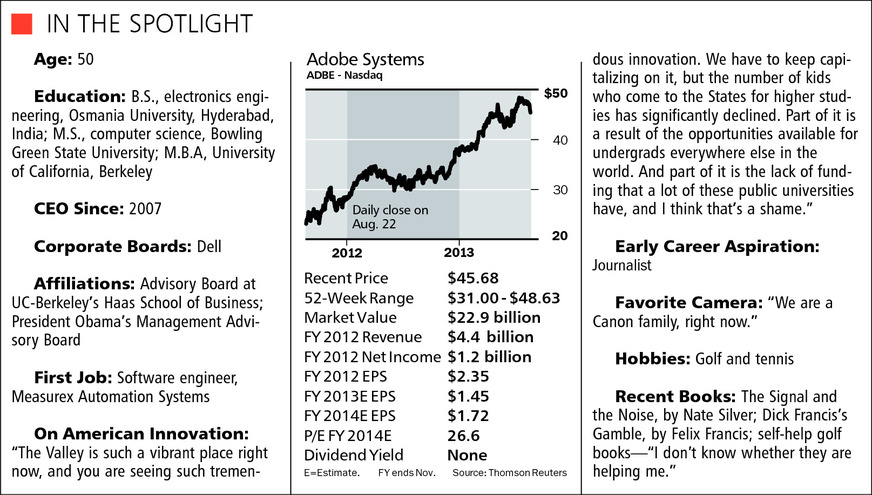
The Man Behind the Turnaround at Adobe; Shantanu Narayen has reshaped Adobe, helping to nearly double its stock price in two years, after a very public dispute with Apple’s Steve Jobs in 2010

SATURDAY, AUGUST 24, 2013

The Turnaround Artist

By ALEXANDER EULE | MORE ARTICLES BY AUTHOR

Shantanu Narayen has reshaped Adobe, helping to nearly double its stock price in two years, after a very public dispute with Apple’s Steve Jobs in 2010.

BA-BC734_ceospt_G_20130824014540 ON-BB929_SPOTLI_G_20130824013902

Shantanu Narayen tends to fly under the radar in Silicon Valley, so he was in uncharted waters when Steve Jobs dragged him and his company, Adobe Systems , into the headlines in 2010. The dispute centered around Flash, Adobe’s Web software standard for enabling video. In an open letter on Apple‘s website, Jobs blasted Flash as flawed technology. Narayen was left to defend his company, which once had a close partnership with Apple. Read more of this post

MediaTek has burst into the market for smartphone chips as the fourth biggest maker with around 10% market share; Domestic smartphone brands’ share in China has soared from 25% to 70% in the past two years, as the market has expanded more than fivefold

MediaTek has burst into the market for smartphone chips

Aug 24th 2013 | HSINCHU |From the print edition

E319HR02H_2010資料照片_copy1

TAIWAN has a paradoxical claim to fame. The island of 23m people is home to many leading information-technology companies—few of which are well known abroad. Most of the world’s personal computers are made by Quanta, Wistron or some other obscure Taiwanese firm, though they bear the names of Dell, HP or Lenovo. The processors in your smartphone or tablet may have been made by Taiwan Semiconductor Manufacturing Company (TSMC) and its touch-screen by TPK. And, especially if your device is Chinese, there is a good and growing chance that the chips were designed by MediaTek. Read more of this post

VMware Killed the Past. Can It Claim the Future? The company that helped bring in cloud computing could become a tired relic or lead big business customers to a whole new kind of computing

AUGUST 24, 2013, 9:00 AM

VMware Killed the Past. Can It Claim the Future?

By QUENTIN HARDY

VMware is a 15-year-old tech company with a market capitalization of $36 billion. Next week, it will host 21,000 customers in San Francisco and will start to find out if that means it is young or old. “It’s a statement of our success how quickly we’ve become mainstream,” said Pat Gelsinger, the company’s chief executive. Now, however, he says, “we’re at the crossroads.” As what he calls “the last great company of the client-server generation,” VMware is going through much of the same transition to the world of cloud computing, big data, and mobility, that bedevils so many giants of the old tech world. Uniquely, the company has a legitimate claim to have helped destroy the software world in which it started. VMware’s main product, virtualization software, allows one computer server to do the work of many, and for complex tasks to be shared across several machines. That disrupted the old computer server business, and helped usher in the current model of big data centers and cloud computing. But now, as other companies offer both proprietary and open source virtualization, VMware has to move on from the world it helped destroy. Read more of this post

Designer headphones: Dr Dre’s creation of a market for costly cans may herald the return of true hi-fi; In America the company now has almost half the market for premium-priced cans, compared with 21% for Bose, a longer-established maker

Designer headphones: The sound of music

Dr Dre’s creation of a market for costly cans may herald the return of true hi-fi

Aug 24th 2013 |From the print edition

20130824_WBP002_0

FOR decades the market for expensive headphones was mainly limited to hi-fi buffs. But now that the boxy stereo system in the corner of the bedroom is largely a thing of the past, and young music fans listen mostly on portable devices, headphones have become as much of a fashion statement as the music player itself. Among the first to spot the potential of this market was Dr Dre, an American rapper-cum-tycoon. In 2008 he and Jimmy Iovine, a record producer, launched their Beats range of headphones, to great success. They have all but created a new product category: premium-priced ($100-plus) cans whose sound quality is good enough, but which mainly sell on their brand image. Read more of this post

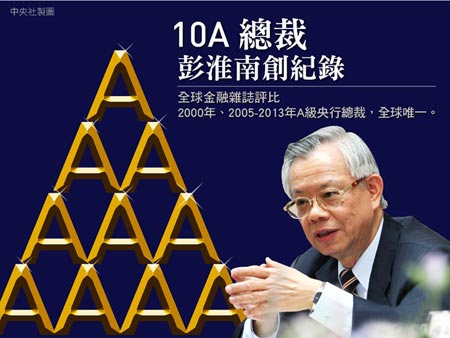
Taiwan’s central bank governor Perng Fai-nan was named as the one of the world’s top central bankers for the 10th time

Taiwan’s Perng wins 10th top central banker honor

CNA 2013-08-24

C823C0178H_N22_2013資料照片_N71_copy1

Taiwan’s central bank governor Perng Fai-nan was named as the one of the world’s top central bankers for the 10th time by Global Finance. (Photo/CNA)

Taiwan’s central bank governor Perng Fai-nan was named as the one of the world’s top central bankers for the 10th time by Global Finance on Friday in its annual report on central bankers’ performance worldwide. Perng was awarded an A for the ninth straight year from 2005-2013 in the magazine’s central bank report cards, which grades central bankers on an A to F scale. He received his first A in 2000, two years after he became governor of the Central Bank of the Republic of China (Taiwan). He is the first central bank chief to receive an A for the 10th time. Perng expressed his gratitude for the recognition and attributed his achievement to the people of Taiwan and all those who work at the central bank. Read more of this post

The adidas method: A German firm’s unusual approach to designing its products

The adidas method: A German firm’s unusual approach to designing its products

Aug 24th 2013 | HERZOGENAURACH |From the print edition

20130824_WBC259

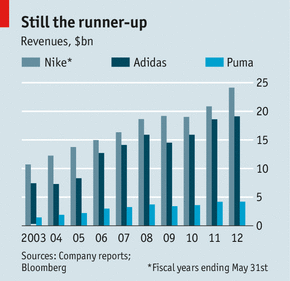
TEN years ago sportswear-makers were cramming ever more features and futuristic designs into their products. They were convinced that the consumer bought, say, training shoes based on their technical specifications. But in 2004 James Carnes, today adidas’s creative director for sportswear, and a Danish consultant named Mikkel Rasmussen met at a conference in Oslo at which Mr Rasmussen challenged this notion. A mobile phone, he said, may have 72 functions, but that is 50 more than most people wanted, or used. Mr Carnes was intrigued, and so began an almost decade-long engagement for ReD, the small consultancy Mr Rasmussen co-founded in Copenhagen. In that decade adidas’s sales and share price have grown steadily, alongside those of Nike, an American firm that is the global leader in sportswear (see chart). It remains far ahead of Puma, its crosstown rival. The two German firms, based in Herzogenaurach in Bavaria, were founded by brothers, Adi Dassler (hence adidas’s name) and the older Rudolf (Puma), who fell out. Read more of this post

Multinationals in China: Guardian warriors and golden eggs; The state’s crackdowns on big firms are not all about bashing foreigners

Multinationals in China: Guardian warriors and golden eggs; The state’s crackdowns on big firms are not all about bashing foreigners

Aug 24th 2013 | SHANGHAI |From the print edition

FOREIGN companies love to complain about doing business in China. The rules of the game are rigged against them, they grouse, the locals are corrupt and the government is always turning the thumbscrews on them. Amid such moans it is worth remembering that, for all the barriers that foreign multinationals face in China, it has welcomed them with open arms compared with the protectionism imposed by Japan and South Korea at comparable stages in their economic development. Nevertheless, the recent spate of high-profile crackdowns on international firms, and people associated with them, has prompted worries about a generalised anti-foreigner backlash. Read more of this post

The Picasso Effect: What The Success of Cubism Teaches Us About Radical Innovation

The Picasso Effect: What The Success of Cubism Teaches Us About Radical Innovation

ian leslie, August 6, 2013

Paris, 1907. In a ramshackle studio in Montmartre, a twenty-six year-old Spanish artist presented the painting he had been working on day and night for the best part of a year to a small group of fellow artists, dealers and friends. They were visibly aghast. One considered the work “a veritable cataclysm”. Another concluded that its creator must be on the brink of suicide. None could foresee that it would one day be considered the most influential artwork of the twentieth century. The painting, then untitled, was later to become known as Les Demoiselles d’Avignon. It is credited as the first work of Cubism, and the catalyst for a revolution in Western art and culture. Read more of this post

Richard Branson Taught Me That ‘Successful People Start Before They’re Ready’

Richard Branson Taught Me That ‘Successful People Start Before They’re Ready’

JAMES CLEARJAMESCLEAR.COM AUG. 23, 2013, 3:06 PM 2,709

In 1966, a dyslexic sixteen–year–old boy dropped out of school. With the help of a friend, he started a magazine for students and made money by selling advertisements to local businesses. With only a little bit of money to get started, he ran the operation out of the crypt inside a local church. Four years later, he was looking for ways to grow his small magazine and started selling mail order records to the students who bought the magazine. The records sold well enough that he built his first record store the next year. After two years of selling records, he decided to open his own record label and recording studio. Read more of this post

Too soon to buy unloved emerging markets; “Bottom-line, investors are now almost unanimously bearish on EM in their minds, but not so in their books. Contrarian investors looking for extreme distress ought not to announce a buying opportunity yet.”

Last updated: August 23, 2013 8:40 pm

Too soon to buy unloved emerging markets

By Robin Wigglesworth

To be utterly unloved is an unusual state of affairs for emerging markets.

Since the economic cataclysms of the 1990s, investors in developing countries have reaped a financial bonanza. But a combination of deteriorating economic fundamentals and the US Federal Reserve’s plans to “taper” its monetary stimulus has convulsed emerging markets since the start of May. Emerging market equity fund managers are more familiar with the unpopularity of their asset class than their bond colleagues. While the latter have suffered only a few dismal months, the former have been in the doldrums for a few years. But with sentiment so overwhelmingly bearish towards equities in particular, is this a golden contrarian buying opportunity? Read more of this post

Emerging Stocks’ Emerging Problems; India Shows How the Emerging-Market Selloff May Have Only Begun

August 23, 2013, 5:28 a.m. ET

Emerging Stocks’ Emerging Problems

India Shows How the Emerging-Market Selloff May Have Only Begun

ABHEEK BHATTACHARYA

AM-AZ945_INDIAH_NS_20130823051505

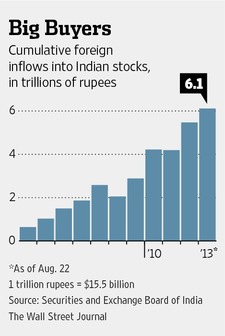
Emerging-market stocks have taken a thumping lately, and it could get a whole lot worse if foreign investors hasten their retreat. The MSCI Emerging Markets index is down 12.6% for the year, but it appears a lot of the selloff has been driven by local players. Foreigners have been slow to get out of emerging-market stocks. In fact, for most of the year they have been putting more money to work, according to EPFR, including inflows into stock funds much of the past two months. Read more of this post

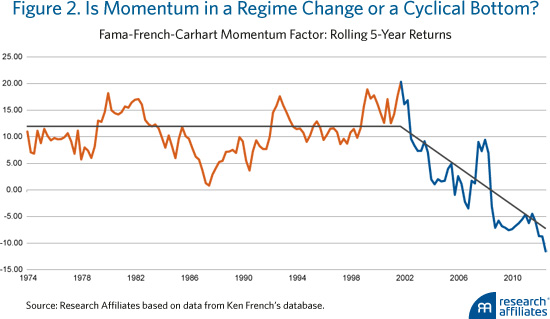
Hot Potato: Momentum As An Investment Strategy; momentum’s strength has eroded over the past decade. Factor-based investing requires strong conviction and a steady hand

Hot Potato: Momentum As An Investment Strategy

August 2013 | Ryan Larson

F_2013_08_Momentum_Factor_fig2_small

Momentum investing has important features in common with other factor-based Smart Beta strategies. For example, it has straightforward index or portfolio construction rules that are easily explained and implemented. And, although momentum investing is emphatically not a contrarian strategy, neither is it necessarily inconsistent with the Smart Beta thesis that prices are noisy and mean-reverting. In this interpretation, momentum investing is a lively game of hot potato—buying rapidly appreciating stocks, holding them for a relatively short period, and selling them before their price trends reverse direction. And in favorable conditions it works very well. Read more of this post

Jeff Bezos’ Hiring Strategy in Amazon’s Early Days: The ‘Anti-Pitch’; Rather than tell prospects how happy and amazing Amazon is, Jeff Bezos would tell them that “it’s not easy to work here.” It had a powerful, intended effect — there was no disillusionment over what Amazon was when the prospect eventually joined. Those who chose Amazon in spite of the anti-pitch knew what they were getting into, and had in fact self-selected for the challenge. Amazon became known as a company whose engineers were intense and elite.

Jeff Bezos’ Hiring Strategy: The ‘Anti-Pitch’

WALTER CHENIDONETHIS BLOG AUG. 23, 2013, 3:36 PM 2,580 1

Today, the competition for top tech talent is as fierce as it’s ever been, and without a high-performing team, it’s tough to survive. It makes sense that such intense competitive pressure drives startup founders to pitch their company to prospective hires in ever more grandiose terms, exaggerate how well their company is “crushing it,” and make their culture sound like the happiest place on earth. How else can you stand out to a top candidate who’s considering offers from all of the hottest companies? It’s counterintuitive, but Amazon founder and CEO Jeff Bezos takes a totally different approach to hiring: he gives prospects a hiring anti-pitch. Rather than tell prospects how happy and amazing Amazon is, Jeff Bezos would tell them that “it’s not easy to work here.” Even in 1997, during the dot-com boom, Bezos’s anti-pitch was stark and to the point: “You can work long, hard, or smart, but at Amazon.com you can’t choose two out of three.” Read more of this post