Wudang can make you a Daoist master — of business administration

Wudang can make you a Daoist master — of business administration

Staff Reporter

2013-08-15

C927X0420H_2012資料照片_N71_copy1

A Daoist temple on Wudang Mountain holds an annual ceremony to celebrate its reconstruction after a fire in 1745. (File photo/Xinhua)

You Xuande, the leader of the Wudang Chinese martial arts school in central China’s Hubei province, says several business executives have expressed an interest in taking a Master of Business Administration course at the school. The school does not currently offer its own MBA course but its staff have lectured at several universities, reports the state-run China National Radio. Many parents from wealthy and influential families said that they would also be interested in sending their children to the school to learn about Daoism, even willing to pay a fortune to enroll their children there. Money is no issue to them, said You, adding that 80 students applied for a place this year, but the school was only able to accept 20 of them. Read more of this post
Rational about superstition; Even hardheaded businesspeople can have workplace rituals and lucky talismans

August 14, 2013 4:21 pm

Rational about superstition

By Rhymer Rigby


Ryan Paugh is a man with a lucky pebble. “My wife gave it to me. It’s from Santa Fe, New Mexico, which is a spiritual sort of place and it is meant to keep away bad spirits and attract good energy. So when I’m trying to raise money or launch a product I keep it in my pocket,” says the founder of YEC, the US invitation-only entrepreneurs’ organisation. Mr Paugh explains that while he does not exactly believe his pebble is imbued with magical powers, “it feels good. It’s an object that reminds you to be in a positive frame of mind and it reminds me that I work hard for my family.” Read more of this post

Why are we teaching like it’s 1992?

Why are we teaching like it’s 1992?

On April 22, 1993, the computer scientists who developed the Mosaic 1.0 browser decided that the Internet should be available to all of us.

BY CATHY DAVIDSON –

5 HOURS 5 MIN AGO

On April 22, 1993, the computer scientists who developed the Mosaic 1.0 browser decided that the Internet should be available to all of us. Before that, it was mostly computer programmers, scientists, university professors and government officials who used the World Wide Web to communicate ideas. After 1993, the rest of humanity was given a new and remarkable power: Anyone with an Internet connection could publish a thought to anyone else anywhere in the world who also had access to an Internet connection. No professional publisher or editor was there to guide you before you hit “send” to ensure accuracy, logic or even common sense. Read more of this post

Brain Shaking Technique Offers Measure of Consciousness

Brain Shaking Technique Offers Measure of Consciousness

A new technique for measuring consciousness offers a reliable way to guide treatment of patients with brain injuries who can’t respond to commands, according to a study.

By using a device that shakes the entire brain with strong magnetic stimulation, researchers led by a team at University of Milan in Italy measured the amount of information flow occurring in the brain. They were able to discriminate between various levels of consciousness with a numerical index they developed. The study was published today in Science Translational Medicine. Read more of this post

America’s doctors, like Wall Street, need a cultural shift; An ‘eat what you treat’ system can tempt doctors to offer excessive treatments

August 14, 2013 6:39 pm

America’s doctors, like Wall Street, need a cultural shift

By Gillian Tett

An ‘eat what you treat’ system can tempt doctors to offer excessive treatments

How can America cut its healthcare costs? The question is generating political heat in Washington right now. No wonder. Healthcare spending now stands at an eye-popping 17 per cent of US gross domestic product. And next year, President Barack Obama’s divisive “Obamacare” reforms will take effect, extending insurance to a much wider part of the population than ever before. But as politicians trade ideas (and insults) about cutting costs – with proposals ranging from better use of information technology through to insurance exchanges – there is another issue that needs to be discussed: doctors’ pay. Read more of this post

Oceanus suspends trading over ‘abnormal deaths’ of abalones; Oceanus operates the Ah Yat Tian Xia chain of restaurants, with outlets in mainland China, Hong Kong, Taiwan and Singapore

Oceanus suspends trading over ‘abnormal deaths’ of abalones

Thursday, Aug 15, 2013

Jonathan Kwok

The Straits Times

CHINA – Abalone producer Oceanus Group has suspended trading of its shares after it received a report of unnatural deaths of its abalones in China. An announcement by the firm on Sunday evening also made reference to an executive director who was recently forced to step down from the board but remains as a key manager. The statement did not link the reports of abalone deaths with the executive director’s departure except to say they had happened at around the same time. Mr Wu Yong Shou had stood for re-election at the Oceanus annual general meeting on July 31. But the motion was defeated by a 95.51 per cent majority of the shareholders present and voting – so he had to step down as an executive director. Read more of this post

The fraudulent actions of Taiwanese family business Rebar Group has landed five next-gens with prison sentences, while their father remains on the run

REBAR GROUP NEXT-GENS SENTENCED TO PRISON

ARTICLE | 15 AUGUST, 2013 11:20 AM | BY JESSICA TASMAN-JONES

The fraudulent actions of Taiwanese family business Rebar Group has landed five next-gens with prison sentences, while their father remains on the run. On Wednesday, Taiwan’s Supreme Court upheld the verdicts of a lower court, which handed out sentences between five and a half and 30 years to the children of Wang You-theng for violations of the Securities and Exchange Act. According to court findings, the Wang family members, who had held senior positions in various companies controlled by Rebar Group, defrauded investors and banks of billions of dollars by means of false accounting and other fraudulent actions over a number of years. The children include Gary Wang, Wang Lin I, Wang Lin-tai, Wang Lin-mei and Wang Lin-chiao. Wang You-theng, 86, who founded Rebar Group in 1959, fled Taiwan in late 2006, days before prosecutors began their investigation into the group. He is listed as one of Taiwan’s 10 most wanted economic criminals. Rebar Group began in the steel industry, but later expanded into textiles, hotels, real estate, insurance, banking and telecommunications.

Hong Kong’s Crisis of Governability

Updated August 14, 2013, 4:44 p.m. ET

Hong Kong’s Crisis of Governability

Lack of democracy turns a kerfuffle into an uproar.

Tensions are running high in Hong Kong as the government dithers over how to implement full democracy by 2017. A coalition of citizen activists promises a showdown in the streets of the business district next summer if the promise to elect the chief executive by universal suffrage is not kept. One sign of just how acrimonious the city’s crisis of legitimacy could become is the way a minor dispute over a teacher’s foul-mouthed tirade against a policeman has become a tug-of-war between pro-Beijing and pro-democracy forces. Read more of this post

Hong Kong Rents Hinder Billionaire Li’s Supermarket Sale

Hong Kong Rents Hinder Billionaire Li’s Supermarket Sale

Soaring Hong Kong rents helped make Li Ka-shing Asia’s richest man. They’re now becoming a hindrance as he looks to sell the city’s No. 2 grocery chain. His biggest company, Hutchison Whampoa Ltd. (13), is seeking $3 billion to $4 billion for its ParknShop supermarkets and has asked potential buyers to submit bids by Aug. 16, according to people with knowledge of the process. Hong Kong’s surging rents and a slowing grocery market could deter buyers from offering top price for the chain that sells everything from eggs to pork chops to whiskey. Shop leases have doubled over the past four years in the city, according to property agent Savills Plc. (SVS) And broker Cushman & Wakefield Inc. last year said Hong Kong’s Causeway Bay area had overtaken New York’s Fifth Avenue as the world’s most expensive district for retail rents. Read more of this post

Corporate China taps can-do spirit of innovation; “In China, the most common phrase in conversations is xiang ge ban fa (let’s find a way), not guanxi”

Corporate China taps can-do spirit of innovation

By Wang Yong | August 15, 2013, Thursday |  PRINT EDITION

FOR many decades until the end of June this year, I had bought into a popular stereotype of Corporate China as a haven of copycats and guanxiology. Indeed, even today, if you look at domestically designed cars and high-rises, they are more often than not copies of Western designs. If you look at business deals, a lot of them are done with guanxi (connections) and greasing of palms. But that’s far from the whole story. I learned about a different Corporate China, which is surprisingly innovative, at the weeklong Orchestrating Winning Performance (OWP) program I attended at IMD (International Institute for Management Development), Lausanne, Switzerland, at the end of June.

Xiang ge ban fa

“In China, the most common phrase in conversations is xiang ge ban fa (let’s find a way), not guanxi,” said Winter Nie, professor of operations and service management at IMD. “Everything is difficult, but nothing is impossible.” Read more of this post

Chinese Banks Feel Strains After Long Credit Binge; Rapid Loan Growth Has Led to Serious Debt Problems at Local Governments

Updated August 14, 2013, 6:05 p.m. ET

Chinese Banks Feel Strains After Long Credit Binge

Rapid Loan Growth Has Led to Serious Debt Problems at Local Governments

LINGLING WEI and DANIEL INMAN

EM-AW785_CBANKS_G_20130814134809

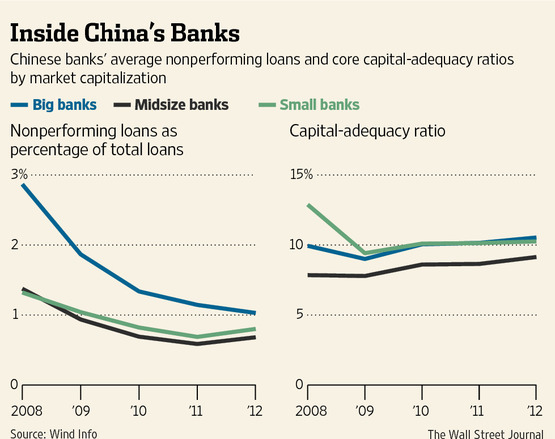
A cornerstone of China’s financial edifice is beginning to show some cracks. The country’s banking sector, a key part of a financial system that has powered China through three decades of breakneck expansion, is feeling the strain of years of rapid credit growth. Bank-fueled lending to state enterprises and local governments has led to overcapacity; serious debt problems for local governments, companies and lenders alike; and numerous white-elephant projects, from nearly empty malls and resorts to bridges to nowhere.

Chinese banks now are trying to strengthen their balance sheets ahead of an expected rise in bad loans coupled with slower earnings growth. Raising capital will likely be expensive for the banks because investors, who have sold off shares of banks, are worried about their deteriorating health and China’s slowing growth. Read more of this post

China Raises Scrutiny on Foreign Firms

August 14, 2013, 2:09 p.m. ET

China Raises Scrutiny on Foreign Firms

Regulators Expand Inquiry Into Drug Sector and Seek Data on Car Pricing

LAURIE BURKITT

BEIJING—China’s regulators are increasing their scrutiny of foreign companies in industries from drugs to cars to baby formula as part of a drive to push down prices for consumers. The intensifying effort could help China’s new leaders win favor at home and give Beijing a greater say in global commerce. The latest move came Wednesday, when officials at China’s State Administration for Industry and Commerce said they would open a three-month probe into possible bribery in the pharmaceutical and medical-device industries, citing public dissatisfaction with high prices. Read more of this post

China Drugmakers Decline on Corruption Crackdown

China Drugmakers Decline on Corruption Crackdown: Shanghai Mover

Jiangsu Hengrui Medicine Co. fell the most in almost three years in Shanghai trading as drugmakers declined after the Xinhua News Agency reported China is starting a campaign to crack down on illegal competition in the industry. Jiangsu Hengrui dropped 5.9 percent to 32.76 yuan at the close, the biggest loss since Oct. 11, 2010. Beijing SL Pharmaceutical Co. slid 5.8 percent to 55.59 yuan. A gauge of health-care companies fell 3 percent, the most among 10 industry groups on the CSI 300 index. The Shanghai Composite index dropped 0.9 percent and CSI 300 index lost 1.2 percent. “The crackdown on irregularities in the medical sector has undermined confidence among some investors and they expect drug prices to fall,” said Wu Kan, a Shanghai-based fund manager at Dragon Life Insurance Co., which oversees $3.3 billion. Read more of this post

China could target oil firms, telecoms, banks in price probes: report

China could target oil firms, telecoms, banks in price probes: report

6:29am EDT

By Kazunori Takada

BEIJING (Reuters) – China’s powerful price regulator could target the petroleum, telecommunications, banking and auto sectors next in its investigations into violations of the country’s anti-trust laws, state media quoted a senior official as saying. The National Development and Reform Commission (NDRC) would look at industries that have an impact on the lives of ordinary Chinese, China Central Television (CCTV) quoted Xu Kunlin, head of the anti-monopoly bureau at the NDRC, as saying on one of its programs. The NDRC has launched nearly 20 pricing-related probes into domestic and foreign firms in the last three years, according to official media reports and research published by law firms. But the scope of its investigations in the world’s second-biggest economy have gathered pace in recent months and coincide with criticism in official media about the price of goods such as milk powder, medicine, luxury cars and jewellery. Read more of this post

Western brands get a feel for Chinese customers’ needs on WeChat

August 14, 2013 5:32 pm

Western brands get a feel for Chinese customers’ needs on WeChat

By Sarah Mishkin in Hong Kong

It is not just Durex, owned by Reckitt Benckiser, that found WeChat’s one-to-one messaging and other features useful for reaching potential Chinese customers. Starbucks, one of the first US brands to run a campaign on WeChat, asked its followers there to tell the company what mood they were in by messaging them an emoticon. In response, the company would send them an audio track of a song that matched their mood. Asking users about their feelings made the company itself seem welcoming, said Joseph Tang, digital business director with ad agency Grey in Shanghai. Read more of this post

What “Netflix for textbook” Chegg did (and didn’t) tell prospective investors in IPO filing

Delving into Chegg’s IPO filing

By Dan Primack August 14, 2013: 4:56 PM ET

What textbook rental company Chegg did (and didn’t) tell prospective investors.

FORTUNE — Textbook rental company Chegg Inc. today filed for a $150 million IPO, with expectations that it will list next month at a premium to the $800 million valuation it received in its latter rounds of venture capital funding. Chegg plans to trade on the NYSE under ticker symbol CHGG, with J.P. Morgan (JPM) and BoA Merrill Lynch (BAC) serving as lead underwriters. Obviously there is lots of data in the company’s registration statement, but two things jumped out in particular:

1. First half growth: If you look at Chegg’s financials between 2010 and 2012, it’s fairly uninspiring. Losses expanded at a faster clip than did revenue, and EBITDA kept slipping. But then comes the first half results for 2013, and you can understand why Chegg chose to wait until now to go public. The company reports $17.96 million in EBITDA for the first half of 2013, compared to just $2.15 million for the first half of 2012. Revenue grew by 26% (up to nearly $117 million), while losses decreased by 34% ($32 million vs. $21 million). And, remember, all of this includes Q2 — typically the company’s slowest quarter, since students are rarely seeking new textbooks between April and June. Read more of this post

Asia’s great investor rotation flows to North from South

Asia’s great investor rotation flows to North from South

3:56am EDT

By Vidya Ranganathan and Vikram Subhedar

SINGAPORE/HONG KONG (Reuters) – Alongside the great rotation from bonds to equities and from emerging to developed markets that has been 2013’s overriding investment theme, Asia is seeing its own migration in portfolio flows: from the South to North. Foreign investment flows have lifted stock markets in China, South Korea and Taiwan since July, the first and tentative signs that investors still see pockets of value at a time the outlook for emerging markets is glum. The appeal of these markets comes from several factors. While the consensus calls are still for an outperformance of equity markets in Japan, the United States and the rest of the developed world, a growing number of investors believe there is scope for Asia’s trade-driven, open economies to do well as U.S. growth recovers. Read more of this post

Asia Faces Higher Borrowing Costs; Rising U.S. Rates Make it Harder for Asian Issuers To Raise Funds Cheaply

August 15, 2013, 12:18 a.m. ET

Asia Faces Higher Borrowing Costs

Rising U.S. Rates Make it Harder for Asian Issuers To Raise Funds Cheaply

MICHAEL S. ARNOLD And NATASHA BRERETON-FUKUI

AI-CC875_ARATES_NS_20130814225706

HONG KONG—Governments and companies across Asia are facing an era of tighter credit that could impact the region’s growth prospects. Since the financial crisis, low global rates have been a significant motor of Asia’s developing economies. Now, rising U.S. rates, amid expectations the Federal Reserve will taper its massive bond-buying program later this year, are making it harder for Asian issuers to raise funds cheaply. Countries and firms across the region have had to pay higher rates to attract investors, or shelve bond issuances, as investors pulled some $6 billion out of regional debt in June and July, according to data provider EPFR Global. Read more of this post

JPMorgan And Goldman Sachs Are Playing Whack-A-Mole With Everyone Suing Them Over Their Metal Warehousing Businesses

JPMorgan And Goldman Sachs Are Playing Whack-A-Mole With Everyone Suing Them Over Their Metal Warehousing Businesses

LINETTE LOPEZ AUG. 13, 2013, 2:16 PM 1,554 6

As if on cue, around the country individuals and companies have started filing lawsuits against JP Morgan and Goldman Sachs for allegedly delaying deliveries of aluminum stored in their metals warehouses, thus manipulating the price of the commodity. Lawsuits have been filed in Michigan, Florida and Louisiana. On top of that, The Commodities Futures Trading Commission has subpoenaed JPM, Goldman, and commodities trading firm Glencore for documents related to their warehouse businesses, Bloomberg reports. The thing is — usually, when an issue is this obscure and hard to understand, it’s easily swept under the rug. Read more of this post

Intermittent Nature of Green Power Is Challenge for Utilities

August 14, 2013

Intermittent Nature of Green Power Is Challenge for Utilities

By DIANE CARDWELL

The 21 turbines at the Kingdom Community Wind farm in Vermont soar above Lowell Mountain, a testament in steel and fiberglass to the state’s growing use of green energy. Except when they aren’t allowed to spin at their fastest. That has been the case several times in the farm’s short existence, including during the record July heat wave when it could have produced enough much-needed energy to fuel a small town. Instead, the grid system operator held it at times to just one-third of what it could have produced. “We were being told to turn on diesel-fired units that are very expensive and dirty and told to ramp down what is renewable, cost-effective energy for our customers,” said Mary Powell, chief executive of Green Mountain Power, the utility that owns and operates the wind plant. “We should go with the sources that can have the highest value, especially during peak times.” Read more of this post

Following a setback in the South Korean government’s efforts to raise taxes against the middle-income class, the new tax code plan has angered those who inherit family business

New tax code angers long-lasting family firms

Lee Sang-deok, Jeon Jung-hong

2013.08.14

Following a setback in the South Korean government’s efforts to raise taxes against the middle-income class, the new tax code plan has angered those who inherit family business. Earlier, the government said it will raise the threshold for inheritance tax reduction in case of family business succession from the current 200 billion won ($178.5 million) in sales to 300 billion won. The measure would benefit 400 companies. But the government also introduced a carryover of transfer tax years in the new tax code. Under this system, if children who inherit family business from their parents inevitably sell the inherited asset, they will have to pay a transfer tax calculated from the date of acquisition by parents, not by children. According to the finance ministry and Korea Federation of Small and Medium-sized Businesses on Wednesday, small companies requested the government to re-examine the calculation method. “Strict conditions, including a 10-year job security program, should be met in order to get tax deduction in family business succession, but the carryover system is too harsh for heirs because it is applied at any time when they sell the inherited asset after inheritance,” said Kang Sang-hoon, Chairman of Dongyang Foods.

Care for some pineapple juice or fermented milk in your beer? Big Brewers Make Summer Wacky Beer Season in Japan

August 14, 2013, 6:51 p.m. ET

Big Brewers Make Summer Wacky Beer Season in Japan

Kirin and Asahi Test Innovations Like Soft-Serve Foam, Extra-Cold Brew and Beer Cocktails

HIROYUKI KACHI

PJ-BP968_BEER_G_20130814175236

At a Kirin Ichiban Garden, a temporary restaurant in downtown Tokyo, a server offers two experimental summer brews from Kirin.

Care for some pineapple juice or fermented milk in your beer? Strange brews are on tap in Japan this summer, as the country’s biggest beer-makers—Asahi Breweries Ltd. 2502.TO -2.23% and Kirin Brewery Co.2503.TO -2.18% —experiment with novelty beers they hope will appeal to younger Japanese drinkers, particularly women, who prefer drinks sweeter than the average pint. The gimmicky concoctions are available mainly at bars and temporary beer gardens the companies have set up for the peak quaffing season in cities across Japan. The drinks are becoming a regular summer feature, a way for Asahi and Kirin to promote and test new-product ideas, the most promising of which can be sold more broadly later. Kirin is selling 12 cocktails featuring its Ichiban Shibori beer leavened with mixers like pineapple, grapefruit or tomato juice, as well as cassis or lemon liqueur. The company calls them Ichiban Shibori Two-Tone Drafts, for the layers of color created in the glass before the beer and mixer are stirred. Read more of this post

Indonesia, a former net oil exporter and OPEC member, has been trying for years to reverse the decline at its aging oil fields. Its annual oil output has fallen about 50% from peak levels reached in the 1990s

August 15, 2013, 1:15 PM

Indonesia’s Energy Watchdog Admits Taking Money

Top of Form

By I Made Sentana and Joko Hariyanto

JAKARTA–Rudi Rubiandini, who until Wednesday was the head of Indonesia’s upstream oil and gas watchdog, has denied he is guilty of corruption but admitted to accepting money in comments to reporters after he was questioned by the country’s antigraft agency. “I didn’t commit an act of corruption, but [what I did] seems to be categorized as [accepting] gratification,” Mr. Rubiandini said to reporters in brief comments late Wednesday after he emerged from the Corruption Eradication Commission’s office and before he was transported to the agency’s jail. “There was a friend who came bringing money,” said Mr. Rubiandini, without elaborating. Read more of this post

Western Financial Firms Sour on Indian Investments

Aug 14, 2013

Western Financial Firms Sour on Indian Investments

By Kenan Machado and Nupur Acharya

AM-AZ857_Amoney_NS_20130814143013

Exasperated by a lack of growth and profitability, Western firms, mostly financial institutions, are selling their Indian investments, with a weakening rupee expediting the departures. And bankers and analysts said more exits are expected. AvivaAV.LN +1.56% PLC and New York Life Insurance Co. are among insurers that are selling or have sold their India franchises in the past year. A person close to Aviva said last week that the U.K. insurer was leaving India because its venture hadn’t grown as much as expected. Banks, too, are scaling back, including BarclaysBARC.LN +0.63% PLC and Royal Bank of Scotland GroupRBS.LN +3.51% PLC, which said on Friday it would sell some of its Indian assets to a local bank as part of its strategy to exit noncore investments. Read more of this post

Take a closer look at the hand that gives; An arbitrary target for Indian corporate giving may do harm not good

August 14, 2013 4:07 pm

Take a closer look at the hand that gives

By James Crabtree

An arbitrary target for Indian corporate giving may do harm not good, writes James Crabtree

Last week, India’s ill-functioning parliament passed a bill rejigging the country’s companies laws. It included an especially eye-catching proposal: all businesses are now expected to give 2 per cent of their net profits to corporate social responsibility projects. The rule is not mandatory but even so, any large enterprise that fails to meet this minimum threshold will have to explain its shortcomings in its annual reports. If not, the company will be fined. It sounds like a splendid means of nudging stingy businesses to greater heights of public spiritedness. Unfortunately, the generally cozy, often inefficient and occasionally corrupt systems through which some Indian companies support worthy causes mean it may do more harm than good. Read more of this post

Jagdeep Chhokar: Why Does Our Political Process Produce Rotten Leaders? By resisting reforms and efforts to introduce transparency in their functioning, the political establishment is defeating the purpose of democracy

Jagdeep Chhokar: Why Does Our Political Process Produce Rotten Leaders?

by Jagdeeep S Chhokar | Aug 15, 2013

By resisting reforms and efforts to introduce transparency in their functioning, the political establishment is defeating the purpose of democracy

Jagdeep S Chhokar
Profile: 
Jagdeep S Chhokar is founder and trustee of Association for Democratic Reforms (ADR). He has been central to ADR’s success in bringing political parties under the ambit of RTI and the Supreme Court ruling barring convicted criminals from contesting elections. He is a former professor, dean, and director in-charge of IIM-A.
The question asked in the title of this piece is obvious, even embarrassing. But it is unequivocal. It says, without any hesitation, that our political process produces rotten leaders and corrupt folk. This is a strong statement, but true. The more complex question is: Why? The answer is not easy but I will attempt an answer. But first, a clarification: The title does not apply to all political leaders; obviously there are exceptions, politicians who are not rotten or corrupt; but those are few and far between. Read more of this post

India’s Quick-Fix Steps Aren’t Helping the Rupee

August 14, 2013, 2:58 AM

India’s Quick-Fix Steps Aren’t Helping the Rupee

By Sudeep Jain and Shefali Anand

India this week announced several steps aimed at shrinking its large current-account gap and stabilizing the rupee, but economists and markets have reacted with a shrug.
The rupee has continued to slide. On Wednesday, it was trading at 61.57 rupees for one U.S. dollar, versus 60.80 for a dollar, before India outlined its plans late Monday. It is not far from a record low of 61.80, reached last week. Read more of this post

Concerns grow over Indian industrials’ debt burdens

August 14, 2013 2:22 pm

Concerns grow over Indian industrials’ debt burdens

By James Crabtree

Concerns are growing in India that a worsening economic slowdown in Asia’s third-largest economy may be increasing debt burdens at some of the country’s most important industrial companies to unsustainable levels. New research from Credit Suisse reveals that 10 of the country’s most heavily indebted industrial conglomerates, including billionaire Anil Ambani’s Reliance companies along with the Vedanta and Essar groups, had combined gross debts of $102bn at the end of the last financial year, up 15 per cent from the year before. Many Indian industrialists have struggled amid the nation’s recent decline in economic growth, which has been exacerbated by chronic regulatory problems delaying crucial investments in power plants and infrastructure projects. Read more of this post

Weather Channel Now Also Forecasts What You’ll Buy; The company’s data helps fine-tune when and where advertisers should place their spots

August 14, 2013, 7:18 p.m. ET

Weather Channel Now Also Forecasts What You’ll Buy

Company’s Data Helps Fine-Tune When and Where Advertisers Should Place Spots

KATHERINE ROSMAN

PJ-BP965A_WEATH_G_20130814193013

The Weather Channel knows the chance for rain in St. Louis on Friday, what the heat index could reach in Santa Fe on Saturday and how humid Baltimore may get on Sunday. It also knows when you’re most likely to buy bug spray. The enterprise is transforming from a cable network viewers flip to during hurricane season into an operation that forecasts consumer behavior by analyzing when, where and how often people check the weather. Last fall the Weather Channel Cos. renamed itself the Weather Co. to reflect the growth of its digital-data business. The Atlanta-based company has amassed more than 75 years’ worth of information: temperatures, dew points, cloud-cover percentages and much more, across North America and elsewhere. The company supplies information for many major smartphone weather apps and has invested in data-crunching algorithms. It uses this analysis to appeal to advertisers who want to fine-tune their pitches to consumers. Read more of this post

The Specter Haunting Pay TV; This Year Could Mark the First-Ever Annual Decline in Pay-TV Subscriber Numbers, Deepening Cord-Cutting Fears

August 14, 2013, 2:28 p.m. ET

The Specter Haunting Pay TV

This Year Could Mark the First-Ever Annual Decline in Pay-TV Subscriber Numbers, Deepening Cord-Cutting Fears

MIRIAM GOTTFRIED

MI-BX863_CORDHE_G_20130814173610

It may once have been nothing more than a boogeyman keeping pay-TV executives awake at night. But cord cutting might now be worth losing sleep over. Amid recent declines in pay-TV subscriber additions, many analysts and investors had assumed a recovery in new-household formation would eventually turn things around. That would have shot down the idea that cord cutting—where viewers quit pay TV in favor of watching video over the Internet—was a growing phenomenon. Instead, as more consumers are priced out of the pay-TV market and alternatives such as NetflixNFLX +1.01% proliferate, such hopes don’t appear to be holding up. Read more of this post