Master limited partnerships have benefited from low rates and an energy boom. But what’s next?

SATURDAY, AUGUST 10, 2013

Boom… or Bust?

By DIMITRA DEFOTIS | MORE ARTICLES BY AUTHOR

ON-BB798_PANELI_G_20130810013558

Master limited partnerships have benefited from low rates and an energy boom. But what’s next?

Income-oriented investors have had a tough time recently. Low bond yields and pricey dividend stocks have made it tough for an investor to find a little yield, let alone growth. Except, that is, in master limited partnerships. This quirky corner of the market beat the Standard & Poor’s 500 for 11 years running, by an average of 20 percentage points, until 2012. Read more of this post

China Builds All in Changsha Rail to Top-Tower Projects

China Builds All in Changsha Rail to Top-Tower Projects

Yang Feng takes a drink from his water bottle as he rests in the shade of a tree near the foot of the Poly International Plaza building where he’s installing lights on the roof of the $653-million real estate development in the central Chinese city of Changsha.

From his perch atop a 150-meter (492 feet) residential tower, he can make out workers rushing to complete a tunnel project under the city’s Xiangjiang River that will cost 1.3 billion yuan ($212 million). About 30 minutes’ drive away, preparatory work has begun on what a local company says will be the tallest building in the world, with 202 floors. And China Development Bank Corp., the state lender, has pledged 14.25 billion yuan for completion of an intercity rail line connecting Changsha with other cities in Hunan province. Read more of this post

Americans Giving Up Passports Jump Sixfold as Tougher Rules Loom

Americans Giving Up Passports Jump Sixfold as Tougher Rules Loom

Americans renouncing U.S. citizenship surged sixfold in the second quarter from a year earlier as the government prepares to introduce tougher asset-disclosure rules.

Expatriates giving up their nationality at U.S. embassies climbed to 1,131 in the three months through June from 189 in the year-earlier period, according to Federal Register figures published today. That brought the first-half total to 1,810 compared with 235 for the whole of 2008. Read more of this post

China Factories Turn to Undocumented Foreign Labor as Local Wages Jump

China Factories Turn to Undocumented Labor as Local Wages Jump

China’s embrace of higher wages to help bolster consumer spending has sparked a jump in factories along the east-coast export corridor bringing in undocumented and lower-paid workers from Myanmar and Vietnam.

Border police found 59 illegal immigrants from Vietnam in a bus heading for the Pearl River Delta on July 29, the official Xinhua news agency reported on Aug. 6. “Thousands” of workers from Vietnam and Myanmar were discovered working illegally in Shenzhen between 2010 and 2012, the state-run China News Service reported, citing a local prosecutor. Read more of this post

German Regulators Said to Review Off-Balance-Sheet Loans

German Regulators Said to Review Off-Balance-Sheet Loans

German regulators will review how the country’s banks made loans that didn’t appear on their balance sheets, obscuring the risk to investors, said two people briefed on the talks.

The inquiry, led by the Bundesbank and Bafin, will focus on whether banks properly applied accounting rules when making the loans, said one of the people, who asked not to be identified because the investigation hasn’t been made public. The review is likely to take several months, the person added. Read more of this post

China H-Shares to Drop 30% in 2013, Societe Generale Says

China H-Shares to Drop 30% in 2013, Societe Generale Says

Chinese companies traded on the Hong Kong stock market will slide the most in five years in 2013 as an economic slowdown weighs on profits and banks curtail credit, according to Societe Generale SA.

The Hang Seng China Enterprises Index will drop to 8,000 by year-end, said Guy Stear, Hong Kong-based head of Asia research at Societe Generale. That’s 16 percent below yesterday’s close and would extend the gauge’s 2013 decline to 30 percent, the biggest tumble since 2008. China’s manufacturing will contract this year, while bad loans will keep rising until late 2014, Stear said. Read more of this post

Taiwanese authorities said a water leak that began 3 1/2 years ago inside a state-owned atomic power plant is yet to be halted, as lawmakers debate whether to put the island’s nuclear future to an island-wide vote.

Taiwan Says Nuclear Water Still Leaking Inside Power Plant

Taiwanese authorities said a water leak that began 3 1/2 years ago inside a state-owned atomic power plant is yet to be halted, as lawmakers debate whether to put the island’s nuclear future to an island-wide vote.

About 19.8 liters (5.2 gallons) has been collected from two leaking used-fuel pools inside Taiwan Power Co.’s No. 1 plant in the period, according to a report from the state oversight body, the Control Yuan. The Ministry of Economic Affairs was faulted for failing to properly supervise the utility, the report shows. Read more of this post

The $1M Check That Sat in a Drawer: How Detroit Went Bust; Underlying poor service is a government that lacks modern technology and can’t perform such basic functions as bill collecting

The $1M Check That Sat in a Drawer: How Detroit Went Bust

In late February, cash-strapped Detroit received a $1 million check from the local school system that wasn’t deposited. The routine payment wound up in a city hall desk drawer, where it was found a month later.

This is the way Detroit did business as it slid toward bankruptcy, which it entered July 18. The move exposed $18 billion of long-term obligations in a city plagued by unreliable buses, broken street lights and long waits for police and ambulances. Underlying poor service is a government that lacks modern technology and can’t perform such basic functions as bill collecting, according to Kevyn Orr, Detroit’s emergency manager. Read more of this post

Norway’s oil fund has raised its holdings in equities to a record level as the world’s largest sovereign wealth fund continues to demonstrate its dislike of bond markets. Norway Fund Says Emerging Market Slump Curbed Returns

Last updated: August 9, 2013 12:04 pm

Norwegian oil fund raises equity holdings

By Richard Milne in Oslo

Norway’s oil fund has raised its holdings in equities to a record level as the world’s largest sovereign wealth fund continues to demonstrate its dislike of bond markets. Equities accounted for 63.4 per cent of the fund at the end of the second quarter while bonds represented just 35.7 per cent, a record low. “I have said before it is less a reflection of enthusiasm for the equity markets and more a lack of enthusiasm for the bond markets,” said Yngve Slyngstad, chief executive of the $760bn oil fund. Read more of this post

After 9 years, Tesco gives up on cracking China alone

After 9 years, Tesco gives up on cracking China alone

6:19am EDT

By Denny ThomasDonny Kwok and Neil Maidment

HONG KONG/LONDON (Reuters) – After nine years in China, British supermarket firm Tesco (TSCO.L: Quote,ProfileResearchStock Buzz) is to fold its unprofitable operation into a state-run company as a minority partner, becoming the latest foreign retailer to give up on trying to crack China on its own. Lured by the prospect of a rapidly growing middle class in the world’s second-biggest economy, many foreign firms have waded into China’s retail market only to find they lack local expertise, particularly in building supplier relationships. The world’s No.3 retailer said on Friday it was in talks to team up with China Resources Enterprise Ltd (CRE) (0291.HK: QuoteProfileResearchStock Buzz), a move that follows decisions to abandon the United States and Japan and focus on investing in its British home market. Read more of this post

Chinese official warns of excessive “empty cities”

Chinese official warns of excessive “empty cities”

(Xinhua)    15:31, August 10, 2013

Reckless expansion of cities in China has left many of them empty, according to a Chinese economic planning official. Qiao Runling, deputy director of the China Center for Urban Development under the National Development and Reform Commission, said local governments had relied on quick urbanization to stimulate economic growth and generate fiscal revenue. “Nearly every big or medium-sized city across China has plans to erect a new town,” Qiao said, quoting the result of his research at a forum on urban development held in Jiangxi Province this week. According to the official, new towns are usually bigger than old ones and many cities are left empty as a result. “China now has an oversupply of cities, given the number of new urban districts that we have,” Qiao said, adding that the excess of new urban districts are especially serious in medium and small-sized cities in central and western parts of the country. Qiao warned that China’s modern urbanization should no longer be bolstered by investment or construction projects but focus on structural reform.
Official statistics showed that land used for urban construction rose by 83.41 percent from 2000 to 2010, while the urban population saw an increase of 45.12 percent in the period


$1 bn stolen in China low-cost housing programme: govt

$1 bn stolen in China low-cost housing programme: govt

Friday, August 9, 2013 – 17:24

AFP

BEIJING – China’s affordable housing programme lost nearly $1 billion to embezzlement last year, the national auditor reported on Friday, underscoring the obstacles to official efforts to fight graft. About 5.8 billion yuan ($950 million) went towards “loan repayment, foreign investment, land requisition and house demolitions, office cash flow and other expenses not related to affordable-housing projects”, the National Audit Office said on its website. Read more of this post

Plane skids off runway as heat melts tarmac in China’s Zhejiang

Plane skids off runway as heat melts tarmac in Zhejiang

Staff Reporter 2013-08-09

d368209-175241_copy1CFP442480826-144212_copy1

The Air China airbus, off the mark. (Photo/CFP); The wheels of the aircraft stuck on the runway. (Internet photo)

Seventy-four passengers aboard an Air China flight ended up off the runway when the plane skidded out of control at Yiwu airport in Zhejiang province in eastern China. Fortunately, no casualties were reported, according to the local Qianjiang Evening Post. The main wheels of flight CA4538 sunk into a pothole as it rolled down the runway when preparing to take off, which effectively disabled the aircraft. The airport was closed immediately after the accident. The passengers on the plane disembarked and the plane was moved onto a safe surface. More than 200 passengers in the airport were transferred to Xiaoshan airport in the provincial capital Hangzhou. The state of the asphalt was attributed to the record-setting heatwave currently affecting Zhejiang and most of south China where temperatures have risen above 40°C.


Here’s Why Tesla Motors Is Named For A Famous Serbian Inventor

Here’s Why Tesla Motors Is Named For A Famous Serbian Inventor

ALEX DAVIES AUG. 8, 2013, 5:40 PM 2,460 10

By making two remarkable electric cars and becoming the first new American auto company to turn a profit in decades, Tesla Motors has made itself into a household name. But why did founders Martin Eberhard and Marc Tarpenning (CEO Elon Musk joined the company soon after it was incorporated) choose the name Tesla? It’s an homage to Nikola Tesla (1856-1943), the Serbian inventor and engineer who created the induction motor and alternating-current (AC) power transmission. According to an old post on the automaker’s website (archived here): Without Tesla‘s vision and brilliance, our car wouldn’t be possible. We’re confident that if he were alive today, Nikola Tesla would look over our 100 percent electric car and nod his head with both understanding and approval. CEO Elon Musk, who was not involved in the founding of the company, has told PBS he counts Thomas Edison, a Tesla rival, as a personal hero, along with Winston Churchill. Musk does have love for Tesla, though, pledging last year to donate to a project to turn the inventor’s old lab into a museum, according to Jalopnik. An inveterate inventor, Tesla filed more than 700 patents for everything from wireless communication to fluorescent lighting. Some of his ideas never came to fruition, including a “death-beam.” In July 1934, he told the New York Times he had invented a way to “send concentrated beams of particles through the free air,” powerful enough to bring down 10,000 planes from 250 miles away, or kill millions of soldiers. All in all, Tesla was a very cool dude. He hung out with Albert Einstein when they and other scientists took a tour of a wireless station in New Jersey, in 1921: There’s a plaque there to honor him:

screen shot 2013-08-08 at 2.59.40 pm nikola-tesla-plaque

Elon Musk And Richard Branson Give Their Best Advice To Entrepreneurs

Elon Musk And Richard Branson Give Their Best Advice To Entrepreneurs

MAX NISEN AND ALEXANDRA MONDALEK AUG. 8, 2013, 12:53 PM 3,572

Tesla CEO Elon Musk and Virgin Chairman Sir Richard Branson, two of the tech world’s most lauded entrepreneurs, just gave their best advice on how to start a company during a Google + hangout this afternoon. It was sponsored jointly by Google for Entrepreneurs, the company’s set of programs and tools to support startups, and Virgin’s not for profit foundation Virgin Unite. Here are some of the most interesting tips and exchanges.

Their core advice for entrepreneurs

Branson: “If you’ve got a great idea that would improve people’s lives, just do it.”

Musk: “You want to be extra rigorous about making best possible thing you can, find everything that’s wrong with it and fix it. Seek negative feedback, particularly from friends”

Elon-Musk-Entrepreneur-Picture-Quote-For-Successquote_yourself-17292just-do-itimages (34)Richard-Branson-Entrepreneur-Picture-Quote-For-Success

Read more of this post

Michael Hayman, co-founder of StartUp Britain, draws inspiration from six innovators who show what entrepreneurs can achieve

Meet the innovators changing our world

Michael Hayman, co-founder of StartUp Britain, draws inspiration from six remarkable people who show what entrepreneurs can achieve .

By Michael Hayman

6:00AM BST 07 Aug 2013

wandisco

“The people who are crazy enough to think they can change the world, are the ones who do.” That was the clarion call of the campaign that relaunched one of the 21st century’s best-loved brands: Think Different was the defining moment for Apple and Steve Jobs. It saved a corporation and, for me, captured the essence of the entrepreneur. It can be hard to define the attributes of an entrepreneur, but you certainly know when you’ve met one. They are an impatient tribe who constantly challenge the status quo – fuelled by a driving intensity to invent or invest, to build or conquer. To get the job done. If you work for an entrepreneur, you might very well see them in extremes, perhaps as a saviour, perhaps a sociopath, very possibly both. One thing is for sure: they are far from ordinary. Steve Jobs caught the swashbuckling characteristics of the breed perfectly when he said: “It’s better to be a pirate than join the navy.” And in these turbulent times, where technology and trade make for a combustible mix, those who have hoisted the Jolly Roger rather than opting for corporate conformity are winning the battle of ideas. You don’t have to look far to find the evidence that entrepreneurs are building the titans of tomorrow. It is estimated that two thirds of the companies that will make up the S&P 500 in 10 years’ time haven’t even been created yet. Or take the Fortune 500 – almost 87pc of the companies that made up the original list in 1955 no longer feature. The lifespan of a S&P 500 company has declined from 67 years in the 1920s to just 15 years today. And it is entrepreneurs who are filling the void. As Carl Schramm, former president and chief executive of the Kauffman Foundation points out, big business has not created one net job in the US during the past 40 years. Not one. For the last four years, I have enjoyed an unparalleled vantage point from which to observe the influence entrepreneurs have on our everyday lives. The firm I co-founded, Seven Hills, is one of the fastest growing in its sector; I helped to create StartUp Britain, the national campaign for early-stage businesses; and I’ve been behind two of the biggest festivals for entrepreneurs in the UK – MADE and Accelerate. My work gives me the chance to meet some of the most exciting and innovative founders in the world. Here are six of them who have most inspired me over the past year. One you will almost certainly have heard of, the rest quite possibly not. They do not cover every sector or innovation that is changing how people across the world live and work. But they each illustrate how entrepreneurship is making a difference, and why it matters. They are the “crazy ones” who change lives. Read more of this post


In Deal Hunt, Big-Game Buffett Settles for Small Prey; Berkshire Hathaway Boss Trains His ‘Elephant Gun’ on Junior-Sized Targets With Larger Ones Scarce

Updated August 8, 2013, 4:38 p.m. ET

In Deal Hunt, Big-Game Buffett Settles for Small Prey

Berkshire Hathaway Boss Trains His ‘Elephant Gun’ on Junior-Sized Targets With Larger Ones Scarce

ANUPREETA DAS

MI-BX750_BUFFDE_G_20130808185109

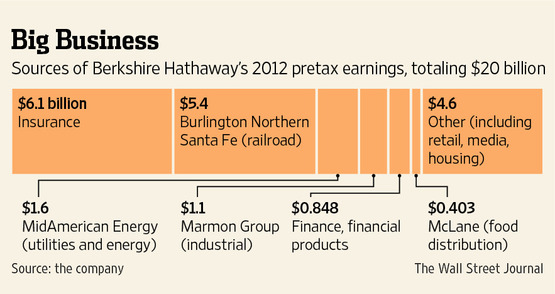
Warren Buffett hasn’t fired his “elephant gun” much recently, but he has put his managers on the hunt for smaller prey. Berkshire Hathaway Inc.’s BRKB +0.72% subsidiary operations collectively spent about $2.3 billion on 26 acquisitions last year, which the company says is a record amount. They have continued that streak this year, acquiring more than a dozen companies in the first half of 2013. Berkshire hasn’t disclosed the amount spent by its subsidiaries on acquisitions this year. With bigger, multibillion-dollar deals few and far between of late, Mr. Buffett increasingly favors such “bolt-on” acquisitions because they increase Berkshire’s earnings and enable it to use its cash pile, which stood at $36 billion at the end of June. Net cash flow from operations rose nearly 36% for the first six months of 2013 from a year earlier, putting greater pressure on Berkshire to use its cash rather than hoard it. In a telephone interview, the Omaha, Neb.-based billionaire investor said he expected these types of deals to be frequent and numerous. “I like the managers finding opportunities,” Mr. Buffett said. Read more of this post

Bill Gross’ Strategy for Combating Rising Rates; The Pimco chief explains how to alter a bond portfolio for a new set of circumstances

THURSDAY, AUGUST 8, 2013

Bill Gross’ Strategy for Combating Rising Rates

By WILLIAM H. GROSS  | MORE ARTICLES BY AUTHOR

The Pimco chief explains how to alter a bond portfolio for a new set of circumstances.

Adaptation is tantamount to survival in the physical world. So argued Darwin, at least, and I am not one to argue with most science and its interpretation of natural laws. Adaptation has been critical as well for the survival of countries during wartime, incidents of which I am drawn to like a bear to honey, especially when they concern WWI. Stick with me for a few paragraphs on this – the following is not likely to be boring and almost certainly should be instructive. In the first decade of the 20th century, British war colleges and their generals were philosophically trapped by the successful strategies of a prior era – an era before the invention of a functional machine gun. They felt that machine guns might dampen the spirit of their fighting forces. What counted was the horse and the sword. Britain’s cavalry training manual of 1907 in fact stated that “the rifle or machine gun, effective as it is, cannot replace the devastation produced by the speed of the horse, the magnetism of the charge, and the terror of cold steel.” Read more of this post

Bill Gates on His Foundation’s Health and Education Campaigns

Bill Gates on His Foundation’s Health and Education Campaigns

By Brad Stone on August 08, 2013

You recently tweeted that very rare clip of FDR being pushed in his wheelchair in 1944. Why did you find that to be a powerful image?
Polio eradication is this amazing effort. We’re raising the money to get it done by 2018. When these problems leave the rich world, they’re out of sight, out of mind. And reminding people of what a big problem it was and how amazingly others responded—which is why we have these tools at all—helps people, saying this can be the second disease to be eradicated.

What are the prospects for the eradication of polio and malaria?
Polio is where we have a very concrete plan. It’s raising $5.5 billion—of which the [Bill & Melinda Gates] Foundation is going to give $1.8 billion. If we get credibility from the polio success, we can be more articulate about a malaria or measles elimination plan. The big one would be malaria, but that’s a long-term, in-my-lifetime-type thing, not imminent. Read more of this post

Smashburger CEO Attributes Success To Unorthodox Marketing Strategy; Smashburger focuses heavily on events, such as when it offered a free sandwich to anyone with “burger” or “berger” in their name on National Cheeseburger day

Smashburger CEO Attributes Success To Unorthodox Marketing Strategy

MICHAEL THRASHER AUG. 8, 2013, 5:53 PM 1,429

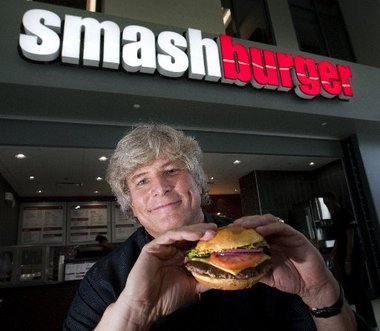
Smashburger has opened more than 200 restaurants in the past seven years.  Founder Tom Ryan told Nation’s Restaurant News the fast-casual chain’s success can be attributed to an unconventional marketing philosophy that relies heavily on social media and old-fashioned word of mouth. Ryan said the chain still uses some radio and television advertising. But Smashburger focuses heavily on events, such as when it offered a free sandwich to anyone with “burger” or “berger” in their name on National Cheeseburger day, he said. Ryan said these events become a topic of conversation for bloggers and social media. “From the beginning, we wanted Smashburger to be a defining brand for the next generation, and the marketing mix for how you engage them is different than for how you engaged the last generation,” Ryan said.

9788675-large

LKY: Mao Promoted Perpetual Struggle; Deng Saved China from Chaos

Mao Promoted Perpetual Struggle; Deng Saved China from Chaos

by Lee Kuan Yew | Aug 8, 2013

Mao’s successor drew lessons from Singapore’s economic development

topimg_22207_lee_kuan_yew_300x400

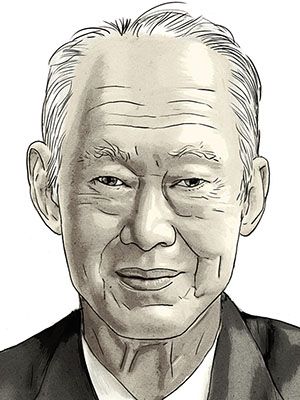
On October 1, 1949, at the Gate of Heavenly Peace in Beijing, Mao Zedong, leader of the Communist Revolution, declared the founding of the modern People’s Republic of China. Mao was an idealist who strove for constant class struggle as a way to keep the Chinese from becoming bourgeois. At the height of the Cultural Revolution, in 1967-69, schools and universities were closed, and children were encouraged to hit and rebel against their parents. Mao was, of course, a famous leader and liberator, but he was less practical when it came to governing the country.

More practical was Deng Xiaoping, who quietly took control after Mao’s death, calmed the country and concentrated on its economic development. Were it not for him, China might well have broken apart. Read more of this post

The Nudge Debate: Considering how mentally lazy most of us are, a little soft paternalism that forces us to choose what’s good for us is probably just what we all need

August 8, 2013

The Nudge Debate

By DAVID BROOKS

This has been a great era for the study of error. We know that people can be induced to buy more cans of soup if you put a “Limit: 12 per customer” sign on the display. We know that if you ask people what movie they want to see next week, they’re likely to mention a classy art film. But, if you ask them what movie they want to see tonight, they’re more likely to mention a mindless blockbuster. In addition, people are pretty bad at sacrificing short-term pleasure for long-term benefit. We’re bad at calculating risk. We’re mentally lazy. We make decision-making errors when thinking in our own language that we don’t make when thinking in another language. When asked to think in a second language, we’re forced to put in a little more mental effort. Read more of this post

Events for Weekend Warriors Become a Gold Mine; Forget Silicon Valley—In the Latest Startup Craze, Fortune Is Being Spun from a Sport of the Cave Man

August 8, 2013, 8:14 p.m. ET

Events for Weekend Warriors Become a Gold Mine

Forget Silicon Valley—In the Latest Startup Craze, Fortune Is Being Spun from a Sport of the Cave Man

KEVIN TRAHAN and KEVIN HELLIKER

The foot race isn’t new. Cave men probably invented it. But suddenly it’s gushing wealth for entrepreneurs, big companies and private-equity firms. The weekend-warrior market is a gold mine, and tapping into it doesn’t require Silicon Valley-style geek credentials or venture capital. Nor must a sports-business career begin anymore in the mail room of a sports network or big-league franchise. Joe Reynolds was 27 when he launched Red Frog Events, a Chicago-based producer of adventure races. In 2012, its sixth year, Red Frog posted revenue exceeding $50 million, prompting Inc. magazine to call it the nation’s ninth-fastest growing company. It can’t add races fast enough to satisfy demand for its $60-and-up slots. Read more of this post

UPS’s Scott Davis on Shipping Sharks, Work Rules, and the Post Office

UPS’s Scott Davis on Shipping Sharks, Work Rules, and the Post Office

By Devin Leonard on August 08, 2013

Have you shipped live sharks?
Yeah. We probably ship a little bit of everything, whales, you name it. We’ve got to be able to handle any precious commodity, and health care is obviously the area we’re moving into. So while we’re doing sharks and lobsters and whales, at the same time people are waiting on the operating table for some things that we’ve got to get to them.

Isn’t that dangerous, shipping live sharks?
It can be. You’ve got to have experts help you.

How do you ship a live whale?
It’s a big container. Read more of this post

Family businesses with succession plans in place are more likely to achieve a better credit rating and as such able to borrow easier than those with no plan

SUCCESSION PLANS KEY TO RATINGS FOR FAMBIZ

ARTICLE | 8 AUGUST, 2013 12:11 PM | BY JESSICA TASMAN-JONES

Family businesses with succession plans in place are more likely to achieve a better credit rating and as such able to borrow easier than those with no plan, according to report from the ratings agency Standard & Poor’s. The report said that family businesses were susceptible to so-called “key man” syndrome, whereby a dominant family figure is associated with the success of the business. But Trevor Pritchard, managing director of corporate ratings at S&P said that this risk can be mitigated by a family business having a clear succession plan in place and this would give help to reassure the ratings agency that the business wasn’t too reliant on one individual. Read more of this post

Investor Loses It Over Adulation And Sympathy For ‘Newspaper Families’ Like The Grahams — This Is A Story Of Incompetence!

Investor Loses It Over Adulation And Sympathy For ‘Newspaper Families’ Like The Grahams — This Is A Story Of Incompetence!

HENRY BLODGET AUG. 8, 2013, 8:02 AM 2,691 12

post-front-page

I was minding my own business last night when I got the note below from a respected investor. As you will see, the investor has had it with all the adulation and sympathy being showered on newspaper families like the Grahams, who are being extolled for their decades-long “stewardship” of institutions like the Washington Post and New York Times and pitied for the terrible misfortune they and society have recently endured. In the common telling, the investor observes, the Grahams and other newspaper families are cast as victims of an unforeseeable and horrible trend–the unstoppable rise of an invasive technology that has crippled the newspaper business and threatened a profession that has held society together for decades. The Grahams have done their heroic best, this story goes, but the forces of evil have just been too numerous and overwhelming. Now, finally, the brave and intrepid Grahams have had no choice but to surrender. So the world will now go to the dogs. Read more of this post

Discount Grocery Chain WinCo Touted As ‘Wal-Mart’s Worst Nightmare’ with a business model that allows for cheaper prices

A Discount Grocery Chain Is Being Touted As ‘Wal-Mart’s Worst Nightmare’

ASHLEY LUTZ AUG. 8, 2013, 5:32 PM 5,562 30

A discount grocery chain is being called “Wal-Mart’s worst nightmare.” WinCo, a Western grocery chain with about 100 stores, has a business model that allows for cheaper prices than Wal-Mart, writes Brad Tuttle at Time.  WinCo keeps costs low by buying directly from suppliers and eliminating middlemen, according to Tuttle. It also doesn’t accept credit cards and has customers bag their own groceries. A recent Idaho Statesman article about WinCo quoted retail analyst Burt Flickinger III as saying that WinCo was “unstoppable.” “They’re Wal-Mart’s worst nightmare,” Flickinger said.  Much like Costco, WinCo offers a minimalist selection instead of a wide array of brands according to Time. For instance, WinCo might only carry two brands of toothpaste, while Wal-Mart has more than 40. Unlike Wal-Mart, whose employees have demanded better wages, the company provides health benefits to employees who work 24 hours per week and a pension. WinCo is expanding fast, and could convert Wal-Mart’s customers, according to Time. “Generally speaking, shoppers tolerate Walmart’s empty shelves and subpar customer service because the prices are so good,” Tuttle writes. “The fact that another retailer—even a small regional one—is able to compete and sometimes beat Walmart on prices, while also operating well-organized stores staffed by workers who enjoy their jobs, like their employer, and genuinely want the company to be successful.”

Nestlé Feels Commodity Crunch; Missed Sales Expectations Four Quarters in a Row; Nestlé got a serious lift over the past few years from rising commodity costs. It was able to pass these on, and perhaps a bit more, to consumers

August 8, 2013, 2:39 p.m. ET

Nestlé Feels Commodity Crunch

Sales Expectations Have Been Missed Four Quarters in a Row, and a Couple More May Be Needed to Get Back on Track

JOHN JANNARONE

Nestlé NESN.VX -2.16% shares are a bit like its sugary treats: After providing a burst of energy, they have left investors in a funk. The Swiss food conglomerate fell short of revenue expectations for the fourth quarter in a row Thursday, when it reported results for the three months through June. Nestlé acknowledged that it will be “a stretch” to achieve 5% organic sales growth this year, meaning it may miss its typical 5%-6% target. That suggests Nestlé got a serious lift over the past few years from rising commodity costs. It was able to pass these on, and perhaps a bit more, to consumers. But prices of many inputs like sugar have declined over the past several months. That leads to competitive pressure that erodes pricing power. As Andrew Wood of Sanford C. Bernstein points out, Nestlé’s second-quarter pricing growth of 0.8% was the lowest in a decade. It is hard to guess when commodity prices will rebound. Emerging-market growth, a big driver of commodity demand, has cooled and may take a couple of years to resume. Read more of this post

Goldman: China might face credit losses of up to 18.6 trillion yuan ($3 trillion), because the speed of its credit expansion has exceeded that seen prior to other credit crises in history

Credit losses may hit $3 trillion, bank says

Updated: 2013-08-09 07:25

By Wang Xiaotian ( China Daily)

Goldman Sachs report warns of shadow banking risk elements

China might face credit losses of up to 18.6 trillion yuan ($3 trillion), because the speed of itscredit expansion has exceeded that seen prior to other credit crises in history, Goldman SachsGroup Inc has warned. In a report dated Aug 5, it said the rapid pace of China’s credit expansion, increasingly sourcedfrom the inherently more risky and less transparent “shadow banking” sector, has become atop concern for global markets. “Our Asian economists and strategists recently published a comprehensive look at this concernand its implications for economic growth and asset performance in China, calculating that anextreme upper-bound for total China credit losses could amount to 18.6 trillion yuan,” the reportsaid. But actual credit losses are likely to be significantly lower than these worst-case figures,emerge gradually and be partially absorbed by bank earnings or other avenues, it added. Read more of this post

China’s Urban Sludge Dilemma: Sinking in Stink; Trucks are dumping sludge on melon fields near Beijing, highlighting a nationwide struggle with waste

08.08.2013 16:12

China’s Urban Sludge Dilemma: Sinking in Stink

Trucks are dumping sludge on melon fields near Beijing, highlighting a nationwide struggle with waste

By staff reporter Cui Zheng and intern reporter Liu Zhiyi

Promptly at noon on March 17, a heavy truck hauling a dark substance and on a dark mission pulled out of the Gaobeidian Wastewater Treatment Plant in eastern Beijing. A wastewater treatment engineer helped a Caixin reporter identify the unusual load, which jiggled in the truck’s bed like gelatin as the driver headed down a bumpy road. The substance was unprocessed sludge – a mucky, smelly and hazardous byproduct of the sewage treatment process. Anything less disgusting coming out of the Gaobeidian plant, the engineer said, would not have jiggled. Gaobeidian is one of the largest wastewater plants in China and the biggest in Beijing, serving the capital’s downtown business district and industrial zones along with about 2.4 million household residents. It handles some 40 percent of Beijing’s wastewater, and has a daily wastewater capacity of about 1 million cubic meters. The plant is one of many built over the past seven years as part of a 500 million yuan, central government push to upgrade wastewater treatment nationwide. The investment has shown some good results: The collective sewage treatment capacity in China’s counties, for example, has risen to more than 70 percent. Read more of this post