Ebay-Style Loans Lure Summers to Mack in Wall Street Asset Craze

Ebay-Style Loans Lure Summers to Mack in Wall Street Asset Craze

On a June morning in midtown Manhattan, more than 300 investors cram into a conference room at the Convene Innovation Center, nibbling on pastries and waiting for Renaud Laplanche to take the stage. As founder and chief executive officer of LendingClub Corp., Laplanche has rock star status at this inaugural LendIt conference, where Wall Street investment managers clamor for insight into the world of peer-to-peer lending. Read more of this post

Leaders must watch and wait more often

August 26, 2013 5:29 pm

Leaders must watch and wait more often

By Tom Peters

Wow or bust! Market yourself or perish! Sign up for the action faction! Don’t get sidetracked by analysis paralysis!

Those phrases urging business people to stop thinking and take action! Now! – always with an exclamation mark! – are associated with my work on what makes a successful management team. I’m not about to to recant. But I will acknowledge that two books have set me back on my heels: Quiet by Susan Cain , and Wait by Frank Partnoy. I despise terms such as “transformational”, but the ideas in these two books may actually merit them. As I put it, when speaking (loudly) about Quiet to one avowedly aggressive senior management team recently: “I’ll bet a pretty penny that you have been ignoring the half of the population who might have saved you from, or at least ameliorated, the horrendous mess of the past six or seven years.” The subtitle of Quiet is “the power of introverts in a world that can’t stop talking” and one of her arguments is that the more measured and thoughtful introverts might have helped to avoid the early 2000s feeding frenzy. But we failed to ask them aboard. Why? She unearthed voluminous research that says we find talkative people “smarter, better looking, more interesting, and more desirable as peers”. And we like fast talkers too. There is a lot to say for action- takers and risk-seekers: I have been celebrating them for 30 years. But Cain’s book gave me pause concerning the imbalance I’ve been party to, and cheerleader for. Read more of this post

The debt dragon: Credit habit proves hard for China to kick

Last updated: August 26, 2013 7:54 pm

The debt dragon: Credit habit proves hard for China to kick

By Simon Rabinovitch in Guiyang

ChinaDebt

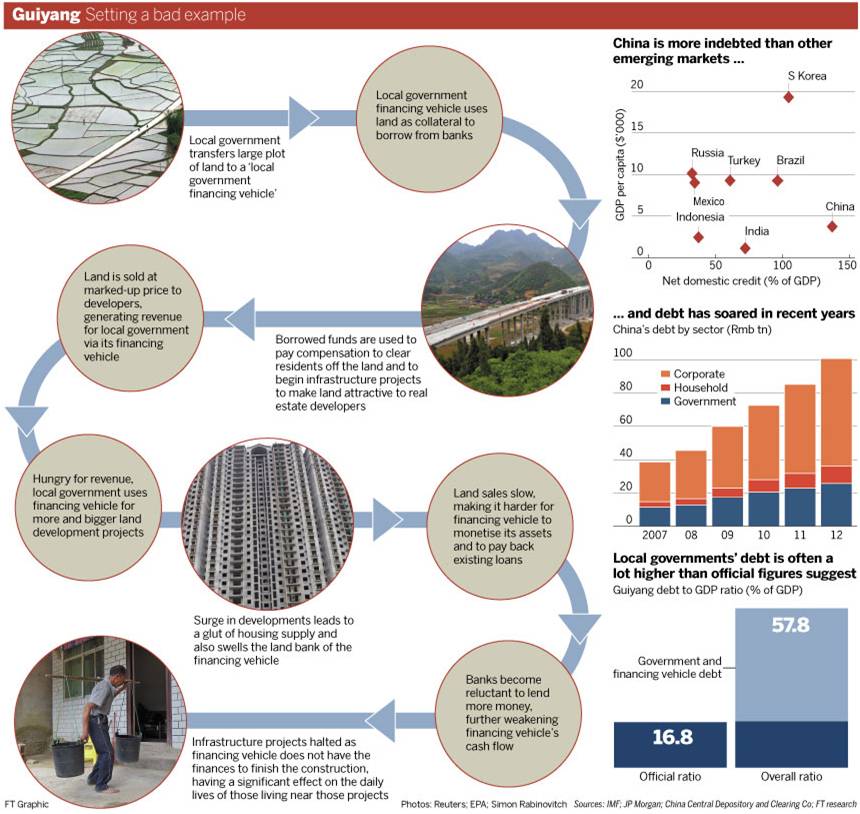
The Chinese government says its debt problem is under control, but the people of Pianpo village have cause to disagree. Over the past year they have seen their water cut off, rubbish pile up in the streets and their wages go unpaid as debt has mounted. An elevated motorway soars over the villagers’ concrete homes, meant to connect them to central Guiyang, one of China’s fastest-growing cities. Instead, the slip road to Pianpo ends in a patch of gravel. The state-owned company building the road took on too much debt and could not pay its construction workers. Water pipes were dismantled when the roadworks began but were never repaired when cash ran short. A couple of times a day, Chen Xiuxiang, 75, trudges up a hill to fetch his weight in water – 120 pounds – from a working tap, carrying two buckets on a wooden pole across his shoulders. Most of his neighbours do the same. “They keep promising they’ll fix things but they never do,” says Mr Chen. Read more of this post

Debt Drags on China’s Growth; Interest Costs Leave Companies With Less Cash to Invest; China Construction Bank encountered a surge in overdue loans during the first half of the year and could face a “hidden crisis”

August 26, 2013, 1:24 p.m. ET

Debt Drags on China’s Growth

Interest Costs Leave Companies With Less Cash to Invest; the Case of Shougang Group

TOM ORLIK

AM-AZ992_CINTER_G_20130826120304

As worries over China’s debt problem mount, the burden of paying off those loans could be the trigger that tips runaway credit into slower economic growth and financial stress. Few areas illustrate the problems better than the old industrial sector, where state-owned steel plants and cement kilns continue to borrow and expand even as overcapacity grows. With debts high and profits low, some companies, such as state-owned steel giant Shougang Group, are using new loans to repay old ones, according to Dagong Global Credit Rating Co. Shougang Group declined to comment. Read more of this post

Taking an Invention From Idea to the Store Shelf: Building a better mousetrap may be the easy part. After that comes patent, production and marketing, and missteps along the way can be costly

August 23, 2013

Taking an Invention From Idea to the Store Shelf

By ALINA TUGEND

EVERY once in a while, my family will toss around ideas for potential inventions. Like my son’s ultimate alarm clock, which wakes you up, tells you the weather and makes tea and toast. None of us have ever gotten past the talking phase. But a lot of other people have. Last year, the United States Patent and Trademark Office reported that 1.5 million patent applications were pending, compared with around 269,000 in 1992. And the office issued around 270,000 patents in 2012, about 160,000 more than two decades before. It’s very easy to believe that a multimillion-dollar invention is just a twist of a screwdriver away. Listen to the seductive radio and television ads that promise to help your invention fly off the shelves. Watch reality television shows like “Shark Tank,” where contestants vie to get businesses to invest in their idea. Read more of this post

The Secret to a Successful Divestiture; When you are selling part of your company, don’t just offer buyers a potential asset; give them the capabilities to gain value from it.

August 27, 2013

The Secret to a Successful Divestiture

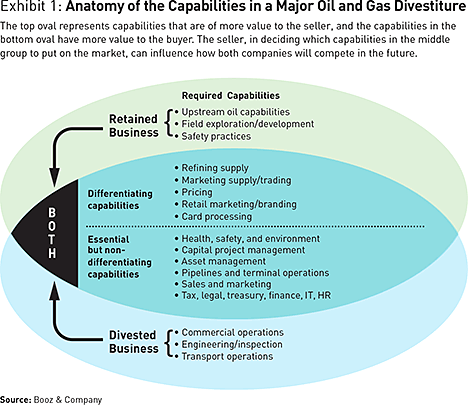
When you are selling part of your company, don’t just offer buyers a potential asset; give them the capabilities to gain value from it.

by Eduardo Alvarez, Steven Waller, and Ahmad Filsoof

00208_ex01

A major North American oil and gas company had formulated the straightforward part of a deal—deciding to sell one of its refineries and a group of its gas stations—a few months earlier. Now, as part of its business strategy in preparing these assets for sale, the company was diving into the details of divestiture, and the capabilities that would be affected by the deal. This exercise was going to be almost as complex as a typical merger or acquisition; certainly it would be more complex than the company’s leaders had expected. Read more of this post

Perils of holding on to corporate pet projects

August 26, 2013 1:48 pm

Perils of holding on to corporate pet projects

By Jonathan Moules, Enterprise Correspondent

Children seldom expect the downside of pet ownership when dreaming about receiving a puppy for Christmas. But at least there is usually a parent on hand with enough wisdom to put them straight. Unfortunately, ambitious business owners often do not hear the sobering warnings when it comes to their corporate pet projects. And when these puppies get out of control, the damage can be considerable. Read more of this post

College Costs Surge 500% in U.S. Since 1985: Chart of the Day

College Costs Surge 500% in U.S. Since 1985: Chart of the Day

College

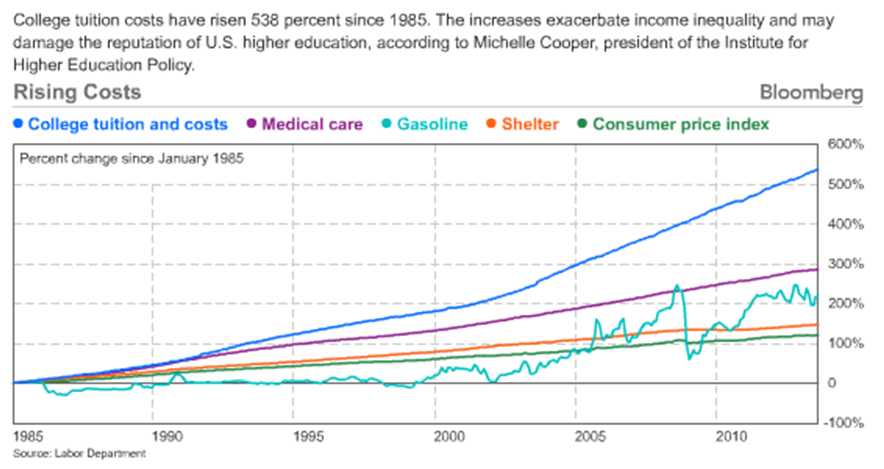
The cost of higher education has surged more than 500 percent since 1985, illustrating why there have been renewed calls for change from both political parties. The CHART OF THE DAY shows that tuition expenses have increased 538 percent in the 28-year period, compared with a 286 percent jump in medical costs and a 121 percent gain in the consumer price index. The ballooning charges have generated swelling demand for educational loans while threatening to make college unaffordable for domestic and international students.

Read more of this post

A Different Formula for Happiness: In Time Perspective Therapy, people stop focusing on the past so much and look to the present and future

August 26, 2013, 7:22 p.m. ET

A Different Therapy to Find Greater Happiness

Instead of dredging up unhappy memories, focus on present, future

ELIZABETH BERNSTEIN

PJ-BQ126_BONDSJ_G_20130826162830

Say the words “therapy session” and many people will picture an hour spent on a couch dredging up unhappy childhood memories. A different approach suggests that redirecting the focus onto the present and future can make people happier, healthier and lead to better relationships. The method, called Time Perspective Therapy, involves figuring out which of six different outlooks a person has: past-positive (you love the past); past-negative (you have regrets and bad things happened in your past—or things that you now exaggerate as bad); present hedonism (you enjoy the present and like to reward yourself); present fatalism (you feel that events are beyond your control, so why bother?); goal-oriented future (you plan ahead and weigh the costs and benefits of any decision); transcendental future (you live a good life because you believe the reward is a heaven after death). Read more of this post

Fighting Fatigue in the Afternoon; Small Changes in Your Exercise Routine Can Keep You From Suffering Midday Blahs

August 26, 2013, 7:13 p.m. ET

Fighting Fatigue in the Afternoon

Small Changes in Your Exercise Routine Can Keep You From Suffering Midday Blahs

JENNIFER ALSEVER

Regular exercise is supposed to boost a person’s energy levels. So why do so many fitness fans complain of feeling fatigued during the afternoon? Making things worse, this workout-induced weariness can make it difficult to stick to a workout regimen. Researchers and fitness trainers say whether you exercise in the morning, afternoon or evening, small changes in your routine can keep you from suffering midday blahs. Read more of this post

What Science Hopes to Learn From a Baby’s Cries; Subtle differences in infant wailing can signal later developmental and neurological conditions

August 26, 2013, 7:31 p.m. ET

What Science Hopes to Learn From a Baby’s Cries

Subtle differences in infant wailing can signal later developmental and neurological conditions

SUMATHI REDDY

A newborn’s cry can signal more than whether she is hungry or tired. Subtle differences in infant wailing can provide important clues to later developmental and neurological conditions, such as poor language acquisition. Cry characteristics may also give hospitals a way to assess pain when treating babies. Down the road, researchers hope cry analysis may help doctors detect conditions and start treatment earlier. Researchers at Brown University and Women & Infants Hospital in Providence have devised a computer program to help analyze a baby’s cries. They hope to soon make it available to researchers world-wide looking to analyze crying patterns that can’t always be detected by the human ear. Read more of this post

Millions of students are finding major changes in the curriculum and battles over how teachers are evaluated, as the biggest revamps of U.S. public education in a decade work their way into classrooms

Updated August 26, 2013, 8:39 p.m. ET

Biggest Changes in a Decade Greet Students

Some Teachers, Parents Push Back on New Standards

STEPHANIE BANCHERO and ARIAN CAMPO-FLORES

NA-BX806_SCHOOL_G_20130826182107 0826SCHOOLSmap1 0826SCHOOLSmap2 0826SCHOOLSmap3 0826SCHOOLSmap4c 0826SCHOOLSmap5

Millions of students heading back to school are finding significant changes in the curriculum and battles over how teachers are evaluated, as the biggest revamps of U.S. public education in a decade work their way into classrooms. Most states are implementing tougher math and reading standards known as Common Core, while teacher evaluations increasingly are linked to student test scores or other measures of achievement. Meantime, traditional public schools face unprecedented competition from charter and private schools. Read more of this post

Researchers Study Self-Knowledge (Literally): The Body Sends Cues to the Brain; Understanding Them Can Improve Your Health

August 26, 2013, 6:59 p.m. ET

Researchers Study Self-Knowledge (Literally)

The Body Sends Cues to the Brain; Understanding Them Can Improve Your Health

SHIRLEY S. WANG

How well do people know their bodies and how does that help them function day to day? The attempt to understand how humans make sense of all the complex feedback they receive from the eyes and ears down has taken off and reached a new level of understanding in the last decade. One prong of the research being conducted in the United Kingdom, Germany, the U.S. and elsewhere is focused on understanding how well brains detect and react to cues from inside the body. Read more of this post

If predictive power is not in the cards for economics, what is it good for?

AUGUST 24, 2013, 3:09 PM

What Is Economics Good For?

By ALEX ROSENBERG and TYLER CURTAIN

Recent debates over who is most qualified to serve as the next chairman of the Federal Reserve have focused on more than just the candidates’ theory-driven economic expertise. They have touched on matters of personality and character as well. This is as it should be. Given the nature of economies, and our ability to understand them, the task of the Fed’s next leader will be more a matter of craft and wisdom than of science. Read more of this post

Kaizen and the art of human wa maintenance

Kaizen and the art of human wa maintenance

An ex-resident and frequent visitor finds convenience and joy in the little things that Japan does so damn well

BY GLENN NEWMAN

AUG 26, 2013

Little things matter. This truth is hard-wired into the Japanese psyche. Kaizen — the Japanese practice of continuous improvement through small, incremental changes — is well-known and influential worldwide. At least in the West, kaizen is primarily thought of as a method for improving manufacturing, engineering and other business processes. But kaizen goes much deeper in Japan. Kaizen here is organic, ubiquitous and attuned to the physical and psychological needs of human beings. At its best, this “human-scale kaizen” (HSK) eliminates or eases many of the mundane uncertainties, annoyances and embarrassments of daily life. Here are but a few of the innumerable examples of HSK in Japan: Read more of this post

Adults salivate at Lego’s robot kits; Mindstorms sets more complex, powerful

Mindstorms sets more complex, powerful

Adults salivate at Lego’s robot kits

AP AUG 25, 2013

p7-lego-a-20130826-870x519

Robot world: Will Gorman plays with a Mindstorms cobralike robot in

SAN JOSE, CALIFORNIA – Few are more excited about Lego’s new Mindstorms sets rolling out next month than Silicon Valley engineers. Many of them were drawn to the tech sector by the flagship kits that came on the market in 1998, introducing computerized movement to the traditional snap-together toy blocks and allowing the young innovators to build their first robots. Now, 15 years later, those robot geeks are entrepreneurs and designers, and the colorful plastic bricks have an significant influence in their lives. Read more of this post

Is Coke’s 127-year-old recipe the same? Not quite

Is Coke’s 127-year-old recipe the same? Not quite

CANDICE CHOI 11 hours ago

ATLANTA (AP) — Coca-Cola keeps the recipe for its 127-year-old soda inside an imposing steel vault that’s bathed in red security lights. Several cameras monitor the area to make sure the fizzy formula stays a secret. But in one of the many signs that the surveillance is as much about theater as reality, the images that pop up on video screens are of smiling tourists waving at themselves. “It’s a little bit for show,” concedes a guard at the World of Coca-Cola museum in downtown Atlanta, where the vault is revealed at the end of an exhibit in a puff of smoke. The ability to push a quaint narrative about a product’s origins and fuel a sense of nostalgia can help drive billions of dollars in sales. That’s invaluable at a time when food makers face greater competition from smaller players and cheaper supermarket store brands that appeal to cash-strapped Americans. Read more of this post

Minzhong Drop Renews China Overseas Listing Woes: Southeast Asia

Minzhong Drop Renews China Overseas Listing Woes: Southeast Asia

China Minzhong Food Corp. (MINZ) lost half its market value in less than two hours after short-seller Glaucus Research Group questioned the vegetable processor’s accounts, reviving investor concern about Chinese companies traded overseas. Glaucus said in a report the Putian, China-based company had been “significantly deceiving” regulators and investors, sending the stock 48 percent lower in Singapore trading yesterday and wiping S$318 million ($249 million) off its market value before it was suspended. Minzhong said it’s seeking legal opinion and will comment as soon as possible. Read more of this post

CEO Investment Cycles

CEO Investment Cycles

Yihui Pan University of Utah – Department of Finance

Tracy Yue Wang University of Minnesota – Twin Cities – Carlson School of Management

Michael S. Weisbach Ohio State University (OSU) – Department of Finance; National Bureau of Economic Research (NBER)

August 2013
NBER Working Paper No. w19330

Abstract: 
This paper documents the existence of a CEO Investment Cycle, in which firms disinvest early in a CEO’s tenure and increase investment subsequently, leading to “cyclical” firm growth in assets as well as in employment over CEO tenure. The CEO investment cycle occurs for both firings and non-performance related CEO turnovers, and for CEOs with different relationships with the firm prior to becoming CEO. The magnitude of the CEO cycle is substantial: The estimated difference in investment rate between the first three years of a CEO’s tenure and subsequent years is approximately 6 to 8 percentage points, which is of the same order of magnitude as the differences caused by other factors known to affect investment, such as business cycles or financial constraints. We present a variety of tests suggesting that this investment cycle is best explained by a combination of agency-based theories: Early in his tenure the CEO disinvests poorly performing assets that his predecessor established and was unwilling to give up on. Subsequently, the CEO overinvests when he gains more control over his board. There is no evidence that the investment cycles occur because of shifting CEO skill or productivity shocks. Overall, the results imply that public corporations’ investments deviate substantially from the first-best, and that governance-related factors internal to the firm are as important as economy-wide factors in explaining firms’ investments.

Summer Is the Real Season for Bad Colds, Not Winter; Summer viruses linger longer, and pack more of a punch, than winter ones

August 26, 2013, 7:23 p.m. ET

Summer Is the Real Season for Bad Colds, Not Winter

Summer viruses linger longer, and pack more of a punch, than winter ones

ANGELA CHEN

OB-YR294_Summer_NS_20130826203822

Having trouble kicking that summer cold? It’s not your imagination. Summer colds are caused by different viruses than winter colds and tend to last longer than the winter variety. Angela Chen reports. Photo: AP.

Something summery may be lingering even as the season fades—the summer cold. Colds in summertime can last for weeks, at times seemingly going away and then suddenly storming back with a vengeance, infectious-disease experts say. A winter cold, by contrast, is typically gone in a few days. The reason for the difference: Summer colds are caused by different viruses from the ones that bring on sniffling and sneezing in the colder months. And some of the things people commonly do in the summer can prolong the illness, like being physically active and going in and out of air-conditioned buildings. Read more of this post

Huge debts send China’s steel industry to verge of bankruptcy

Huge debts send China’s steel industry to verge of bankruptcy

Staff Reporter

2013-08-27

Eighty six of China’s major medium-and-large steel enterprises incurred more than 3 trillion yuan (US$486.4 billion) in total liabilities as of June, or a debt ratio of 69.74%, signaling that the industry is on the verge of bankruptcy, reports Beijing’s Economic Observer, citing figures from the China Iron and Steel Association (CISA). Meanwhile, the industry’s profits for the first six months of the year totaled only 2.2 billion yuan (US$356.7 million), with 35 steel enterprises, or about 40% of the total, reporting losses. However, their assets-liabilities ratio, accounts receivable turnover ratio and accounts payable turnover ratio registered a rise. Read more of this post

Don’t Blame the Fed for Asia’s Problems

Don’t Blame the Fed for Asia’s Problems

It’s time to set our clocks back in Asia. (ADXY) Not to 1997, as many are recommending, but to 1994.

Memories of the former year remain raw. Currencies had gone into free fall and current-account deficits exploded. Central bankers and International Monetary Fund officials scurried to contain the chaos. It’s true that another 1997-like crisis is highly unlikely. Today, exchange rates are more flexible, foreign-currency debt is lower, banks are healthier, countries are sitting on trillions of dollars of reserves, and economies are far more transparent. The differences between 1997 and today trump the similarities. Read more of this post

Think You Can Drive a Bulldozer? Fearing Shortage of Skilled Operators, Machinery Makers Add Auto-Pilot Technologies

August 26, 2013, 9:12 p.m. ET

Think You Can Drive a Bulldozer?

Fearing Shortage of Skilled Operators, Machinery Makers Add Auto-Pilot Technologies

JAMES R. HAGERTY

MK-CF842_DOZER_G_20130826154254

As experienced bulldozer drivers retire, heavy equipment manufacturers are including technology in new models to make precise earth-moving easier. This Komatsu bulldozer has a ‘machine control’ system that uses GPS to program movements around a work site.

CARTERSVILLE, Ga.—As he closed the door, leaving me alone at the controls of a 41,000-pound bulldozer with list price of nearly $432,000, a Komatsu Ltd.6301.TO -1.16% executive shouted, “No worries!” That’s when I started sweating. Typing I can do—blindfolded, if necessary. But mechanical flair has always eluded me. I recently had to ask a neighbor to help me start a lawn mower. Even so, Komatsu assured me that technological advances would allow me to learn the basics of dozing in a couple of hours. Dozers are used to smooth ground for roads and runways or shape the contours of building sites and golf courses. They are among the trickier types of heavy machinery to operate because drivers must shave huge mounds of earth to precise contours, often while perched on hillsides or mired in mud. Unlike excavators, dozers typically are in motion as they move earth. Read more of this post
Capital Flight Drains Reserves as Rupee, Rupiah Fall: Currencies

Capital Flight Drains Reserves as Rupee, Rupiah Fall: Currencies

By Candice Zachariahs and Lilian Karunungan  Aug 25, 2013

Asian nations are depleting foreign reserves as they seek to bolster their currencies while investors pull billions of dollars from the region. Of the 10 Asian central banks with the largest reserves, six have cut their holdings this year, led by a record 18 percent reduction byIndonesia, data compiled by Bloomberg show. Their reserves are rising at the slowest pace in data going back to 2000. Holdings in Asiaprobably contracted once price moves are taken into account, Citigroup Inc. estimates. Read more of this post

Everything that’s wrong with Microsoft, as told by veterans who abandoned the company; Low morale and a destructive internal culture

Everything that’s wrong with Microsoft, as told by veterans who abandoned the company

By Christopher Mims @mims August 26, 2013

It’s possible, even likely, that Microsoft is about to enter the darkest period in the firm’s history. Darker, even, than July 2000, when it seemed the US government might dissolve the house that Bill built, and force the company to be split into two different companies. The revenue Microsoft earned in the quarter ending in March 2013, $20.5 billion, probably represents a high water mark for the company, at least for the foreseeable future. In the most recent quarter, the company’s revenue missed expectations, which Microsoft blamed on ongoing weakness in the market for PCs. There is no sign that demand for PCs is going to pick up again—even Intel is projecting sales will be flat, at best—and plenty that the world’s demand for PCs, or at least the kind that run Microsoft Windows, is in terminal decline (1). Read more of this post

Microsoft’s decline from technology superpower to office utility has many causes, but none has received more focus than the management technique known inside the company as “stack ranking.”

Microsoft’s Massively Misplaced Incentives

Microsoft’s decline from technology superpower to office utility has many causes, but none has received more focus than the management technique known inside the company as “stack ranking.”

Everyone on every team is divided into three groups. A few are top performers, and are eligible for promotion and larger bonuses. Most are average. The rest are denied bonuses and often asked to leave. The performance reviews that determine these rankings occur every six months. Read more of this post

Ballmer Departure From Microsoft Was More Sudden Than Portrayed by the Company

Ballmer Departure From Microsoft Was More Sudden Than Portrayed by the Company

Published on August 25, 2013
by Kara Swisher

According to sources close to the situation, the departure of CEO Steve Ballmer from Microsoft last week was more sudden than was depicted by the company in itsannouncement that he would be retiring within the next year in a planned smooth transition. It was neither planned nor as smooth as portrayed. While the decision to go seems to have technically been Ballmer’s, interviews with dozens of people inside and outside the company, including many close to the situation, indicate that he had not aimed to leave this soon and especially after the recent restructuring of the company that he had intensely planned. Instead, sources said Ballmer’s timeline had been moved up drastically — first by him and then the nine-member board, including his longtime partner and Microsoft co-founder and chairman Bill Gates — after all agreed that it was best if he left sooner than later. Read more of this post

Why New York tech is still lagging

Why New York tech is still lagging

By Jessi Hempel, writer August 26, 2013: 5:00 AM ET

Tech is big in New York — but the alley still ain’t the valley. Here’s our annual report card.

FORTUNE — Last May when Yahoo (YHOO) CEO Marissa Mayer paid $1.1 billion in cash to buy Tumblr, New York techies cheered. Finally! A New York startup exits for more than a billion dollars! This hasn’t happened since Doubleclick sold to Google in 2007. And it is one of the signs people look for in determining whether the tech scene is robust enough to rival Silicon Valley. Read more of this post

Tesla Market Value Rises to $20 Billion on EV Optimism

Tesla Market Value Rises to $20 Billion on EV Optimism

Tesla Motors Inc. (TSLA)’s market value exceeded $20 billion on investor optimism that Elon Musk can keep widening the appeal of electric-powered cars as the company’s sales increase. The stock climbed 5.7 percent to a $171.03 at 12:02 p.m. New York time after reaching an intraday record of $172.75. Shares of the Palo Alto, California-based company, which had its initial public offering just three years ago, have surged about fivefold this year.

Read more of this post

Facebook Market Value Tops $100 Billion Amid Mobile Push

Facebook Market Value Tops $100 Billion Amid Mobile Push

Facebook Inc. (FB)’s market value passed $100 billion amid optimism that the world’s largest social network can bolster sales from mobile advertising.

The stock increased 2.6 percent to $41.61 at 12:45 p.m. in New York. Earlier, it touched $41.94, the highest intraday price since Facebook’s first trading day on May 18, 2012. Before today, the shares had advanced 52 percent this year, compared with a 17 percent gain in the Standard & Poor’s 500 Index. Read more of this post