Smartphones try fashion makeovers to stand out from pack
September 9, 2013 Leave a comment
Smartphones try fashion makeovers to stand out from pack
Sun, Sep 8 2013
By Alexei Oreskovic and Poornima Gupta
SAN FRANCISCO (Reuters) – Bright colors, funky textures and personalization are coming to a smartphone near you as mobile phone makers turn to fashion to buoy sales in a crowded market. Apple Inc and Google Inc’s Motorola are among those trying to score style points as game-changing technological innovation becomes harder to achieve in the maturing business.Since the first touch-screen iPhone hit the market in 2007, software features have become easier to replicate and improvements in speed, weight, display size and resolution have become routine. The explosion of me-too products is already hurting profit margins and nibbling at Apple and Samsung Electronic Co Ltd’s market share.
Time to bring out the paintbrush.
Apple has invited reporters to an event on Tuesday where it is expected to introduce new iPhones in a much broader palette of colors, perhaps even gold.
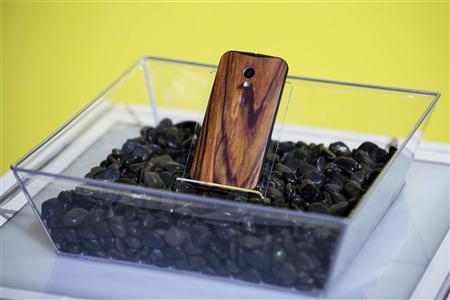
One-time leader Motorola, now owned by Google, is trying to win back consumers with the Moto X, relying partly on customized colors and, soon to come, engravings and unusual casing materials such as wood.
Robert Brunner, founder of design consultancy Ammunition and a former Apple industrial design chief, said personalization is a well-worn tactic employed when a product’s uniqueness fades.
“As something becomes embedded in lifestyle and as it starts to become commoditized, people look toward more superficial design things to differentiate or at least reach more people,” said Brunner, whose clients have included Amazon.com Inc, Dell Inc and Nike Inc.
“And colors are the classic. If you do it at the right time, it will create a significant increase in sales every time.”
Much of the speculation around new iPhones this year has focused on colors and material, in marked contrast to previous years when hopes ran high for a breakthrough feature.
PERSONALIZATION IS KEY
The consumer electronics industry lives and dies by innovation, and resorting to aesthetics is at best a stop-gap measure until frequently talked about new technologies such as fingerprint identification, holographics or flexible displays become reality.
Smartphone shipments grew 52 percent in the second quarter, according to research firm IDC. But the market is getting crowded, with everyone from Alcatel Lucent to China’s Huawei producing an abundance of look-alike phones based on Google’s Android software.
Consumers face a sea of “rectangles that are black and white” that all use similar software and capabilities, said Carolina Milanesi, an analyst with research firm Gartner. “So you need that instant hook in the store to get people to pay attention, and that comes from the fashion and style.”
Nokia’s phone business, soon to be part of Microsoft Corp, was one of the first to try color. Nokia’s Windows-powered Lumias came in a variety of shades from blue and red to yellow, helping boost shipments by 76 percent in the second quarter and outpacing the overall market’s growth rate.
“We have always believed technology is highly personal, highly individual,” said Yves Behar, the chief creative officer at Jawbone, who has designed a successful line of customizable gadgets including the Up wristband and Jambox wireless speakers. “We get more people wanting to customize their Jambox than we get people not wanting to.”
Making more stylish phones, however, can increase production costs and make inventory management and demand forecasting more challenging. Also, taste varies from region to region. So success in the fashion game requires mastering new supply chain and manufacturing skills.
“If you try to predict in advance precise numbers, it is a sure way to over stock or under stock,” Behar warned.
BUILT TO ORDER
In 2010, Apple had to delay the launch of the white iPhone 4 twice, citing manufacturing challenges. While the company did not provide details, speculation ranged from color-matching difficulties to an issue with the device’s back light.
More recently, Motorola delayed offering the personalized engravings it promised for the Moto X, and the special wood panels that consumers can choose for their phones will not be available until later this year.
To help with logistics, Motorola is using a Flextronics International Ltd contract facility near Dallas that can custom-build phones and ship within 6 days. Its long-term target is 4 days.
That kind of customization requires a completely different supply chain system, said Massachusetts Institute of Technology professor David Simchi-Levi.
Instead of optimizing for the lowest cost components, a build-to-order model needs to focus on speed, said Simchi-Levi, who has previously consulted for computer maker Dell, which popularized the model in the 1990s.
Done right, the build-to-order model can generate richer margins and provide flexibility to respond to demand: maintaining stockpiles of components means lower cost and less risk than keeping inventory of finished goods, Simchi-Levi said.
Analysts have said the impact of Motorola’s new strategy on its profit margins is unclear. Mark Randall, the company’s senior vice president of supply chain and operations, said it knows a build-to-order model will not be easy but is convinced that is the right approach for today’s market.
“We decided on this approach ourselves, relying on some market research but also our own instincts. We thought it was time to get away from just having a white or black phone.”
TRIED AND TESTED
In the 1990s, cellphone makers relied on aesthetics to stand out. Phone makers pumped slider phones, flip phones and “candy bars” in the hope of getting a hit like the sleek Motorola Razr.
Some compared the industry’s evolution to watches, which rely on 50-year-old quartz or centuries-old mechanical technology and are the epitome of a business that hinges on fashion.
“Mobile phone makers are going to some of the watch suppliers to get the kinds of finishes and the quality feel that have been in the luxury watch business,” said Gregor Berkowitz, a consultant who specializes in consumer electronics design.
Swatch Group, one of the world’s largest watchmakers, shows how lucrative fashion can be, analysts said.
“The company benefits from being vertically integrated,” Morningstar analyst Peter Wahlstrom said. “They have the designers in-house. They own the manufacturing, the distribution, they control the brands and pricing very well.”
Swatch, which owns Breguet, Omega, Flick Flack as well as its namesake brand, boasts operating profit margins of 25 percent. While that is below Apple’s 35 percent-range on mobile devices, it is above those of Samsung and many other phone makers.
But while fashion can provide a nice way for phone-makers to buoy sales for now, smartphone companies ultimately need unique technology to maintain a long-term advantage.
“The way we think about technology companies is in terms of sustainable competitive advantages, or economic moats,” said Wahlstrom. “It’s not sustainable unless you have the intellectual property or patent support behind it that really creates a barrier to entry.”
 About bambooinnovator

