Brazil may be spending its way towards a downgrade

Brazil may be spending its way towards a downgrade

Filed 11 hours ago

By Silvio Cascione and Asher Levine

SAO PAULO – Brazil’s finances are set to deteriorate substantially next year, leaving the government with few options to revive a sputtering economy and raising the threat of a credit downgrade. The government is likely to miss its key 2014 budget target, the primary surplus, by as much as 50 billion reais ($22 billion), delivering only about half its goal, estimates by Reuters and private economists show. Read more of this post
Inside the End of the U.S. Bid to Punish Lehman Executives; “Why is there no case? The world won’t understand.”

SEPTEMBER 8, 2013, 8:57 PM

Inside the End of the U.S. Bid to Punish Lehman Executives

By BEN PROTESS and SUSANNE CRAIG

At a closed-door meeting in early 2011, Wall Street regulators were close to throwing in the towel on their biggest case. The Securities and Exchange Commission’s eight-member Lehman Brothers team, having hit one dead end after another over the previous two years, concluded that suing the bank’s executives would be legally unjustified. The group, noting that prosecutors and F.B.I. agents had already walked away from a parallel criminal case, reached unanimous agreement to close its most prominent investigation stemming from the financial crisis, according to officials who attended the meeting, which has not been reported previously. Read more of this post

Banks Seen at Risk Five Years After Lehman Collapse

Banks Seen at Risk Five Years After Lehman Collapse

Ruth Porat didn’t see it coming.

The Morgan Stanley (MS) banker who thought she understood the risks to the financial system in September 2008 was advising the U.S. Treasury Department on its rescue of Fannie Mae and Freddie Mac when she got a message: Would she come back to Washington to deal with the collapse of American International Group Inc. (AIG)? Read more of this post

Banks Face Physical Commodity Curbs

September 10, 2013, 8:01 p.m. ET

Banks Face Physical Commodity Curbs

Fed Is Expected to Issue Rules Soon

MICHAEL R. CRITTENDEN And CHRISTIAN BERTHELSEN

MI-BY387_COMMOD_NS_20130910183903

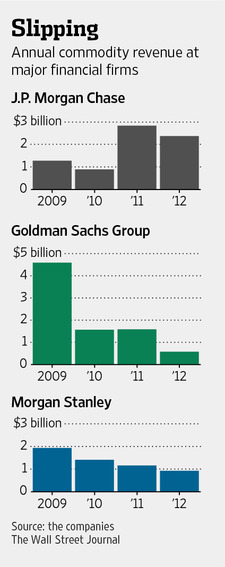
Wall Street is bracing for a ruling that may hasten the exit of J.P. Morgan ChaseJPM +1.53% & Co., Goldman Sachs Group Inc. GS +3.54% and Morgan StanleyMS +2.19% from businesses such as metals warehousing, oil shipping and power generation. Financial-industry executives expect the Federal Reserve to issue guidelines as soon as this month limiting bank participation in so-called physical-commodities businesses. The decision would mark a significant step in the government’s effort to curtail risky activities on Wall Street, forcing large financial companies to dismantle franchises a decade or more in the making. The rules would apply to all U.S. banking companies. Read more of this post

Alan Blinder: Five Years Later, Financial Lessons Not Learned as the law sinks under the weight of special-interest lobbies

September 10, 2013, 6:53 p.m. ET

Alan Blinder: Five Years Later, Financial Lessons Not Learned

A good-though-weak law sinks under the weight of special-interest lobbies.

ALAN S. BLINDER

Next Sunday marks the fifth anniversary of the fateful day that investment bank Lehman Brothers filed for bankruptcy, signaling the start of a frightening financial meltdown. It’s a good time to ponder how the U.S. economy was nearly brought to ruin. But will we? Or are we already forgetting? Consider the stark historical contrast between the 1930s and this decade: Read more of this post

A 500-year-old bank in Italy is teetering, and threatens to take the rest of the country’s financial system with it

A 500-year-old bank in Italy is teetering, and threatens to take the rest of the country’s financial system with it

By Jason Karaian @jkaraian September 10, 2013

Uniquely among the euro zone’s beleaguered “periphery”, Italy’s response to the financial crisis has not included nationalizing large parts of its banking system. Compared with the wreckage in Cyprus, Ireland, Portugal and Spain, Italian lenders have gotten off relatively lightly. Until now. The finance ministry has announced a revised rescue plan (link in Italian) for the country’s third-largest bank, Monte dei Paschi di Siena. The bank, which traces its roots back to 1472, was propped up with €4.1 billion ($5.4 billion) in government loans earlier this year. The blessing of the European Commission is necessary for it to keep this aid, and Brussels wants tougher conditions attached. If the bank cannot meet these conditions, the loan will convert into shares and the fragiledebt-ridden Italian government will become the proud owner of a bank that has reported more than €8 billion in losses since 2011. At that point, the state of the Italian banking industry as a whole might turn from chronic to acute. Read more of this post