For Migrants, New Land of Opportunity Is Mexico; With Europe sputtering and China costly, the “stars are aligning” for Mexico as broad changes in the global economy create new dynamics of migration

September 21, 2013

For Migrants, New Land of Opportunity Is Mexico

By DAMIEN CAVE

MEXICO CITY — Mexico, whose economic woes have pushed millions of people north, is increasingly becoming an immigrant destination. The country’s documented foreign-born population nearly doubled between 2000 and 2010, and officials now say the pace is accelerating as broad changes in the global economy create new dynamics of migration. Rising wages in China and higher transportation costs have made Mexican manufacturing highly competitive again, with some projections suggesting it is already cheaper than China for many industries serving the American market. Europe is sputtering, pushing workers away. And while Mexico’s economy is far from trouble free, its growth easily outpaced the giants of the hemisphere — the United States, Canada and Brazil — in 2011 and 2012, according to International Monetary Fund data, making the country more attractive to fortune seekers worldwide. Read more of this post
Jobless recoveries are here to stay, economists say, but it’s a mystery why

Jobless recoveries are here to stay, economists say, but it’s a mystery why

By Jim Tankersley, Published: September 20

The U.S. economy just hasn’t looked like its old self lately, especially when it comes to regaining the jobs lost during a recession. It looks a lot more like 1980s-era Europe — slow to rebound and hire after a downturn, leaving workers to flail for years in a weak job market. The United States is stuck in its third consecutive “jobless recovery,” stretching back to the rebound from the 1990 recession. And Americans might need to get used to them: A major new study from economists at the University of Texas at Austin and the University of California at Berkeley suggests that vintage Europe is the new American normal for recessions and recoveries. But even after an exhaustive series of tests, the economists still can’t explain what has gone wrong. Read more of this post

Jeremy Grantham called the Internet bubble, then the housing bubble. What alarm bell is the chief investment strategist at GMO ringing about now?

September 20, 2013, 10:31 a.m. ET

Our Chat With Jeremy Grantham

He called the Internet bubble, then the housing bubble. What alarm bell is Jeremy Grantham, the chief investment strategist at GMO, ringing about now?

IAN SALISBURY

JEREMY GRANTHAM’S GOT A TRACK RECORD that’s impossible to ignore—he called the Internet bubble, then the housing bubble. While moves like those have earned the famed forecaster the nickname “perma-bear,” in early 2009 he also told clients at GMO, his $100 billion, Boston-based money-management firm, to jump back into the market. It was the same week that stocks hit their post-Lehman low. Now, however, the outspoken Yorkshireman, who is chief investment strategist at GMO, is making headlines with a new prediction: Dire, Malthusian warnings about environmental catastrophe. To hear him tell it, the world is running out of food. Resources will only keep getting more expensive. And climate change looms over it all. Indeed, at times he sounds like someone Greenpeace would send door-to-door with a clipboard. (He’s not above likening the coal-industry spin to the handiwork of Goebbels.) If it were anyone else, Wall Street would probably laugh him off. But because it’s Jeremy Grantham, they just might listen. Read more of this post

It’s Not Too Early to Start Worrying About Banks Again; Washington regulators are publicly raising alarms about banks’ accounting practices

It’s Not Too Early to Start Worrying About Banks Again

By Jonathan Weil  Sep 20, 2013

You don’t often see Washington regulators publicly raising alarms about banks’ accounting practices. That’s why a speech this week by the comptroller of the currency, Thomas Curry, deserves more attention. The way Curry described the situation, you get the sense that some banks’ numbers may be too good to be true. He made clear he wasn’t warning about an imminent crisis. Yet he cautioned that some banks seemed to have been “scrimping on their allowances against their loan losses,” which is a fancy way of saying they may be fudging their numbers. Read more of this post

Fed reveals weak spot in superhero powers

September 20, 2013 5:18 pm

Fed reveals weak spot in superhero powers

By Ralph Atkins in London and Michael MacKenzie in New York

Superman had issues with Kryptonite. For Achilles, it was his heel. With central bankers, is it communicating with markets? The US Federal Reserve startled investors round the globe this week by deciding not to start scaling back its $85bn a month of asset purchases, or quantitative easing. Bond and share prices jumped sharply on the prospect of unexpectedly undiminished Fed largesse. But even as they pocketed gains, investors wondered if they had misunderstood Ben Bernanke, Fed chairman. Based on hints dropped since May, the consensus view had been for a $10bn to $15bn reduction in the pace of purchases. Read more of this post

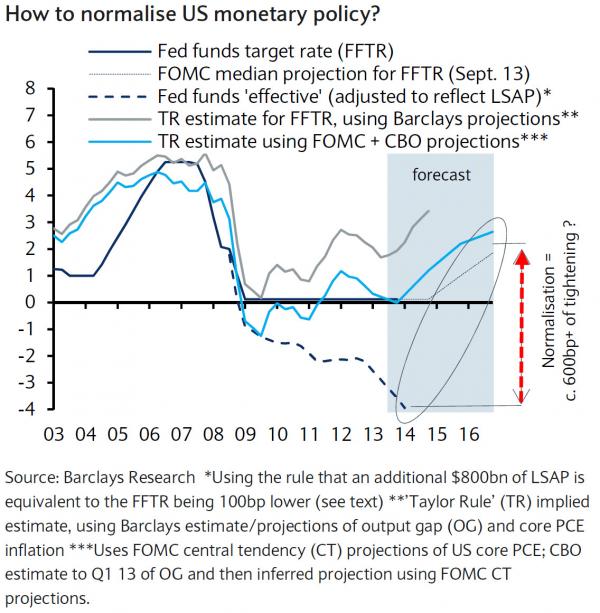
Chart Of The Day: The Fed’s “Renormalization” Shock (All 600 bps Of It)

Chart Of The Day: The Fed’s “Renormalization” Shock (All 600 bps Of It)

Tyler Durden on 09/21/2013 15:21 -0400

20130921_beniscornered_0

As we noted earlier, Bernanke’s actions this week make it very clear that between “financial conditions” and the fragility of growth, the US is incapable of surviving without ZIRP and QE (for now). As Barclays notes, ultimately, normalisation should proceed according to a timeline that does not threaten recovery, yet will result in a neutral monetary policy by the time the economy reaches full capacity and the desired inflation rate. However, there are many uncertainties along this path. Read more of this post

CEOs to Reveal Their ‘Cheap Number’; SEC Wants to Compare CEO Pay with Average Worker’s

September 21, 2013, 8:30 p.m. ET

CEOs to Reveal Their ‘Cheap Number’

SEC Wants to Compare CEO Pay with Average Worker’s

AL LEWIS

BF-AF837_PAYGAP_NS_20130920201814

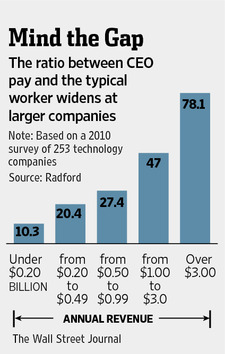
Perhaps you’ve seen those commercials for the Sleep Number mattress. What’s your Sleep Number? Learn it and you’ll have pleasant dreams. There is another number that’s giving the chief executives of America’s largest companies nightmares. It expresses the ratio of their pay to that of their employees. I call it the Cheap Number. In 1977, renowned management thinker Peter Drucker wrote a piece for The Wall Street Journal complaining that this number had grown as high as 50 at many companies. “A ratio of 25-to-1…is well within the ratio most people in this country…consider proper and indeed desirable,” he wrote. Today the number is 354, according to a study touted by the AFL-CIO. Other studies show it well over 1,000 at some companies. A recent analysis by Bloomberg compared a former J.C. Penney CEO to a former J.C. Penney cashier and pegged the number there at 1,795. Knowing this number raises a salient question: If you own a business, what would you rather have for your money? An army of more than 1,000 workers, or one delusional jerk in a suit? The world is filled with enterprises paying fortunes to chief executives, but relatively little to almost everyone else. Read more of this post