How China Lost Its Mojo: One Town’s Story; Once Booming Yantian Looks for New Sources of Growth

September 16, 2013, 11:00 p.m. ET

How China Lost Its Mojo: One Town’s Story

Once Booming Yantian Looks for New Sources of Growth

TOM ORLIK

YANTIAN, China—Not long ago, this factory town in southeastern China was an emblem of the country’s massive export boom. Today, it is a symbol of China’s struggle to sustain a growth streak. Low wages, easy access to overseas markets, and a business-savvy leadership helped transform Yantian in the 1990s from a sleepy agricultural hamlet to a manufacturing hub with close to 150,000 people. By 1998, more than 400 foreign firms set up shop, churning out electronics, toys and watches for export. A golf course and high-end hotel sprang up to keep Japanese and Hong Kong factory bosses amused. Read more of this post


JPMorgan Reduces Stake in China Merchant Banks amid Chinese Banks Sell-off; Foreign institutions expressed concerns over surging credit and non-performing loans in Chinese banking industry as well as an economic slowdown

JPMorgan Reduces Stake in China Merchant Banks amid Chinese Banks Sell-off

09-17 12:10 Caijing

Foreign institutions have frequently expressed concerns over surging credit and non-performing loans in Chinese banking industry as well as an economic slowdown.

JPMorgan Chase & Co. has lowered its stake in China Merchants Bank in the latest sell-off of Chinese banks amid worries over deteriorating bank assets in a slowing economy. JPMorgan reduced its long position in the H shares of the bank from 8.29 percent to 7.79 percent last week by unloading 23million shares at HK$ 15.06 per share on average, the Hong Kong Stock Exchange’s disclosure of interests information showed Monday. Read more of this post

There is no real secret about how to win the war on cancer

There is no real secret about how to win the war on cancer

Sep 14th 2013 |From the print edition

The Cancer Chronicles: Unlocking Medicine’s Biggest Mystery. By George Johnson. Knopf; 304 pages; $27.95. Bodley Head; £18.99. Buy fromAmazon.comAmazon.co.uk

The Truth in Small Doses: Why We’re Losing the War on Cancer—and How to Win It. By Clifton Leaf. Simon & Schuster; 499 pages; $27. Buy fromAmazon.com

NOW that AIDS is treatable, and only poor people die from it, cancer has resumed its role as the health bugaboo of the rich world. The headlines shout daily about what does, or does not cause it, with the same things often appearing in both lists. Magazines are full of tales of celebrities who have had the disease—or rather, “battled” with it. And the science columns discourse learnedly on this or that new drug which might prove (though always five to ten years hence) a crucial breakthrough in the war against it. Read more of this post

Bigmouth strikes again: How Manchester became a model for other British cities

Bigmouth strikes again: How Manchester became a model for other British cities

Sep 14th 2013 | MANCHESTER |From the print edition

MANCHESTER, wrote Benjamin Disraeli in 1844, “is the most wonderful city of modern times”. Mancunians, known for many virtues but not for their modesty, are not shy to repeat it. But they do have a point. Manchester was arguably the first true modern city. Whereas Bristol was built on the slave trade, and Birmingham on the industry of a thousand tiny workshops, Manchester was a city of enormous factories, supplying cotton to the world. Its ruthlessly competitive entrepreneurial culture became the model of Victorian industrial capitalism. Read more of this post

What does Chuseok mean to you?

2013-09-17 15:58

What does Chuseok mean to you?

Jeffrey Miller
This week, Koreans will be celebrating one of their most important and venerated holidays, Chuseok. By the time you are reading this Op-Ed piece, nearly a third of South Korea’s population will either be on their way or getting ready to head to their hometown for ancestral rites and family rituals. However, if you are a foreigner in Korea (and not married to a Korean) the extended holiday has a different meaning in the way that it is celebrated. Indeed, celebrating the holiday has any number of possibilities, from traveling around Korea or overseas (if you were lucky enough to find a ticket) to hunkering down in one’s dwelling and catching up on sleep, movies or work. Fortunately, the country doesn’t “close down” like it used to in the past when you had to stock up on food and videos to get through the holiday. These days there’s always some place open whether it’s a coffee shop or convenience store. Read more of this post

Just as Lee Kuan Yew overcame the Republic’s early challenges by being a “man of action” with an “unwavering and total dedication” to the country, Singaporeans can, and need to, aspire to these qualities

S’poreans need to emulate LKY’s total dedication to country: Heng

SINGAPORE — Just as former Minister Mentor Lee Kuan Yew overcame the Republic’s early challenges by being a “man of action” with an “unwavering and total dedication” to the country, Singaporeans can, and need to, aspire to these qualities as they confront the issues of a “different world” today, Education Minister Heng Swee Keat said yesterday.

BY TEO XUANWEI –

5 HOURS 13 MIN AGO

SINGAPORE — Just as former Minister Mentor Lee Kuan Yew overcame the Republic’s early challenges by being a “man of action” with an “unwavering and total dedication” to the country, Singaporeans can, and need to, aspire to these qualities as they confront the issues of a “different world” today, Education Minister Heng Swee Keat said yesterday. Making a call for action and unity among Singaporeans at a conference to mark Mr Lee’s 90th birthday, Mr Heng cited these qualities as the “deepest impression” Mr Lee left on him in his time as the founding father’s Principal Private Secretary between 1997 and 2000. Read more of this post

Are Insomnia’s Effects on the Brain as Bad As They Feel? Researchers are intrigued by how insomnia patients perform cognitive tasks despite feeling sleepy and unable to concentrate

September 16, 2013, 6:47 p.m. ET

Are Insomnia’s Effects on the Brain as Bad As They Feel?

Researchers are intrigued by how insomnia patients perform cognitive tasks despite feeling sleepy and unable to concentrate

SUMATHI REDDY

Insomniacs don’t just suffer at night. During the day, they often feel sleepy, have trouble concentrating and report greater difficulty with work or school performance than individuals who get adequate sleep. But researchers are intrigued by an apparent discrepancy: Despite what insomnia patients experience subjectively, they often seem able to perform cognitive tasks as well as people getting adequate sleep. One possibility is that insomnia doesn’t lead to inferior performance after all—maybe it just feels that way. Read more of this post

Nature vs. Nurture: New Science Stirs Debate; How Behavior Is Shaped; Who’s an Orchid, Who’s a Dandelion

September 16, 2013, 6:57 p.m. ET

Nature vs. Nurture: New Science Stirs Debate

How Behavior Is Shaped; Who’s an Orchid, Who’s a Dandelion

Researchers are making big strides understanding how genes work with the environment to shape behavior. Jonathan Rockoff and University of Arizona human development professor Bruce Ellis explain on Lunch Break.

JONATHAN D. ROCKOFF

Researchers are making strides in understanding how genes work with the environment to shape behavior, adding a new twist to the age-old debate over whether nature or nurture is mostly responsible for how people develop. They are finding that sensitivity to the environment resides in the biology of the nervous system. And some people, because of their genetic makeup and life experiences, are more sensitive to outside influences than others. Scientists point to a type they call orchids—people who wilt under poor conditions but flourish in supportive climes. Meanwhile, dandelions aren’t much affected by the world around them, whether supportive or harsh. Read more of this post

There is no secret recipe for landing the corner office, but leadership lessons from the former chiefs of Campbell Soup and Schering-Plough have helped many to the top

September 16, 2013, 11:24 a.m. ET

So You Want to Be CEO. Start Here.

There is no secret recipe for landing the corner office, but leadership lessons from the former chiefs of Campbell Soup Co. and Schering-Plough Corp. have helped many to the top.

JOANN S. LUBLIN

Many executives yearn to run a company someday. Few succeed. Doug Conant and Fred Hassan know how to up the odds. The former chief executives have helped numerous protégés make it to CEO. Five lieutenants from Mr. Conant’s decade atop Campbell Soup Co. CPB +0.33%landed the No. 1 job at a public company. They include Sean Connolly at Hillshire Brands Co. HSH +0.69% and Chris Delaney at Goodman Fielder Ltd.GFF.AU +0.27% The same dream job came true for eight associates of Mr. Hassan, a prior chief of Pharmacia Corp. and Schering-Plough Corp. MRK +0.84% Among them: Stephen P. MacMillan at StrykerCorp. SYK +1.01% and Hugh Grant atMonsanto Co. MON +1.46% (A ninth, Brent Saunders, will take the helm ofForest Laboratories Inc. FRX +1.22% on Oct. 1.) There is no secret recipe for landing the corner office. But there are plenty of ways that a strong CEO candidate can veer off track, leadership specialists say. Some fall short after rationalizing missteps by “looking at the world through rose-colored glasses,” Mr. Conant says. Other unsuccessful aspirants typically “lose their humility,” adds Mr. Hassan, who wrote a leadership book – as did Mr. Conant (though with a co-author). Read more of this post

As Education Declines, So Does Civic Culture; A generation of college graduates unable to write or reason bodes ill for liberal democracy

September 16, 2013, 7:14 p.m. ET

As Education Declines, So Does Civic Culture

A generation of college graduates unable to write or reason bodes ill for liberal democracy.

JONATHAN JACOBS

OB-YX815_jacobs_G_20130916133702

Even as the cost of higher education skyrockets, its benefits are increasingly being called into doubt. We’re familiar with laments from graduates who emerge from college burdened with student loans and wondering if their studies have prepared them for jobs and careers. A less familiar but even more troubling problem is that their education did not prepare them for responsible civic life. The decline in education means a decline in the ability of individuals—and ultimately the nation as a whole—to address political, social and moral matters in effective, considered ways. Read more of this post

When a new chief executive moves into the C-suite, the chances are about one in four the chief financial officer will be out the door within a year

September 17, 2013, 12:50 AM ET

New Bosses Often Clean House

MAXWELL MURPHY

Senior Editor

When a new chief executive moves into the C-suite, the chances are about one in four the chief financial officer will be out the door within a year. Within two years of getting a new boss, about a third of CFOs are gone, according toKorn/Ferry International, which looked at 504 CFO departures since 2010 from 1,000 of the largest companies it tracks. Among the firms with recent high-profile CFO exits: truck and engine maker Navistar International Corp.; grocery chain Supervalu; and closeout retailer Tuesday MorningCorp. Some CFOs who have successfully navigated a CEO transition offer three main tips for survival: Communication is key; identify the new boss’s strengths and weaknesses and compensate for the latter; and don’t be sand in the gears of a new strategy. Read more of this post

Get off the pitch for ideas in the boardroom; Leading a business is not like leading a sports team. In fact, it is much harder

September 16, 2013 4:36 pm

Get off the pitch for ideas in the boardroom

By Andrew Hill

Leading a business is not like leading a sports team. In fact, it is much harder

Howard Wilkinson, former manager of Leeds United, knows about pressure: “No offence to captains of industry but even a FTSE 100 chairman can postpone a board meeting. A manager can’t postpone a football match and every match is a shareholder meeting, [sometimes] in front of 88,000 people.” Mr Wilkinson’s comment also underlines what plenty of corporate executives – dazzled by insights imparted by their sporting idols – tend to forget. Leading a business is not like leading a sports team. In fact, it is much harder. Read more of this post

“To finish a piece of work, an artist [has to know how] to marshal the material [in time for an audience] coming through the door.”

September 15, 2013 1:50 pm

The art of managing artists’ egos

By Emma Jacobs

Yoko Ono has a reputation for being beyond bonkers. But not with Jude Kelly. The artistic director of London’s Southbank Centre, which had Ono curate its annual Meltdown music festival this summer, describes her as “wonderful”. Three times in fact. “A wonderful woman . . . totally untemperamental, completely wonderful . . .Totally wonderful, easy to deal with . . lovely.” Ms Kelly believes the “characterisation of creative people as temperamental” is wrong. Divas are few and far between, she says. However, on the rare occasion she does come across a prima donna (she refuses to name one) she does a quick mental calculation: weighing the quality of their output against the amount of effort involved in managing them. “It’s really annoying but if the end-product is extremely amazing, you deal with it.” Read more of this post

Can Building Great Products Help You Build Great Teams?

Can Building Great Products Help You Build Great Teams?

by Deep Nishar  |   11:00 AM September 16, 2013

Silicon Valley was built on amazing products, not on stellar leadership skills. In fact, veterans of some of the world’s most successful tech companies often look with skepticism, even disdain, on efforts to build strong management skills. The premise is that all energy should be focused solely on turning fabulous ideas into hyper growth. It’s true that if a start-up fails — or is sold — the need for enduring leadership may never arise. And in the earliest stages of a company, the need to organize, motivate and inspire large groups of people to accomplish shared goals may not be obvious. Read more of this post

Panda poop power: Microbes in pandas’ guts can help in biofuel production

Panda poop power: Microbes in pandas’ guts can help in biofuel production

Sep 14th 2013 |From the print edition

GIANT PANDAS are well known for being rather different from other bears. Having a diet composed almost entirely of bamboo is one of the things that sets them apart. It is also what attracted the interest of Ashli Brown of Mississippi State University, in a search for more efficient ways to make biofuel. Most of the nutrients found in bamboo are locked away in tough substances known as cellulose and lignin. Liberating those nutrients is an energy-intensive process that involves high temperatures and extreme pressures when carried out in a laboratory or by an industrial process. Indeed, it is the cost of doing so that makes producing biofuel out of cellulose- and lignin-rich materials, like discarded corn (maize) cobs and husks, less financially viable than generating biofuel directly from more readily digestible corn kernels. The kernels, however, can be used to feed people whereas the cobs and husks cannot. So a process that is able efficiently to turn what is a waste product into fuel could have great potential. Read more of this post

‘Everyday Sadists’ Among Us; Those who enjoying inflicting pain without provocation are not that uncommon, and not complete monsters, suggests a study trying to identify the distinct traits of such “everyday sadism.”

SEPTEMBER 16, 2013, 4:50 PM

‘Everyday Sadists’ Among Us

By JAN HOFFMAN

Try this quick word association: Sadist. And you respond… Hannibal Lecter? The Marquis de Sade? Actually, you didn’t need to come up with representatives of extreme criminal behavior or sexual torture. You might just as well have considered the colleague two cubicles over. The one who spends lunch hour splattering the brains of video game characters. Those who enjoy inflicting at least moderate pain on others, directly or vicariously, mingle with us daily. Think mean girls, taunting a classmate to commit suicide. Or the professor who grills a squirming, clueless student, lips curled in a small, savage smile. Delroy L. Paulhus, a psychology professor at the University of British Columbia, calls such people “everyday sadists.” Read more of this post

When a curry puff works – but a croissant doesn’t: When Han Keen Juan acquired Old Chang Kee in 1986, blending the old and the new worked wonders. The company grew rapidly.

When a curry puff works – but a croissant doesn’t

hankj_oldchangkee2

Monday, September 16, 2013 – 15:06

The Business Times

When Han Keen Juan acquired Old Chang Kee in 1986, blending the old and the new worked wonders. The company grew rapidly. So, next, he tried blending cultures, and introduced croissants. They were tantalisingly displayed together with the curry puffs, but did not take off. That was when the company realised that while it was the norm to hold a curry puff and eat it on the go, people preferred to enjoy their French pastry sitting down. Read more of this post

Defense is no longer the best offense; ITV Shows Boring Is No Longer Beautiful

September 15, 2013, 3:21 p.m. ET

ITV Shows Boring Is No Longer Beautiful

It’s Tough to See the Picture Getting Much Brighter for the U.K.’s ITV

JOHN JANNARONE

Defense is no longer the best offense—at least that is what many investors have decided. The stock market’s surprise standouts earlier this year were some of its dullest, most defensive companies. Risk-averse investors chased stocks with dependable cash flows and stable dividend yields like Unilever UN +0.96% and Clorox CLX +0.68% . That resulted in a significant outperformance: In the year through April 22, global defensive stocks beat cyclical stocks by nine percentage points, says Philip Isherwood of Absolute Strategy Research. But since April 22, the outperformance has been almost completely reversed: Cyclical stocks have beaten defensive stocks by 10 percentage points. Why the change of heart? A likely reason is that shareholders are betting a broad-based earnings recovery will soon give companies the confidence to start investing in their businesses. Read more of this post

How Asia’s messaging apps will blossom as mobile platforms

How Asia’s messaging apps will blossom as mobile platforms

September 17, 2013

by Joshua Kevin

Joshua Kevin is a former blogger at Tech in Asia and former community manager at KakaoTalk Indonesia. Now, he’s working on his own startup which he hopes to have fully launched early next year. You can follow him on Twitter, @jshkvn. The views expressed are his own and are not related to KakaoTalk in any way.


There has been a lot of debate about how messaging apps, especially those from Asia. LineKakaoTalk, and WeChat are going to rule the world, starting from their own region or country, then expanding. While it’s still early days for these apps, I want to talk about something that’s often mis-interpreted: stickers. Yes, those huge, animated stickers/emoticons were started by KakaoTalk and Line, then WeChat followed, and then even western companies such as Path and Facebook followed the trend. This has made tech blogs and the media, in general, go crazy about how stickers are going to set the social media world on fire and make tons of money for these companies. Yes, they’ll bring in some cash, but they won’t be the main source of income. Read more of this post

Steps to Better Foot Health; Foot pain can signal big and small problems. Even how you get out of bed matters.

September 16, 2013, 7:04 p.m. ET

Steps to Better Foot Health

Foot pain can signal big and small problems. Even how you get out of bed matters.

ANGELA CHEN

PJ-BQ514_FEET_G_20130916172239

Are your feet healthy? Even people who try to cover all the bases—avoiding fattening foods, hitting the gym and wearing sunscreen—may not be able to answer yes. Doctors say people often ignore persistent but minor foot complaints, which can later develop into bigger problems, like lower back pain. Some common foot problems can mask underlying issues that are correctable if addressed early. Tender feet might be a sign of a pinched nerve, for example, or bunions might stem from weak arches. Other foot ailments, such as sores that don’t heal, can point to a more serious condition, such as diabetes. Read more of this post

Patients Share DNA for Cures

September 16, 2013, 9:45 p.m. ET

Patients Share DNA for Cures

RON WINSLOW

Patients with rare and deadly diseases are getting a powerful new boost. Cancer foundations and other nonprofit patient groups are investing tens of millions of dollars to build genetic databases in an effort to speed drug development and jumpstart clinical trials. The databases are designed to collect DNA and other information from patients with hard-to-treat diseases. The material can be analyzed for certain genetic mutations and made available to scholars and pharmaceutical companies. The databases could also help patients familiar with their own genetic mutations to find information about clinical trials. Read more of this post

Drugs for Inherited Cancers Get Fresh Push

September 15, 2013, 9:37 p.m. ET

Drugs for Inherited Cancers Get Fresh Push

After Earlier Disappointments, Treatments Are Seen Helping Patients With Breast-Gene Mutation

JOSEPH WALKER

OB-YX587_DRUGS0_G_20130915220303

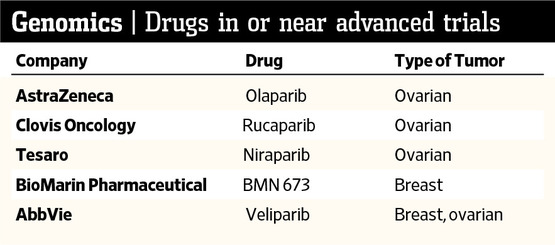
Drug makers are rallying to a class of drugs that, if they succeed, could be the first treatments to target breast and ovarian cancers tied to the genetic mutations known as BRCA 1 and BRCA 2. Two years ago, the drugs were all but written off after a string of clinical study failures in broader cancer-patient populations. But later research and a closer examination of existing data showed the drugs, known as PARP inhibitors, had a pronounced effect in BRCA patients. Read more of this post

Antibiotics Losing Battle Against Bugs; More than two million people in the U.S. develop infections every year that are resistant to antibiotics, and at least 23,000 of them die as a result

Updated September 16, 2013, 7:32 p.m. ET

Antibiotics Losing Battle Against Bugs: Report

BETSY MCKAY

NA-BY086_ANTIBI_G_20130916151206

More than two million people in the U.S. develop infections every year that are resistant to antibiotics, and at least 23,000 of them die as a result, according to a government report Monday that called for aggressive steps to counter a worsening public health problem. Another 250,000 people annually develop a bacterial infection, clostridium difficile, and about 14,000 of those cases prove fatal, the Centers for Disease Control and Prevention said in its first report to give an overview of the threat and toll of antibiotic-resistant bugs that cause most infections. Read more of this post

Wal-Mart Sells Coors Almost at Cost to Be Largest Beer Seller

Wal-Mart Sells Coors Almost at Cost to Be Largest Beer Seller

Wal-Mart Stores Inc. (WMT) is so committed to becoming America’s biggest beer retailer that it has been selling Budweiser, Coors and other brews almost at cost in at least some stores. The markup on a 36-pack of Coors Light cans at a Los-Angeles-area store was 0.6 percent, compared with 16.2 percent for a package of Flaming Hot Cheetos, according to internal documents reviewed by Bloomberg. Companies typically don’t release information about markups so the March data provide a rare glimpse of Wal-Mart’s alcohol pricing strategy. Read more of this post

London designers seek to defy tough markets with luxury pieces

London designers seek to defy tough markets with luxury pieces

6:15pm EDT

By Marie-Louise Gumuchian

LONDON (Reuters) – London designers are seeking to entice more demanding fashion followers with luxurious materials, rich embellishment and vivid colors, hopeful that the country’s luxury industry will grow despite continuing global economic woes. London Fashion Week, effectively a trade show that sees hundreds of buyers, journalists and celebrities descend on the British capital, is expected to result in orders worth more than 100 million pounds ($159.35 million) during its September 13-17 run. Read more of this post

Crocs Wants You To Forget About Its Signature Product

Crocs Wants You To Forget About Its Signature Product

ASHLEY LUTZ SEP. 16, 2013, 1:46 PM 2,617 2

Crocs, maker of the notoriously unstylish rubber clog, is trying to break into high fashion. The shoe line will release “high-heeled pumps, sleek flats, and ankle-strap thongs,” early next year, reports Kyle Stock at Bloomberg Businessweek. The fancy new shoes will be manufactured in Italy — not the brand’s Colorado headquarters. Prices will range from $80 to $120. The line is part of Crocs’ push to distance itself from the clogs that made it famous. Businessweek, reported earlier this years that the company is trying to double sales in the next five years and doesn’t feel it can do it with the polarizing clogs. A visit to Crocs’ homepage shows that the brand is promoting ballet flats and wedges alongside its signature product:

screen shot 2013-09-16 at 11.56.54 am Read more of this post

Tencent Approaches Facebook Value of $100 Billion Amid China Web Boom; joins six other Hong Kong-listed companies in the $100 billion club that includes PetroChina and China Mobile

Tencent Approaches Facebook Value Amid China Web Boom

Tencent Holdings Ltd. (700)’s market value surpassed $100 billion within a decade of going public as Asia’s biggest Internet company capitalizes on China’s explosion in online gaming and messaging. Tencent rose 2.5 percent to HK$421.20 in Hong Kong, lifting its market value to HK$782.8 billion ($101 billion). The company run by billionaire Pony Ma joins six other Hong Kong-listed companies in the $100 billion club, including PetroChina Co. (857) and China Mobile Ltd. (941) Read more of this post

Wooing, and Also Resenting, Chinese Tourists

September 16, 2013

Wooing, and Also Resenting, Chinese Tourists

By DAN LEVIN

TOKYO — The Ugly Americans terrorized Europeans and Asians with their booming voices and tennis shoes in the years after World War II. Decades later, Japanese tour groups descended from their air-conditioned buses to flash peace signs as they shot photos of every known landmark as well as laundry on backyard clotheslines. Now it is China’s turn to face the brunt of complaints. The grievances are familiar — they gawk, they shove, they eschew local cuisine, and last year, 83 million mainland Chinese spent $102 billion abroad — overtaking Americans and Germans — making them the world’s biggest tourism spenders, according to the United Nations World Tourism Organization. Read more of this post

The property bubble in 14 Chinese cities is in danger of bursting, an NDRC adviser to the nation’s highest planning body has warned

Property bubble fragile in 14 cities, expert warns
Tuesday, September 17, 2013
The property bubble in 14 mainland cities is in danger of bursting, an adviser to the the nation’s highest planning body has warned. Guo Shiping, consultant to the National Development and Reform Commission, claims to have predicted the property market crash in 1997, news portal 163.com reported. He said cities such as Ordos in Inner Mongolia, Wenzhou and those in Hainan have already slumped. Home prices in Ordos, which is also known as “ghost city,” have slumped more than 92 percent in nearly 1 years to 1,700 yuan (HK$2,153) per square meter in August from 22,000 yuan per sq m in March last year, Guo said. In Wenzhou, defaulting borrowers have surrendered their homes to banks for public auction, Southern Weekly reported. It added more than 10,000 units were involved. Home prices in Zhejiang fell for the 23rd consecutive month, official data showed. But property markets remained red hot in Guangzhou and Nanjing, which saw new projects sold out on the launch date. China’s new home prices rose for the 15th consecutive month in August, according to Soufun, the nation’s largest real estate information platform. The central government has noticed the trend and will continue to send inspection teams to discuss the situation with local governments, China Times reported.

GRACE CAO

In China, the Devil doesn’t wear Prada

In China, the Devil doesn’t wear Prada

5:03pm EDT

By Donny Kwok

HONG KONG (Reuters) – The Devil, it seems, wears anything but Prada in the eyes of Chinese bloggers determined to expose corrupt government officials flashing luxury labels way past their pay grades. Prada is among a few premium brands reporting solid growth in the world’s second largest luxury market even as a government campaign against conspicuous spending and gift-giving hurts firms with instantly recognizable brands like LVMH, Compagnie Financiere Richemont and Kering SA. Read more of this post