Narendra Modi tempers Hindu nationalist message to woo India; Polarising figure has a sense of purpose and ‘rock star appeal’

September 17, 2013 3:19 pm

Narendra Modi tempers Hindu nationalist message to woo India

By Victor Mallet in New Delhi

Polarising figure has a sense of purpose and ‘rock star appeal’

The boast last month by Manmohan Singh, India’s 80-year-old prime minister, about how connected the country had become since he took office a decade ago may come back to haunt the ruling Congress party at the next general election – especially if the claim is true. “In 2004, only 7 per cent of the people had telephone connections,” Mr Singh intoned mechanically as he read out his independence day speech in Hindi from the ramparts of the Red Fort in Delhi. “Today 73 per cent enjoy this facility.” India also had more roads, airports, electricity, schools and – he might have added – televisions. Read more of this post

Leprosy Return Shows Neglect in India of Ancient Blight

Leprosy Return Shows Neglect in India of Ancient Blight

Sandeep Gupta fidgets nervously in a Mumbai clinic while waiting to learn if the white patches and boils that appeared on his elbow a month ago are signs of leprosy — the disease that disfigured his cousin and maimed millions of people in India and elsewhere for 8,000 years. The lesions on the 12-year-old’s arm are a sign of leprosy which, left untreated, can cause disfigurement and nerve damage. While leprosy, described in Indian texts from the 6th century BC, has been cleared from the developed world, it’s regaining ground in India, which has become the biggest source of cases imported into the U.K. and Australia. Read more of this post

India Escalates Gold Capital Controls, Hikes Duty On Gold Jewerly Imports To 15%

India Escalates Gold Capital Controls, Hikes Duty On Gold Jewerly Imports To 15%

Tyler Durden on 09/17/2013 13:59 -0400

Anyone following the Indian economy and capital markets has been witness to what is the worst case outcome for a modern-day central banker: on one hand forced to keep inflation down, on the other fighting a fierce capital outflow which recently shocked Rupee holders by send the currency to all time lows against the dollar and sending gold priced in INR to record highs. All of this is, of course, happening as India fights tooth and nail to keep its monthly trade deficit under control, not overpay for oil, and keep businesses running now that inflation expectations are becoming unanchored. And, as we have reported previously, the biggest scapegoat to the Indian central bank and government is, understandably, gold, which has been the source of much of the population’s “wealth preservation” currency outflow. Read more of this post

Li Ka-Shing: I’m staying in HK – but I’m worried

I’m staying – but I’m worried
Karen Chiu and Imogene Wong
Wednesday, September 18, 2013
Tycoon Li Ka-shing yesterday vowed to never leave Hong Kong. But the Cheung Kong Holdings chairman noted all his future investments in the SAR will depend on the prevailing political and economic situation. And he warned Hong Kong is getting less competitive. “I love Hong Kong and the country. Cheung Kong and Hutchison Whampoa won’t move away from Hong Kong after so many years of being here,” he said yesterday. Read more of this post

Li Ka-Shing Says Hong Kong May Lose Out to Shanghai; Hong Kong Most Costly City for Office, Home Rents, Savills Says

Li Ka-Shing Says Hong Kong May Lose Out to Shanghai: RTHK

Li Ka-shing, Asia’s richest man, said Hong Kong needs to raise its competitiveness if it wants to avoid losing out to Shanghai, where China is setting up a free trade zone, Radio Television Hong Kong reported. Li, the 85 year-old chairman of Hong Kong-based Cheung Kong Holdings Ltd. (1) and Hutchison Whampoa Ltd. (13), said the Shanghai free trade zone “will affect Hong Kong heavily,” RTHK reported on its website, citing Li’s comments at a briefing today. Read more of this post

MTR in Hong Kong is probably the best-run metro in the world and that brand is what they bring with them

Updated September 17, 2013, 1:00 p.m. ET

Hong Kong’s MTR Rides Toward Expansion

Company Makes Tracks Toward Becoming World’s Top Metro-Train Operator

JEFFREY NG

A subway system with a 99.9% on-time rate would be a source of pride in most cities. In famously efficient Hong Kong, it elicits an explanation from the director of operations: “Zero delay is difficult to achieve on any railway system,” he said in a recent service update. Hong Kong’s MTR Corp. 0066.HK +0.82% is taking its high standards abroad, bidding to run subways in Europe, Asia and Australia. If it wins just a few of the bids, it will become the biggest operator of metro systems in the world. Led by a New Yorker, it is also considering other projects, even in Germany, another place that places a high value on efficiency. “MTR in Hong Kong is probably the best-run metro in the world and that brand is what they bring with them,” says Nigel Harris, managing director at the Railway Consultancy Ltd., a U.K.-based firm. Read more of this post

Vacant Japan Homes Show Holes in Abe’s Push for Housing Growth; “It used to be common that parents find ways to increase the value of what they have and pass it down to their children. But now, one can no longer expect much.”

Vacant Japan Homes Show Holes in Abe’s Push for Housing Growth

Broken wood pieces dangle and sway like autumn leaves from the window frames of vacant homes in Inariyato, part of Yokosuka in the greater-Tokyo urban area, where taped-over mailbox slots tell a story of abandonment. More than 50 houses and apartments, almost 20 percent of the quaint residential neighborhood of narrow streets and stairway paths leading into green hills, are empty here, an hour’s train ride south of Tokyo and 1,000 yards (900 meters) from the Yokosuka naval base, home of the U.S. Seventh Fleet. That hasn’t stopped developers from building at least eight new apartment blocks in the same city in the past two years. Read more of this post

Tens of thousands of Japanese homeowners are generating their own power with hydrogen fuel cells and solar panels, part of a post-tsunami revolt against electric utilities

Updated September 17, 2013, 11:34 p.m. ET

In Post-Tsunami Japan, Homeowners Pull Away From Grid

PETER LANDERS and MAYUMI NEGISHI

P1-BN176_JENERG_NS_20130917174815P1-BN173_JENERG_G_20130917184808

OSAKA, Japan—In a post-tsunami revolt against conventional electric utilities, tens of thousands of Japanese homeowners have started generating their own power from hydrogen fuel cells and solar panels, turning the country into the world’s leading laboratory for overturning the traditional grid and the century-old business model behind it. Two and a half years after a nuclear-plant disaster crippled a primary source of electricity, major home builders are incorporating the alternative technologies as a standard feature of new homes. Japan’s biggest builder of single-family homes,Sekisui House Ltd., 1928.TO +0.91% says more than 80% of those it produces have solar power and half have fuel cells, an emerging technology little-known in homes elsewhere. “If you’re going to use electricity, you might as well make it yourself,” said Sekisui executive Kenichi Ishida, describing the nation’s mood. Read more of this post

Kanebo must focus on fixing the flaws in its corporate culture that caused this scandal

Kanebo’s costly scandal

SEP 16, 2013

The scandal involving Kanebo Cosmetics’ skin-whitening products shows that the company’s business-as-usual attitude has caused suffering for a large number of consumers. Both people in the pharmaceutical, cosmetics and food industries, and experts and officials engaged in examination of the safety of related products should draw lessons from the Kanebo scandal and ask themselves whether they are doing their best to ensure that its products are safe for consumers and taking timely action to issue product recalls when necessary. Read more of this post

Japanese Ask, What’s Wrong With a Little Deflation?

Japanese Ask, What’s Wrong With a Little Deflation?

By William Pesek  Sep 16, 2013

As Haruhiko Kuroda tries to spur Japan (JGDPAGDP)’s inflation rate, he faces a worrying question: What if his Bank of Japanpredecessor was right about why he will fail? In June 2011, then-BOJ Governor Masaaki Shirakawa faced extreme pressure to double the monetary base, a step Kuroda took just days after replacing him in March. When Shirakawa, a University of Chicago-trained economist, was asked why he’d refused to budge, he offered a surprising excuse: Japan’s aging population, whose fixed incomes would be eaten away by rising prices. Politicians thought the rationale was a copout. Shinzo Abe’s first act as prime minister was to dump Shirakawa. Read more of this post

Indonesian President Susilo Bambang Yudhoyono’s party is putting its presidential hopefuls through an American Idol-style contest that will see them criss-crossing the country for eight months

Yudhoyono Uses Idol-Style Test to Find Successor: Southeast Asia

Indonesian President Susilo Bambang Yudhoyono’s party is putting its presidential hopefuls through an American Idol-style contest that will see them criss-crossing the country for eight months while footing some of the cost. The contestant who tops a nationwide public survey held by May will win the Democrat Party nomination for the July election, according to Suaidi Marasabessy, secretary of its convention committee. Among the 11 standing in the party primary are Pramono Edhie Wibowo, Yudhoyono’s brother-in-law and a former army chief of staff, and Trade Minister Gita Wirjawan, a former JPMorgan Chase & Co. banker. Read more of this post

Corporate Indonesia worries as rupiah wobbles

September 17, 2013 2:14 pm

Corporate Indonesia worries as rupiah wobbles

By Ben Bland

The slump in the value of Indonesia’s rupiah has revived bitter memories of the 1997-98 Asian financial crisis, when a currency collapse pushed companies with large US dollar borrowings into bankruptcy, tripping up the banking sector and sending the country spiralling into political and social turmoil. With dollar interest rates kept low by the US Federal Reserve’s quantitative easing programme, companies in Indonesia and other emerging markets have loaded up on dollar debt over the past few years. Read more of this post

Bakrie Development May Go Bankrupt if No Debt Agreement is Reached

Bakrie Development May Go Bankrupt if No Debt Agreement is Reached

By Investor Daily & Reuters on 10:09 am September 17, 2013.
Property firm Bakrieland Development will face its creditors in Central Jakarta commercial court today in an attempt to defeat a bankruptcy petition. The latest saga underscores the financial problems faced by Bakrie Group conglomerate, owned by presidential hopeful Aburizal Bakrie. A group of bondholders, including hedge fund Cube Capital, filed on Sept. 2 a delayed debt payment petition (PKPU) with the commercial court against Bakrieland over $155 million in bonds. The five-year unsecured equity-linked bonds were issued in 2010 with an annual yield of 8.625 percent. Read more of this post

Philippine Economy Withstands Latest Corruption Scandal

September 17, 2013, 12:20 p.m. ET

Philippine Economy Withstands Latest Corruption Scandal

President Aquino Renews Battle Against Graft, Bolstering Investor Confidence

JAMES HOOKWAY

The latest Philippine corruption scandal could bolster President Benigno Aquino III‘s own war against graft—and lead to further investor confidence in the country’s economy. Prosecutors this week filed graft charges against three prominent senators, two former lawmakers and a businesswoman for their alleged roles in misusing more than $200 million in state funds, a scandal that has rocked the Philippines’ political system. All six persons charged so far, including a former Senate president, have denied wrongdoing. Read more of this post

Don’t Catch The Liquidity-Impacted EM Falling Knife (Yet)

Don’t Catch The Liquidity-Impacted EM Falling Knife (Yet)

Tyler Durden on 09/17/2013 20:11 -0400

The Euro area is no longer the centre of all the stress… EM countries are! Despite their significant correction in recent months, SocGen notes that valuations remain far more extreme (or cheap) and outflows are dominating (despite a 24% discount on a price-to-book basis across EM stocks, they reain rich historically). Significant structural issues like balance of payments, deficit or inflation may lead to further turmoil in emerging markets, potentially destabilising the underlying economies.

Via Societe Generale,

Epicentre of the crisis is moving towards EM Countries

We read history in a simple way.

20130917_socgen1 Read more of this post

CEO-to-Worker Pay Ratio Disclosure Proposal to Be Issued by SEC

CEO-to-Worker Pay Ratio Disclosure Proposal to Be Issued by SEC

A divided U.S. Securities and Exchange Commission will propose that public companies disclose how much more their chief executives earn than rank-and-file workers. SEC commissioners meeting in Washington tomorrow will vote to propose and seek comment on a requirement that has been opposed by the agency’s two Republican members and more than 20 large business lobbying groups, which say the data will be costly to compile and won’t help investors. The disclosure rule, championed by unions and some congressional Democrats, must be issued under the 2010 Dodd-Frank law. Read more of this post

CBO Says Short-Term Deficit Cut Won’t Avert Fiscal Crisis

CBO Says Short-Term Deficit Cut Won’t Avert Fiscal Crisis

A short-term shrinkage of annual budget deficits since 2009 won’t reverse the 25-year growth of U.S. debt that requires Congress to avert a long-term fiscal crisis by choosing among spending cuts, tax increases or a combination of both, the Congressional Budget Office said today. The nonpartisan agency said that the sooner Congress strikes a closer balance between tax revenues and expenditures, the easier it will be to implement policy changes with minimal economic disruption. The options confronting lawmakers are raising taxes, cutting spending for entitlements such as Medicare and Social Security, or a combination of the two, the CBO said in its annual report on long-term budget projections. Read more of this post

From Brazil to India, Pain From Currencies; Rupee and Real, Weakened After Fed’s Signal on Bonds, Translate Into Higher Costs to Repay Debt, Buy Jet Fuel

September 17, 2013, 7:43 p.m. ET

From Brazil to India, Pain From Currencies

Rupee and Real, Weakened After Fed’s Signal on Bonds, Translate Into Higher Costs to Repay Debt, Buy Jet Fuel.

PAULO WINTERSTEIN And GRACIELA IBÁÑEZ

SÃO PAULO—The expected end of the Federal Reserve’s era of easy money has hit currencies in emerging markets from the rupee to the real. And that is hurting corporate profits from Bangalore to Brazil. Consider the case of Brazil’s Gol Linhas Aereas InteligentesGOLL4.BR -1.01% the country’s second-biggest airline. About 60% of its costs, such as jet fuel, are in dollars, while revenue is in reais. The real fell as much as 15% after the Fed in June signaled that it would be ending its bond-buying program; as of Tuesday, it was down 9.5% year to date. Read more of this post

Subprime Auto Loans Get Larger as Competition Grows, S&P Says

Subprime Auto Loans Get Larger as Competition Grows, S&P Says

Subprime auto lenders are enabling buyers to borrow more relative to the cost of a car in a sign that underwriting standards are deteriorating amid increased competition, according to Standard & Poor’s. The average loan-to-value ratio, or LTV, on vehicle sales to consumers with spotty credit has risen to 114.5 percent this year from about 112 percent in 2010, S&P said in a report yesterday. That compares with a peak of 121 percent in 2008, according to the New York-based rating company. Read more of this post

We still live in Lehman’s shadow; The bank’s collapse was but a symptom of the looming crisis

September 17, 2013 6:38 pm

We still live in Lehman’s shadow

By Martin Wolf

The bank’s collapse was but a symptom of the looming crisis

Both the past and future of our financial system remain as poisonous a topic as they were five years ago, when Lehman Brothers failed. That is a lesson to draw from the forced withdrawal of Lawrence Summers, former US Treasury secretary, from the list of candidates for chair of the US Federal Reserve. For many Democrats, Mr Summers is responsible for the financial liberalisation that led, in their view, to the crisis of 2007-09. Indeed, the debate about the origins and aftermath of the crisis is not over. How can it be when the exceptional policies it caused are still with us? Read more of this post

SEC Approves Publicly Reporting Trades of Privately Placed Bonds

SEC Approves Publicly Reporting Trades of Privately Placed Bonds

The U.S. Securities and Exchange Commission approved a plan to publicly report trades of privately placed corporate bonds. The Financial Industry Regulatory Authority, the private-sector overseer of U.S. brokerages, asked the SEC for permission to use the Trace price-reporting system for the securities, and the U.S. government agency authorized the proposal on Sept. 6. Finra will announce the start of the system within 60 days of the SEC’s decision. Read more of this post

More than a third of the £150m in public funds being lent to individuals to start their own business – ranging from gluten-free pet food to a magazine about Croydon – could be lost,

September 17, 2013 4:21 pm

Up to 40% of start-up loans unlikely to be repaid

By Andrew Bounds, Enterprise Editor

More than a third of the £150m in public funds being lent to individuals to start their own business – ranging from gluten-free pet food to a magazine about Croydon – could be lost, according to official projections. David Cameron last week increased funding for the Start-Up loan scheme – intended to spur entrepreneurship and promote economic growth – and extended eligibility from under-30s to all adults. Read more of this post

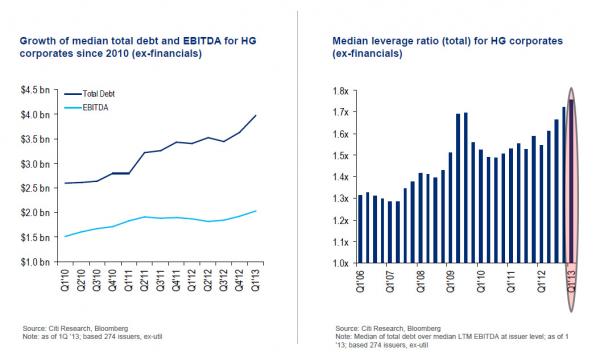
Largest LBO Ever Prepares For Largest Non-Financial Bankruptcy In 30 Years

Largest LBO Ever Prepares For Largest Non-Financial Bankruptcy In 30 Years

Tyler Durden on 09/17/2013 16:25 -0400

Median Leverage_0

If there was one deal that epitomized the last credit bubble, aside from the Blackstone IPO of course, it was the ginormous, $45 billion 2007 LBO of TXU, now Energy Future Holdings. And while the tide for the New Abnormal credit bubble has yet to expose its megalevered monoliths swimming fully naked, as for now corporations have opted for graduated semi-MBOs in the form of ever larger stock buybacks (although as rates rise this too day of reckoning is coming), the time to pay the piper for the last credit-fuelled binge has arrived and inevitable bankruptcy of this landmark deal is now just days away. From the WSJ: “Energy Future Holdings Corp. has begun sounding out banks for financing to help it operate during expected bankruptcy proceedings, which could come as soon as November for the Texas power producer.” Read more of this post

Detecting Accounting Frauds in Asia (Part 2) (Bamboo Innovator Insight)

The following article is extracted from the Bamboo Innovator Insight weekly column blog related to the context and thought leadership behind the stock idea generation process of Asian wide-moat businesses that are featured in the upcoming monthly entitled Moat Report Asia. Fellow value investors get to go behind the scene to learn thought-provoking timely insights on key macro and industry trends in Asia as well as benefit from the occasional discussion of potential red flags, misgovernance or fraud-detection trails ahead of time to enhance the critical-thinking skill about the myriad pitfalls of investing in Asia at the microstructure- and firm-level.

Detecting Accounting Frauds in Asia Part 2

Less Tapering Becomes Tightening Credit No Matter What Fed Says

Less Tapering Becomes Tightening Credit No Matter What Fed Says

By just talking about adding stimulus at a slower pace, Federal Reserve Chairman Ben S. Bernanke sent bond yields a percentage point higher. The rout serves as a warning to monetary policy makers that their exit from record accommodation won’t be easy to control. The jump in yields has pushed up the cost of mortgages for millions of Americans, curbed demand for homes and prompted thousands of job cuts at Bank of America Corp. and Wells Fargo & Co., all at a time when the Fed’s policies are aimed at creating jobs and supporting housing. Read more of this post

Eiji Toyoda, Creator of Toyota Export Giant, Dies at 100

Eiji Toyoda, Creator of Toyota Export Giant, Dies at 100

toyoda-roger-smith

GM’s Roger Smith and Eiji Toyoda created their joint venture NUMMI

Eiji Toyoda, who spearheaded Toyota Motor Corp. (7203)’s expansion in the U.S. as the automaker’s longest-serving president, has died. He was 100. Toyoda died at 4:32 a.m. today because of heart failure at the Toyota Memorial Hospital in Toyota City, Japan, Toyota Motor said in a statement. Funeral services will be held for close family members only, it said. During his 57-year career, the younger cousin of Toyota Motor’s founder helped reshape a maker of Chevrolet knockoffs into an automaker whose manufacturing efficiency became the envy of General Motors Corp. (GM) and Ford Motor Co. By the time he stepped down in 1994, the company was assembling Corollas in the U.S., had started the Lexus luxury brand and had initiated a project that would develop the world’s most successful gas-electric vehicle, the Prius. “He played an important role in leading Toyota’s expansion into North America, and in developing the carmaker into a global company,” Japan’s Chief Cabinet Secretary Yoshihide Suga, said at a press conference in Tokyo. “He was someone who was indispensable to the nation’s entire industry.” Toyoda was a cousin of Kiichiro Toyoda, the founder of the company that bears a slightly altered version of the family’s name. He was one of six presidents to come from the family. Read more of this post

Aging Boomers Befuddle Marketers Eying $15 Trillion Prize

Aging Boomers Befuddle Marketers Eying $15 Trillion Prize

Six years ago, the University of Cincinnati unveiled what it called an “unusual consortium” between its students, faculty and corporations, including Procter & Gamble Co., the consumer-product giant headquartered nearby. The group’s goal: to research and develop product ideas for consumers age 50 and over. “The world has never before seen such a powerful market,” with about $3 trillion to spend in the U.S. alone, the school said then. The segment’s needs were “underserved,” requiring a shake-up of models to find the “sweet spot” between those needs and what was feasible to produce. They’re still searching. Read more of this post

Lantern master’s passion burns bright even after 50 years; “They know it’s not lucrative. My selling price often cannot cover the time and effort used to create the lanterns. But to me, money is secondary. This is my passion, and I hope to do it until i die.”

Lantern master’s passion burns bright even after 50 years

lantern_np

Tuesday, September 17, 2013 – 06:30

Benson Ang, The New Paper

During the Mid-Autumn Festival, most of the lanterns you see in Singapore are imported. But some Singaporeans are still hanging on to the old skills, making, designing and painting traditional Chinese lanterns. Mr Yeo Hung Teo, 75, has been designing and painting Chinese lanterns for about 50 years. He owns Yeo Swee Huat Paper Agency, operating out of a small unit in Toa Payoh Industrial Park. Lanterns, he says in Mandarin, are symbols of identity and status. “Temples, businesses and individuals want them to be hung outside their homes or premises.” Some lanterns are specially commissioned for occasions like the birthdays of deities, funerals and the Hungry Ghost Festival. Made of paper, bamboo and glue, the lanterns are lit with a candle or light bulb. Mr Yeo imports the skeletons of the lanterns from China. He pastes the “skin” over the skeleton and painstakingly hand-paints the lantern with Chinese calligraphy and motifs. The colour of the characters depends on the lantern’s purpose. Most organisations want red characters as the colour represents good luck and fortune. Martial arts organisations might want black characters as the colour symbolises strength, he says. Blue characters are only for funeral lanterns. Each character is painted over at least six times to ensure there are no uneven areas, even when the lantern is lit. Some lanterns also have a decorative drawing – usually of flowers, trees, animals or fruits. To create these designs, Mr Yeo first draws them on the lantern with a ball point pen. He then uses one brush to colour them and another to create textures and effects. He says: “These effects make the objects look more ‘alive’ and beautiful.” He can complete simple designs in two days. More complex ones can take up to a month. The finished lanterns can fetch up to hundreds of dollars, depending on the complexity of their designs. Mr Yeo learnt how to paint lanterns from his father, who set up the business in the 1960s. After two years under his father’s tutelage, Mr Yeo could paint words and simple designs. He learnt more designs during business trips to China and studying the lanterns in temples there. He also sought out other lantern masters – most of whom are now dead – to hone his craft. “After practising for so long, I think my designs have got better.” Sadly, the sun appears to be setting on this art form. His six children, in their 20s to 50s, are not interested in taking over his business.

“They know it’s not lucrative. My selling price often cannot cover the time and effort used to create the lanterns.

“But to me, money is secondary. This is my passion, and I hope to do it until I die.”
Celltrion CEO is facing sanctions from regulators for allegedly manipulating the stock price. Affiliates received loans back by equity stake in Celltrion and have to pay back loans or provide more collateral should Celltrion’s stock price fall. “That’s why Seo attempted to keep its stock price high.”

2013-09-16 19:08

Celltrion CEO under scrutiny

By Na Jeong-ju

Seo Jung-jin, CEO of the country’s largest bio firm Celltrion, is facing sanctions from regulators for allegedly manipulating the stock price of his company. The fraud case represents a dramatic fall from grace for Seo, once called the living legend of the bio industry. He founded Celltrion in 2002 in the midst of a venture boom, and nurtured it into the biggest firm on the tech-laden KOSDAQ bourse in terms of market capitalization. But he is now on the verge of becoming another venture company CEO who may end up in prison.
According to financial regulators Monday, Seo allegedly engaged in illegal stock trading, along with some friendly investors, early this year, using insider information. “We’ve found evidence showing Seo and some others bought shares just before the firm unveiled favorable measures for stock investors,” an official from the Financial Supervisory Service (FSS) said. “Seo is also suspected of having misused his status to inflate Celltrion’s stock price. He claims it was to defend his firm from short-selling investors, but that shouldn’t be an excuse.” Read more of this post

Baupost’s Klarman Returns Money To Clients Amid “Too Few Opportunities”

Baupost’s Klarman Returns Money To Clients Amid “Too Few Opportunities”

Tyler Durden on 09/16/2013 19:26 -0400

Seth Klarman’s Baupost Group will be returning money to investors at year-end. As II Alpha reports, though the amount has yet to be determined, this would be only the second time the hedge fund has returned money in the firm’s 31-year history. With the world of asset managers, as we recently noted, increasingly become herd-like beta-chasers, it seems Klarman – just as he noted earlier in the year – will return capital unless investment opportunities dramatically increased – and that hasn’t happened. Read more of this post