Abenomics Litmus Test Looms as Pressure Mounts for Cutting Taxes

Abenomics Litmus Test Looms as Pressure Mounts for Cutting Taxes

Prime Minister Shinzo Abe faces rising pressure to expand tax relief for Japan’s companies after the longest slump in business investment since 2009, setting up a potential battle with the Finance Ministry. Officials will unveil tax breaks for capital spending in coming months, according to 15 of 16 economists surveyed by Bloomberg News — a step Finance Minister Taro Aso has backed. Aso opposes a broader cut in corporate tax rates, even after a slide in investment since the start of 2012, and his ministry has a history of shielding revenue. Read more of this post
Politicians Talk, the Rupee Drops, India’s Economy Tanks

Politicians Talk, the Rupee Drops, India’s Economy Tanks

India’s economy has stalled. Growth in the second quarter fell to 4.4 percent at an annual rate, down from 8 percent two years ago. The rupee has slumped. Consumer-price inflation is about 10 percent and rising. The country faces what could be a full-scale financial crisis. This would be a testing situation even if India had a well-functioning government, but it doesn’t. With a general election due next May, politics are paralyzed. Between now and the vote, the Reserve Bank of India, led by its new governor, Raghuram Rajan, can do only so much — but the central bank can at least resist demands to make a bad situation worse. Read more of this post

India Slowdown Pressures Singh to Bolster Lowest BRIC Reserves

India Slowdown Pressures Singh to Bolster Lowest BRIC Reserves

India’s weakest economic growth since 2009 escalates pressure on the government to increase the smallest foreign-exchange reserves among BRIC nations, as policy makers struggle to contain a sliding rupee. The reserves have dropped 13 percent to $278 billion since a peak in 2011 and are equivalent to less than seven months of imports. Bank of America Merrill Lynch estimates India needs as much as 10 months of import cover for currency stability, a figure still about half the average in Brazil, Russia and China. Read more of this post

India Is Still Waiting for Superman; Even if new central banker Raghuram Rajan works miracles with monetary policy, it will take more than one man to fix the economy

September 2, 2013, 12:46 p.m. ET

India Is Still Waiting for Superman

Even if new central banker Raghuram Rajan works miracles with monetary policy, it will take more than one man to fix the economy.

ESWAR PRASAD

The Indian economy is facing a rout. The latest data, which show growth slowing sharply, and a plunging currency have laid bare the fragility of the economy. Raghuram Rajan, who takes over at the helm of India’s central bank this week, is being heralded as the savior the country needs. However, it will take a lot more than one person, even if he works miracles with monetary policy, to stem the tide. Decisive action is needed on a number of fronts to revive growth and rebuild the confidence of domestic and foreign investors. Monetary policy can play an important role but not if it remains hamstrung by other policies that are working at cross-purposes. The central bank may be forced to raise interest rates further to defend the currency, but that would only hurt the economy if other policies don’t take on the burden of supporting growth. Read more of this post

The mysterious corruption scandal engulfing PetroChina, China’s largest oil company, is a reminder of why shares in the country’s state-owned enterprises are a thorny asset class.

Updated September 2, 2013, 7:24 a.m. ET

Investors Left Hanging in PetroChina Saga

State-Owned Companies Enjoy Some Advantages—but Aren’t Run In Shareholders’ Interest

AARON BACK

AM-BA083_CHINAH_NS_20130902082111

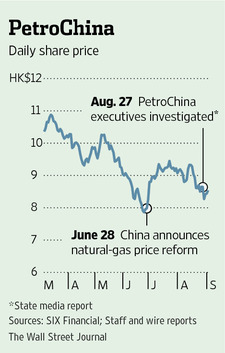
The mysterious corruption scandal engulfing PetroChina601857.SH -0.13% China’s largest oil company by production, is a reminder of why shares in the country’s state-owned enterprises are a uniquely thorny asset class. Last week, state media named three executives at PetroChina and one at its parent company, China National Petroleum Corp., as targets of a corruption probe. All four stepped down from their posts. On Sunday, Beijing announced that the former chairman of CNPC, Jiang Jiemin, is also under investigation. Mr. Jiang left CNPC in March to become the head of a powerful government body that oversees China’s state-owned companies. PetroChina shareholders are suffering whiplash. The company’s shares had been buoyed by news that Beijing was set to increase government-controlled prices for natural gas. The stock dropped 4.4% in one session last week on news of the corruption investigation and, despite recovering slightly, has underperformed Hong Kong’s Hang Seng Index since. Read more of this post

As U.S. authorities examine the hiring by banks of relatives of powerful Chinese officials, two of the biggest IPOs in history show how widespread the practice was in Hong Kong

September 2, 2013, 3:38 p.m. ET

Banks Employing ‘Princelings’ Played Roles in Big Hong Kong IPOs

U.S. Examines Lenders’ Hiring of Relatives of Chinese Officials

CYNTHIA KOONS, NISHA GOPALAN and ROBIN SIDEL

As U.S. authorities examine the hiring by banks of relatives of powerful Chinese officials, two of the biggest IPOs in history show how widespread the practice was in Hong Kong. Some banks that won roles in IPOs, such as Industrial & Commercial Bank of China’s, hired ‘princelings.’ The initial public offerings of Agricultural Bank of China Ltd. 601288.SH -0.40% in 2010 and Industrial & Commercial Bank of China Ltd. 601398.SH -0.26% in 2006 raised $22 billion apiece. Several of the banks that won key roles in the deal employed so-called princelings. Investment banks in Hong Kong have long hired princelings, the relatives of high-ranking Chinese government officials, for their knowledge of the Chinese financial system and their connections inside China, people in the industry say. They add that most are well-educated graduates of Western universities. Read more of this post

Decades of Ruptures from Defect Show Perils of Old Pipe; Replacing all the ERW pipe still in use would cost as much as $1 million a mile, or more than $50 billion

Decades of Ruptures from Defect Show Perils of Old Pipe

Cristobal Sustaita didn’t know about the pipeline running underground near his West Texas home until it erupted into a fireball in 1976, burning to death five people including his wife and 20-month old son. The explosion was one of the first to focus attention on a lethal welding flaw in U.S. pipelines built before 1970. In the decades since, this type of pipe has continued to leak, rupture and explode, killing more people, despite repeated warnings to the industry from federal investigators and private consultants. Read more of this post

Suddenly, emerging market countries are rediscovering just how hard economic policy can be. Just what can they do?

Sep 2, 2013

Emerging Market Economic Policy Is Hard

By Alen Mattich

Suddenly, emerging market countries are rediscovering just how hard economic policy can be. Just what can they do? For years, the side-effects of globalization, past structural reforms and hot money inflows generated strong economic growth. The citizens of these countries were made to feel even better as appreciating currencies kept inflation in check and boosted their purchasing power so they could by ever more imports. The burgeoning middle classes of Turkey and Brazil and Indonesia and South Africa fell in love German cars and Japanese electronics. Even the global financial crisis of 2008 only caused a temporary bump on the endless road forward. Read more of this post

Buybacks to Dividends at Risk With Record-Low U.S. Yields Ending

Buybacks to Dividends at Risk With Record-Low U.S. Yields Ending

U.S. companies, which have almost doubled profits since the financial crisis, are losing the benefit of record-low debt expenses as Federal Reserve plans to taper bond purchases send borrowing costs higher. Borrowing costs for Standard & Poor’s 500 Index companies fell to 1.4 percent of sales the last 12 months, a record low in 11 years of data compiled by Bloomberg. While interest rates on corporate bonds are below the 5.7 percent average since the start of the financial crisis, yields are increasing the most since 2009 and rose to about 4.3 percent from a 17-year low of 3.35 percent in May, as economists project the Fed will start reducing economic stimulus this month. Read more of this post

Ill Wind Blows on Treasurys

September 2, 2013, 7:38 p.m. ET

Ill Wind Blows on Treasurys

Yields Expected to Keep Rising, But at Slower Pace

CAROLYN CUI

MI-BY213_ABREAS_G_20130902175404

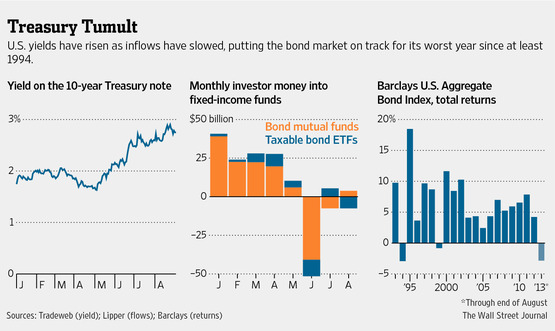
The bond market is likely headed for more pain this fall, as many investors say the prices of ultrasafe U.S. Treasurys will have to decline further before the debt starts looking like a good buy. This year is on track to be the worst for fixed-income investors since 1994, when the Federal Reserve surprised the market with rate increases. Money has flowed out of bond funds in 2013 at the fastest clip in nine years, with $57.3 billion leaving U.S.-listed taxable mutual funds and exchange-traded funds in the past three months alone, according to Lipper. U.S. Treasury yields have increased by more than a percentage point since May, a rise that has caught many analysts and investors off guard. Read more of this post

New York to Seattle Buyers Tap Brakes After Rates Rise

New York to Seattle Buyers Tap Brakes After Rates Rise

Amy and Ted Wilder lost out in the bidding for several Seattle-area homes during the past six months, even with offers well above the asking price. After May’s sudden spike in mortgage rates, the Microsoft Corp. consultants put their search on hold. “We fell in love with a house for about $400,000 and thought we could afford it, and then we discovered it was $300 more a month than what we would have paid in February when we started looking,” Amy Wilder, 42, said. “The mortgage rates just pushed it too far.” Read more of this post

The liquidation of First Strut (Pty) Ltd. following the murder of its chairman in June has cut sales of high-yielding debt in South Africa as investors shun the risk of more corporate bond defaults

First Strut Default Jolts High-Yield Market: South Africa Credit

By Renee Bonorchis  Sep 2, 2013

The liquidation of First Strut (Pty) Ltd. following the murder of its chairman in June has cut sales of high-yielding debt in South Africa as investors shun the risk of more corporate bond defaults. First Strut, a building company also traded as First Tech, applied for provisional liquidation on July 16 after Chairman Jeff Wiggill was found dead with bullet wounds next to his Bentley in Soweto, southwest of Johannesburg. In 2011 the company sold 925 million rand ($90 million) of floating-rate notes due September 2016 at 550 basis points above the three-month Johannesburg interbank agreed rate, which was 5.13 percent on Aug. 30. High-yield emerging-market bonds have fallen 575 basis points in 2013, according to Bloomberg indexes. Read more of this post

Ikea chief drops plan to double pace of store openings; rapid pace of the expansion had been opposed by Ingvar Kamprad, Ikea’s mercurial 87-year-old founder, who favoured more investment in existing stores

September 1, 2013 3:09 pm

Ikea chief drops plan to double pace of store openings

By Richard Milne in Älmhult

Ikea’s new chief executive has rowed back on his predecessor’s pledge to double the pace of store openings, underlining a power shift at the world’s largest furniture retailer. In his first interview as chief executive, Peter Agnefjäll told the Financial Times he was hoping to increase the number of annual store openings from five this year, a figure he called a “record low”. But asked about his predecessor Mikael Ohlsson’srepeated pledge to open 20-25 stores a year, Mr Agnefjäll said: “I don’t recognise that, really.” The shift is significant because the rapid pace of the expansion had been opposed by Ingvar Kamprad,Ikea’s mercurial 87-year-old founder, who favoured more investment in existing stores. Read more of this post

China Banking Regulator Warns of Rising Risks

September 2, 2013, 4:24 PM

China Banking Regulator Warns of Rising Risks

China’s banks don’t properly serve the country’s real economy, and the financial system has become so complex that risks are falling through the gaps in the regulatory system. That is now a familiar message from the cohort of bearish analysts and hedge-fund managers counting the cracks in China’s economic model. It is less familiar coming from China’s banking regulator. In a question-and-answer interview in this week’s Seeking Truth magazine, the Communist Party’s theoretical journal, China Banking Regulatory Commission Chairman Shang Fulin says the financial system’s support of the real economy “needs to be vastly improved,” and he warns of the need to “prevent regulatory arbitrage” and “reduce the risks of financial contagion.” Read more of this post

Malone as ‘Happy’ Owner of Liberty Says He’d Look at M&A Offers

Malone as ‘Happy’ Owner of Liberty Says He’d Look at M&A Offers

John Malone, the U.S. cable magnate who built Europe’s largest cable-television operator through acquisitions, said while he would consider offers for Liberty Global Plc, he’s “happy” with the company as is. As Vodafone Group Plc (VOD) nears closing a $130 billion sale of its stake in U.S. venture Verizon Wireless, the question of how the second-biggest mobile phone company could spend the windfall has focused on its recent efforts to expand in cable. Since Vodafone agreed to buy Kabel Deutschland Holding AG (KD8) in June, speculation has shifted to whether Liberty Global will be among its next targets. Read more of this post

Indofood sank 7.7 percent after it offered to buy the remaining Minzhong stock it doesn’t already own for S$1.12 a share as compared to its last traded price of S$0.53 in an attempt to preserve value of its investments

Indonesia Stocks Drop Most in Asia After Trade Gap; Rupiah Falls

Indonesian stocks declined most in Asia and the rupiah weakened after the government unexpectedly reported the biggest trade deficit since at least 2007.

The Jakarta Composite Index fell 2.1 percent to 4,106.08 at 2:15 p.m. local time, after climbing 0.3 percent earlier. PT Indofood Sukses Makmur (INDF), the nation’s biggest instant-noodle maker, sank 7.7 percent after it offered to buy China Minzhong Food Corp. The rupiah depreciated 0.2 percent to 10,940 per dollar and one-month non-deliverable forwards on the currency declined 0.3 percent to 11,473, data compiled by Bloomberg show. Read more of this post

In an era when digital effects have made the use of small models and suited actors look quaint, tokusatsu, or “special filming,” is on the way out

September 1, 2013

Rubber-Suit Monsters Fade. Tiny Tokyos Relax.

By MARTIN FACKLER

sub-japan-articleLarge

“Ultraman Ginga” is a rarity, made without digital graphics.

CHOFU, Japan — Daisuke Terai plays one of the best-known characters in the history of science fiction, but few fans have ever seen the actor’s face. That is because Mr. Terai puts on a bright silver and red rubber suit before stepping onto a set made of miniature trees and buildings to do battle as the cosmic superhero Ultraman. On a recent afternoon, Mr. Terai’s character was locked in mortal combat to defend the Earth from a giant extraterrestrial dinosaur with glowing eyes and forked spikes called Grand King. When the cameras paused, a sweating Mr. Terai, 36, peeled off the top of his Ultraman suit, while stagehands removed Grand King’s foam spikes to reveal a zipper down the back of the 65-pound costume. Read more of this post

Fallen SASAC chief Jiang Jiemin; Xi’s anti-graft sweep to turn focus to PLA

Fallen SASAC chief Jiang Jiemin

Staff Reporter

2013-09-02

CFP443326428-092433_copy1

Jiang Jiemin. (Photo/CFP)

China’s disciplinary authorities have announced a corruption probe into Jiang Jiemin, head of the commission overseeing the country’s biggest state-owned enterprises. Until March this year, the 57-year-old Jiang was the chief of state-owned China National Petroleum Corporation, the country’s largest integrated energy company. Born in eastern China’s Shandong province in 1955, Jiang graduated from the University of Shandong and also underwent an in-service postgraduate course for ministerial officials and provincial heads at the CPC Central Committee party school. Read more of this post

Why the Chinese government spent $33 billion on cotton that nobody wants

Why the Chinese government spent $33 billion on cotton that nobody wants

By Gwynn Guilford @sinoceros August 30, 2013

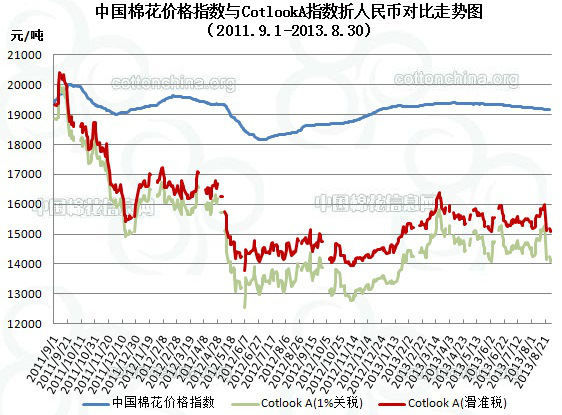
Texhong Textile Group, one of China’s biggest textile makers, has been shifting production to Vietnam, and the market loves it, reports Bloomberg—the stock is up 445% from a year ago. And that’s not because of the much-bemoaned rise of Chinese labor costs. It’s because the Chinese government is making cotton way more expensive than it should be.

Cotton stockpiling: a terrible idea

The Chinese government buys and stockpiles domestic cotton when prices fall below a set level, a policy designed to support the textile industry after the 2008 financial crisis swallowed export demand. The problem? Excess supply has made foreign cotton much cheaper than Chinese cotton. Ever conscious of dwindling profits, companies like Texhong have turned to cotton imports, which has forced the government to shell out $33 billion in the last two years to soak up the excess in domestic cotton, as Reuters reports. In 2012 alone, it stockpiled 89% of China-produced cotton (link in Chinese). The government’s price in blue, international cotton indices in red and green.Cottonchina.org

ccindex1308302

Read more of this post

Opinion monitoring services doing brisk business in China as online media reduced the time it takes to form public opinion from 24 hours to just one to four hours

Opinion monitoring services doing brisk business in China

Staff Reporter

2013-09-02

With online media having reduced the time it takes to form public opinion from 24 hours to just one to four hours, the business of public opinion monitoring is booming in China, the Guangzhou-based Southern Weekly newspaper reports. The monitoring of online opinions caught attention in 2007, owing to the rise of social media, which has allowed people to actively express their thoughts on political and social issues, said Shan Xuegang, deputy head of the Public Opinion Monitoring Office at the People’s Daily. Former Chinese president Hu Jintao’s taking part in an online discussion in June 2008, the first time a Chinese leader had done so with internet users, led to the Chinese media marking that year as the beginning of online political participation in the country. Read more of this post

In sweatshops, the ‘Brazilian dream’ goes awry

In sweatshops, the ‘Brazilian dream’ goes awry

Sun, Sep 1 2013

By Lucas Iberico-Lozada

SAO PAULO (Reuters) – When Margot Alarconciles woke up one morning last year and found her son sick with what appeared to be a cold, there was little she could do but wrap him in an extra blanket, walk down the hallway and start her workday: sewing clothes for up to 11 hours a day, six days a week. “I couldn’t leave my machine,” she said. “Without my job, we could not eat.” Her 5-year-old son’s condition deteriorated, and without proper care he soon died. Still grieving, Alarconciles now questions her decision to leave her native Bolivia for Brazil, where salaries can be many times higher but poor immigrants often must settle for work in sweatshops. Read more of this post

Insolvent town exposes gulf between EU dreams and reality

Insolvent town exposes gulf between EU dreams and reality

Sun, Sep 1 2013

By Luiza Ilie

ANINOASA, Romania (Reuters) – On an abandoned storefront, an old poster advertises one of the few career opportunities available in this Romanian town: naked webcam models wanted for Internet chatrooms. If joining the European Union was supposed to lift Romania out of poverty, it has yet to work in Aninoasa, a town of 4,800 people in the mountainous central region of Jiu Valley. Six years after Romania’s accession to the EU, not only is Aninoasa still poor – it has also become the first town in Romania to file for insolvency. Read more of this post

Asian Bonds Tumble Below Par in Capital Flight

Asian Bonds Tumble Below Par in Capital Flight: Credit Markets

Asia dollar-denominated bonds have dropped below par for the first time since 2011 as investors pull money out of the region amid concerns that growth is slowing and as currencies from the rupee to rupiah plunge. Average prices of company debentures in the region fell to 98.61 cents on the dollar on Aug. 22, the least since October 2011, Bank of America Merrill Lynch indexes show. Dollar bonds globally have held above 100 cents since September 2009. Both investment- and non-investment-grade debt in Asia were below par on Aug. 22. The last time that happened was in September 2008, when Lehman Brothers Holdings Inc. collapsed. Read more of this post

Forget playing to your strengths, today the best marketing campaigns play to a business’s weakness.

That’s ‘flawsome!’

September 2, 2013

Claire Dunn

iiNet-New-No-2-Ad--2--300x0

Forget playing to your strengths, today the best marketing campaigns play to a business’s weakness. iiNet knows the power of authentic engagement in advertising. Brands are being encouraged to flaunt rather than hide their flaws – to be “flawsome” – in a bid to appeal to consumer desire for authenticity and transparency. According to global firm TrendWatching, “flawsome” (a portmanteau of flawed and awesome) strategies walk hand-in-hand with “maturalism” (mature materialism, another Trendwatching neologism). They are both responses to the cynicism and disbelief traditional “flawless” marketing often elicits. We no longer buy ad campaigns that are too good to be true. Consumers now want honest conversations about products and appreciate brands that show some maturity, humility, and humour. Consumers now want honest conversations about products and appreciate brands that show some maturity, humility, and humour.   Read more of this post

Plunging Currencies Plague Asian Firms; Weak Currencies Make it More Costly to Pay Foreign Debt

September 2, 2013, 12:15 a.m. ET

Plunging Currencies Plague Asian Firms

Weak Currencies Make it More Costly to Pay Foreign Debt

SEAN MCLAIN IN NEW DELHI And I MADE SENTANA IN JAKARTA

Companies across Asia are facing a debt-repayment crunch as plunging local currencies make it more costly to repay foreign loans, a situation that is exacerbating stresses on the region’s economies. Asian companies took out sizable foreign loans in recent years as the U.S. Federal Reserve kept interest rates low and printed money. For firms in nations like India and Indonesia, rates on U.S.-denominated debt were more attractive than local borrowing costs. Read more of this post

Ditch the stats: China retailers don’t buy signs of recovery

Ditch the stats: China retailers don’t buy signs of recovery

6:05pm EDT

By Anne Marie Roantree and Donny Kwok

HONG KONG (Reuters) – If things are really starting to look up for China’s economy, as a recent spate of better-than-expected government data seems to suggest, nobody appears to have told its biggest retailers. A Reuters review of first-half earnings showed that more than 20 Chinese companies selling everything from footwear to food were not convinced the economic slowdown had bottomed out, and neither were their traditionally thrifty customers. Read more of this post

How to transform into open firm

2013-09-01 13:36

How to transform into open firm

By Kim Min-su
For well over a century, the firm has been viewed as an efficient mechanism for organizing inputs such as capital and labor into productive activities. Firms grew large because of economies of scale and scope, and because it was often easier to organize production within the borders of the company than to use the wider marketplace.
Recently, however, this traditional view of the firm has changed with the evidence of how firms actually operate in markets. Spurred on by a raft of new technologies such as cloud computing, social media, wireless and remote mobility, the primary impulse in most markets today is toward greater openness.
In these more open business ecosystems, the borders between the firm and its stakeholders — customers, suppliers, workers, and innovators — have become much more permeable and reconfigurable. Read more of this post

Peter Agnefjäll, Ikea chief, is keen to stress he has his own style

September 1, 2013 2:16 pm

Peter Agnefjäll, Ikea chief

By Richard Milne


It would be easy to think that the Ikea manual on how to build a chief executive goes something like this: take a blond, Swedish man from the south of the country; dress him in a shirt, jumper and chinos; have him stress the importance of the retailer’s vision of “a better life for many people”; tighten with an Allen key. On meeting Peter Agnefjäll, who officially became the Swedish company’s fifth chief executive in its 70-year history yesterday, it is tempting to see him as an Identikit ofMikael Ohlsson, the man he replaced. Both are softly spoken and prefer to talk about the company’s unique culture and its interaction with customers than about profits and targets. Read more of this post

Origin of heavy metals like gold: Bling Began With Golden Bang in Space, Scientists Find

Bling Began With Golden Bang in Space, Scientists Find

Those who look to the heavens and wish for gold may have the right idea, just the wrong timing. A new scientific look at how elements heavier than iron are formed in the universe suggests that much of the gold on earth may have floated in space for billions of years after being spat out in the collision of two neutron stars. It arrived on earth millions of years ago in meteor showers, researchers said. The origin of heavy metals like gold has long been a scientific mystery, said Don Lamb, an astronomer at the University of Chicago. Now, astronomers at Harvard University have analyzed a gamma ray burst thought to be from a rare neutron star collision and found it helped seed the universe with heavy metals, including enough gold to create a pile that would have about 10 times more mass than the earth’s moon. Read more of this post

“Communication is not communication, it is changing consumers’ perception, changing consumers’ attitudes, and to lift up a brand’s image and make sure that the consumer understand the core value of the brand”

Understanding consumers crucial to success: ad man

NEERACHA MALISAK-LEMIRE,
CHANPOLYDET MER
THE NATION September 2, 2013 1:00 am

UTILISATION OF THE media and understanding consumers’ behaviour will be necessary components for competitiveness in the Asean Economic Community (AEC), an advertising expert says. To be successful in business, many aspects are required. However, in the final outcome, marketing and advertising play a dominant role. This rule applies everywhere in the world, including Thailand, said Dr Wilert Puriwat, chief consultant for Spa-Hakuhodo Advertising Co. Read more of this post