Genesis Colors: Success Beyond Satya Paul; its scale of 30 stores is unique for the upscale end of the Indian apparel sector which is dotted with designers, many of whom are celebrities but often fail to create a successful business

Genesis Colors: Success Beyond Satya Paul

by Prince Mathews Thomas | Sep 2, 2013

Though the company is far from a one-brand wonder, Satya Paul continues to be its calling card

topimg_22375_sanjay_kapoor_300x400 Sanjay Kapoor_Final.indd

One of India’s largest fashion retailers in the premium and luxury segment is, ironically, not a familiar name to the average shopper. Ask about Genesis Colors and you are likely to draw a blank. But mention Satya Paul and you are on familiar terrain. Designer brand trumps company brand: That is the Genesis business model. Here’s how it works. Although founded in 2001, the Genesis story began in 2002 with the launch of a revamped Satya Paul. Named after the designer who created it in 1985, the brand had established itself in the Indian fashion firmament before it came under Genesis’s fold. But it was only after 2002 that Satya Paul scaled up to become, arguably, the country’s leading homegrown fashion brand in the high-end segment. And Genesis’s biggest success. It has 30 exclusive stores in India, the largest network for any domestic premium brand, and accounts for 30 percent of Genesis’s Rs 310 crore revenue (for 2012-13). The scale is unique for the upscale end of the Indian apparel sector which is dotted with designers, many of whom are celebrities but often fail to create a successful business. This segment constitutes about 25 percent of India’s premium/luxury market, worth $5 billion, says Ankur Bisen, head of retail and consumer products, Technopak, a management consulting firm.  Read more of this post
Indian Land Deform; Amid an economic crisis, Delhi makes it harder to invest

Updated September 2, 2013, 8:28 p.m. ET

Indian Land Deform

Amid an economic crisis, Delhi makes it harder to invest.

Someone should tell New Delhi that when sensible leaders talk about not letting a crisis go to waste, they mean seizing the opportunity to enact pro-growth reforms. Instead, as capital flees and growth slips again, Indian politicians last week passed a land acquisition bill that will hurt farmers, hinder investment and increase corruption. India’s current system of land laws, largely unchanged since 1894, is certainly in desperate need of a revamp. Woefully incomplete government land registries make it hard for anyone to establish a clear title to property, especially in rural areas. Attempts to buy land directly from owners can take years as the notoriously inefficient courts grapple with the resulting litigation. Read more of this post

The Malaysian Government has yet to decide which projects would be postponed to address the narrowing of the country’s current account surplus on the balance of payments and high fiscal debt

Updated: Tuesday September 3, 2013 MYT 9:19:16 AM

Government will review projects

BY LEONG HUNG YEE 
HUNGYEE@THESTAR.COM.MY

MRT lines 1,2 and 3 unaffected and will proceed as planned

PUTRAJAYA: The Government has yet to decide which projects would be postponed, but maintained that the Mass Rapid Transit (MRT) project would proceed as planned, according to Prime Minister Datuk Seri Najib Tun Razak. He said the Government, in addressing the narrowing of the country’s current account surplus on the balance of payments, would consider carefully the public sector projects to be undertaken. Read more of this post

Why Canada’s financial news is often a thinly disguised weather report

Why Canada’s financial news is often a thinly disguised weather report

Philip Cross, Special to Financial Post | 13/08/30 | Last Updated:13/09/02 4:03 PM ET
Welcome to September, Canada’s busiest month.

The quickened pace might come as a shock to you, in your life, because you just left August where the living is easy. OTTAWA — The U.S. economy has been picking up and overburdened Canadian consumers are still spending, as are fiscally strapped governments. But that’s hardly a scenario for robust growth in this country — not without the long-promised increase in business investment and expanded exports. Read more of this post

Shareholders, Small-Town America Enemy No. 1?

Shareholders, Small-Town America Enemy No. 1?

Did greedy investors really destroy small-town America?

That’s about the only conclusion one can draw from a Washington Post article last week recounting how Endicott, New York, where International Business Machines Corp. was founded and based for many years, was gutted as the company responded to shareholders who insisted on better investment returns. It used to be a given that the interests of corporations and communities such as Endicott were closely aligned. But no more. Across the United States, as companies continue posting record profits, workers face high unemployment and stagnant wages. Read more of this post

Misconceptions About Fed’s Bond Buying

Misconceptions About Fed’s Bond Buying

To combat the recession that began in 2007, the Federal Reserve and some other central banks have been buying large amounts of long-term bonds. The novelty of this quantitative easing makes the policy especially prone to popular misconceptions.

Misconception No. 1: QE bond purchases are comparable to stimulus spending on roads and tax cuts, which adds to the national debt.

— QE actions to lower long-term interest rates require much bigger changes in the Fed’s balance sheet than conventional policy aimed at short-term interest rates. The “Q” in QE is the quantity of assets purchased — and the dollar amounts are necessarily very large. But QE is a swap of one asset (bank reserves) for another (bonds); this has no direct effect on the national debt. Indeed, QE indirectly shrinks the national debt by reducing interest payments and by strengthening economic activity, which raises tax revenue. Read more of this post

Is your bond fund quietly investing in shares?

Is your bond fund quietly investing in shares?

Some fund managers have the option to invest outside their main area of expertise. Should you be worried, asks Kyle Caldwell.

Some funds managers have been straying outside their normal markets.  Photo: JLImages / Alamy

By Kyle Caldwell

7:00AM BST 02 Sep 2013

Professional fund managers are usually endlessly upbeat whether the market is rising steadily or plunging headlong. But now – after several years of healthy stock market gains, during which world economies have not recovered as swiftly – a growing number of fund managers are admitting they can no longer see value in the markets they specialise in. In other words, prices are too high. This has led some to stray outside their normal remits – with the result that the make-up of the fund is no longer the same as when many investors first put money with the manager. Read more of this post

Larry Summers the next big risk for emerging markets? “Larry Summers is not an advocate of QE and the reality is that all things being equal, he will unwind QE fast”

Larry Summers the next big risk for emerging markets?

Published: Monday, 2 Sep 2013 | 10:58 PM ET

By: Dhara Ranasinghe | Senior Writer

Thought speculation about Federal Reserve tapering was bad for emerging markets? Then just wait to see what happens if Larry Summers is appointed as the next U.S. central bank chief, analysts say. They argue that if Summers replaces Ben Bernanke, whose second term as Fed chairman expires in January, any scaling back in the central bank’s asset-purchase program would be ramped up by the hawkish Summers and deal a further blow to battered emerging markets. Read more of this post

Clash of the Cape crusaders: The world’s leading market historians are locked in an intense debate over the true value of stocks

September 2, 2013 7:57 pm

Clash of the Cape crusaders

By John Authers

The world’s leading market historians are locked in an intense debate over the true value of stocks

CAPE

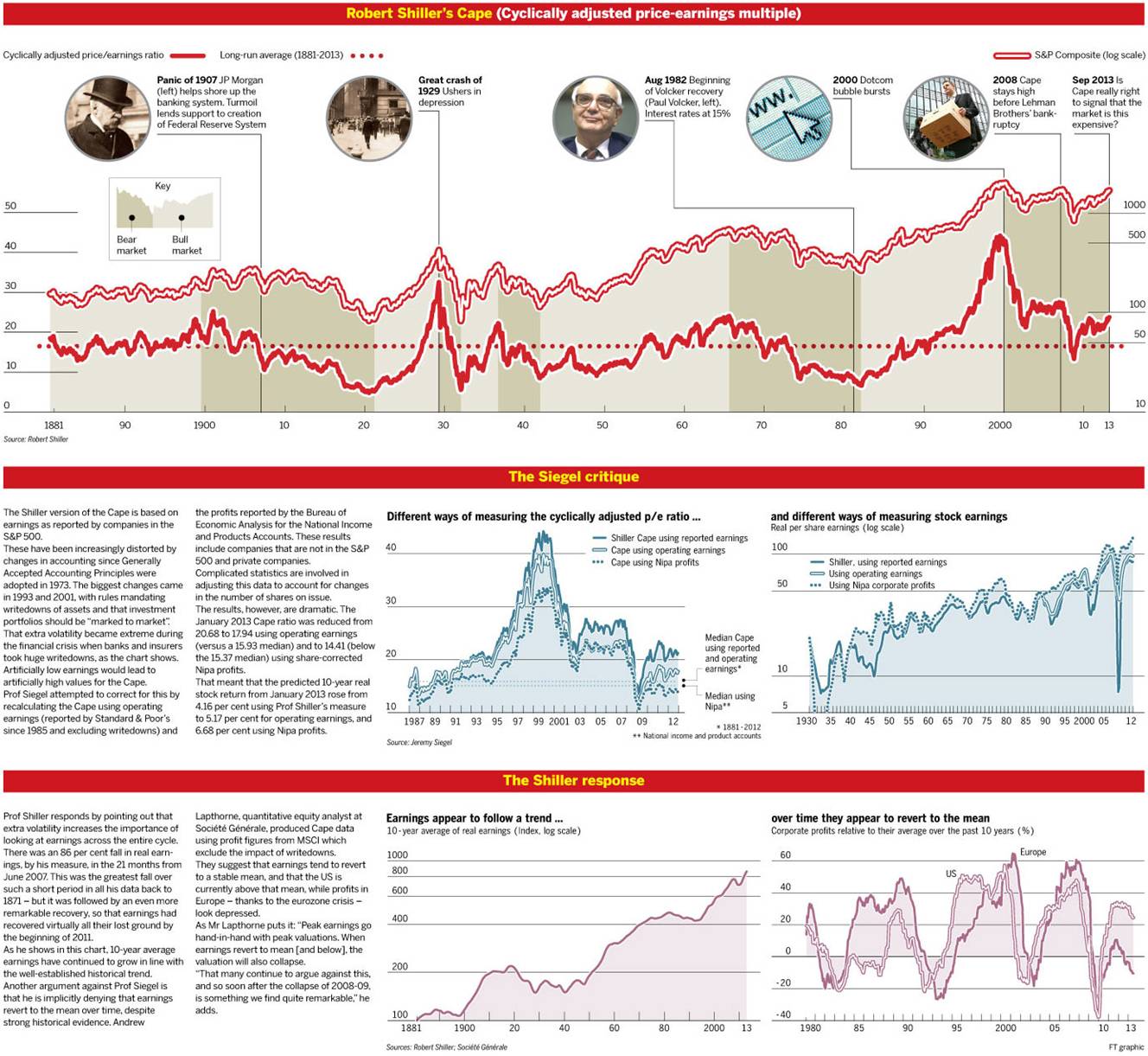
Robert Shiller’s warnings about the internet stock bubble of the late 1990s, followed after a few years by a controversial – and accurate – prediction on the US housing market, earned him the respect of Wall Street and a place on the bestseller list. The Yale economist’s call on the internet boom, articulated in his book Irrational Exuberance, was based on the measure he developed called the Cape, for cyclically adjusted price/earnings multiple. The Cape, which uses earnings data going back to 1871, has gained wide acceptance as an accurate gauge of the market. Prof Shiller and the Cape are sounding the alarm once again, implying that the US market is 62 per cent overvalued and more expensive than any other big stock market. Read more of this post

Germany’s jobs record masks hidden flaws; Number of temporary workers has trebled in 10 years

September 2, 2013 2:02 pm

Germany’s gold standard jobs record masks hidden flaws

By Chris Bryant in Frankfurt

Angela Merkel has one key trump card when voters go to the polls in September: a record 41.8m Germans are now in employment. A decade after its sclerotic labour market caused Germany to be branded the “sick man of Europe”, the country is the envy of a continent only just crawling out of recession while still grappling with record unemployment in many nations But the German “jobwunder” has come at a cost – the big increase in low paid, precarious types of employment such as part-time work, temporary contracts, so-called “minijobs” and outsourcing. Read more of this post

Ireland fears the unthinkable – a Dublin property bubble

Ireland fears the unthinkable – a Dublin property bubble

Wed, Aug 28 2013

By Padraic Halpin

DUBLIN (Reuters) – Five years after a huge property crash devastated the Irish economy, prices are finally stabilising, but a booming urban market where supply is scarce and competition fierce is raising concerns about a new bubble in the capital. House prices quadrupled on a decade of easy credit during the boom years that earned Ireland the sobriquet Celtic Tiger, then fell by more than half from 2007, leading the country into an EU/IMF bailout, a costly bank rescue and leaving almost one in five homeowners behind on their mortgage payments. Read more of this post

Long-Term Jobless Left Out of the Recovery; Despite Improving Economy, Prospects Are Bleak for Millions of Unemployed

September 2, 2013, 7:15 p.m. ET

Long-Term Jobless Left Out of the Recovery

Despite Improving Economy, Prospects Are Bleak for Millions of Unemployed

BEN CASSELMAN

NA-BX910_DROPOU_G_20130902182105

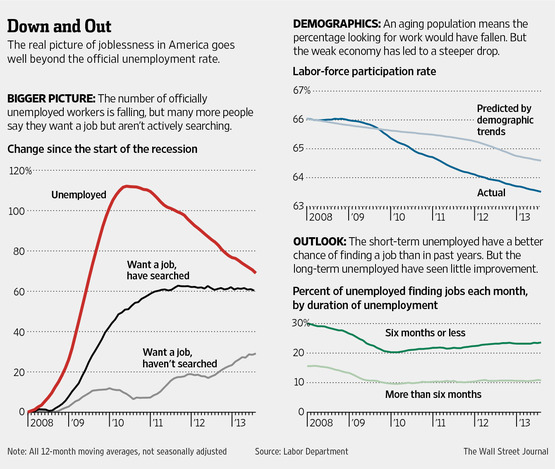
For those left behind by the long, slow economic recovery, time is running out. More than four years after the recession officially ended, 11.5 million Americans are unemployed, many of them for years. Millions more have abandoned their job searches, hiding from the economic storm in school or turning to government programs for support. A growing body of economic research suggests that the longer they remain on the sidelines, the less likely they will be to work again; for many, it may already be too late. Read more of this post

Hayao Miyazaki, the anime director behind such classics as “Spirited Away” and “Ponyo,” has reportedly announced his retirement. Was the great Japanese animator greater than Walt Disney?

September 2, 2013, 12:18 PM

Hayao Miyazaki Retires: Was He Better Than Walt Disney?

By CHRISTOPHER JOHN FARLEY

OB-YT235_spirit_G_20130902100218 WK-AQ687_ADVISE_D_20090805121221

2001 – Studio Ghibli “Spirited Away.”

Reports that Japanese animator Hayao Miyazaki is retiring has sent anime fans into mourning. But it should also send them to their DVD collections and to iTunes to watch his work and celebrate his genius. The news about the famed filmmaker’s retirement was announced yesterday at theVenice Film Festival, where the director’s latest movie,  “The Wind Rises,” received its international premiere, Variety reported. Miyazaki reportedly will give a press conference later this week. Representatives for DisneyDIS -0.41%, which distributes Miyazaki’s movies in the U.S., didn’t respond to a request for comment. Miyazaki was often likened to Walt Disney, but such comparisons sold both animators short. Read more of this post

6 Exercises to Strengthen Compassionate Leadership

6 EXERCISES TO STRENGTHEN COMPASSIONATE LEADERSHIP

WANT LOYAL, DEDICATED, AND PASSIONATE EMPLOYEES? BE A LOYAL, DEDICATED, AND PASSIONATE BOSS. HERE ARE SOME TOOLS TO DEVELOP WELL-BEING IN YOUR WORKPLACE THROUGH BETTER COMMUNICATION.

BY: ANDREW NEWBERG MD

When you use compassionate communication in your conversations, something quite surprising occurs: both your brain and the brain of the person you’re talking to begin to align themselves with each other. This special bond is a phenomenon referred to as “neural resonance,” and in this enhanced state of mutual attunement, two people can accomplish remarkable things together. Why? Because it eliminates the natural defensiveness that normally exists when people casually converse. The capacity to deeply relate to others is a key to all forms of relational success–at work and at home. If you find yourself in the position of overseeing others–be they your employees or your children–remember this: leaders who give the least amount of positive guidance to their subordinates are less successful in achieving their organizations’ goals, and the employees are unhappier with their work. Indeed, by not taking an active role in dialogue and teamwork building, they generate more interpersonal conflicts within their groups. Here are 6 steps to work on to become a more compassionate leader.  Read more of this post

How Radical Transparency Kills Stress

HOW RADICAL TRANSPARENCY KILLS STRESS

SHARING ISN’T STRESSFUL. IN FACT, IT’S JUST THE OPPOSITE. HERE’S HOW REAL TRANSPARENCY CAN BOOST TRUST, AND GIVE YOUR EMPLOYEES THE PSYCHOLOGICAL FREEDOM THEY’VE BEEN CRAVING.

BY: JANET CHOI

A Utah-based research software company, Qualtrics, practices a management approach they call “radical transparency.” Details and data regarding individual and company performance–including quarterly objectives and results as well as weekly snippets of employees’ past work and future goals–are shared throughout the company of over 300 employees. This way, the company communicates information that people need to do their jobs, which is particularly critical considering the largely invisible nature of knowledge work. “We’re hiring people to think,” Ryan Smith, CEO, explains in an interview with The Motley Fool. While the creativity and amorphous nature of knowledge work makes it difficult to control, the trick is that it, in fact, shouldn’t be controlled. Instead, if you’re hiring people to think, you should be concerned with whether you’re providing favorable conditions for them to do that thinking clearly and well. Radical transparency is actually one key to creating a positive setting in order for your brain and performance to flourish. Read more of this post

Why Transparency Is Your Biggest Untapped Competitive Advantage

WHY TRANSPARENCY IS YOUR BIGGEST UNTAPPED COMPETITIVE ADVANTAGE

FOR BUFFER’S LEO WIDRICH, IT’S MUCH MORE THAN A BUZZWORD. SO WHY ISN’T EVERYONE EMBRACING IT?

BY: LEO WIDRICH

“Default to transparency” is one of our deepest values at Buffer and it’s been absolutely instrumental in our growth from making nothing just two years ago to making over $1 million a year today.

EMPLOYEES SHARE DEEP PERSONAL CONVERSATIONS ABOUT HOW THEY’RE REALLY DOING AND FEELING THAT START FROM SEEING HOW THEIR TEAMMATE IS SLEEPING.

To us, transparency isn’t a buzzword–it’s a huge competitive advantage when everyone knows what everyone is working on and getting done. It seems obvious, right? But I’m constantly shocked by how many companies say they understand the importance of transparency but don’t make any steps to make their companies more transparent. Then I read a quote from Marc Effron, president of The Talent Strategy Group, that made it crystal clear to me why that happens, and it changed the way that I thought about transparency forever. Read more of this post

Caught In A Stress Spiral? Innovate Your Day With 8 Minutes Of “Ready, Set, Pause”

CAUGHT IN A STRESS SPIRAL? INNOVATE YOUR DAY WITH 8 MINUTES OF “READY, SET, PAUSE”

PEOPLE SPEND ABOUT 47% OF THEIR LIVES LOST IN THOUGHT, PONDERING THE PAST AND WORRYING ABOUT THE FUTURE. STOP THE CYCLE AND GET MORE PRODUCTIVE AND EFFICIENT BY BLOCKING OUT 8 MINUTES A DAY FOR “READY, SET, PAUSE.”

BY: AMY JO MARTIN

Stress, anxiety, and pressure are no longer fleeting feelings we flirt with while working on a stressful project or stuck in a traffic jam. They have become permanent fixtures in our lives. We have let them creep into our psyche and strangle our well-being. The American Medical Association purports that stress is the basic cause of more than 60 percent of all human illness and disease. They also state that stress is the number one proxy killer disease today. Whether we mean to or not, stress often dominates our thinking and decision-making process. Some may say pressure and stress are motivators. To a certain extent, yes, but at what overall cost? What is the cumulative effect of all this stress, and what is happening to us collectively as a result? Read more of this post

Cost Makes Chemicals WMD of Choice for Shrinking Group of Rogues

Cost Makes Chemicals WMD of Choice for Shrinking Group of Rogues

Syria, accused of launching a chemical attack against its own people last month, is one of a shrinking group of nations to retain a form of weaponry that the rest of the world abandoned over the past 20 years. Syria is one of only five countries not to have signed the 1993 Chemical Weapons Convention, which bans the development, stockpiling, transfer and use of chemical arms. The others are Egypt, North Korea, South Sudan and Angola. Israel and Myanmar have signed the convention but not ratified it. Libya became a party to the convention in 2004 and Iraq in 2009. Read more of this post

Genetic Manipulation Extends Life of Mice 20%; But Translating Findings to Humans Faces Many Hurdles

Updated August 29, 2013, 5:00 p.m. ET

Genetic Manipulation Extends Life of Mice 20%

But Translating Findings to Humans Faces Many Hurdles

RON WINSLOW

By reducing the activity of one type of gene, scientists said they increased the average life span of mice by about 20%, a feat that in human terms is akin to extending life by about 15 years. Moreover, the researchers at the National Institutes of Health found that memory, cognition and some other important traits were better preserved in the mice as they aged, compared with a control group of mice that had normal levels of a protein put out by the gene. Read more of this post

London driver says skyscraper “melted” his car

London driver says skyscraper “melted” his car

2:59pm EDT

LONDON (Reuters) – A cluster of new skyscrapers transforming the London skyline are often blamed for spoiling the view. Now one has been accused of “melting” a car. A motorist said intense sunlight reflected from the “Walkie Talkie” – one of several flashy towers under construction in The City, London’s historic financial district – warped his Jaguar which he had parked across the road. Read more of this post

Taiwan’s government is seeking to ban tuition classes in English and maths for children under six years old, saying the rote-learning method widely used by cram schools adversely affects the mental and physical development of pre-schoolers

Cram schools face ban on English and maths tuition

Monday, September 2, 2013 – 06:00

Lee Seok Hwai

The Straits Times

TAIWAN – Taiwan’s government is seeking to ban tuition classes in English and maths for children under six years old, saying the rote-learning method widely used by cram schools adversely affects the mental and physical development of pre-schoolers. The Cabinet on Thursday approved an amendment to the Supplementary Education Act that could fine cram schools NT$100,000 to NT$500,000 (S$4,300 to S$21,300) for violating the ban. The amendment will have to be passed by the legislature. Read more of this post

Expert networks: thriving in Asia, away from U.S. scrutiny, even though the legal risks of using the networks outweigh the potential rewards

Expert networks: thriving in Asia, away from U.S. scrutiny

5:27pm EDT

By Rachel Armstrong and Nishant Kumar

SINGAPORE/HONG KONG (Reuters) – Expert networks – a matchmaking service linking investors such as hedge funds with company insiders – are under scrutiny from regulators in the United States, but are expanding across Asia, where the market for corporate intelligence is less transparent. The U.S. Securities and Exchange Commission has charged over three dozen people and firms as part of a broad investigation into ties between investors and expert networks that has uncovered insider trading and helped trigger the high-profile fall of Raj Rajaratnamrun’s Galleon hedge fund. Those cases have bruised confidence in expert networks in the United States, and some clients have stopped using the service for fear of falling foul of regulators. But in Asia, where regulators have yet to pay the industry much attention, the service is thriving – fertile ground where emerging market investors are willing to pay for inside knowledge on company supply chains, key personnel moves or regulatory shifts. Read more of this post

Beijing Will Cut Coal Burning and Barbecues in Bid to Fight Smog

Beijing Will Cut Coal Burning and Barbecues in Bid to Fight Smog

The Chinese capital will limit cars, outdoor barbecues and coal burning under new measures to reduce air pollution that exceeded recommended World Health Organization levels by nearly 40 times in January. Coal use for electricity consumption in Beijing will be reduced by 13 million metric tons by 2017 from the 2012 level, while limits will be put on outdoor barbecues in suburban areas and the number of cars will be kept below 6 million, the city government said in a statement today. The restrictions follow 10 pollution control measures that the country announced in June, after levels of PM2.5, the fine particulates that pose the greatest health risk, hit a record 993 in January. At his first briefing as China’s premier in March, Li Keqiang said China’s smog gave him a “heavy heart” and promised more vigorous efforts to fight it. The measures in Beijing are meant to reduce concentrations of PM2.5 by 25 percent to about 60 micrograms per cubic meter in 2017 from last year. The World Health Organization recommends 24-hour exposure to PM2.5 of no higher than 25. The measures announced today also include closing 1,200 companies that generate pollutants and limiting public offerings of companies that violate environmental laws. The city had 5.2 million vehicles at the end of last year, according to the official Xinhua News Agency.

To contact Bloomberg News staff for this story: Sarah Chen in Beijing at schen514@bloomberg.net

Rattled by investigations, foreign firms in China beef up compliance

Rattled by investigations, foreign firms in China beef up compliance

5:12pm EDT

By Michael Martina and Kazunori Takada

BEIJING/SHANGHAI (Reuters) – Foreign companies in China are getting increasingly jumpy about a spate of antitrust and corruption investigations by Chinese authorities and are hiring lawyers to make sure their operations comply with the law. The investigations represent one of the most significant risks to doing business in China in years. Antitrust regulators have looked into sectors such as pharmaceuticals, milk powder and jewelry in recent months and suggested that autos, telecommunications, banks and oil firms could be next. Read more of this post

Stock offering plans by China’s banks seen as short-term fix

Stock offering plans by China’s banks seen as short-term fix

5:15pm EDT

By Michael Flaherty and Denny Thomas

HONG KONG (Reuters) – For the Chinese banks seeking billions of dollars in upcoming stock offerings, a concern is growing that the money will only refinance old loans and do little to prevent the lenders from hitting up shareholders for more cash in a few years or less. In 2010, Chinese lenders raised $82 billion as a surging stock market helped them replenish cash after a post-financial crisis lending binge. Now, in a far less forgiving climate, they are again lining up for more money, attempting to tap investors as the economy slows, profits shrink and unpaid debts pile up. Read more of this post

TV Market Tough to Crack for OLED Makers

Sep 2, 2013

TV Market Tough to Crack for OLED Makers

By  Juro Osawa and Min-Jeong Lee

Long touted as the next-generation display technology, organic light-emitting diode or OLED screens have made it to the mainstream in the world of smartphones, with market leaderSamsung Electronics Co.005930.SE -1.24% using them in popular models like the Galaxy S4 and Galaxy Note II. But when it comes to larger screens for televisions, OLED is still far from taking off. Technology for producing TV-size OLED screens hasn’t yet matured, and it’s also difficult for electronics makers to make a lot of capital investment in that area, given low expected returns in the thin-margin TV market. Read more of this post

Airport Wait Times Set to Drop With New Technology, Rockwell Collin’s Arinc Says

Airport Wait Times Set to Drop With New Technology, Arinc Says

Passengers will spend less time at airports in coming years as more efficient operators deploy advanced technology to reduce waiting, aviation services company Arinc Inc. said. Arinc’s products targeted at improving the screening of passenger information and travel documents to improve the flow through terminals will help make travel “much less stressful,” said Michael DiGeorge, a Singapore-based managing director of the Asia-Pacific division for the Annapolis, Maryland-based company, which Rockwell Collins Inc. (COL) agreed last month to buy for $1.39 billion. Read more of this post

Malaysia Raises Fuel Prices as Najib Seeks to Trim Budget Gap

Malaysia Raises Fuel Prices as Najib Seeks to Trim Budget Gap

Malaysia raised fuel prices for the first time since 2010, joining neighboring Indonesia in curbing subsidies that have stretched government budgets and threatened investor confidence. The price of the widely used RON 95 grade of gasoline will rise 20 sen to 2.10 ringgit ($0.64) a liter at midnight, according to an announcement by Prime Minister Najib Razak today in Putrajaya, outside of Kuala Lumpur. Diesel will increase 20 sen to 2 ringgit a liter. The increases will help the government save about 1.1 billion ringgit this year and 3.3 billion ringgit annually in future by reducing state subsidies, he said. Read more of this post

Japan Radioactive Water Raises Alarm as Government to Intervene

Japan Radioactive Water Raises Alarm as Government to Intervene

Japan may announce measures today to contain the growing volume of radiated water at the Fukushima atomic station, following findings of radioactive hot spots and leaks more than two years after reactors melted at the plant. The Nuclear Emergency Response Headquarters may present steps to tackle the leaks today and plans a “complete package” of measures on the water management crisis, Deputy Chief Cabinet Secretary Katsunobu Kato said yesterday, relaying earlier comments made by Chief Cabinet Secretary Yoshihide Suga. Read more of this post

Airbus struggles to loosen Boeing’s grip on Fortress Japan

Airbus struggles to loosen Boeing’s grip on Fortress Japan

5:08pm EDT

By Siva Govindasamy and Tim Kelly

SINGAPORE/TOKYO (Reuters) – Airbus appears to have been pushed back once again in landmark efforts to break Boeing Co’s grip on Japan’s two largest airlines, which need to buy billions of dollars worth of planes in the next decade. In Japan, where buying American jets once helped take the sting out of trade deficit tensions, Boeing dominates with around an 80 percent market share. Flag carrier Japan Airlines Co Ltd has yet to buy an Airbus aircraft even though the political prodding to purchase Boeing jets partially built in Japan has lessened. Read more of this post