Mergers Market Loses Its Driver
October 1, 2013 Leave a comment
September 30, 2013, 6:33 p.m. ET
Mergers Market Loses Its Driver
Fed Move Lowers Threat of Interest-Rate Increase
SHARON TERLEP
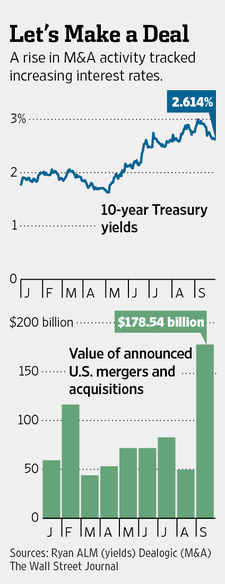
Fear that interest rates could jump further gave Verizon Communications Inc.VZ -0.69% extra motivation to plow ahead with its monster deal in September to buy the part of Verizon Wireless it doesn’t own, after years of talking about such a deal with seller Vodafone Group PLC. VOD.LN -0.55% Without the acquisition of Verizon Wireless, growth in deal activity would have been far more meager.But now that the threat of an imminent rate increase has subsided, so has some of the steam behind mergers-and-acquisitions activity, deal makers say.
Federal Reserve Chairman Ben Bernanke in mid-September indicated the central bank would keep its bond buying intact, which keeps interest rates low.
The stance eases some of the pressure companies felt to get deals done before a rate increase, while throwing more cold water on an already tepid deal environment, say bankers and lawyers who advise companies on deal activity.
M&A activity is up from the low levels of last year but remains far more muted than before the financial crisis. Global deal volume reached $778 billion in the third quarter, up about 41% from a year earlier, according to data provider Dealogic. The growth was fueled by a 37% increase in the U.S., by far the world’s largest mergers-and-acquisitions market.
Without the $130 billion Verizon deal, growth would have been far more meager. The global deal count was down for the quarter: 8,647 deals compared with 10,337 a year earlier. Global volume for the first nine months of the year was $2 trillion, up 14%.
While interest rates are by no means the biggest driver of M&A, deal makers say, the threat of a rate increase was a prod to get deals done, particularly ones that require loads of debt. Verizon’s decision to pay $130 billion for Vodafone’s 45% stake in Verizon Wireless fit that bill.
“There was momentum building around the potential for rising interest rates and some of the air has come out of that,” said Jim Woolery, deputy chairman of law firm Cadwalader, Wickersham & Taft LLP. Mr. Woolery said he expects deal activity to gradually pick up this year, but that it won’t improve meaningfully until early 2014.
At the same time, the Fed’s decision to maintain a bond-purchase program in an effort to keep rates stable is seen by many boards and CEOs as a signal that the economy remains weak, deal makers say.
“If the Fed is nervous about the state of the economy and not raising interest rates, CEOs are thinking, ‘Well, maybe I should be conservative too,'” said Peter Lyons, a partner at Shearman & Sterling LLP.
Deal makers also note this stock-market recovery is the first time in memory that deal activity hasn’t closely tracked the equity markets. They say potential suitors see some valuations of companies as unsupported by economic fundamentals. So improving stock prices are scaring away buyers rather than driving activity.
Meanwhile, uncertainty over the debt ceiling, which limits U.S. borrowing, and the prospect of a government shutdown have many companies wary of making big moves.
“When management teams look at making decisions such as whether to pursue an acquisition, the fact that there may be a government shutdown in the next few weeks is definitely something they are considering,” said Scott Barshay, head of Cravath, Swaine & Moore LLP’s corporate department.
 About bambooinnovator
 Bamboo Innovator