Silk Road collected 9.5 million bitcoin—and only 11.75 million exist

Silk Road collected 9.5 million bitcoin—and only 11.75 million exist

By Tim Fernholz @timfernholz 9 hours ago

Silk Road, the illicit online marketplace that first brought bitcoin to notoriety in 2011, was shut down today and its alleged founder was arrested. The criminal complaint revealed that the site had collected revenues of some 9.5 million bitcoin since 2011, the equivalent today of $1.2 billion in sales and $80 million in commissions for Ross Ulbricht, who allegedly ran the site under the moniker “Dread Pirate Roberts.” Read more of this post

At $47tn, the gross international investment position of the US is 20 times bigger than Brazil’s, 51 times bigger than India’s. Any movement into and out of US assets is sizeable relative to other and may translate into sharp asset price and exchange rate movements

October 2, 2013 10:03 am

Dollar-based system is inherently unstable

By Ousmène Mandeng

The international economy needs more currencies

The international monetary system does not work as intended. An international economy relying predominantly on one currency is inherently unstable. This is amply demonstrated by the recent turbulence in foreign exchange markets. Over the summer, several emerging markets faced sudden reversals in capital flows. Blaming economic fundamentals to explain such shifts misses the point. There are none sufficiently important. Read more of this post

Malaysia is encouraging Thailand to establish a “rubber city” to develop the key sector in both countries and ensure sustainable prices for farmers

Malaysia urges creation of ‘rubber city’ in deep South

PETCHANET PRATRUANGKRAI
THE NATION October 3, 2013 1:00 am

MALAYSIA is encouraging Thailand to establish a “rubber city” to develop the key sector in both countries and ensure sustainable prices for farmers. Under the proposed project, a city would be created in the border area linking Dan Prakob in Songkhla’s Na Thawee district and Kota Putra in the Malaysian state of Kedah. Malaysia wants Thailand to supply raw materials to support its industries producing items such as rubber gloves and tyres. Read more of this post

Stop Trying to Engineer Success

Stop Trying to Engineer Success

by David K. Hurst  |   11:00 AM October 2, 2013

Every organization that aspires to greatness has something to learn from relevant success stories of the past. But how should managers go about unlocking the lessons of those efforts? Many of their consultants advocate an engineering approach:

Find multiple examples of organizations that have coped with equivalent challenges successfully.

Reverse-engineer the reasons for their success, looking for features that they share in common.

Present these shared “success factors” as precepts, rules, and principles that should be implemented by all those who wish to achieve similar levels of success.

This approach sounds great, and the growth of the consultancies pushing it cannot be gainsaid. But it simply doesn’t work. The engineering approach can be described but not practiced. Start by considering an extreme and high-visibility case. At the outset of the Iraq War, President George W. Bush expressed the hope that Iraq would become a federal democracy and a beacon to all the totalitarian states in the Middle East. The Americans then set about creating facsimiles of various institutions – the critical success factors of its own democracy. But if these were necessary conditions then clearly they were not sufficient. Iraq is far from a viable democratic system. Similarly, in the management world, we constantly see the engineering approach being urged and falling short. As just one example, academics W. Chan Kim and Renée Mauborgne examined the emergence of outrageously successful companies like Cirque du Soleil, and claim to have discovered the keys. While never claiming that their case organizations, with their idiosyncratic histories and unique contexts, had consciously implemented their “blue ocean” principles, Kim and Maubourgne argued that it was “as if” they had. How else could they have moved their businesses into positions that so thoroughly defied competition?

Unfortunately this approach has done no more for corporate strategic success than it has for nation states. Managers are presented with inspiring stories from the past that they quickly discover cannot be replicated, and with abstract principles that sound incontrovertible yet cannot be implemented. They might, at best, produce facsimiles of certain features of great organizations, or get learn to say all the right words about what it will take to succeed. But while they can talk the talk, their organizations can’t walk the walk. The fundamental problem with the engineering approach is that simple mechanics do not drive outcomes in complex systems. Where causes and effects are constantly subject to dynamic adaptation, as they are in ecosystems, societies, and organizations, conditions cannot be reproduced. Read more of this post

Was Jesus an Effective Leader? Insights from Reza Aslan’s ‘Zealot’

Was Jesus an Effective Leader? Insights from Reza Aslan’s ‘Zealot’

Oct 01, 2013 Books Law and Public Policy Video Middle East & Africa North America

In his bestselling new book, Zealot: The Life and Times of Jesus of Nazareth, author Reza Aslan’s goal was to write a biography of one of history’s most influential people, drawing on historical sources instead of the traditional Gospels to help people understand the man who would one day be called the Messiah. Wharton legal studies and business ethics professorG. Richard Shell recently talked with Aslan about the life of Jesus, what Jesus taught us about leadership, and how a leader’s message can sometimes change after his or her death. 

An edited transcript of the conversation follows. Read more of this post

Because the results of China’s local government debt audit just can’t come fast enough

Because the results of China’s local government debt audit just can’t come fast enough

David Keohane

| Oct 02 11:15 | 2 comments | Share

SIV/ LGFV/ LGIV/ *shrug*

Whatever you choose to call the vehicles China’s local governments used to fund infrastructure when Beijing restricted financing (we are going with LGFVs here) they are very near the centre of Chinese debt fears. Which means it’d be nice to know how big they really are. From Stephen Green at Standard Chartered (our emphasis): The National Audit Office (NAO) is now carrying out a survey of local government debt. Thousands of officials have been running around the country trying to generate accurate estimates of liabilities at the four levels of local government, down to the township level. At least 10,000 separate legal entities carry this debt burden (some large cities have hundreds of such vehicles), and many have an interest in disguising their liabilities. In addition, a portion of the debt is in the form of inter-company loans and IOUs. The auditors have an extremely challenging task. Read more of this post

ADHD Pill Faces High Hurdle in Europe as Stigma Persists

ADHD Pill Faces High Hurdle in Europe as Stigma Persists

The European debut of a pill to treat children with attention deficit hyperactivity disorder faces a major hurdle: convincing people the condition exists. Shire Plc (SHP), the world’s biggest seller of ADHD drugs, has been rolling out the pill, Vyvanse, in eight countries while discussing the prevalence of the illness with doctors at psychiatry conferences around Europe. More than 90 percent of the Dublin-based company’s sales of ADHD drugs come from the U.S., where the illness is diagnosed about 25 times more frequently than in the U.K. Read more of this post

Tesla is suddenly the No. 1 car in Norway, where the government is using its oil wealth to smooth the way for battery-powered cars

October 2, 2013, 9:09 a.m. ET

Tesla Sedan Roars Ahead in Norway

Norway Has Relatively Small Market But Buyers Are Affluent

SVEN GRUNDBERG And NICLAS ROLANDER

Tesla Motors Inc.’s TSLA -6.24% Model S is suddenly the No. 1 car in Norway, where the government is using its oil wealth to smooth the way for battery-powered cars. The California company’s electric sedan, the Model S, vaulted to become the best-selling car in Norway in September, just its second month on the market. Tesla captured 5.1% of Norway’s total car sales share during the month. The total number of rechargeable electric cars on the road in Norway is estimated to total 14,500 vehicles. (In all of 2012, auto makers sold just 13,427 electric cars in the larger U.S. market, according to figures compiled by the Electric Drive Transportation Association.) Read more of this post

Tom Clancy, whose chillingly realistic novels reflected his knowledge of the military and the changing nature of threats to U.S. while providing Hollywood with fodder for blockbuster movies, has died. He was 66.

Updated October 2, 2013, 12:38 p.m. ET

Best-Selling Author Tom Clancy Dead at 66

STEPHEN MILLER And JEFFREY A. TRACHTENBERG

OB-ZD138_1002cl_G_20131002112124

Best-selling author Tom Clancy, pictured in 1997.

Tom Clancy’s tightly wound military thrillers grew into a multimedia entertainment franchise encompassing not just novels but also films, videogames and board games.

Mr. Clancy, whose death in Baltimore at age 66 was announced Wednesday by his publisher, G.P. Putnam’s Sons, incorporated current events into his books starting from his first, “The Hunt for Red October,” a Cold War submarine thriller that was a bestseller when it was published in 1984. Read more of this post

Best Buy Updates Decade-Old Site to Double Online Sales

Best Buy Updates Decade-Old Site to Double Online Sales

When Best Buy Co. (BBY) unveiled its new rewards program last month, riffing on the word “my,” the name had a familiar ring. “My Best Buy” sounds a lot like “My Macy’s” from the Macy’s Inc. (M) department-store chain, “MyLowe’s” from home-improvement retailer Lowe’s Cos. and even Zoeller Co.’s “MyPlumbingStuff.” Best Buy Chief Executive Officer Hubert Joly is borrowing that two-letter word and plenty more from rivals to improve the retailer’s e-commerce operations, which even his own colleagues say had fallen a decade behind. While the website won’t seriously vie with Amazon.com Inc. (AMZN) any time soon, Best Buy can harness its brand recognition and status as the largest consumer-electronics retailer to grab e-commerce share. The efforts may already be helping, with Best Buy’s online traffic rising 9.9 percent in August from a year earlier, according to data from Compete.com that the company uses. Read more of this post

The Most Destructive, Unpredictable Force in Tech

October 2, 2013, 1:26 p.m. ET

The Most Destructive, Unpredictable Force in Tech

FARHAD MANJOO

What’s the most destructive force in the tech world, the thing that has nearly killedBlackBerryBB.T +0.98% pushed Dell DELL -0.07% to go private, and made a mess of Microsoft MSFT +1.01% ? Conventional wisdom in Silicon Valley would finger one of the following technologies: smartphones, tablets, social networks, “the cloud,” app platforms, or some other inscrutable bit of jargon. Actually, though, the most destructive, unpredictable, and fickle force in the tech industry is much closer to home: It’s you and me and everyone we know. Read more of this post

The Golden Age of TV Theme Songs: In the age of binge-viewing, it’s more important than ever that a show’s theme music be engineered to reward multiple plays

October 2, 2013, 3:03 p.m. ET

The Golden Age of TV Theme Songs

In the age of binge-viewing, it’s more important than ever that a show’s theme music be engineered to reward multiple plays

STEVE KNOPPER

Bob Dylan’s “Forever Young” was never a hit, but these days people are listening to the 39-year-old rock classic so frequently that it may as well be on Top 40 radio. It’s the opening theme to NBC’s “Parenthood,” a binge-watching fixture on Netflix, Hulu and DVRs everywhere. Like “Breaking Bad,” “The Wire,” “Lost” and other TV series with rich character development and abundant cliffhangers, “Parenthood” is made for living-room marathons, and it comes with a main-title theme built to withstand repetition. Read more of this post

Satellite-TV Providers Plan for Survival as Growth Fades

Satellite-TV Providers Plan for Survival as Growth Fades

By Alex Sherman October 02, 2013

Satellite-television providers, which shook up the pay-TV industry in the 1990s by luring millions of customers away from cable companies, are now struggling to adjust to the technology of the 2010s. As more Americans shun pricey TV subscriptions and watch video over the Internet, DirecTV (DTV:US) and Dish Network Corp. (DISH:US) are at risk of eventually becoming obsolete. They don’t offer the same high-speed broadband service as their cable and telecom rivals, making it harder to adapt to the world of Web-based television, where robust Internet access is a must. Read more of this post

Ontario Teachers’ fund invests in online retailer Zalando

Ontario Teachers’ fund invests in online retailer Zalando

4:43am EDT

FRANKFURT (Reuters) – The Ontario Teachers’ Pension Plan (OTPP) has bought a 2 percent stake in Europe’s biggest online fashion retailer Zalando, continuing a push into e-commerce investment for the fund. Berlin-based Zalando, which has brought on board several new investors over the last year as it seeks to fund expansion, said on Wednesday OTPP took the stake as part of a 4 percent capital increase at the group. Read more of this post

IPad Prices Jumping 12% on Rupiah Show Indonesia Inflation Risk

IPad Prices Jumping 12% on Rupiah Show Indonesia Inflation Risk

The rupiah’s slump is fueling a surge in Indonesia’s costs of imported goods from iPads to soybeans, spurring Southeast Asia’s fastest inflation and increasing growth risks ahead of elections next year. The cost of iPads jumped 12 percent last month, according to a price list at Indonesia’s leading Apple Inc. (AAPL) retailer iBox. Tofu makers in the world’s fourth-most populous nation went on strike in September as imported soybeans climbed 12 percent this year, according to data from the trade ministry. Read more of this post

Taiwanese banks, once seen as a gateway into China, look more like a trap for private-equity firms including Carlyle as the mainland market proves elusive and competition at home curbs profits for small lenders

Carlyle Among Firms Finding Taiwan Banks No Path to China

Taiwanese banks, once seen as a gateway into China, look more like a trap for private-equity firms including Carlyle Group LP (CG) as the mainland market proves elusive and competition at home curbs profits for small lenders. Cosmos Bank Taiwan (2837), controlled by a buyout firm owned by Steven A. Cohen’s SAC Capital Advisors LLC, has lost 66 percent since the end of 2007, data compiled by Bloomberg show. Taipei-based Ta Chong Bank Ltd. (2847), backed by Carlyle, declined 9.5 percent, while EnTie Commercial Bank, whose owners include Longreach Group Ltd., fell 19 percent in that period. Read more of this post

Asia grain mountains swell as governments fret over food security

Asia grain mountains swell as governments fret over food security

5:12pm EDT

By Naveen Thukral

SINGAPORE (Reuters) – Towering grain mountains in Asia, already large enough to feed China for eight months, are set to grow even bigger as governments persist in shoring up their safety buffers against hard times. Haunted by a 2008 food crisis that sparked unrest and panic buying, states will keep piling grain into reserves despite the strain on their finances and storage problems, buoying prices that have been hit by expectations of bumper harvests. Read more of this post

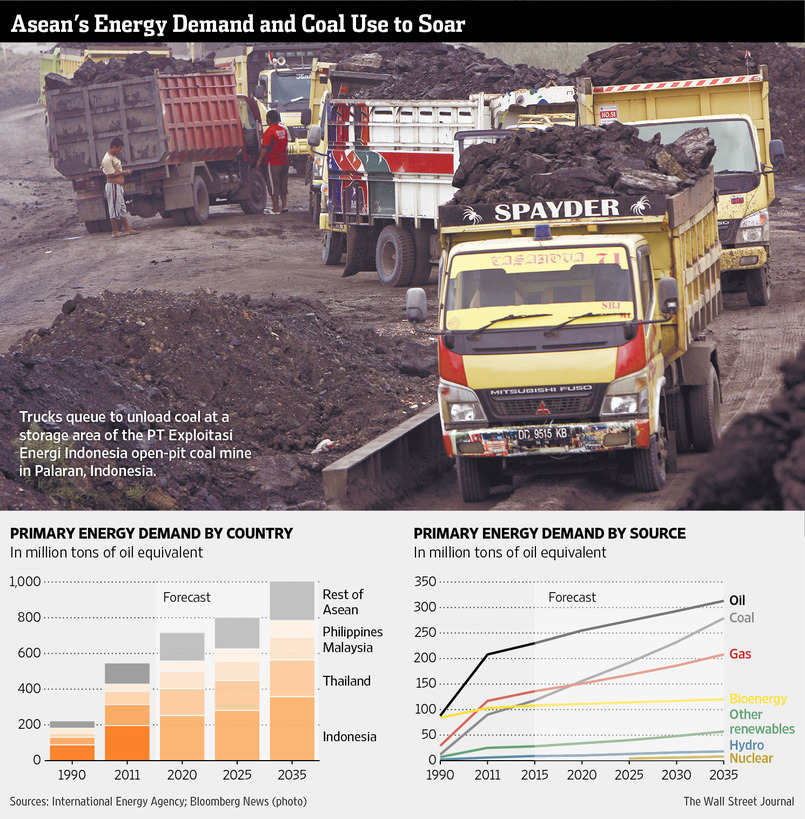
Southeast Asian Energy Bills Set to Rise as Exports Fall, Oil Imports Soar

Updated October 2, 2013, 3:10 a.m. ET

Southeast Asian Energy Bills Set to Rise as Exports Fall, Oil Imports Soar

International Energy Agency Forecasts Oil Imports Will More Than Double by 2035

ERIC YEP And SIMON HALL

Coal and natural gas exports from Southeast Asia will fall sharply over the next two decades as the region grapples with rapidly growing energy demand, which will increase its dependency on imported oil over the next two decades, the International Energy Agency said Wednesday

AI-CD895_AENERG_G_20131002020908 (1)

Between 2011 and 2035, the 10-nation Association of Southeast Asian Nations could see its energy demand rise by 83%, equivalent to Japan’s present energy consumption. Economic growth, population growth projected at nearly 25% and urbanization will drive demand, the Paris-based agency said in its “Southeast Asia Energy Outlook,” which also urged the governments of the region to increase energy efficiency to help cope with the changes ahead. Read more of this post

Asian companies are raising the largest-sized loans in more than five years as they seek big-ticket deals before a potential rise in lending costs

Fed-Wary Borrowers Grab Jumbo Loans in Asia Before Margins Rise

Asian companies are raising the largest-sized loans in more than five years as they seek big-ticket deals before a potential rise in lending costs. Alibaba Group Holding Ltd. and Origin Energy Ltd. (ORG) syndicated about $15 billion of facilities in the third quarter, leading companies in the Asia-Pacific region outside Japan, according to data compiled by Bloomberg. That boosted the average deal size to $333 million, the highest since the first quarter of 2008. Average margins for dollar-denominated loans fell 22 basis points from a year earlier to 266 basis points on Sept. 30, the data show. Read more of this post

Lego to up its game in Asia over next 20 years

Lego to up its game in Asia over next 20 years

SINGAPORE — Lego has its eyes set on some serious play in Asia, including Singapore, over the next 20 years in an attempt to build on the company’s performance in the region, the Chief Executive of the Danish toy-maker said in an interview yesterday.

BY LEE YEN NEE –

3 HOURS 32 MIN AGO

SINGAPORE — Lego has its eyes set on some serious play in Asia, including Singapore, over the next 20 years in an attempt to build on the company’s performance in the region, the Chief Executive of the Danish toy-maker said in an interview yesterday. Consumer sales in Asia, Lego’s fastest-growing market, have risen 35 per cent in the first half of the year alone, outpacing a 4-per-cent increase in both North and Latin America, and an 8-per-cent growth in Europe during the same period. Read more of this post

HTC Follows BlackBerry to Smartphone Dead-End: Chart of the Day

HTC Follows BlackBerry to Smartphone Dead-End: Chart of the Day

HTC Corp. (2498), the smartphone maker that’s lost 90 percent of its market value since 2011, is still too expensive for potential buyers following acquisition deals for BlackBerry Ltd. and Nokia Oyj (NOK1V), said Yuanta Securities Co. The CHART OF THE DAY shows Taoyuan City, Taiwan-based HTC trades at 1.4 times net assets, almost triple the 0.5 level of BlackBerry, the smartphone maker that agreed Sept. 23 to a $4.7 billion buyout. The lower panel shows the consensus ratings of analysts who follow HTC, BlackBerry and Nokia, which agreed last month to sell its handset business. The Taiwanese company is ranked 1.6 out of a possible 5, the lowest of more than 500 listed technology companies, data compiled by Bloomberg show. Read more of this post

Corruption and cover-ups in Leighton Holdings’ international construction empire were rife and known to top company executives and directors, according to internal company files

Building giant Leighton rife with corruption: claims

October 3, 2013

Nick McKenzie and Richard Baker

Bribery scandal engulfs Leighton Holdings

0310leighton353-300x0

Leighton Holdings is once again facing scrutiny over its business practices following the release of internal documents. Corruption and cover-ups in Leighton Holdings’ international construction empire were rife and known to top company executives and directors, according to internal company files. Those in the know included the Australian construction giant’s chief executive at the time, Wal King, and his short-term successor David Stewart. Read more of this post

Pension Lessons From Down Under; Australians could teach Americans a thing or two about the benefits of reform

October 2, 2013, 12:15 p.m. ET

Pension Lessons From Down Under

Australians could teach Americans a thing or two about the benefits of reform.

America’s municipal finance woes are well known, especially unfunded pension liabilities. For a lesson in how to fix the mess, the Yanks could do worse than get a plane ticket to Australia. That’s the lesson in a recent Moody’s report that shows how Australia’s state governments are reaping the rewards of reforms that began 15 years ago. Starting in the 1990s, they enrolled new employees in defined-contribution plans. As a result, although the old defined-benefit plans still exist for older employees, the states’ unfunded liabilities are smaller and more manageable—something for Americans to envy. Read more of this post

‘Slow frequency’ technology faces tough shift from FX to stock markets

‘Slow frequency’ technology faces tough shift from FX to stock markets

12:38pm EDT

By Eric Onstad

LONDON (Reuters) – Efforts to curb the advantage of high frequency traders – who use computers churning out numerous transactions at lightning speed – face resistance on stock markets, although technology is already starting to level the playing field in currency dealing. Critics of high frequency trading (HFT) say it distorts prices, causes “flash crashes” when markets dive in an instant, and fuels an expensive arms race to shave milliseconds off trading times. Read more of this post

Will ‘Silk Road’ Bust Kill Bitcoin? Bitcoin Prices Plunge on Bust of Online ‘Black Market’

Will ‘Silk Road’ Bust Kill Bitcoin?

The eBay of the black market has met its demise. The U.S. Justice Department has shuttered Silk Road and indicted its alleged founder.

An online marketplace founded in 2011, Silk Road facilitated commerce in illegal goods and services, including narcotics, counterfeit currency and hacking services, with payments processed in the digital currency Bitcoin. Perhaps not coincidentally, the price of Bitcoin fell to about $119 at 3 p.m. EST, down from $145 at the end of September. Read more of this post

Investors turn their backs on “robot” hedge funds

Investors turn their backs on “robot” hedge funds

1:02pm EDT

By Laurence Fletcher and Tommy Wilkes

LONDON (Reuters) – Investors in the $330 billion computer-driven hedge fund sector are pulling out money for the first time since 2008, data showed on Wednesday, signaling the possible start of a bigger exit from the industry. These so-called CTAs (commodity trading advisors), which employ mathematicians and physicists to build programs betting on market trends, have been in demand since they racked up large profits during the credit crisis. Read more of this post

Henkel CEO Predicts Four More Difficult Years for Europe

Henkel CEO Predicts Four More Difficult Years for Europe

Henkel AG Chief Executive Officer Kasper Rorsted said Europe’s economic struggles may last another four years, downplaying the prospect of any imminent recovery. “We don’t expect a lot of growth, if any at all in western Europe” by 2017, Rorsted said in an interview with Bloomberg TV at the company’s headquarters in Dusseldorf, Germany. “Europe overall in the next four years will have quite a challenging position.” Read more of this post

Gross Says Market Mispricing Eventual Fed Target Rate Increase

Gross Says Market Mispricing Eventual Fed Target Rate Increase

Pacific Investment Management Co.’s Bill Gross said investors should focus on purchasing debt that will benefit from the market’s mispricing of when the Federal Reserve will eventually increase borrowing rates. “If you want to trust one thing and one thing only, trust that once QE is gone and the policy rate becomes the focus, that fed funds will then stay lower than expected for a long, long time,” Gross wrote in his monthly investment outlook posted on Newport Beach, California-based Pimco’s website today. “Right now the market, and the Fed forecasts, expect fed funds to be 1 percent higher by late 2015 and 1 percent higher still by December 2016. Bet against that.” Read more of this post

Emerging-Market Currencies Fall 30% in Reserves, Citigroup Says

Emerging-Market Currencies Fall 30% in Reserves, Citigroup Says

Global central banks sold 30 percent of their holdings in emerging-market currencies from foreign reserves in the second quarter as the Brazilian real to the Indian rupee tumbled, according to Citigroup Inc. Reserve managers divested as much as $20 billion in their holdings in developing-nation currencies, strategist Steven Englander wrote yesterday in a research note to clients, citing data from the International Monetary Fund’s quarterly reserves report. The central banks may have sold a similar amount from the reserves in the third quarter, Englander wrote. Read more of this post

Emerging market firms to reshape corporate world: report

Emerging market firms to reshape corporate world: report

7:02pm EDT

LONDON (Reuters) – The number of large emerging market companies will surge in coming years and they will become competitors but also customers for rich-country firms, according to a new study.

Almost three-quarters of today’s 8,000 companies with annual revenue of $1 billion or more are based in advanced economies.

By 2025, another 7,000 will have joined their ranks, with seven out of 10 of them based in emerging economies, McKinsey Global Institute (MGI) projects.

Emerging markets have fallen out of favor with investors this year because of worries over the sustainability of China’s economic model, slower growth in India and Brazil and worries about the ability of the likes of Indonesia and Turkey to attract funds to plug their current account deficits.

MGI director Richard Dobbs said there would be hiccups along the way but he saw little to stop the rise of the big emerging-market corporation.

“Yes, it’s going to be a turbulent ride for the next 20 or 30 years as we go through this massive transition. But the rise is going to happen. Some countries may stall, but there are enough emerging markets that there’s a degree of inevitability about this,” Dobbs told Reuters.

The first wave of development in emerging markets was based on cheap labor, MGI said. As wages rise, a second wave has unfurled – selling to newly rich consumers. The third, overlapping wave is breaking as companies bulk up, propelled by urbanization, income growth and exchange rate appreciation.

By 2025, emerging market firms are likely to account for 40-50 percent of the Fortune Global 500, twice today’s share and up from just 5 percent in the period 1980-2000, reckons MGI, the research arm of the consultancy McKinsey & Co.

The China region alone will account for almost a quarter of the Fortune Global 500 in 2025.

“By 2025, some of the global leaders in many industries may be companies we have not yet heard of, and many are likely to be based in cities that we could not point to on a map,” MGI said.

The projected trend will shift more of the world’s decision making, capital, standard setting and innovation to emerging markets.

“The corporate giants that emerge in the years ahead will be central actors shaping the global economy. They will fuel local growth in some regions and reconfigure global transport and communications networks,” the report said.

The proliferation of large companies is likely to generate increased competition for markets, resources and talent.

What’s more, companies based in emerging markets could be sources of low-cost innovation that could disrupt entire industries. But MGI said their growth will also represent a major opportunity for service firms and suppliers.

“Developed world companies need to change their mindset from seeing emerging markets as a source of cheap labor and of consumption and add emerging markets as a source of corporate customers,” Dobbs said.