Southeast Asian Energy Bills Set to Rise as Exports Fall, Oil Imports Soar
October 3, 2013 Leave a comment
Updated October 2, 2013, 3:10 a.m. ET
Southeast Asian Energy Bills Set to Rise as Exports Fall, Oil Imports Soar
International Energy Agency Forecasts Oil Imports Will More Than Double by 2035
ERIC YEP And SIMON HALL
Coal and natural gas exports from Southeast Asia will fall sharply over the next two decades as the region grapples with rapidly growing energy demand, which will increase its dependency on imported oil over the next two decades, the International Energy Agency said Wednesday
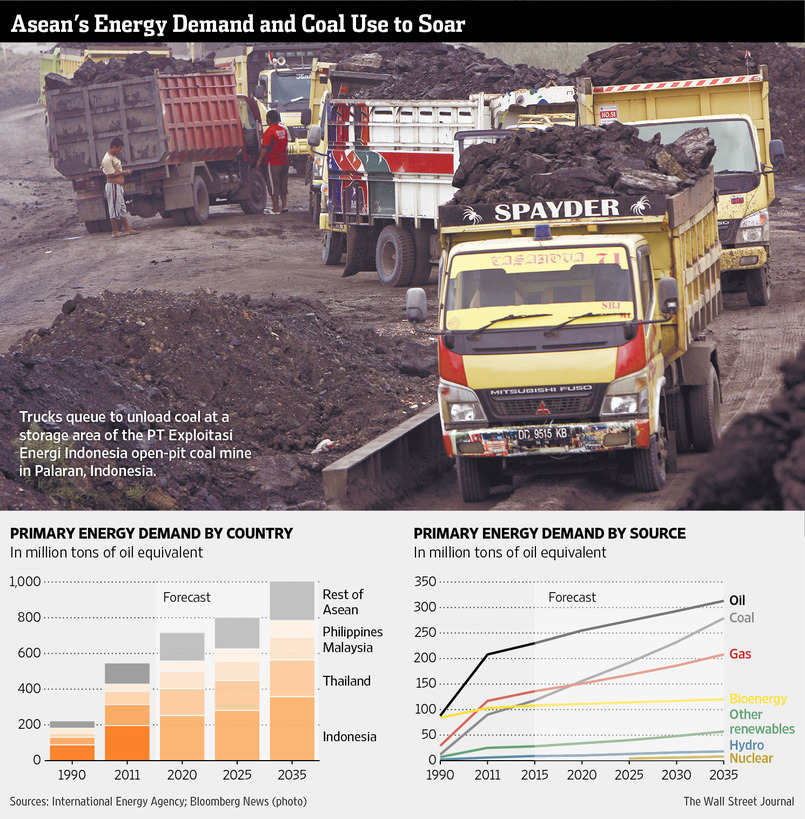
Between 2011 and 2035, the 10-nation Association of Southeast Asian Nations could see its energy demand rise by 83%, equivalent to Japan’s present energy consumption. Economic growth, population growth projected at nearly 25% and urbanization will drive demand, the Paris-based agency said in its “Southeast Asia Energy Outlook,” which also urged the governments of the region to increase energy efficiency to help cope with the changes ahead.Indonesia, the region’s economic and energy powerhouse, will be particularly hard-hit. It will have to accommodate a soaring oil import and subsidy bill, massive spending on new energy projects and sharply rising domestic demand for its coal and gas, which will reduce its export earnings and have ripple effects on its economy.
More From the IEA
Singapore to See More Oil Traffic
The 10 Southeast Asian countries covered by the study are home to almost 600 million people, more than 20% of which still don’t have access to electricity. Despite boasting large coal and gas reserves, the region is poor in oil and so far has no nuclear power.
As a result, its net oil import needs will rise to more than five million barrels a day in 2035 from about 1.9 million barrels a day last year, which would make the region the fourth-ranked oil importer after China, India and the European Union, said the IEA, which represents 28 developed, energy-consuming member countries. Its overall energy needs will rise to one billion tons of oil equivalent from 549 million toe.
Given the growth in energy demand in Asean, “I think it will be very important to have a kind of stockpiling mechanism and also see to it that you have an emergency response mechanism,” IEA Executive Director Maria van der Hoeven said in an interview. “Thailand is working on having strategic petroleum reserves. Other countries like Indonesia are thinking about that.”
Thailand and Indonesia will spend the most on net oil imports, with expenditures rising threefold to nearly $70 billion each by 2035, the IEA said, adding that spending on net oil imports for the whole region is expected to reach $240 billion from $77 billion today.
Long a critic of subsidies for what it sees as detrimental effects they have on markets, the IEA said that in 2012 Southeast Asia spent $51 billion on fossil-fuel subsidies.
Asean should reorient the subsidies so they don’t encourage wasteful consumption, targeting them at poor people and then phasing them out gradually, Ms. van der Hoeven said. “By doing that you free up a lot of money that you can use in a different way.”
Indonesia is the largest energy user in the region, with 36% of overall demand, followed by Thailand, Malaysia and the Philippines, while Brunei has the lowest consumption, the IEA said.
Coal will overtake natural gas as the region’s main power generating fuel, with its share rising to 49% from 31% and the share held by gas falling to 28% from 44%. The IEA also said that 40% of the additional power-generating capacity needed by 2035 will come from coal-fired plants.
Coal exports will rise from 220 million tons in 2011 to 288 million in 2020 before falling back to 217 million tons in 2035, the IEA said. Indonesia, the world’s leading thermal-coal exporter is at the forefront of a string of countries across the region that are building or planning to build new coal-fired power plants to take advantage of coal prices that are far below those of competing fuels.
The IEA warned that the increasing reliance on coal will cause a rapid buildup in carbon emissions from the region, particularly in Indonesia, where its share of energy generation will rise to 66% from 44% by 2035. Indonesia’s energy-related CO2 emissions will nearly double to over 800 million tons, it said. In per capita terms that would still be only 38% of the average in member countries of the Organization for Economic Cooperation and Development, it said.
Southeast Asia’s net gas exports will rise marginally to 68 billion cubic meters in 2020, but will fall back sharply to less than a quarter of this volume by 2035 due to surging domestic demand in main producers Indonesia and Malaysia and rapid demand growth in Vietnam, Thailand and other nations in the region, the agency said.
Southeast Asia needs $705 billion of investment in infrastructure to supply fossil fuels between 2013 and 2035, of which $205 billion is needed for oil, $460 billion for gas and $40 billion for coal, with Indonesia accounting for nearly 45% of the total, it said.
 About bambooinnovator
 Bamboo Innovator