Electronic Road Pricing to Hit Jakarta Streets in 2014; Call for Moratorium on New Roads, Car Sales as Traffic Worsens
October 5, 2013 Leave a comment
Electronic Road Pricing to Hit Jakarta Streets in 2014
By Lenny Tristia Tambun on 10:50 am October 4, 2013.
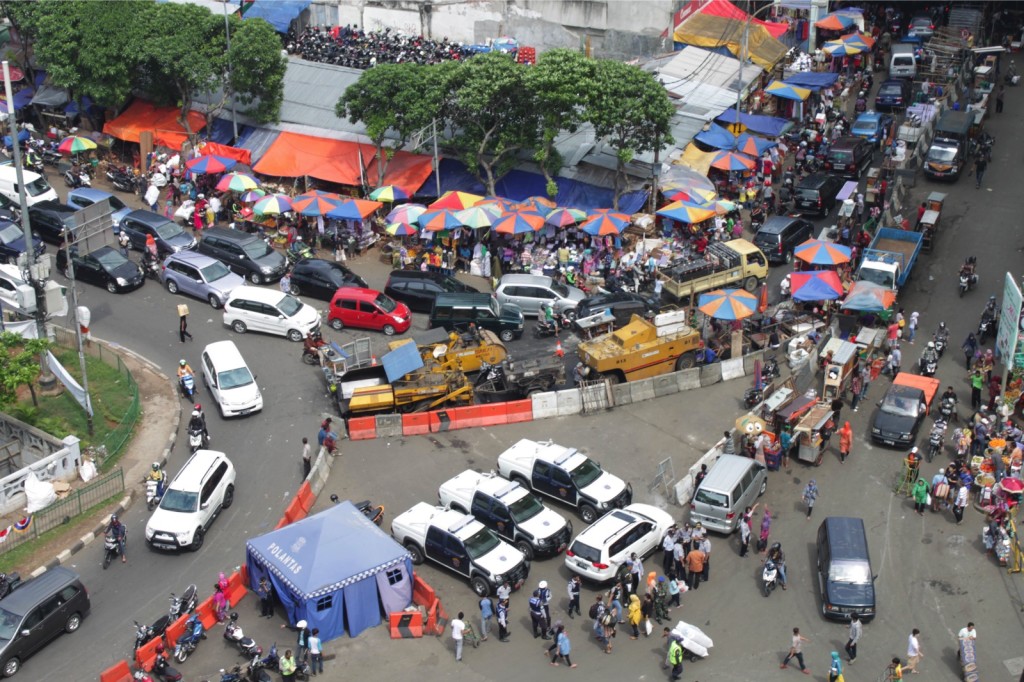
Traffic around the Block A and B Tanah Abang market in Central Jakarta. (JG Photo/Yudhi Sukma Wijaya)
The Jakarta transportation agency plans to implement an electronic road pricing scheme that will automatically charge toll fees on cars using roads in the city during certain hours. The scheme, announced on Monday, will require drivers to place transponder in their car that automatically deducts money from a prepaid card. The system is expected to ease traffic congestion by making it prohibitively expensive for people to drive in downtown Jakarta. Police said last week they expect the transponders to be able to track any car moving through Jakarta at any time or speed. The electronic road pricing scheme replaces earlier plans to apply odd-and-even plate number restrictions.Jakarta Governor Joko Widodo ordered the transportation agency to implement the ERP scheme within the first quarter of 2014, agency chief Udar Pristono said.
“It is not possible for us to commence the system in January because we still don’t have enough buses as a public transportation alternative. We have to procure the buses first,” he said.
Udar said the first stage of the ERP scheme will be implemented on Rasuna Said, since the area has three busway corridors, thereby offering alternatives.
Udar said his office is still waiting for revision of a 2009 bylaw on regional taxes to authorize the system.
He also criticized plans to exempt motorcycles from charges under the electronic road pricing scheme, saying such an exemption would not significantly reduce traffic congestion.
“We want [motorcycles] to also be subject to ERP charges. Otherwise, more people will buy motorcycles and traffic congestion will not significantly change,” he said.
Jakarta City Council Deputy Speaker Triwisaksana said the ERP scheme should be implemented immediately.
“For the ERP system, the regulations needed to implement the policy are sufficient and we hope the system can be implemented immediately,’ he said.
Electronic traffic surveillance and road pricing systems, such as envisaged by the Jakarta administration and police, are exceptionally rare anywhere in the world.
Almost all cities that have implemented such a system did so only after rigorous protections for civil liberties were codified in written regulations following a period of public debate.
Civil rights groups have yet to weigh in on how the administration and police’s plans fit with existing privacy laws.
Deputy Governor Basuki Tjahaja Purnama said the electronic road pricing scheme was crucial entry point for the an Electronic Registration and Identification system that the administration hopes to unroll by 2015.
This system will aid vehicle tax collection and police efforts to crack down on vehicle-related crime.
Police said last week it will give them vast new capabilities to assess fines for traffic violations and track vehicles’ movements.
Jakarta police traffic director Sr. Comr. Chrysnanda Dwilaksana said the Electronic Registration and Identification system will be a game changer, radically overhauling the national vehicle registration system.
Basuki added that the odd-even traffic scheme announced last March would be dropped if the electronic road pricing scheme is accelerated, along with the procurement of new TransJakarta and local buses.
Deputy Minister for Transportation Bambang Susantono previously said odd-and-even plate number restrictions were not an ideal solution.
Bambang favored using the money and manpower required to enforce such a scheme to build better public transportation instead.
The electronic road pricing scheme will likely appeal to lawmakers with an eye on revenues, as elsewhere such schemes have been a tax boon to cities.
The odd-even scheme would have replaced the current “three-in-one” policy that restricts cars’ access to certain streets based on their number of occupants. It is unclear whether the “three-in-one” policy will continue under electronic road pricing.
Separately, Basuki said this week that the city administration plans to take all privately registered vehicles older than 10 years off the streets, as part of the governor’s plans to cut back private vehicle ownership.
Yoga Adiwinarto, who directs the Institute for Transportation and Development Policy, said he supports authorities’ plans to impose vehicle age limits. Vehicle age limits had proven effective elsewhere in reducing exhaust emissions and car use, he said.
Yoga added that the idea had long been discussed by city officials but never implemented.
Jakarta’s traffic costs on the city Rp 35 trillion for pollution-related health problems alone, according to Ahmad Safrudin of Transportation Demand Management.
Call for Moratorium on New Roads, Car Sales as Traffic Worsens
By Lenny Tristia Tambun & Fana FS Putra on 11:00 am October 4, 2013.
The Jakarta administration is being urged to implement a moratorium on private vehicle sales and road construction to prevent the city from suffering gridlock.
“We have issued two recommendations to ease the traffic congestion, suggesting there should be a push and pull strategy,” Ahmad Safrudin, a member of the coalition Transportation Demand Management (TDM) said on Thursday.
The “push” strategy, he said, should be done by restricting the number of private vehicle sales in Jakarta.
Ahmad said the Jakarta administration should be brave enough to take drastic measures to stop congestion from worsening.
He said the government should reconsider the low-cost green car project (LCGC) because it would exacerbate the city’s traffic problems.
The administration should also stop building more roads because it encourages residents to buy more vehicles.
“There should be real action to restrict private vehicles for the next few years while an electronic road pricing system [ERP]should be implemented immediately,” he said.
Ahmad also called on the city to increase parking tariffs
Regarding “pull” strategies, Ahmad said the government needs to provide a reliable mass public transport system while at the same time building more sidewalks.
Ellen Tangkudung, secretary general of the nongovernmental Indonesian Transportation Society (MTI), said an ERP system was a much better proposition than the odd-even traffic scheme that had been suggested.
Ellen said the ERP system was more comprehensive. Not only would it limit the amount of vehicles entering the zones it covered, the money raised could be used to improve public transport.
However, she said, the ERP system by itself would not be enough. It must be supported by an electronic registration and identification system (ERI), a real-time data system which could be used to overcome traffic-related problems in the capital, such as congested roads, violations, accidents and vehicle-related crimes.
An ERI system would be able to limit the number of vehicles through electronic law enforcement. The system entails installing a series of gantries that carry a sensor platform of cameras, scanners and digital detectors to monitor traffic flow.
Ellen also echoed Ahmad’s sentiment that the city should stop building more roads because the policy doesn’t work.
A survey conducted by MTI found the 5-kilometer elevated road stretching from Antasari to Blok M in south Jakarta had not eased traffic in the area, especially during the rush hour.
“So it’s obvious building elevated roads is not the solution. On the contrary, it has created new choke points,” she said.
Meanwhile Jakarta’s efforts to crack down on illegal parking by using pliers to pull out the air valves of vehicles obstructing traffic has been gaining support.
Jakarta Transportation Council (DTKJ) chairman Azas Tigor Nainggolan praised the move, saying deflating tires would be a much more effective measure to prevent illegal parking compared to wheel padlocking.
Azas said the policy should be vigorously imposed on public and private vehicles.
City officials have also been revoking permits of public minivan drivers who had been breaking the law by parking and stopping for passengers in prohibited areas.
Udar Pristono, head of the Jakarta city transportation agency, said that now, as a first warning, officials would deflate the tires of minivans which violated regulations and record the driver’s details.
Repeat offenders would have their licenses revoked, he added.
 About bambooinnovator
 Bamboo Innovator