How Stella Saved the Farm: A tale about making innovation happen
October 5, 2013 Leave a comment
Updated: Saturday October 5, 2013 MYT 7:55:19 AM
Management lessons from animals
How Stella Saved the Farm: A tale about making innovation happen
Author: Vijay Govindarajan and Chris Trimble
Publisher: Macmillan
HOW Stella Saved the Farm belongs to a genre like the classic Animal Farm, the more modern Who Moved My Cheese? and Our Iceberg is Melting. All three of them use animals to tell a story about management and leadership. Using parables does simplify things and sets the tone for a relaxed read. Animal Farm is a tale about apathy and ignorance while Who Moved My Cheese? is a story about the human spirit overcoming change and transition. Ultimately, the one who is able to accept change thrives. Like its predecessors, How Stella Saved The Farmis a parable about a group of animals that live on a farm which once belonged to humans but is now operated and managed by the animals that live and work there. It is both a business-related as well as a self-help book as it revolves around the various characters and their dealings with one another. The story’s main theme is the need for the farm to innovate and find new products to keep the setup profitable and to prevent it from being overtaken by humans, who run the neighbouring farm.A horse named Deirdre inherites Windsor Farm from her father. She has to work with Bull, her late father’s right-hand man, who thought he will be taking over the reins. He is devastated when the farm goes to the young mare.
Windsor Farm’s main challenge is a lack of innovation while the neighbouring farm, operated by humans, is using machines to increase production. For decades, Windsor Farm, under Marcus the horse, has depended on hard work to keep the place going, and just before his death, he tells his daughter Deirdre that hard work is not enough. If the farm is to progress, it has to innovate. But going after innovation for innovation’s sake will not work. While handing over the reins, Marcus dies.
After Deirdre got over the death of her father, she holds a contest to look for ways to keep the farm going. The most viable idea seems to be from her protege Stella who suggested going into the production of luxury wool. Stella is a sheep who has befriended an alpaca while holidaying in Peru. Stella advocates going into the production of luxury wool from alpaca. That means starting a new line of business from scratch and importing the first batch of alpaca from Peru.
Many companies today use technology in one form or another. But as the authors Vijay and Trimble point out, leveraging on technology and having new ways of doing things may not be enough. Technology must be used to spawn new products. Diedre and her friends did not divert from the original role and operations of the farm.
They just added a new line to complement what they already are familiar with.
Often, companies make a quantum leap for a new industry or sector that they have little or no experience in. Their goal is, after all, profit. While most businesses exist to make a profit, the authors are of the view that differentiation in using technology may be the key.
The word “innovation” is a big one and to many, it can be rather conceptual. After all, what constitutes “innovation”. Vijay and Trimble use the animals on a farm to take the vagueness out of the word.
As the story moves along, they outline eight most fundamental principles for managing an innovation initiative. However, it does not thoroughly examine what that innovation is. That belongs to another book The Other Side of Innovation: Solving the Execution Challenge (Harvard Business Review Press) by the same two authors.
Three of the eight fundamentals the authors advocate are the importance of nurturing healthy relationships among team members, learning through disciplined experimentation results in profitability sooner and the need to gather evidence to validate each major expenditure.
Another one of the eight principles is the fact that having a great idea is just the beginning. It is the execution that matters.
In the same way, telling this great story about how companies can innovate is just the beginning and it is a wonderful beginning. Using a parable has indeed simplified a lot of things for the reader. Being able to simplify hard-to-explain subjects is a skill. It is not something that many academic writers are able to do.
The authors are of the view that by taking this non-traditional approach, the principles they have highlighted can be used across all sectors of the economy and in every industry, large and small.
Vijay is a professor of international business and the founding director of the Tuck School’s Center for Global Leadership.
Trimble has dedicated more than a decade to studying a single challenge that vexes the best-management corporations – how to execute an innovation initiative. You can’t find two writers with better credentials to explain how to use innovation to move forward.
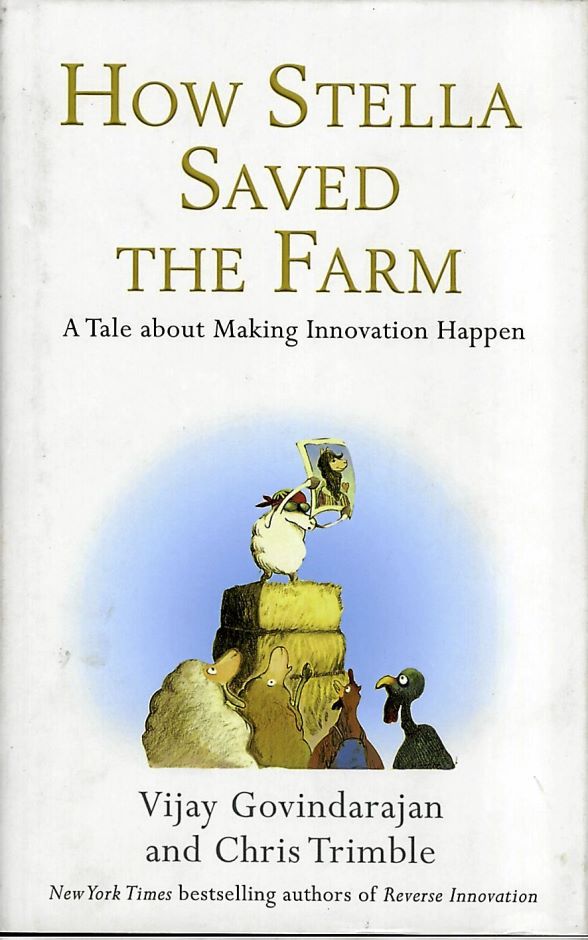
The authors also make a leap into the unknown with the cover they have chosen – a cartoon of Stella, the sheep, showing a picture of what an alpaca looks like to a turkey, a chicken and a pair of her own kind.
Other than Stella who fell in love with an alpaca, none of the other animals in the farm has seen one before. Colourful cartoons complete the book which can be mistaken for a children’s book. It can be a teenager’s book, read with adult supervision.
Just as Stella prepares her friends for the arrival of the new farm members, management too needs to prepare its staff about the changes, or a new direction the company is going to take.
All in all, it’s a really nice change from all the graphs, diagrams and conceptualised ideas about managing people and leadership found in most management books.
 About bambooinnovator
 Bamboo Innovator