Cashiers Trump Self-Checkout Machines at the Grocery Store
October 7, 2013 1 Comment
October 6, 2013, 6:40 p.m. ET
Humans 1, Robots 0
Cashiers Trump Self-Checkout Machines at the Grocery Store
FARHAD MANJOO
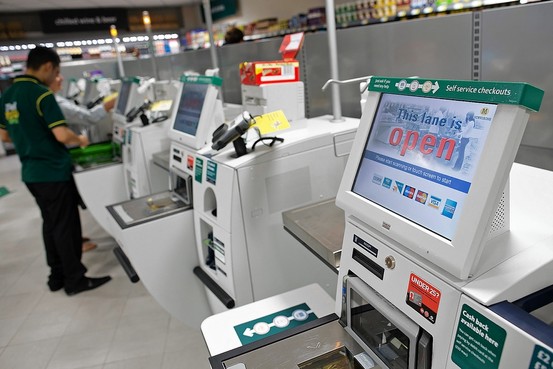
Self-checkout machines at groceries need a lot of human intervention. Computers seem to be replacing humans across many industries, and we’re all getting very nervous. But if you want some reason for optimism, visit your local supermarket. See that self-checkout machine? It doesn’t hold a candle to the humans—and its deficiencies neatly illustrate the limits of computers’ abilities to mimic human skills.The human supermarket checker is superior to the self-checkout machine in almost every way. The human is faster. The human has a more pleasing, less buggy interface. The human doesn’t expect me to remember or look up codes for produce, she bags my groceries, and unlike the machine, she isn’t on hair-trigger alert for any sign that I might be trying to steal toilet paper. Best of all, the human does all the work while I’m allowed to stand there and stupidly stare at my phone, which is my natural state of being.
There is only one problem with human checkers: They’re in short supply. At my neighborhood big-box suburban supermarket, the lines for human checkers are often three or four deep, while the self-checkout queue is usually sparse. Customers who are new to self-checkout might take their short lines to mean that the machines are more efficient than the humans, but that would be a gross misunderstanding.
As far as I can tell, the self-checkout lines are short only because the machines aren’t very good.
They work well enough in a pinch—when you want to check out just a handful of items, when you don’t have much produce, when you aren’t loaded down with coupons. But for any standard order, they’re a big pain. Perversely, then, self-checkout machines’ shortcomings are their best feature: because they’re useless for most orders, their lines are shorter, making the machines seem faster than humans.
In most instances where I’m presented with a machine instead of a human, I rejoice. I prefer an ATM to a flesh-and-blood banker, and I find airport check-in machines more efficient than the unsmiling guy at the desk. But both these tasks—along with more routine computerized skills like robotic assembly lines—share a common feature: They’re very narrow, specific, repeatable problems, ones that require little physical labor and not much cognitive flexibility.
Supermarket checkout—a low-wage job that doesn’t require much training—sounds like it should be similarly vulnerable to robotic invasion. But it turns out that checking out groceries requires just enough mental-processing skills to be a prohibitive challenge for computers. In that way, supermarket checkout represents a class of jobs that computers can’t yet match because, for now, they’re just not very good substituting key human abilities.
What’s so cognitively demanding about supermarket checkout? I spoke to several former checkout people, and they all pointed to the same skill: Identifying fruits and vegetables. Some supermarket produce is tagged with small stickers carrying product-lookup codes, but a lot of stuff isn’t. It’s the human checker’s job to tell the difference between green leaf lettuce and green bell peppers, and then to remember the proper code.
“It took me about three or four weeks to get to the point where I wouldn’t have to look up most items that came by,” said Sam Orme, a 30-year-old grad student who worked as a checker when he was a teenager.
Another one-time checker, Ken Haskell, explained that even after months of doing the job, he would often get stumped. “Every once in a while I’d get a papaya or a mango and I’d have to reach for the book,” he said.
In a recent research paper called “Dancing With Robots,” the economists Frank Levy and Richard Murnane point out that computers replace human workers only when machines meet two key conditions. First, the information necessary to carry out the task must be put in a form that computers can understand, and second, the job must be routine enough that it can be expressed in a series of rules.
Supermarket checkout machines meet the second of these conditions, but they fail on the first. They lack proper information to do the job a human would do. To put it another way: They can’t tell shiitakes from Shinola. Instead of identifying your produce, the machine asks you, the customer, to type in a code for every leafy green in your cart. Many times you’ll have to look up the code in an on-screen directory. If a human checker asked you to remind him what that bunch of the oblong yellow fruit in your basket was, you’d ask to see his boss.
This deficiency extends far beyond the checkout lane.
“In the ’60s people assumed you’d be reading X-rays and CT scans by computers within years,” Mr. Levy said. “But it’s nowhere near anything like that. You have certaincomputerized enhancements for simple images, but nothing like a real CT scan can be read by a computer—and the same thing would be true trying to separate arugula from everything else.”
You could imagine certain ways to make the identification process easier for supermarket computers. For example, we could tag every produce item with an electronic identification tag. But that would be an enormous infrastructural challenge for a dubious return.
A representative for NCR, the world’s largest self-checkout vendor, pointed me to acompany-sponsored survey that shows that customers believe self-checkout systems are faster than cashier lanes. But I doubt those perceptions. When you actually watch self-checkout lanes matched up against cashiers, the cashiers come out significantly faster—read this Ph.D. thesis for proof, or go to your local store and marvel at how speedy the humans are.
Can computers beat them? Perhaps one day, but I doubt it will be soon. And that gets to the other issue: Unless the store gives me an explicit price break for scanning my stuff, why, exactly, should I be rejoicing about doing more work?
 About bambooinnovator
 Bamboo Innovator
I loved the article. Probably because I have a possible solution: http://www.hybridcheckout.com
HybridCheckout is the self-service checkout that allows cashiers to become checkout specialists, while the customer can do simple scanning of barcodes for non-troubled articles.
This allows for “1 to 1” outcome utilizing the best of two worlds.