Chu brothers, the second-generation masters behind S Culture (1255), the exclusive distributor of European casual footwear brands – such as Clarks – in the Greater China region
October 8, 2013 Leave a comment
Dash of culture
Grace Cao
Monday, October 07, 2013
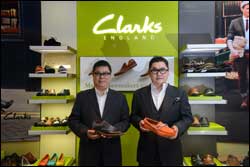
The Chu brothers, Dominic and Haeta, radiate such enthusiasm and liveliness that even those century-old shoe brands they market look vibrant. They are the second-generation masters behind S Culture International Holdings (1255), the exclusive distributor of European casual footwear brands – such as Clarks – in the Greater China region. Dominic Chu Chun-ho, 41, who always has a smile on his face, is especially buoyant when it comes to showing off Clarks’ shoe line for next season. “Here is the special one,” he enthused, picking up a pair of bright orange men’s suede shoes. “It’s Haeta’s favorite, specially made.”But his younger brother, Haeta Chu Chun-wah, 39, was wearing more formal-looking shoes that day, to complement his three-piece suit with navy blue handkerchief in his breast pocket.
The two brothers are co-chief executives, but with different focuses.
The friendly older sibling describes himself as a “senior worker” overseeing strategic planning and execution, while the fashionable younger one looks after brand development and retail operations.
“We grew up with these brands and are trying to help them rejuvenate,” said Dominic Chu.
They are referring to C&J Clark International – a British shoe maker founded by Quaker brothers Cyrus and James Clark back in 1825.
Nearly two centuries later, Somerset-based Clarks has become an international brand, with annual sales exceeding 50 million pairs to 35 countries.
While shoe design is still predominan
tly done in Britain, manufacturing has been outsourced to Brazil, China, Cambodia, India and Vietnam.
It was Chu Siu-ming – the father of Dominic and Haeta – who introduced the brand to Hong Kong, offering more comfortable footwear to local white- collar workers as an alternative to stiff leather dress shoes.
In 1974, the father established a firm to carry out mainly wholesale business, but switched focus in the 1990s to footwear and the retail market.
The senior Chu remains vice chairman.
Clarks was the first to reach an exclusive distribution agreement with S Culture, giving the company rights to Hong Kong and Taiwan at the beginning, then Macau.
Since opening the first Clarks store in Hong Kong in 1996, the firm has expanded its retail network to 52 shops in the SAR, including independent outlets for Clarks, Clarks Originals, and other licensed brands such as Germany’s Josef Seibel.
“Why casual shoes? Because it is the trend and will continue to be in the future,” said Haeta Chu, adding that his 15 years’ experience in the local retail industry strengthens his confidence in focusing on the niche market.
In the fast-paced city, locals have developed a taste for more comfortable shoes that can be both casual and suitable for more formal attire.
“They want something between business and sports, so here we are,” said Haeta Chu, pointing to his own shoes and his brother’s. “We wear Clarks and Josef Seibel to meet clients, telling them how comfortable they are, and how good they look.”
S Culture’s sales hit HK$255.2 million in the first half, up 7.2 percent from a year back. The boom was led by Josef Seibel, which had a growth of 44.3 percent.
In July, the firm reached another milestone – raising HK$106.5 million through an initial public offering. Its current market capitalization is HK$388 million.
But being a successful distributor is far more complicated than just importing shoes and opening shops. The foremost challenge is to know what customers like before they do.
“We never sit in the office, but patrol in our stores,” Dominic Chu smiled. “It is important to update market sense.”
He said S Culture has actually become a “re-designer” engaging in discussions with foreign brands to correctly deliver the right products to consumers.
Generally speaking, Europeans’ feet are wider than Asians, he said, adding that boots are more popular in Europe than Hong Kong because of their colder weather.
Haeta Chu is the color expert. Traveling at least four times a year to Britain to meet with Clarks’ designers, he has a “crystal ball” to tell Asian men’s tastes.
Black will never be wrong for Hong Kong men, he laughed, citing research showing nine out of 10 of these locals picked black out of five color choices.
“We are the most conservative, while the mainlanders are the most daring,” Haeta Chu said. “Taiwanese men prefer hand-made details.”
He added: “Clarks is aging, just like a 50-year-old man. But the good thing is, it realizes the problem and is actively seeking change. It hopes to go back to being 30 in the next few years.”
Changes include abandoning the use of blackish green – its legacy color – for a younger look.
Another benefit of choosing the right products is low inventory, which puts less pressure on the firm to offer discounts. S Culture strictly refuses to discount more than 30 percent, and any half-priced clearance items are sent to outlet stores.
Its overall gross profit margin has climbed in the past three years – touching 65.9 percent in the first six months.
Rent is the major challenge facing Hong Kong retailers. In the first half, S Culture relocated some stores and boosted its network inside malls.
“[Street-level] stores are too expensive, but malls welcome us and offer preferential rents,” said Dominic Chu.
He has mixed feelings for his outlet on Haiphong Road – a one-way street in Tsim Sha Tsui that connects the MTR and the popular Harbour City.
“It costs us the most, but is also one of our best performing, thanks to the huge tourist traffic.”
He joked that S Culture is good friends with the landlord, who even subscribed to the IPO.
The brothers say they never think of leaving S Culture because it’s a family business. “But it’s more difficult to keep it growing than starting a new company,” Dominic Chu said.
Their headquarters, instead of being centrally located in a premium Grade A building, is housed in an industrial building in Kwai Chung.
Below their showrooms and office is a warehouse where Dominic Chu said he can closely manage the inventory.
Haeta Chu spends much of his time on airplanes, once visiting 12 countries in two months searching for new footwear brands.
His latest project is Petite Jolie, a Brazilian brand specializing in chic plastic shoes and slippers.
But Dominic Chu said the brothers are picky. “We need our partners to provide around 350 models for one season. Without such creativity, we will not work with them.”
And what is the older brother’s best advice to ambitious young people who are unsure about when and how to start their own operation?
“Get involved [in a chosen sector] for years before you decide to set up a business for yourself,” he said.
As for Haeta Chu, he quoted their father as saying: “Never be too sure, and always be well-prepared for the worst.”
 About bambooinnovator
 Bamboo Innovator