Is Chinese Contemporary Ink Painting the Next Big Thing?
October 8, 2013 Leave a comment
October 7, 2013, 4:15 PM
Is Chinese Contemporary Ink Painting the Next Big Thing?
By Wei Gu and Jason Chow
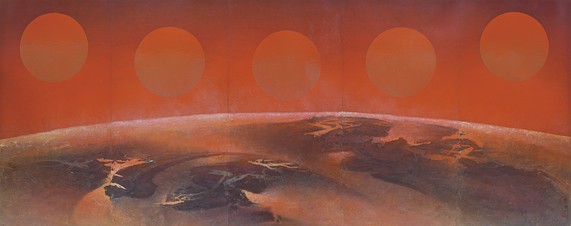
Liu Guosong’s ink painting ‘Midnight Sun’ achieved HK$6.3 million at Sotheby’s, several times above its pre-sale high estimate.
The biggest names in Chinese contemporary art, from Zeng Fanzhi to Yue Minjun and Liu Ye, have all made their mark in oil paintings. But the foundation of Chinese art isn’t oil, but ink, a traditional art form that has informed Chinese aesthetics and culture through the ages. Art dealers and auction houses are saying the traditional is new again, marketing contemporary ink paintings to mainland Chinese buyers. Their hope is to expand and diversify the art market in China by tapping into an art form that domestic audiences are familiar with.“The market needs new excitement to attract people,” said Andy Hei, co-chairman of art and antiques fair Fine Art Asia. “Now it’s back to basics.”
The latest efforts to promote the genre seem to have paid off this weekend, when Sotheby’s, Poly Auction and China Guardian went head to head in Hong Kong with sales that included contemporary ink works.
Poly, mainland China’s largest auction house, put more than 200 works of contemporary ink on the block, the largest number of items among all the categories it offered over its three-day sale. The sale finishes Monday, and results have so far met expectations, according to the company.
Some works by old ink masters appear to have been conservatively priced.
“This looks like a bargain,” said Qu Guangci, a Chinese sculptor, inspecting a Zhou Sicong painting at a preview for a Poly sale this weekend. The work, a portrait of two young women, was estimated to fetch 200,000 Hong Kong dollars (around US$25,800), or less than half of that of a sculpture by his spouse Xiang Jin offered at the same auction.
Mr. Qu remembers Zhou, a 20th-century female artist, as “a big star when my wife and I were at arts school.” He put in written bids at the low end of the estimates for half a dozen of contemporary ink paintings.
“It will be a real steal if I get them,” he said. “They make good gifts even if they don’t go up in value.”
Mr. Qu went home empty-handed: The paintings all sold well above their estimates, with the work by Zhou fetching three times its estimated value.
Poly generated HK$80.3 million (about US$10.4 million) in the contemporary-ink-painting category, with the most expensive item at the sale being an ink portrait by Zhu Wei that achieved HK$7.5 million on Saturday. Titled “Ink and Wash Research Lecture Series,” the painting was a colored ink portrait of a Chinese man with tightly parted hair in front of a red curtain.
Next door, Sotheby’s was holding its own sale of contemporary ink. Its “Contemporary Literati” auction generated HK$25.4 million, almost four times the pre-sale estimate. The most valuable ink painting sold was “Midnight Sun,” a 1970 piece by Liu Guosong, which realized HK$6.3 million, several times more than its HK$1.6 million high estimate. Almost four meters wide, the work has an intense red color and depicts a sun moving across the horizon.
Despite being heavily promoted, contemporary ink paintings are still a small and emerging category. The biggest works in contemporary art remain oil-based paintings: take Zeng Fanzhi’s “The Last Supper,” which fetched a record-breaking $23.3 million at a Sotheby’s Saturday evening sale in Hong Kong. Among the 61 works on offer at that auction, which realized HK$1.13 billion, none was by a contemporary Chinese ink artist.
All the more reason for dealers to push the category as the next big thing.
“Western buyers have already collected ink and now the West has started to promote it,” said Calvin Hui, co-chairman at Fine Art Asia. “Chinese people start to think, maybe that’s another thing that’s going to become popular.”
 About bambooinnovator
 Bamboo Innovator