HTC under pressure to find partner after first quarterly loss

HTC under pressure to find partner after first quarterly loss

Fri, Oct 4 2013

By Michael Gold

TAIPEI (Reuters) – Taiwan’s HTC Corp slid into the red for the first time in the third quarter, adding to the case for the troubled smartphone maker to abandon its prized independence and reach out for a white knight soon. Like other strugglers in the sector, HTC has been laid low by the product and marketing might of Apple Inc and Samsung Electronics Co Ltd – woes that have been exacerbated by supply chain constraints and internal turmoil. Read more of this post

Same old shameful story: Every year, we recoil in shock when we read the Auditor-General’s Report and yet we hear little about punishment being meted out to those responsible for the colossal loss of billions of ringgit

Updated: Sunday October 6, 2013 MYT 7:42:33 AM

Same old shameful story

BY WONG CHUN WAI

Every year, we recoil in shock when we read the Auditor-General’s Report and yet we hear little about punishment being meted out to those responsible for the colossal loss of billions of ringgit.

IT’S simply disgusting and shameful. Whether the colossal loss of billions of ringgit is due to negligence, slipshod decisions, incompetence, stupidity, criminal breach of trust or, worse, plain corruption, Malaysians are finding it too painful to bear. Every year, we read of such horrible accounts and yet we hear little about punishment being meted out to those responsible. Who can blame taxpayers if they have the perception that the Auditor-General’s reports are tabled in Parliament yearly only because it is mandated by law? Aside from the fiery debates, for a little while at least, there is really not much that can be done. Read more of this post

Foreign property buyers in Johor to pay 4%-5% processing fee

Foreign property buyers in Johor to pay 4%-5% processing fee

POSTED: 08 Oct 2013 07:44
The Johor state government will levy a processing fee on foreigners who buy properties in the Malaysian state from next year. PASIR GUDANG: The Johor state government will levy a processing fee on foreigners who buy properties in the Malaysian state from next year. Bernama news agency quoted State Executive Councillor for Housing and Local Government Abdul Latiff Bandi as saying that the fee will be based on the property value. Currently, foreign buyers pay only RM10,000 as processing fee. Mr Abdul Latiff said the new processing fee of between four and five per cent of the property value enables the state government to control the sale of properties to foreigners. “For instance, foreigners buying a property worth RM5 million, they have to pay only RM10,000 as processing fee currently. From next year, they have to pay based on the property value,” he told a media conference after opening a seminar on Green Industry 2013 on Monday. Mr Abdul Latiff said proceeds from the processing fee will be used for projects and programmes towards the people’s development.

Is Chinese Contemporary Ink Painting the Next Big Thing?

October 7, 2013, 4:15 PM

Is Chinese Contemporary Ink Painting the Next Big Thing?

By Wei Gu and Jason Chow

OB-ZE495_liu_F_20131007030853

Liu Guosong’s ink painting ‘Midnight Sun’ achieved HK$6.3 million at Sotheby’s, several times above its pre-sale high estimate.

The biggest names in Chinese contemporary art, from Zeng Fanzhi to Yue Minjun and Liu Ye, have all made their mark in oil paintings. But the foundation of Chinese art isn’t oil, but ink, a traditional art form that has informed Chinese aesthetics and culture through the ages. Art dealers and auction houses are saying the traditional is new again, marketing contemporary ink paintings to mainland Chinese buyers. Their hope is to expand and diversify the art market in China by tapping into an art form that domestic audiences are familiar with. Read more of this post

Xi Jinping Gets Mocked Going After New Zealand on Food Safety

October 7, 2013, 3:21 PM

Xi Jinping Gets Mocked Going After New Zealand on Food Safety

It’s rare for Chinese citizens to laugh outwardly at their president. But when Xi Jinping appeared to scold his New Zealand counterpart over food safety during a face-to-face meeting in Bali on Sunday, the irony proved too delicious to ignore. During a short get-together ahead of this week’s Asia-Pacific Economic Cooperation forum, Mr. Xi reminded New Zealand Prime Minister John Key that food safety mattered to people’s health,according to the official Xinhua news agency. Read more of this post

Startup Aims to Reinvent Wireless Communication; Kumu Networks Says It Can Double the Use of Radio Spectrum, Easing Congestion

October 7, 2013, 7:36 p.m. ET

Startup Aims to Reinvent Wireless Communication

Kumu Networks Says It Can Double the Use of Radio Spectrum, Easing Congestion

DON CLARK

A small startup is challenging one of the long-held precepts in communications, that mobile devices can’t transmit and receive data on one frequency at the same time. An unusual technology proposed by Kumu Networks Inc. emerges as telecom carriers ponder what’s next after today’s fourth-generation cellular networks to cope with a flood of new smartphone users and data demands on wireless networks. Kumu says its technology can play an important role by effectively doubling the capacity of both cellular and Wi-Fi communications. Read more of this post

Markets’ Anxiety Isn’t Felt by Some Prominent Money Managers

October 7, 2013, 6:35 p.m. ET

Markets’ Anxiety Isn’t Felt by Some Prominent Money Managers

Theme Prevailed Among Investors Who Spoke at The Wall Street Journal’s Heard on the Street Live Conference

STEVEN RUSSOLILLO and DAVID BENOIT

Anxiety is spreading through financial markets in the second week of the partial federal-government shutdown, but several prominent money managers don’t share it. “I’m not nervous at all. Not in the slightest bit,” said Bruce Richards, chief executive at Marathon Asset Management. “There’s no fear running through the bones. Maybe there should be, but there isn’t.” Read more of this post

Loan Spigot Runs Dry for Small Businesses: Government Shutdown Creates Headaches for Borrowers, Lenders

October 7, 2013, 5:56 p.m. ET

Loan Spigot Runs Dry for Small Businesses

Government Shutdown Creates Headaches for Borrowers, Lenders

RUTH SIMON and ANGUS LOTEN

The government shutdown is throwing a wrench into efforts by some small businesses to get government-backed loans from the U.S. Small Business Administration. Lenders said they continue to process and submit loans to the SBA, but borrowers will have to wait for approvals. Other borrowers are facing shutdown-related paperwork snafus that are slowing loan fundings. Read more of this post

Asia’s Chocolate Craving Paces Global Demand: Chart of the Day

Asia’s Chocolate Craving Paces Global Demand: Chart of the Day

iclqR1e04RI4

Asia’s craving for chocolate will pace the 2.1 percent increase in global demand in 2014 amid a rally in cocoa prices to the highest in almost two years. The CHART OF THE DAY shows chocolate-confectionary sales in the Asia Pacific will climb 5.4 percent next year from 2013, more than doubling since 1999, according to data from Euromonitor International Ltd. Sales in North America were forecast to drop 0.1 percent in 2014, capping a 9.9 percent decline in 15 years. Read more of this post

Tanker Rates Rallying as Owners Demolish Most in Decade; Rates still won’t be high enough for owners to break even

Tanker Rates Rallying as Owners Demolish Most in Decade: Freight

The cost of hauling crude on the largest tankers is poised to rise to a four-year high as the biggest demolition program in a decade trims a glut of capacity. Rates still won’t be high enough for owners to break even. Shipping companies will demolish 23 very large crude carriers in 2013 and scrapping will stay at about that level for the next three years, according to E.A. Gibson Shipbrokers Ltd., a brokerage in London. Daily rates will average $22,000 in 2014, the mean of 10 analyst estimates compiled by Bloomberg News shows. While that’s almost three times more than current earnings, it’s still below the $25,000 that Frontline Ltd. (FRO), which operates 31 of the vessels, says it needs to cover costs. Read more of this post

How Upstart Xiaomi Rattled China’s Smartphone Race

Updated October 7, 2013, 9:14 p.m. ET

How Upstart Xiaomi Rattled China’s Smartphone Race

Low-Price Device Maker Undercuts Apple in Competitive Market

PAUL MOZUR

BEIJING—At the raucous September release event for Chinese smartphone maker Xiaomi Inc.’s latest device, fans with glow sticks and company shirts shouted loudest when founder Lei Jun announced its price. At 1,999 yuan ($326), its Mi3 handset sells for roughly half the price as AppleInc.’s AAPL +0.98% new budget iPhone 5C. It is priced similarly lower to devices with comparable specs made by heavyweights such as Samsung Electronics Co.

Read more of this post

Asia Goes Slow on High-Speed Trading

Oct 7, 2013

Asia Goes Slow on High-Speed Trading

By Michelle Price

AM-BA581_AMONEY_G_20131007141804

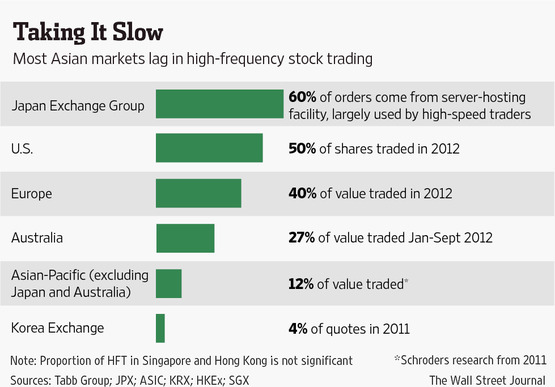
High-speed trading firms revolutionized stock trading in the U.S., but many have faced challenges in Asian markets. Most regulators in the Asian-Pacific region, eager to protect individual investors and the dominant exchanges, have declined to implement the changes that would open many stock markets to profitable high-speed trading. And a number of trading glitches in the U.S.—most notably the May 2010 “flash crash,” in which the Dow Jones Industrial Average lost about 1,000 points in minutes before recovering—has made them more reluctant. Read more of this post

Yum Brands: Asian Flu Is Sapping the Appetite; Slowing Economy, Food-Safety Scare Drag on Yum in China

Updated October 7, 2013, 4:19 p.m. ET

Yum Brands: Asian Flu Is Sapping the Appetite

Slowing Economy, Food-Safety Scare Drag on Yum in China

SPENCER JAKAB

MI-BY913_AOT_NS_20131007172403

The world looked different the last time Yum Brands Inc. suffered a decline in full-year earnings per share. In 1997, Asia’s borrowings inspired scary headlines, not America’s. Then called Tricon, the business was loss-making, and management spent most of its time discussing the U.S. fast-food jungle. Its Chinese operations weren’t broken out separately, and total sales in the Asian-Pacific region were less than half of international revenue. Read more of this post

Raising the Curtain on Proxy Advisers; Too little is known about how ISS and Glass Lewis make the recommendations many investors rely on

October 7, 2013, 7:12 p.m. ET

Edward Knight: Raising the Curtain on Proxy Advisers

Too little is known about how ISS and Glass Lewis make the recommendations many investors rely on.

EDWARD S. KNIGHT

ED-AR350_KNIGHT_G_20131007165342

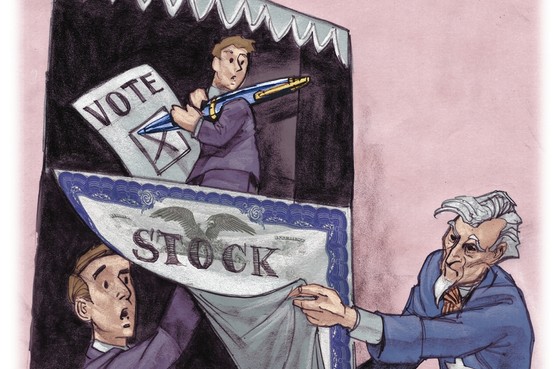
The number of publicly traded companies listed on U.S. exchanges has steadily declined to 5,000 this year from around 8,000 in 1995. There are a number of reasons, but no one doubts that going and staying public has become increasingly more expensive, time-consuming and distracting for management. As a result, businesses have sought other ways to organize and finance themselves. Read more of this post

Questions Arise About Beijing’s Support for Free-Trade Zone; Premier Li Keqiang Doesn’t Attend Launch of Shanghai Free-Trade Zone

October 7, 2013, 11:39 a.m. ET

Questions Arise About Beijing’s Support for Free-Trade Zone

Premier Li Keqiang Doesn’t Attend Launch of Shanghai Free-Trade Zone

ANDREW BROWNE

Two decades ago, when Deng Xiaoping wanted to send a message to the world that China was still open for business, he dropped by Shanghai as part of his barnstorming “Southern Tour.” That trip has gone down in Communist Party history as a turning point in China’s modern economic fortunes. It was part of Mr. Deng’s strategy to outflank his conservative rivals in Beijing, who had seized control after the military onslaught against the Tiananmen Square protests in 1989. And it offered high-level endorsement of Shanghai’s cherished goal to restore its lost glory as the financial capital of East Asia. “It will take many years, but we should act now,” Mr. Deng was quoted as saying. Read more of this post

Wal-Mart: Rules Too Tough to Open in India

October 7, 2013, 6:33 PM

Wal-Mart: Rules Too Tough to Open in India

By Laurie Burkitt

Wal-Mart Stores Inc.WMT -1.28% one of the world’s largest retailers is still trying to decide what to do next in India. After launching its brand to much fanfare with its Indian partner Bharti Enterprises Ltd., Wal-Mart has hit a wall as restrictive regulations as well as number of court cases have soured its view on the Indian opportunity. The retailer wants to open new stores in India under its wholesale venture with Bharti Enterprises Ltd. But even after India last year eased its restrictions on foreign companies investing supermarkets, Wal-Mart has yet to file an application to open any. The Wall Street Journal interviewed Scott Price, the chief executive of Wal-Mart’s Asia division, about the retailer’s plans and problems in Asia. Here is an excerpt of the interview: Read more of this post

Change in Korean Adoption Law Followed by More Abandoned Babies; Domestic Adoption Is Still Uncommon in South Korea

Updated October 7, 2013, 9:53 a.m. ET

Change in Korean Adoption Law Followed by More Abandoned Babies

Domestic Adoption Is Still Uncommon in South Korea

STEVEN BOROWIEC

SEOUL—When South Korea amended its adoption law in August of last year, it was intended to reduce unregistered adoptions of children overseas. A year later, it appears to have accomplished that with an unintended side effect: a drastic increase in the number of babies abandoned anonymously by their mothers. In the first seven months of this year, 152 infants were abandoned in South Korea, up from 62 in the same period of 2012, according to Ministry of Health and Welfare data. The increase has been attributed by some to the new Special Adoption Law, which stipulates that infants can’t be put up for adoption without their births being registered with the government. It also requires that mothers remain with their newborns for a minimum of seven days before putting them up for adoption. Read more of this post

Seoul’s suicide rate fell for the first time in six years in 2012 but Still Very High

October 7, 2013, 4:09 PM

Suicide Rate Falls in Seoul but Still Very High

By Kwanwoo Jun

KRT_suicide_rates

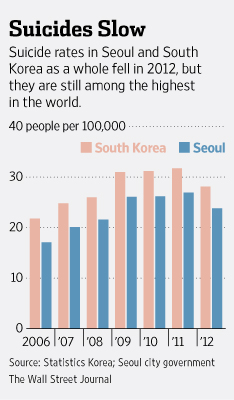
Seoul’s suicide rate fell for the first time in six years in 2012, mirroring the national trend announced late last month. While it may be too early to celebrate, as both the capital and the country’s rates are among the world’s highest, at least they’re going in the right direction. Seoul’s suicide rate fell to 23.8 people per 100,000 last year from 26.9 in 2011, thanks in large part to a 28% decline in the rate for men and women in their 20s, the city government said Monday in a news release. Read more of this post

U.S. banks get ready for the day when deposits shrink

U.S. banks get ready for the day when deposits shrink

8:04am EDT

By Peter Rudegeair and Carrick Mollenkamp

NEW YORK (Reuters) – U.S. banks, with nudging from regulators, are planning for the day when the economy recovers, rates rise, and depositors yank money from safe but low-paying accounts. Those withdrawals could be fast and painful for banks, which will have to pay depositors with either cash on hand, money borrowed from elsewhere, or in a worst case scenario the proceeds of asset sales. Read more of this post

A U.S. Default Seen as Catastrophe Dwarfing Lehman’s Fall; The $12 trillion of outstanding government debt is 23 times the $517 billion Lehman owed when it filed for bankruptcy on Sept. 15, 2008

A U.S. Default Seen as Catastrophe Dwarfing Lehman’s Fall

By Yalman Onaran  Oct 6, 2013

Anyone who remembers the collapse of Lehman Brothers Holdings Inc. little more than five years ago knows what a global financial disaster is. A U.S. government default, just weeks away if Congress fails to raise the debt ceiling as it now threatens to do, will be an economic calamity like none the world has ever seen. Failure by the world’s largest borrower to pay its debt — unprecedented in modern history — will devastate stock markets from Brazil to Zurich, halt a $5 trillion lending mechanism for investors who rely on Treasuries, blow up borrowing costs for billions of people and companies, ravage the dollar and throw the U.S. and world economies into a recession that probably would become a depression. Among the dozens of money managers, economists, bankers, traders and former government officials interviewed for this story, few view a U.S. default as anything but a financial apocalypse. Read more of this post

Japan’s Government Pension Investment Fund, the world’s largest manager of retirement savings, isn’t ready for Abenomics

World’s Biggest Pension Fund Not Ready for Abenomics, Ito Says

By Shigeki Nozawa  Oct 7, 2013

Japan’s Government Pension Investment Fund, the world’s largest manager of retirement savings, isn’t ready for Abenomics, according to the head of an expert panel advising on public investments. The set of policies from Prime Minister Shinzo Abe aims to defeat 15 years of deflation and spur growth by using the “three arrows” of fiscal stimulus, monetary easing and business deregulation. GPIF needs to reduce the risk of losses on its bond holdings should interest rates start to rise as the economy improves, said Takatoshi Ito. Read more of this post

There are 25 million pets in Australia (two million more than the human population), and they have created a flourishing industry worth an estimated $8 billion a year

‘Petpreneurs’ barking up the right tree

October 7, 2013

Christine D’Mello

Australia’s increasing interaction with household pets has spawned a robust small business industry. From dog cafes and gourmet treats to animal shampoos and minding homes, enterprising “petpreneurs” are seizing the opportunity to cater to a whole range of creature comforts. There are 25 million pets in Australia (two million more than the human population), and they have created a flourishing industry worth an estimated $8 billion a year. One venture taking a bite out of the market is the Gourmet Dog Barkery in the NSW city of Newcastle. Specialising in dog treats, it is a cafe and bakery for our canine companions. Read more of this post

Buybacks Around the World

Buybacks Around the World

Alberto Manconi Tilburg University

Urs Peyer INSEAD – Finance

Theo Vermaelen INSEAD – Finance

September 2, 2013
INSEAD Working Paper No. 2013/101/FIN

Abstract: 
This paper documents that outside the U.S. short-term returns around share repurchase announcements are positive, although only about half the size as in the U.S. Long-run abnormal returns after buyback announcements follow the same pattern in non-U.S. firms as document by prior literature for U.S. firms extending the buyback puzzle to the global level. Cross-country differences in corporate governance quality and regulatory differences can explain variation in the short- and long-run abnormal returns. Globally, long-run abnormal returns are related to an undervaluation index (Peyer and Vermaelen, 2009, RFS) consistent with the interpretation that managers are able to time the market.

Analyst Forecasts: It Pays to Be Off!

Analyst Forecasts: It Pays to Be Off!

Gilles Hilary INSEAD

Charles Hsu Hong Kong University of Science & Technology

August 27, 2013
Journal of Investment Management, Forthcoming
INSEAD Working Paper No. 2013/92/AC

Abstract: 
We show that analysts who display more consistent forecast errors have a greater effect on stock prices than analysts who provide more accurate but less consistent forecasts. This result leads to three implications. First, consistent analysts are less likely to be demoted to a less prestigious brokerage house and are more likely to be named All Star analysts. Second, analysts strategically “lowball” (that is, deliver downward-biased forecasts) to increase their consistency. This is because lowballing gives management an easier target to beat and, in turn, management grants analysts greater access to company information. Finally, the benefits of both consistency and lowballing increase while those of accuracy decrease when institutional/sophisticated investors are more of a presence in the analyst’s audience.

On the Effectiveness of Patenting Strategies in Innovation Races

On the Effectiveness of Patenting Strategies in Innovation Races

Jurgen Mihm INSEAD

Fabian J. Sting Erasmus University – Rotterdam School of Management

Tan Wang Independent

July 19, 2013
INSEAD Working Paper No. 2013/88/TOM

Abstract: 
Which inventions should a company patent? Should it patent at all? Many companies engaged in an innovation race seek a patenting strategy that will protect their intellectual property, but not much is known about factors that determine the best strategy. Although scholars in various management, economics, and engineering disciplines have conducted research on patents, little work has addressed the normative issues pertaining to formation of an appropriate patenting strategy. We develop an inventory of patenting strategies and integrate them into a framework accommodating the contingencies that influuence their selection. Our simulation model characterizes the optimal patenting choices for different settings, and it captures the dynamics between firms that compete via strategic interactions. We identify those competitive dynamics driven by the choice of R&D strategy as the most salient determinant of the firm’s optimal patenting strategy. Thus our research contributes to establishing a contingency theory of patenting strategies.